Showing posts with label Books. Show all posts

Sunday, June 1, 2025

The Cadaver Princess

 (2025)
by Chuck Rothman

The Cadaver Princess

My Novel, The Cadaver Princess, has been published.

London, 1831. The city teems with secrets, science, and shadows—and one of those shadows just opened her eyes on an anatomist’s slab.

She says her name is Victoria. She insists she’s a princess. But she’s missing her teeth, wrapped in a burial shroud, and undeniably… dead. Or was.

Thrown together with a streetwise orphan named Pablo, a skeptical doctor, and a tavern keeper with secrets of her own, this strange girl unravels a conspiracy that stretches from the slums of London to the halls of Kensington Palace. Someone is stealing bodies—not just for science, but for power. And someone else is playing a dangerous game with the soul of the British Empire.

Part gothic mystery, part alternate history, The Cadaver Princess is a gripping, witty, and darkly magical tale of resurrection, rebellion, and identity. If Mary Shelley and Terry Pratchett had collaborated on a Victorian version of The Princess Bride, with fewer weddings and more corpses, it might have looked something like this.

“…it is equally clear that vile plots are afoot. The ensuing tale is engrossing and satisfying. Recommended!” — Tom Easton, coauthor of ESPionage: Regime Change and Boondoggle.

Allen Steele agrees: “A dark mélange of fantasy, horror, and history, The Cadaver Princess hooked me on the first page. Like Dickens crossed with Poe, there isn’t anything else quite like it.”

Get it today!

Sunday, March 3, 2024

Mr. Tompkins in Wonderland

Mr. Tompkins in Wonderland

by George Gamow
 
(1939)

Twentieth Century physics became a little daunting to the layman, with with relativity and quantum theory and the Big Bang. George Gamow decided to make it a bit easier with his book, Mr. Tompkins in Wonderland.

He created Mr. Tompkins, a middle ages banker type who decides to attend a professors lectures on the newer concepts on physics of the age. The lecture is boring and Tompkins falls asleep and starts dreaming.

The dreams cover various topics. The professor is there to guide him by showing how things work. It starts out showing the expanding universe. The key is that the setup allows a minimum of lecture and shows the concept with concrete examples that are easy to grasp. Quantum theory is shown by the example of a pool room, where the balls move in quantum paths, so that they appear to be in multiple places as they move. 

Tomkins is not a deep character; he is there to ask questions that the professor can explain to him.Still there is some character development as Tompkins finally proposes to the professor's daughter.

Speed of Light

My favorite were two chapters where the speed of light is only 10 mph. Cars and bicycles contract as they try to go faster, but when on a train, the telephone poles along the tracks get closer together. They also show how tune dilation works.

The book was a hit, and soon other volumes followed.

Sunday, November 1, 2020

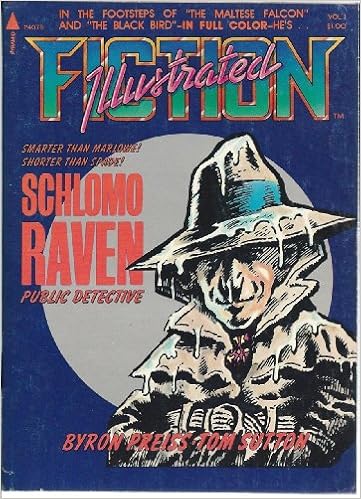
Schlomo Raven, Public Detective

(1976)
Written by
Byron Preiss
Illustrated by Tom Sutton

Byron Preiss was a book packager. He would put together books and series and sell them to publishers, saving them the effort of finding writers and coming up with themes. Preiss was a little different in that he was also an accomplished author, and one of his strangest projects was Schlomo Raven, Public Detective in the first issue of an intended series Fiction Illustrated.

The book was in graphic form, showing the adventures of Raven, who was based in Hollywood. It  consisted of two stories.In the first, “The Farx Job,”  where the Farx Brothers are kidnapped, possibly by monsters. The second story, “Rosebug,” has a more serious tone, as it shows an Orson Welles character working to save his film, American.

The names throughout are parodies of the real people. “The Farx Job” tries for a slapstick feel, while “Rosebug” is played a bit more straight.

Raven is short and with a prominent nose, part parody of the hard-boiled detective trope, and part pure slapstick. Tom Sutton’s art is reminiscent of 50s Mad Magazine. He shows a strong talent for caricature.

Fiction Illustrated format was strange. The book itself was an odd size (5 x 6 1/2”) and the pages were on newsprint, like a comic book. I wonder if the size hurt the distribution.

The magazine only ran four issues. Number two, Starfawn, had art by Stephen Fabien, but the story didn’t really go anywhere; I think they were hoping for a series.  Two more issues were produced before the series ended.

Schlomo Raven was an interesting experiment, but I think it might have had a better chance of catching on if there had been more issues of Fiction Illustrated featuring him.

Sunday, February 17, 2019

The Adventures of Jimmie Dale (books)

 adventures of Jimmie dale(1914)
By Frank L. Packard
Superheroes didn’t come into being in a vacuum. The tropes of the genre slowly evolved long before comics were invented. I’ve talked about the Scarlet Pimpernel, who was probably the first time a hero took on on a secret identity and much else. But I recently discovered another source, one that further refined the tropes that showed up in the early superhero comics: The Adventures of Jimmie Dale.
Jimmie Dale is a wealthy man-about-New-York, heir to his father’s fortune made from the development of office safes. But, Jimmie (as you’ve guessed) isn’t just a rich playboy. He also masquerades at the Grey Seal, the slickest thief in New York, known for emptying safes (usually from his father’s company) and leaving a gray sticker to mark his passage. The Grey Seal takes his orders from a mysterious woman, who sends him information on what to steal, and the crime hides that fact that he is actually helping others out: his real objective isn’t the flashy item he stole, but often something small and innocuous that saves someone from ruin.
Packard invented or expanded on may tropes of the superhero. Dale is probably the first superhero character to wear a mask.*  He also had a special sanctum, in this case a cheap room on the Bowery that he rents in a second alter ego: the dope fiend Larry the Bat.
The first novel is a series of adventures where the Grey Seal returns after a hiatus as his mysterious mentor tells him what he need to do. One story invents the common trope of a superhero protecting his identity, as one of the woman’s letters is stolen along with Jimmie’s purse. The stories are cleverly plotted, though sometimes they don’t play fair according to how stories are supposed to to now.
The series first appeared in magazines and then was collected into books between their introduction and 1935.  A silent serial was made in 1917, now lost.
Author Frank L. Packard had written several successful mysteries before Jimmy Dale, and continued to put out books throughout the 20s and 30s.
It’s certainly likely that Bob Kane and Bill Finger knew about Jimmie Dale when they created Batman in 1939 and with a major character named “Larry the Bat,” you kind of wonder how much of an influence it is. I’d never come across Jimmie Dale in reading about the history of comics. Bob Kane never seemed to mention it, though Kane was well-known for downplaying influences.  One point is that the Grey Seal had a small domino mask which he could keep in his pocket and Kane’s original concept of Batman used the same mask. Probably a coincidence, but It would seem likely he knew about Jimmie Dale, since he was still appearing in adventures in Kane’s teen years.
In any case, the books faded from the popular culture mindset in the 30s. The comic books preferred to create new characters and as time went by, Jimmie Dale and the Grey Seal were forgotten. The stories are still first-class adventures, though, and work seeking out.
_____________________________________________________
* Zorro showed up five years later.

Sunday, November 18, 2018

The Worldly Adventures of a Teenage Tycoon (Book)

image(1956)
By Roger W. Eddy

Back in the day, there was a small subgenre of books where people reminisced about their childhood, replete with humorous stories. Cheaper by the Dozen is probably the best known and there were others that were often seen as fodder for what would now be called YA books. I read several, but the one that sticks in my mind was Roger W. Eddy’s The Worldly Adventures of a Teenage Tycoon.

The book was abridged from a longer work, The Bulls and the Bees. Evidently, the adult version had some passages about how Roger learned about sex from the animals in the farm where he lived.  This was obviously unsuited for teens in the 1950s, but the rest made some good reading.

It was filled with anecdotes. Roger’s father was a stockbroker in the 1920s in addition to living on the farm.  The one that sticks in my mind was the one that gave the book its name.

Roger developed a liking for stocks.  Not as investments, but for the stock certificates themselves.*

And, indeed, there is much to like. Certificates were intricately engraved, much like currency, and featured elaborate artwork representing Progress and the company’s mission. Roger would pore over them, admiring the mottos and art. So he began buying them.

He had $1 a month to spend, so would pick out stocks that fit in that budget for his father to buy.**  Over the years, he had papered his bedroom with them.

Then came the stock market crash.  Roger describes the scene that night as his father came into his room and started ripping his beautiful certificates off the walls and into shreds, bemoaning the fact that they were worthless.  Roger knew better than to stop him, but couldn’t understand what was going on.  Didn’t they look as good as they ever did?***

The book was a nice, ironic look at growing up in the 1920s, that doesn’t sentimentalize the era.

______________________________________________________
*Today the hobby is called scripophily.

**Probably commission free.

***As an aside, if you find an old stock certificate, don’t throw it out.  It may be worth something to collectors. And it may actually still be worth cash: the company may have been swallowed up in a merger (or several) and it descendant company could still be around. The certificates don’t expire, so long as any portion of the original company exists, you can cash it it. When I worked at a brokerage, we had one person whose job it was to track these down and figure out what they were worth. It gets complex to calculate the value with all the various splits and mergers over the years.

Sunday, September 30, 2018

Archy and Mehitabel (literature)

Archy and Mehitabel(1916-1922+)
By Don Marquis

“‘the question is whether the stuff is
literature or not.’’ – Archy

Last week, I wrote about the great George Herriman and Krazy Kat and as I looked over his career, I was reminded of one of his side projects, something that equaled his inventiveness and love of words:  Don Marquis’s Archy and Mehitabel.

Marquis was a newspaperman and columnist for the New York Sun. Back then, columnists weren’t strictly political; their job was to fill the column with entertaining observations and comments One day, in a fit of whimsy, he wrote a bit of a poem

expression is the need of my soul
i was once a vers libre bard
but i died and my soul went into a body of a cockroach
it has given me a new outlook on life.

According Marquis, he had left a sheet of paper in his typewriter before leaving for the day and Archy* the cockroach, who climbed on the typewriter and banged his head onto the keys to painstakingly write out the letter.

And thus a bard was born. Archy wrote (in all lower case and without punctuation) on whatever seized his fancy. Some where philosophical; others humorous, and others charmingly absurd. He would sometimes talk about Mehitabel the cat, who thought herself the reincarnation of Queen Cleopatra** and whose motto was “toujours gai.”  Marquis would let his imagination run wild.

Archy was a hit.  And why not, with verses like these:

coarse jocosity
captures the crowd
shakespeare and i are
often low-browed

Or

and the spirit of
a camel
in the midnight gloom
can be so very
cheerless
as it wanders
round the room

Of course, most of the poems are free verse and all of them are a delightful mix of philosophy and entertainment. Marquis wrote in a very direct style that isn’t dated at all.

The poems were popular from the start. Marquis ran them every few days in his column and in 1927, selected ones were put into a collection, Archy and Mehitabel. Herriman added illustrations to some of the poems.*** There have been various editions of the collections through the years, and even attempts at plays and musicals.  None of these achieved any sort of success.

The musical is an interesting case in point. It started as a concept album, with music by George Kleinsinger and lyrics by Joe Darion.**** It was expanded to a stage version with Darion wrote the book with newcomer Mel Brooks and named Shinbone Alley.  Eartha Kitt played Mehitabel and Eddie Bracken was Archy, and it featured an integrated cast, possibly the first on Broadway. Alas, all the talent and good intentions was for nothing; the play only ran 49 performances. There was an animated version made in 1970 with the voices of Bracken and Carol Channing that didn’t fare any better.

This is not surprising. Archy has no overarching story, and the attempt to add one diminished the charm of the original.

But the books are still around. And the answer to Archy’s question is clear:  they are definitely literature.  And still delightful.

___________________________________________________________
*Archy insisted his name be capitalized outside of his own writing.

**Despite getting equal billing, Mehitabel only appears occasionally.

***Mehitabel was clearly Krazy Kat, and some drawings showed Freddy the rat who was clearly Ignatz

****Later to write lyrics for Man of La Mancha.

Sunday, March 25, 2018

The Addams Family (book)

(1965)
by Jack Sharkey

TAddams Familyhe Addams Family are, next to The Simpsons, arguably the greatest comic family franchise, and still going strong today, appearing in live TV, animated TV, movies, cartoons, and even more.*  And when the TV show went on the air, the idea came to do a tie-in novel.  The result was The Addams Family by Jack Sharkey.

Sharkey was a hack in the very best meaning of the word:  he cranked out dozens of books in all genres over the years,** and is clearly at home with the macabre comedy of Addams.

The book is often described as a novel, but it’s really just a collection of short stories. And they’re all hilarious.  Sharkey captures the weirdness of the New Yorker cartoons with a macabre sense of humor that matches Addams's own. The basic stories included an introduction to the family, the story of how they got Thing, and several others.

My favorite was “From Here to Perplexity,” when Fester was accidentally drafted into the army and had to undergo a physical. Among other things, they discover he has no fingerprints and weighs 0 pounds.  And what he looks like under his cloak . . .

There’s also “Dear Old Mold and Ghoul Days,” where Wednesday and Pugsley have to go to school, where their teacher is enamored beyond sense by a certain obscure poet.  Who Grandma Addams knew …

And “That Was the Weakness that Was,” where Gomez sets himself up to find ways to make monsters less vulnerable to sunlight or silver bullets or the like.

The book suffered the fate of all tie-ins: it was published to cash in and then vanished. It seems to have sold well enough, since there are reports online of many people who found it, picked it up, and fell in love with it.*** It should definitely appeal to readers nowadays, who can appreciate macabre humor.

__________________________________________________________
*Despite their being his most famous creation, Charles Addams actually produced very few Addams family cartoons.  I can think of only a dozen or so offhand, and only some of those featured more than one character.  Pugsley (ironically one of the least used characters of the TV show) had several panels to himself (notably when he was blowing up his train set) and Fester showed up occasionally, but I’ve come across very few that showed them as a family.  (I don’t think they were conceived in that way: Addams just used a few existing characters when he did his family panels.)

**This one appears to be a work for hire: the copyright is not in his name.  I remember his name from an SF short story “Multim in Parvo,” which is really a series of short jokes.

***A second tie-in novel was written during the run of the show: The Addams Family Strikes Back! by W.F. Miksch.  It was an actual novel about the family taking on a school board, but is no more than mildly amusing and not particually Addams=like.

Sunday, December 25, 2016

Marital Blitz (book)

image(1954)
By Stan and Jan Berenstain

The Berenstain Bears are a beloved series of children’s books, and there seems to be a minor controversy about the spelling of the authors’ names.  Many people think it’s Berenstein, even though it’s been spelled Berenstain on all the books they’ve written.

I never thought it was spelled that way. Also, I have never read any of the books about their bears.* What did introduce me to them was their paperback, Marital Blitz.

This is not a children’s book. It’s a humorous look at the foibles of married life (note the cover, which is a little risqué for children).  It concentrated on the early years of a marriage.

I read through my parents’ copy many times.  It was one of the things that gave me my idea of what a marriage should be, along with my parents and Jean Kerr.

The Berenstains did quite a few books of this kind in the 50s and 60s, with titles like Lover Boy, The Facts of Life for Grownups, and How to Teach Your Children about Sex without Making a Complete Fool of Yourself.  Of course, as the bears became a phenomenon, they concentrated on that.  Their last book of this nature was published in 1972.

Most, if not all, of these books are long out of print.  But they were a charming sidelight to the careers of a successful husband-and-wife team.  And I noticed from the start the way they spelled their name.

____________________________________________
*I was too old for them when they first came out in 1962, and they never came up when my daughter was the right age.

Sunday, July 10, 2016

Through Time and Space with Ferdinand Fegoot (book)

By Grendel Briarton

FeghootAh, Ferdinand Feghoot.  Traveler through space and time*and always ready to show up in any situation and crack the world’s worst puns.  He even gave his name to the literary form: the feghoot.

It began in The Magazine of Fantasy and Science Fiction.  Grendel Briarton’s** first effort immediately set the stage when, when Feghoot was captured by a shaggy alien with a hand on its head and holding a hypodermic needle.  But Feghoot wasn’t fazed:  he recognized the creature for what it was:  a furry with a syringe on top.

And it continued for years and over 120 variations, all capable of eliciting appreciative groans from any audience.  There were only two rules:  You couldn’t use made up names, and you had to keep it as short as possible.

The first time I encountered one was in an issue of Venture Science Fiction, *** who’s Feghoot told of a Paris landlord who jumped in the river and refused to come out because he didn’t have enough rents to come in out of the Seine.

The concept took off.  George Scithers, editor of Isaac Asimov’s Science Fiction Magazine, helped keep it going with other authors. Asimov himself wrote several, including the brilliant “Death of a Foy.”****

Currently, Steve Pastis uses feghoots in his comic strip, Pearls Before Swine.”

But, if Briarton hadn’t actually invented the genre, he certainly popularized it. The originals are still brilliant puns, if some of the references are a bit dated.

And remember:  a gritty pearl is Michael, L.Ld.

___________________________________
* Preceded Doctor Who by several years.

**An anagrammatic pseudonym for author Reginald Bretnor.

***A short-lived sister publication of F&SF.  It published a full-length novel in every issue, but only lasted a short time in each of its two separate runs.  For many years afterwards, though, the masthead of F&SF had a line “including Venture Science Fiction.”

****Scithers turned it down for Asimov’s, probably because it broke rule number 1.  But if you’re Isaac Asimov, you can break rules.

Saturday, June 27, 2015

Theodore Sturgeon (author)

(1918-1985)
Wikipedia Page
Science Fiction Encyclopedia
Internet SF Database

Theodore SturgeonI’ve been watching Sense8 on Netflix and have been following the commentary on it.  Some have compared it to Philip K. Dick, but the clearest precedent is one of the great writers of the genre:  Theodore Sturgeon.

Sturgeon was born as Edward Hamilton Waldo but changed his name at age 11 when his mother remarried.,  He started publishing in 1937 – mainstream stuff, it seems – but switched to science fiction,  where his first genre story, “Ether Breather,” appeared in Astounding in 1939.

Sturgeon was a prolific short story writer, and he quickly became noted as one of the top names in the genre.  His first truly original story – and most influential -- was “It,” in 1941.  “It” established the concept of a vegetation-based monster like Swamp Thing, The Heap, and Man-Thing.  It’s also a masterpiece of horror, with a scare in it that has rarely been duplicated.  Sturgeon’s monster is scary because it’s not evil, which means its actions cannot be predicted.

“Shottle Bop” from the next year is one of the first in the mysterious shop subgenre of fiction and “Microcosmic God” – about a man who creates a whole civilization of people – is still considered one of the greatest sf short stories of all time.  Some of my other favorites include

  • “Two Percent Inspiration,” a slight story, but one Sturgeon loved for pulling off three plot twists at the end.
  • “Killdozer!” about a sentient killer machine; it’s been dramatized a couple of time.
  • Baby is Three,”  the introduction of the concept used in Sense8.
  • “Mr. Costello, Hero,” a devastating attack on Joseph McCarthy and the modern culture of surveillance.*
  • “The World Well Lost” – Aliens have (for the time) a terrible secret.  Maybe the first sympathetic treatment of homosexuality in the genre.
  • “The Man Who Lost the Sea
  • “When You Care, When You Love” – mostly the story of a loving relationship, with a twist at the end.
  • “If All Men Are Brothers, Would You Let One Marry Your Sister?”  Not only a great title, but probably the most dangerous of the Dangerous Visions.
  • “It Was Nothing, Really” – a lighter piece about force fields and toilet paper.
  • “Slow Sculpture” where a woman and a scientist heal each other by their presence.
  • “Not an Affair” about a seduction and a disease that has surprising consequences for the human race.

There are many more.

Sturgeon’s best known influence is from two TV scripts her wrote for the original Star Trek: “Shore Leave” and “Amok Time.”  In the latter, he created the concept of pon farr, wrote the line “Live Long and Prosper,” and suggested the Vulcan salute.**  And, of course, he’s known most widely for Sturgeon’s Law:  “90% of everything is crap.”***  He’s also known in science fiction for his credo, “Ask the next question.”

He only had a handful of novels published.  Sturgeon both preferred the short story and also seemed to go through periods of writers block, which may have caused him to stay away from longer work.  One of his best novels overall wasn’t even under his own name:  The Player on the Other Side was an Ellery Queen novel that Sturgeon wrote with advice from Queen.

It was a cliché of the time that Sturgeon wrote about love.  It’s basically true, but his stories were not just simple romances.  They explored the possibilities of relationships of all types.

Sturgeon was anthologized all over the place during his lifetime; anyone who read SF anthologies would come across his name.  He also had several collections published.****  And, like most short story writers of his era, he’s slowly fading away.  His complete short works are available for completists, and anything republishing stories from his time frame will include something of his.  But reprint anthologies are more for the long-time fan than anyone new.

But he deserves to be listed as one of the true greats of the field.

_____________________________________________
*It was made into a radio play and I was surprised to learn the name of the characters was pronounced COS-tuh-lo.

**Though Nimoy determined what exactly it would be.

***This was in reply to someone saying that 90% of science fiction was crap.  Note that there are various other words used instead of “crap.”

****One was probably the cleverest title ever given to an anthology:  Caviar.  Think about it.

Sunday, March 22, 2015

Rock Dreams (book, music)

(1973)
By Guy Peelaert (art) and Nik Cohn (text)

Guy Peelaert was a Belgian artist who began selling his work in the 60s, and who was very attuned to the rock and roll scene of the time.  Based in Paris, he had a couple of successful comic strips, and in 1974, he produced Rock Dreams, a fascinating set of images of the rock and roll world.

The book was a series of painting, representing rock music from its roots to the time of publication. It showed the important artists of the genre – but rarely doing anything that related to their career or even to reality.  The images were all visually striking and portrayed the myths of rock more than its reality. 

And it was fascinating.  Stars were shown in situations that they probably had never been in, and yet they fit perfectly into their images, no matter how weird.  So you had the Rolling Stones dressed in black leather drag; the Beatles having tea with the Queen; Brian Wilson looking chubby and lonely in a cluttered room, picking out a tune on a piano; Otis Redding sitting on a dock; the Mothers of Invention as a motorcycle gang. 

Here are some examples:

image

image

image

image

The photos were accompanied by text by rock critic Nik Cohn, which was also evocative, but it was the art the caught everyone’s attention.  The book was a major best seller  and put Peellaert on the map.

As should be obvious, he started doing album covers, most notably It’s Only Rock and Roll by the Rolling Stones and David Bowie’s Diamond Dogs.  He also worked in movie posters and many other things until his death in 2008.

Saturday, September 20, 2014

The Woman in White (book)

(1859)
By Wilkie Collins
Wikipedia Entry
Full book at Gutenberg.org

Edgar Allen Poe invented the mystery story with “The Murders of the Rue Morgue” in 1841, and the genre caught rapidly. But it was mostly a short story genre.  It was English author Wilkie Collins who started to create mystery novels, and The Woman in White is often cited as the earliest in the genre.  But the fact it was a pioneer doesn’t take away from the fact that it is still an extremely good book in its own right.

Wilkie CollinsCollins was born in 1826, son of landscape painter William Collins and grew up planning to be a lawyer.  In 1851, he met Charles Dickens. They became close friends and Collins started to write articles and short works. In 1852, his first novel, Basil, was published, and he started making a living at it.  In 1859, he wrote his fifth novel, The Woman in White.

The story centers on William Hartwright,* a drawing master who meets a woman dressed all in white, who is extremely upset and has some disreputable men trying to capture her.  He helps in her escape, but not after she asks him, “Do you know any baronets?” a question that piques his interest, especially when he learns she is an escapee from a mental asylum.  He is then hired to teach drawing at Limmeridge House to two young women: Laura Fairlie (who looks remarkably like the woman in white) and her half sister, Marian Halcombe.

Walter falls for Laura, but she is pledged to marry a baronet:  Sir Perceval Glyde.  There are many disturbing things about Glyde, including the fact that he clearly is marrying Laura for her money, but Laura’s hypochondriac uncle Frederick insists that the marriage must go through.  Due to Marian’s investigation, Laura slowly learns that Glyde – and his ebullient but dangerous friend Count Fosco – is up to no good.

Despite the fact the book is over 105 years old, it turns out to be surprisingly modern in many ways, and the plot never goes where you think it might go.  It revolves on a secret known by the Woman in White, and it turns out that the secret is not what anyone expects.

It’s told in an unusual style:  chunks of the book are told in the first person by different protagonists.  While most of the chapters are told by William Hartwright, others are told by Marian, Count Fosco, Laura’s uncle,  and one of Gylde’s servants, among others. 

The book is filled with wonderful characters.  Walter is a serviceable and resourceful hero, but the three most interesting characters are on the periphery. 

Laura’s uncle Frederick is a selfish and lazy hypochondriac who whines about the slightest change to his routine and it put out by the smallest request.  His section of the testimony is a delight of whining and complaints of how much work it is to remember.

There’s also Marian.  Laura is a pretty bland heroine, but Marian is clever, resourceful, insightful, and every bit a modern female protagonist. She advises Laura and protects her, and is willing to put herself at risk to ferret out Sir Percival’s plans.  If the book were written today, she would be the one that Walter falls in love with.

But the real find is Count Fosco.  He’s charming, but also dangerous, with a personality that dominates every scene he’s in, whether it’s doting on his pet mice and birds, scheming against Laura, or threatening murder.  His ego is a joy to behold, and his honest admiration for Marian – even though she is a threat to his plans – makes him one of the most interesting villains in literature.

The book was a popular success when it came out, even though the critics of the time thought it too melodramatic,** but the book has remained popular even today. 

Collins continued to write.  His book The Moonstone is another landmark in mystery fiction, establishing many important genre tropes and it what he’s best known for today. But he seems to have thought The Woman in White was his best work.  It’s still an wonderful read after all these years.

______________________________________________
*With a last name like that, you know he’s going be be a hero.

**Not an unfair claim; the means of resolution of the mystery is pure pulp years before pulp fiction was a thing. 

Monday, January 20, 2014

Paper Lion

Paper Lion (book)(Book: 1966, Film 1968)
Book written by
George Plimpton
Movie directed by Alex March
Screenplay by Lawrence Roman, based on the novel
Starring Alan Alda, Lauren Hutton, Joe Schmidt, Alex Karras, John Gordy, Mike Lucci, Pat Studstill. Vince Lombardi
IMDB Entry.

George Plimpton would seem an unlikely person to have a best seller about sports.  He was a Harvard and Cambridge educated intellectual, and editor in chief of The Paris Review, a well-regarded literary journal.  But he did love sports, and in 1958 came up with the idea that made his fame: showing how a regular person (Plimpton himself) would fare against professional athletes.

He started in 1958, facing a series of National League batters in an exhibition game.  He fared poorly (he tired badly and had to be relieved) but wrote a successful book about the experience called Out of My League.  His next role was to box against Archie Moore and Sugar Ray Robinson.  But his biggest success was when he managed to make his way onto the exhibition season* roster of the Detroit Lions in 1963.

Plimpton’s background was supposed to be kept secret; he was the team’s new third-string quarterback, a rookie from Harvard who was trying to make the team.  The players, however, began to be suspicious as training camp progressed. 

The book not only covers Plimpton’s trials as a regular person trying to play with the pros, but lists anecdotes about the training camp and the other players.  Many stories involve defensive tackle Alex Karras, who wasn’t even in camp at the time.**

Plimpton got his chance to play in a team scrimmage,*** where he lost yardage on every play.  There was a plan to play him in an exhibition game, but Commissioner Peter Rozelle refused to let him.

Plimpton wrote up his experiences in articles in Sports Illustrated in 1964, and in 1966, they were expanded into a book.  It was a best seller.

And, like most best sellers, Hollywood decided to make it into the movie. To star, they picked an obscure actor best known for being the son of a big Broadway star.****  This was Alan Alda’s first major movie role and he certainly looked enough like Plimpton.  The film also had Lauren Hutton as his girlfriend (her first movie role).  And director Alex March had the idea of using actual football players as the members of the Lions, led by Alex Karras.

Plimpton is warnedThe movie took liberties on the book (and gleefully admitted to it).  Karras, of course, was in the camp, and Alda’s Plimpton actually played in an exhibition game.  It was otherwise a nice movie version of the book.

Alda’s career stalled for several years after the film (though he won a Golden Globe as Best Newcomer), but he eventually became a TV icon.  Hutton carved out a long career.  But probably the most surprising success at the time was Alex Karras, who, when he retired, became a successful actor in TV and movies like Blazing Saddles and Victor/Victoria. 

Director Alex March was a TV veteran, and continued to work on the small screen, with only one other movie to his credit.

Plimpton continued trying out other sports, most notably in
The Bogey Man, where he went on the PGA tour.  He also had a minor acting career, claimed the title of “Fireworks Commissioner of New York City,” and tended to pop up as one of the few intellectuals that the general public liked to see.  He died in 2003.

_____________________________________________
*As they called it at the time.

**He had been suspended for betting on games.

***Wearing the number “0.”

****Robert Alda, who created the role of Sky Masterson in Guys and Dolls.

Monday, October 7, 2013

The Best (book)

the best(1974)
by Paul Passell and Leonard Ross

Before The Book of Lists and before Internet listicles, people argued what was the best in just about any category.  And that was the concept behind The Best, a book that entertainingly lays out what the authors think is the best in dozens of categories – and the reason for it.

I don’t know where the idea or the authors came from, but it was an inspired idea.  Covering topics like “The Best Science Fiction Novel” (Arthur Bester’s The Stars My Destination). the best Pepperidge Farm Cookie (Geneva), the Best Television Show (The George Burns and Gracie Allen Show), the Best Vice President (which shows that snark existed even back then:  William Wheeler, who only lasted a month in office) and many other categories. 

It’s really the sort of thing that places like Cracked is doing now, though they didn’t always go for the laughs.  But the book was a big enough success to spawn a sequel in 1977, The Best, Encore,* with topics like The Best Chocolate Chip Cookie (Mrs. A’s Choco-Crunch),** the Best Roller Coaster (Thunderbolt in Pittsburgh), and the Best Way to Skin a Cat (dermestid beetles).

The series ended there.  The books are extremely dated by now – not only have prices for items gone up, but many of the names are obscure nowadays.  Still, it was an nice entertainment that was ahead of its time.

__________________________________________
*by Passell only.

**This was one of their few actual tests comparing what they were talking about.  It’s a bogus taste taste, though, since it didn’t include Freihofer’s Chocolate Chip Cookies.

Saturday, August 17, 2013

Great Science Fiction Stories (book)

(1964)
Selected and Edited by Cordelia Titcomb Smith

Great SF storiesIn 1964, I went off to Camp Wawokiye on Nassau Point on Long Island.* We were only allowed to bring one book with us for the entire summer.  For someone who had turned into a voracious reader, that was an agonizing lack of material.  My choice was a new anthology of stories of the favorite type of reading, Great Science Fiction Stories.
The editor, Cordelia Titcomb Smith is something of a mystery.  Her biographical blurb indicates that she was a librarian at the Lucas County Library  in Maumee, Ohio, in a role that nowadays would be called a specialist in YA fiction.   She had never been connected with any other SF book.** 
The publisher, Dell Books, was a major paperback house in its day, but which rarely published science fiction.  This was part of their Laurel Leaf Library, which fits in the the YA feel.
But whatever the origins, the book took some of the best stories and authors from early SF and put them into paperback.  The table of contents reads:
  • Introduction -- Cordelia Titcomb Smith
  • Vital Factor -- Nelson S. Bond
  • Pottage -- Zenna Henderson
  • The Roads Must Roll -- Robert A. Heinlein
  • The Stolen Bacillus -- H. G. Wells
  • The Star -- H. G. Wells
  • Nightfall -- Isaac Asimov
  • History Lesson -- Arthur C. Clarke
  • In Hiding -- Wilmar H. Shiras
  • The Martian Crown Jewels -- Poul Anderson
  • The Sands of Time -- P. Schuyler Miller
  • Into Space (Excerpt from Round the Moon, the sequel to From the Earth to the Moon) -- Jules Verne
If you know anything about science fiction at all, you know half these writers:  Asimov, Heinlein, Wells, Clarke, Verne.  Poul Anderson is also a great one, though less know to the public at large.  Zenna Henderson made a reputation for her “People” stories (of which this is one) about aliens stranded on Earth.  Nelson Bond is successful but underrated.***  P. Schuyler Miller was book reviewer for Analog for years; this is the only example of his fiction I’ve come across.
And the stories!
  • “Vital Factor” shows exactly what you need to actually go to the stars, with a clever twist ending.
  • “The Roads Must Roll” is one of Heinlein’s best stories, about the use of immense conveyor belts for commuting traffic.  The engineering is fascinating, but it a slam-bang adventure, too.
  • “History Lesson” is one of the great works of the genre, with a Twilight Zone ending years before The Twilight Zone.
  • “The Star” by H.G. Wells is also a cynical look at disaster, completely different in tone from the famous Arthur C. Clarke story of the same name. 
And then there’s “Nightfall,” certainly one of the top ten stories of the Golden Age, and one that packs a punch even now.
I read these stories over and over that summer, in among the swimming and Nok Hockey games.  I was a fan of SF already, but the book made me a fan for life.
_________________________________________
*Located in the hamlet of Peconic.  Its most famous resident was Albert Einstein, who spend the summer of 1939 there.
**Other than the UK version of this one, entitled The Best Science Fiction Stories 3.  It also looks like she co-wrote something in 1947 called Paul Bunyan in Geauga County, which seemed to be self-published.
***As I write this, I’m reading Bud Webster’s Past Masters and other Bookish Natterings about forgotten SF writers (highly recommended).  He covers Bond and I couldn’t recall ever having read him until I started on this entry.

Saturday, May 25, 2013

Lillian Roxon’s Rock Encyclopedia (book)

image(1969)
by Lillian Roxon

Rock music was always slightly disreputable, which is a major part of its popularity and charm.  And because of this, few critics took it seriously. One of the first was Lillian Roxon, and her Rock Encyclopedia was a critical landmark:  the first attempt to list the groups that made the genre.

Roxon was born Lillian Ropschitz in Italy.  He family, fleeing fascism in Europe,* migrated to Australia in 1937 and changed their name to Roxon.  Lillian became a journalist and moved to New York city in 1939 as an overseas correspondent.  By the mid-60s, she turned her attention to rock music.  She became part of the rock scene by being willing to take it seriously and she had a good eye for what groups might make it big.

By 1968, she had developed enough of a reputation to put together the major project:  the world’s first encyclopedia of rock.   The book covered all the major acts, of course, but also many minor ones, and included what she saw as interesting new groups.** 

But what made the book special was Roxon’s writing.  This wasn’t a dry listing of groups and their history, but an entertaining and lively personal journey through the music.  Some of the entries were unforgettable, as this description of how B.B. King was introduced to rock fans at a concert where he was billed beneath Elvin Bishop and Eric Clapton:

“Well, for a start, old B. doesn’t even stand up. He doesn’t have to. He just sits back in his chair, still relaxin’, smilin’ a little and smokin’ his Tiparillo, and suddenly he lets go a little pure and ever-so-simple soul.  Like he’s been doin’ this for a long time.  No fancy playing now, just a couple of strokes, and – well, the whole room is wiped out.”

She could have a wonderfully dry sense of humor as in this entry about the Royal Guardsmen:

“Their song depicting Snoopy (the Peanuts dog) fighting the Red Baron became a million seller in three weeks. One month later, they did a sequel to it.  And one year later, `Snoopy’s Christmas.’  Some people question the Royal Guardsmen’s imagination.”

After the book, Roxon continued to write on rock and on feminist issues, but her health started failing as she developed asthma.  She died in 1973.

The Rock Encyclopedia is her legacy.  There was an attempt to revise in in 1978 with Ed Naha brought in to update the book, but Naha*** was not in Roxon’s league as a stylist, and the book was rewritten to eliminate some of the more obscure entries and adding new groups from the previous decade.  It was considered inferior to the original.

The book is a bit dated, and some of the groups have been forgotten.**** But the book was and still is the perfect snapshot of where rock was in 1969.

_______________________________________
*She was Jewish.

**The Rock Encyclopedia, for instance, had an article on Soft White Underbelly, a group from Stony Brook, Long Island that had not even put out an album yet.  You’ve probably never heard of them, but you have heard of the name they finally settled on:  Blue Oyster Cult.

***Whose most famous work was his screenplay for Honey, I Shrunk the Kids.

**** Acts such as the Brotherhood, the Candymen, Even Dozen Jug Band, Penny Whistlers, and Stone Country, and Jeremy Steig and the Satyrs, who had two entries in the Encyclopedia, under “Jeremy” and “Steig”.

Sunday, April 14, 2013

Out of the Silent Planet (book)

image(1938)
By C. S. Lewis
Wikipedia Entry

C. S. Lewis today is known for his epic fantasy Chronicles of Narnia, but before he started with the series, he tried his hand at science fiction, with spectacular success.  Out of the Silent Planet is one of the forgotten classics of the genre.

The first book in his “Space Trilogy,” the story features Elwin Ransom, a philologist who while on a walking tour of the UK, falls in with a mad scientist and is taken to the planet Malacandra – known to humans as Mars.  Thinking he’s to be sacrificed to the scary-looking humanoids, the Sorns, he runs off and falls in with a different race of Malacandrans, the Hrossa.  The Hrossa bring to mind otters and slowly integrate Ransom into their tribe.  But he eventually had to face meeting Oyarsa, the ruler of the world.

The portion with the hrossa is the book’s biggest strength.  There is no universal translator, so the book is one of the few that concentrates on the progress Ransom makes in learning the language, which Lewis did a conscientious job of constructing.  There are three races on Malacandra, the Hrossa, the humanoid Seroni (Sorns), and the Pfifltriggi (I seem to recall they are froglike).  It’s very unusual even today to populate a planet with more than one alien, and Lewis was also one of the first to show a well-thought-out alien society. I also love the fact that he keeps the Pfifltriggi offstage – because there’s no reason to show much of them.*

Lewis does use the novel to introduce Christian theology, of course, but it never cloys.  On the surface, it’s a great SF adventure novel, just like the Narnia books are great fantasy adventures.

Lewis followed his friend J. R. R. Tolkien by making this the basis for a trilogy.  The sequel, Perelandra, was set on Venus as a water world.  The plot, however, is a retelling of Eve being tempted in the Garden of Eden.  Even Lewis thought the plot was secondary to his description of the world and the book is a drop down from the first.  The final book in the trilogy, That Hideous Strength, I found unreadable. 

In any case, the weaknesses of the other two books is one reason why Out of the Silent Planet** is not as well known as it should be.  The books are still available, but they are footnotes compared to the success of Narnia, and very few people alive today are introduced to him through his space trilogy.

____________________________________________
*At the end, Ransom talks about being able to describe life among them, but that since he never went there in the course of his adventures.

**The title refers to Earth, known on Malacandra as Thulcandra, which means “The Silent Planet.”

Saturday, March 2, 2013

Arthur Upfield (author)

(1890-1964)
Wikipedia Page

Arthur UpfieldMystery stories are about gimmicks:  the gimmick that makes the murder stand out, the one that leads the detective to the solution.  And, of course, the detective him- or herself.  And its these gimmicks that create great detectives.  Arthur Upfield used an off-beat detective and a talent for creating great mysteries to create a long career that is underappreciated in the US.

Upfield was English, but moved to Australia as a boy, where he spent most of his life.  After WWI, he worked on various stations in the outback and started writing.  His first novel, The House of Cain, was successful enough, but his second, The Barrakee Mystery, introduced his signature character:  Inspector Napoleon “Bony” Bonaparte.

Bony* had an Aboriginal mother and white father (something that was extremely daring when the book came out in 1929), and leaned heavily on this Aboriginal background.  It wasn’t mystical mumbo jumbo, though, but rather the application of both keen observation and a knowledge of the natural world of the Australian bush.  Bony was sure of his own abilities and proud of never having let a case go unsolved.

The mysteries themselves were also clever and well constructed.  Upfield was always on the lookout for new twists (usually one that related to Australia). 

In one occasion, The Sands of Windee, he even did it too well,  The “Murchison Murders” were committed by an acquaintance of Upfield who used it to dispose of bodies of people he killed.  He didn’t follow the method perfectly, though, and Upfield testified against him at the trial.**

Upfield also wrote some other mysteries,*** but it was Bony who made his reputation.  He completed 29 novels with the character until his death in 1964.  His work is still well known in Australia, of course, and in the UK, but most American mystery fans have never heard of him.  His Bony books can be found, though, and are worth the effort to dig up.

In memory of the Wombat: jan howard finder (March 2, 1939 – February 26, 2013).

____________________________________________
*He insisted everyone use that name.

**He later wrote a nonfiction book about the case.

***The Beach of Atonement, which was next to impossible to find, was recently reprinted.  I designed the cover.

Saturday, May 5, 2012

Theodore Sturgeon (author)

Theodore Sturgeon(1918-1985)
Wikipedia Entry
Bibliography.

As I may have mentioned before, when I first started reading science fiction, the short story was king.  Authors could make a living writing them* and readers were happy with anthologies and single-author collections.

And one of the kings of the short story was Theodore Sturgeon.  While his name is well known to SF writers, and his stories remain in print in small presses, you’d be hard pressed to find him in mass market works.

Sturgeon was born as Edward Hamilton Waldo, but had his name legally changed to when his mother remarried when he was 11.  He started writing in 1938, and soon established himself as a master storyteller, writing science fiction, fantasy, and horror with equal facility.

Sturgeon is best known today for Sturgeon’s Law:  90% of everything is crap.  But very little of his output fits in that category.  He had a fantastic and free imagination and a way of creating vivid  and quirky characters.

The cliché is that he wrote about love, and that’s true in many ways, but he was not writing romance.  He was interested in it in all variations.  “The World Well Lost” from 1953 is one of the earliest stories to treat homosexuality sympathetically.  “If All Men Were Brothers, Would You Let Your Sister Marry One,” in the original Dangerous Visions makes a case for a form of sexuality that is still taboo today.** “When You Care, When You Love” shows to what extent someone will go to help someone they love.  “Not an Affair” is about a seduction for a purpose.  The latter two stories have ending twists that make them unforgettable.  “A Saucer of Lonliness” – made into an episode of The New Twilight Zone is a charming love story.

But Sturgeon was no softy.  His short story “It,”*** written in 1940, is one of the best horror stories ever written, because the monster in it is not evil and thus predictable, but amoral and capable of anything at all.  “Killdozer” – later made into a TV movie – is a straight adventure story.  “Mr. Costello, Hero” is a scathing denunciation of McCarthyism; the final image condemns all people who take power by playing on fear.

In a different vein, there were dramatic stories like “The Man who Lost the Sea” (again with a powerful ending) and “Slow Sculpture.”

As for humor, Sturgeon actually had a story in The National Lampoon and while “Pruzy’s Pot” may not be his best work, it’s certainly a great idea for a humor story that fit right in with the Lampoon’s sensibility.  “Two Percent Inspiration” is a fun story, with a great triple twist at the end. 

Sturgeon’s best known works were for TV.  He wrote two Star Trek episodes, both memorable.  “Shore Leave” has people enjoying themselves on what turns out to be an amusement park planet.  His other, “Amok  Time,” wrote the bible for Vulcan sexuality.

As far as novels are concerned, his More than Human is considered a classic, telling the story of the evolution of a gestalt human being, the next step in evolution.****  But his other novels were few and far between.  He ended up writing only six under his own name, plus some novelizations.  One of these is my favorite.  His book The Player on the Other Side is sometimes cited as Ellery Queen’s best novel, but Sturgeon wrote it under Queen’s direction.

Sturgeon didn’t really need to write novels, though.  His stories were sold and constantly anthologized, bringing in a regular income.  He also had dozens of collections, more than just about any other author this side of Asimov.*****

The list of memorable Sturgeon stories is long, though he won very few awards – only the International Fantasy Award, and a Hugo and Nebula for “Slow Sculpture.”  Much of this was timing; a lot of his best work was written before the awards were set up.

Sturgeon died in 1985.  His last novel, Godbody, was published the next year but because SF readers prefer novels (and long ones) to anthologies, it’s hard to stumble upon his work.  A ten-volume edition of his complete stories is available, but it’s not likely something you’ll see in your local bookstore. 

But his contribution to the genre is immense.  There’s even a Theodore Sturgeon Award for best SF short story given each year, though it’s relatively unknown.  Sturgeon’s personal motto:  “Ask the next question” (represented by a Q with an arrow through it) is also well known in SF circles.

Seek out his stories.  No one was better at firing the imagination.

_____________________________________________
*The one cent a word that you could get at a top market works out to almost 9 cents a word nowadays, more than any major science fiction market nowadays.  There were also many more decently paying magazines, and, if you wrote a series of short stories, you could repackage them into a book.  Plus there were short story reprint anthologies.

**And will probably remain so.  But Sturgeon raises questions about our assumptions.

***I’m certain that Stephen King knew of it when he reused the title.  The monster in the story was the precursor of other plant-based monsters like The Heap, Man Thing, and Swamp Thing.

****Like many SF novels of the time, it’s a fix-up of three shorter works.  This allowed him to sell the book twice – to the magazine that published the original.

*****Including one titled Caviar, probably the cleverest title for a science fiction collection ever.  Think about it.

Sunday, March 18, 2012

Fletcher Knebel (author)

(1911-1993)
Wikipedia Page

Fletcher KnebelPolitical humor dates badly.  I remember taking an Art Buchwald column during the Watergate days and saving it, because it was the funniest thing he had written.  Six months later, it was mildly amusing.  A year later, it was just barely funny.  Now, I doubt anyone would laugh it all.*

It’s the same thing for political drama.  Political books written in the Cold War era just don’t have the same impact today, and have long since been forgotten.  But one of the biggest names in the genre was Fletcher Knebel.

imageKnebel was a reporter and political columnist in the late 50s and early 60s. He started writing novels, joining up with another newspaperman Charles W. Bailey.  Their first novel – and the only one by Knebel that is still familiar today was Seven Days in May.  It was the story of an attempted military coup against the US president, inspired in part by Knebel’s meeting General Curtis LeMay.**  The book was a massive popular and critical success, and spawned a well-regarded movie.***

For most people these days, that’s probably all that Knebel is known for.  But he continued to write successful political thrillers into the 1980s.

He followed his success with Convention, then parted company with Bailey to write on his own.  All his books were of the same type:  political events lead to serious questions like what to do if the president may be insane (Night of Camp David)**** or an important top aide disappears (Vanished) or if the presidential candidate dies just before the election (Dark Horse).  The books were great page turners.

But I doubt they’d have much appeal today.  The assumptions and fears were in a far different political climate.  Trespass, for instance, is about Black militants taking revolutionary action, something that was a potential (if unlikely) threat back then, but which sounds just silly today.

Still, Knebel was a major success, his books selling over 6 million copies worldwide.  All are out of print (including Seven Days in May, though you can buy the movie), and aren’t likely to be rediscovered. 

Knebel died in 1993, committing suicide after a long bout with lung cancer.  Ironically, his most famous quote is “Smoking is one of the leading causes of statistics.”

He may never come back into style, but his writing is worth remembering.

_______________________________________________
*It was titled (at least in my local newspaper), “What We Have Learned So Far.”  Buchwald evidently understood the problem; as far as I know, it was never reprinted in any of his books.

**LeMay was a successful commander who became too right wing for the military, famous for his comment about bombing North Vietnam back into the Stone Age.  He advocated using nuclear weapons in Vietnam and ended up running as George Wallace’s vice president for the American Independent Party in 1968.

***The book was actually near-future science fiction.  The movie tried to show this by using people talking on videophones.

****Written prior to the 25th Amendment spelled out the process.