Showing posts with label music. Show all posts

Sunday, April 5, 2026

Cat Mother and the All-Night Newsboys


Albion Doo-Wah

(1967-1973)
Personnel: Roy Michaels (bass, vocals), Charlie Chin (guitar, vocals), Bob Smith (drums, keyboards, vocals), Larry Packer (guitar, violin), Michael Equine (drums, guitar), Jay Ungar (violin)
Wikipedia Page

Many groups try hard, but never make a big success. Cat Mother and the All-Night Newsboys was one example. Two of their songs made a minor splash, but they were never able to capitalize on it, and the best known piece connected to one of their members became a familiar melody years after they broke up.

Roy Michaels played with Steven Stills and Rich Furay in the Au Go Go Singers, and joined with Bob Smith, Charlie Chin, Larry Packer and Michael Equine. They started out  in New York, performing in the Woodstock area*  and in New York city. They became friends with Jimi Hendrix, who used them as an opening act and produced their first album, The Street Giveth and the Street Taketh Away. Despite its title, which hints at a punk sensibility, they were more an early example of soft country rock.. 

But they did have a minor hit with "Good Old Rock 'n' Roll." The song has a short intro waxing nostalgic at the old rock and roll songs, and then includes excerpts of "Sweet Little Sixteen," "Long Tall Sally," "Whole Lotta Shakin' Goin' On" and others. 

Remember that in 1969, a lot of younger music fans rarely had a chance to hear Chuck Berry or Little Richard. No radio stations specialized in oldies; if they played them, they were playing songs from two or three years previously, not from the previous decade. Even the oldies were played sporadically. "Good Old Rock 'n' Roll" was featured often enough to give the fans a chance to hear the songs.

The album did well enough, and the Jimi Hendrix connection helped a bit, but not enough.  The group moved from New York to California and added Jay Ungar on violin before coming out with their next album, Albion Doo-Wah. Reception was mixed but one song became an minor classic:  "Strike a Match and Light Another." This country-tinged tune was a humorous song about marijuana that got a lot of airplay on underground and college radio.

Still, it was not enough to keep the band going. After a couple of failed albums, the group broke up.

One member, however, did have a major success.  Jay Ungar, living in the Woodstock area composed a charming little waltz called "Ashokan Farewell." You may not recognize the name, but you probably have heard it:  Ken Burns used it extensively (25 times) in his documentary The Civil War.


____________________________________________________________
*Possible giving people the idea of doing a music festival there.


Sunday, June 29, 2025

Smash Your Head Against the Wall (Music)


Smash Your Head Against the Wall

(1971)
John Entwistle (vocals, bass, keyboards)
Dave "Cyrano" Langston (guitars)
Jerry Shirley (drums)
Vivian Stanshall, Keith Moon, Neil Innes (percussion)
Wikipedia Page

It can be difficult when, as a member of a rock group, you can't get your songs on record. George Harrison was frustrated by it, and it was something similar for John Entwistle of the Who. He could have one or two songs on the albums. Pete Townsend recognized his ability, especially in creating dark characters and images, but Townsend was the main songwriters and Entwistle's music was not featured. So, in 1971, he did a solo album, Smash Your Head Against the Wall.

Entwistle was an odd songwriter, concentrating on dark and disturbing images. His two songs on Tommy, for instance, are "Cousin Kevin" and "Fiddle About," both describing disturbing events. Smash Your Head Against the Wall is in a similar dark vein. Songs were about bullying, the devil, eternal life, and other dark subjects. It also includes the group's stage opener, "Heaven and Hell," which didn't get a studio recording by the Who until several years after.

Of note to me is the appearance of the primary songwriters of my favorite band, The Bonzo Dog Band: Vivian Stanshall and Neal Innes.


Sunday, June 22, 2025

The Best (music)

 (1990)
Members Keith Emerson (keyboards), John Entwistle (Bass), Joe Walsh (guitar), Jeff "Skunk" Baxter (guitar), Simon Phillips (drums), Rick Livingston (vocals)
Wikipedia Page

In the mid-60s, the idea of a "supergroup" began to take form. It was coined to mean a group of rock musicians who had already been successful with other groups and who came together. Cream is probably the first example of this, and the term was probably coined to describe Blind Faith. These usually are short-lived, since the musicians involved end up going off in their own directions. But one lesser known example is the Best.

The name wasn't just bravado. The group consisted of Keith Emerson (the Nice, ELP), John Entwhistle (the Who), Joe Walsh (James Gang, the Eagles), Jeff "Skunk" Baxter (Steely Dan, Doobie Brothers), and Simon Philips (Jeff Beck Group). They added Rick Livingston, a Canadian singer who was not well known, on vocals.

The group didn't stay together long, but did a tour of Japan which is available online. They didn't write any new music, but instead performed songs that they written individually, with new solos.  The joy is listening to how they chose to interpret the songs.

The tour was a success, and there was talk of an American tour but it never happened.  It was just too hard to keep together.

Sunday, August 28, 2022

Nicky Hopkins (music)

Nicky Hopkins

(1944-1994)
Wikipedia Entry

Even if you don’t recognize the name, if you listened to rock music – especially UK rockers – you have heard Nicky Hopkins play. He was quite simply, the businest studio musician of his era.

Hopkins learned the piano at age 3, and began playing professionally when he was 16. Just as his career was taking off, he became bedridden. Hopkins had Crohn’s disease, leading to operations and frail health. It prevented him from joining a band – the touring was too stressful. So he settled into being a session musician.

For a while, if you wanted someone to play piano, you called Hopkins.And the big names called him. He started with the Kinks and the Who, and then worked with the Rolling Stones for nine years.  Other acts that used him included Jefferson Airplane, Jeff Beck, Joe Cocker, Rod Steward, Donovan, Jerry Garcia, Steve Miller, Donovan, Carly Simon, Art Garfundel, Spinal Tap, Joe Walsh and even the Beatles – both as a group and individually with all four members.

With Quicksilver Messenger Service, he recorded his most exciting composition, Edward the Mad Shirt Grinder.

Hopkins took on the nickname of “Edward” elsewhere. When the Rolling Stones released an album of jams from their Let it Bleed sessions, the named it Jamming with Edward.

Hopkins also put out some solo albums, but they didn’t sell enough to make him a star.

He also was a member of the early supergroup, Sweet Thursday. Consisting of Hopkins, Alun Davies, Jon Mark, Harvey Burns, and Brian Odgers, The group might have achieved much, but their record company went bankrupt and could not promote it.

His Crohn’s finally caught up with him in 1994, but he left a legacy of brilliant piano playing.

Sunday, July 4, 2021

The Goofers (music)

(1951-1963)
Members:
Frank Nichols (Trumpet), Jimmy Vincent (drums), Jimmy Dell (trombone, bass), \Tom Terry Fresh (bass), Jack Holliday (piano)
Tribute page

The Goofers

Lately I’ve been watching reruns of The Ed Sullivan Show. It’s fascinating to see the big-name acts that appeared on the show, plus the acts I remember but who are less well known today. And sometimes, they feature an act I’ve never heard of. Most of these are acrobats.  The Goofers were both.

The band split off from Louis Prima’s band, five musicians who wanted to follow their own path. They included dancing in their act – not too strange, of course, though the Goofers were more acrobatic than most dancers. But Jimmy Dell had something else to offer:  the ability to perform on a trapeze. While playing. Dell would do a few tricks then hung by his feet.  Someone else handed him a double bass, where which he proceeded to perform a solo on while hanging upside down.  After a break, he’d do another solo upside down on a trombone.

Here’s an example:

The group didn’t have any notable hits – not surprising, since they were such a visual act – but played in Vegas throughout the 50s. Their songs were pleasant and jaunty and they no doubt were a big crowd pleaser.

The broke up in the early 60s, I suspect mostly because it was hard to expand the act, but also because audiences were moving on from the jazz/big band sound.

Sunday, December 13, 2020

Cruisin’ (Music)

Cruisin' 1956


(1970-1978)

Created by Ron Jacobs
Tribute Page

Nowadays, when you have your pick of oldies channels on SiriusXM, and when oldies stations have been a part of terrestrial radio for decades, it’s hard to understand what the situation was back in the 1960s. Oldies were considered disposable; top 40 radio rarely played anything more than a year old.* But in 1970, record producer Ron Jacobs figured the way to market them:  the Cruising series.

Jacobs grew up in Hawaii and started working in radio at the age of 15. By 1962, he was working as a DJ and program director, eventually working his way up to KHJ in Los Angeles and was noted for pushing his stations to number one in the market. After that, he moved on to produce American Top 40 with Casey Kasem and began the dream project of Crusin’ in 1970.

The concept was as brilliant as it was simple. Jacobs chose the top singles from a particular year and  put them on a disk with the voice of well-know DJs of the era, as well as advertisements, so it was just like listening to a radio show. The first entry Cruising 1956 was typical. Robin Seymour, who was working in 1956, was the DJ:

SIDE ONE:
Robin Seymour Theme -- The Four Lads
Roll Over Beethoven -- Chuck Berry
Recommended Record Stores
Eddie My Love -- The Teen Queens
Faygo Root Beer commercial
Why Do Fools Fall In Love -- Frankie Lymon & the Teenagers
Robin Seymour's Original Rock 'n' Roll Review
Tonite Tonite -- The Mello Kings
Dog Pound (remote) announcement
Fever -- Little Willie John
1956 Ford Commercial -- The Four Lads
The Great Pretender -- The Platters
WKMH station ID
SIDE TWO:
WKMH sports headlines -- Van Patrick
Tutti Frutti -- Little Richard (
Sunday Show Promo
Stranded in the Jungle -- The Cadets
Merchants Green Stamp commercial
Speedo -- The Cadillacs
WKMH jingle
Gee -- The Crows
Budweiser® commercial -- The Crew Cuts
In the Still of the Night -- The Five Satins
Detroit Times commercial
Honky Tonk -- Bill Doggett

As you can see, it was clearly a radio show of the time. Some songs that are classics, but also a few that have faded from memory, even at the time the records were release.

Jacobs continued with the series over the next few years, each record advancing a year and with a different DJ.

Cruisin' 1960

One of the charms of the series were their covers. Done in comic book style, they showed scenes from the lives of Peg and Eddie. The two would age and change (Hairstyles especially) as time went on.

The series continued to several years. The first series (1956-1962) was successful enough that Cruisin 1955 and Cruisin’ 63 were produced a year and a half later. and in 1973 four other volumes were produced, taking things to 1967. Later volumes were added in the late 80s and early 90s.

______________________________________________________
*I was amazed when a friend of mine recognized “Come Go With Me” from the Del-Vikings from an oldies collection I had, since I had never heard of it before.

Sunday, April 26, 2020

Honeycombs (music)

Honeycombs
The Honeycombs
1964-66
Members:
Denis D’Ell (vocals, harmonica), Martin Murray (rhythm guitar), Allan Ward (lead guitar), John Lantree (bass), Anne “Honey” Lantree (drums, vocals)
Wikipedia Page

“One-hit wonder”* is something of a pejorative term, often designating musicians who were talented but only managed to hit it big once. The Honeycombs only had one hit, but it’s a terrific song.

The group came out of London, founded by Martin Murray, who worked in a hair salon with Anne “Honey” Lantree. They brought in Honey’s brother John, and others and started playing in local pubs in February of 1964, just a Beatlemania was hitting the states. While performing, they attracted the attention of Ken Howard and Alan Blaikley, who were just starting out their careers, who gave them “Have I the Right?”

As the “Sheratons,” they were signed by producer Joe Meek, who produced a bunch of UK hits in the era. The record company changed their name to “The Honeycombs,”* and the song was released.
The song went to #1 in the UK and #5 in the US.

The band was notable for being one of the few with a female drummer. Honey Lantree became something of a star, with articles being written about her, concentrating on the novelty of a woman in a rock band – and one who was a drummer. She rightly considered herself a pioneer, but the interest was, sadly, due to the novelty.***

Alas, they had trouble doing a followup. Their next few singles were minor successes in the UK and didn’t break in the US.

They did, however become popular in Japan.  Most of the group broke up in 1966. Honey (who started doing vocals) and John Lantree recruited new members, but only released one single. Despite some popularity in Japan, the group faded away.

The result was one great song.
__________________________________________________
*For a series of looks at one-hit wonder acts, look for videos by ToddintheShadows on Youtube, which are always fascinating.
**A pun on Honey’s job has a hairdresser: Honey combs.
***Some sneered that Honey was not actually playing drums. From videos, though it does look like she’s handling things, and drumming is really hard to fake for a lip sync. Still, she was derided as a gimmick.

Sunday, February 9, 2020

The Turtles Present the Battle of the Bands (music)

The Turtles Present the Battle of the Bands.
(1968)Howard Kayland (lead vocals), Mark Volman (vocals), Al Nichol (guitars, organ, Jim Pons (bass, vocals, Johnny Barbarta (drums)
Wikipedia Entry

I’m a big fan of concept albums. There’s something very exciting about seeing a group trying to write an entire album of songs with a thematic link. But most concept albums are serious (if not bombastic). One of the few that manages to be funny is The Turtles Present the Battle of the Bands.

The Turtles were a California-based group that started out performing surf rock. They signed a contract with the small label White Whale records and began to record. Sensing that surf rock was losing popularity, their first album leaned toward protest rock, with three Bob Dylan songs, plus “Eve of Destruction.” Most of the album was made up of covers.

Then the Lovin’ Spoonful came along.  The group was intrigued and wanted to get away from the protests and into lighter, feel-good fare. And, on their third album they hit the jackpot: “Happy Together” was a number one hit.* They then had a number 3 hit with “She’s Rather Be With Me.”

They had hit the big time, but, of course, there were storm clouds. White Whale had no other successful acts. So the pressured the group to put out another hit.

Meanwhile, Howard Kaylan, the group’s front man, was becoming more ambitious. He wanted to write more of the songs** and to get the rest of the band involved in the songwriting. The result was The Turtles Present the Battle of the Bands.

The concept was a clever one. The album was ostensibly about various different groups all performing in a battle of the bands.*** So you had the fake groups The Atomic Enchilada, Quad City Ramblers, The Fabulous Dawgs, The Cross Fires.**** The inner gatefold showed these groups – all the Turtles – in different costumes. They ran a gamut of musical styles, from surf music, to R&B, to Bluegrass, to psychedelic rock.
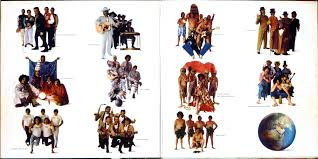
Inner gatefold
Column 1: The U.S. Teens featuring Raoul, The Atomic Enchilada, Howie, Mark, Johnny, Jim & Al
Column 2: Quad City Ramblers, The L.A. Bust '66, The Fabulous Dawgs,
Column 3: The Cross Fires, King Kamanwanalea and the Royal Macadamia Nuts, Nature's Chidren,
Column 4: The Bigg Brothers, Fats Mallard and the Bluegrass Firebal, All


In response to White Whale’s pressure to produce a hit, the group wrote a song with the dumbest lyrics they could, a satirical looks at the pop love songs of the day. Of course, as luck would have it, the song, “Elenore,”  was a major hit, making everyone happy.

The record also included “You Showed Me,” a song by the early Byrds that had not been previously recorded. It also made the charts.

One of the slyest jokes was the song “I’m King Kamanawanlea (We’re the Royal Macadamia Nuts),” the title of which came from a risque schoolyard joke of the era.

Despite the two hits, the album only did middling sales. Perhaps the mix of styles was an issue: people who didn’t get the joke were not interested in songs that weren’t in the genre they preferred.

The group did one more album, Turtle Soup, produced by Ray Davies, but that got good press but failed to crack the charts. At that point, the group broke up, though White Whale put out an album of B-sides and whatever could be found in the studio.

Volman and Kaylan (along with drummer Jim Pons*****) joined the Mothers of Invention.****** White Whale, refused to let them use the Turtles name, or even their own, so they were billed as “The Phlorescent Leech and Eddie.” They were featured and given a large part in Zappa’s 200 Motels. As “Flo and Eddie,” they did several moderately successful humorous albums. Eventually, they got the rights to their own names back, but by then Flo and Eddie was too well-established to change.
___________________________________________________________
*Knocking the Beatles out of the #1 spot.
**Their two hits were written by outside songwriters, as were most of their songs on the albums.  Of note was that they recorded at least one song written by Warren Zevon.
***This was a common concept in the 60s, where several local groups would perform one evening, with a prize given to those who the audience liked best (judged by applause at the end). It’s a common plot element of any TV show or movie featuring a rock band, from Josie and the Pussycats to School of Rock.
****An early name of the group.
*****Who later quit music to work for PR with the New York Jets, and designed the logo the team used in the 1980s.
*****One nice irony: on the Mothers’ first album, the liner notes disdainfully quoted a record executive who wanted to make the Mothers as big as the Turtles.

Sunday, November 17, 2019

Ariel (music)

(1977)
Written and performed by
Dean Friedman
Wikipedia Page

Being a one-hit wonder is no disgrace. It takes a lot of talent to get a recording contract and both talent and luck to have a hit. Dean Friedman only had one song that made it on the US charts,* but it was a delight.

“Ariel” is a song about meeting a girl and becoming lovers, but it’s filled with charm and clever lyrics.

Part of its charm was that it was set in Paramus, NJ, where Friedman grew up, and there are many references to it and to the NYC area. Indeed, there are several lines in the song that only someone from the area would understand.** Plus there is some clever wordplay, like in the line “I said ‘Hi,’ she said, ‘Yeah, I guess I am.’" Or “I was messing around with the vertical hold.”***

The song got a lot of FM airplay, and reached 26 on the charts. One issue was that the record company was new and hadn’t pressed enough copies to meet the demand.****

Freidman was not able to duplicate that success, but continued to record and perform and also wrote some music for TV.

____________________________________________________
*Though he continued to record and is still performing today.

**For instance, there’s a line about the “Friends of BAI,” a reference to WBAI, a listener supported station in the area.

***A control on TVs of the era, unneeded now. But in the context of the song, it also meant he was holding her.

****See what I said about luck.

Sunday, August 4, 2019

Record Club of America (music)

c1960-c1975

When I was growing up, records were hard to find. I lived an hour from the nearest record shop* and it was hard to find a selection. The Columbia Record Club was out there, but their records were far more expensive than what they cost in a store. They gave a come-on rate – a bunch of records for a ridiculously low price** – and then you had to pay their full price (IIRC $6.98 when a record was about $3
.98).

Worse, it was on a negative refusal plan. They’d send you a card every month. If you didn’t return it, their choice for the month was automatically shipped and billed to you. You had to buy a certain amount of records to end the service. and if you forgot to return the card, you’d get a record you didn’t want. The overall cost of the records was far more than buying them in a store.

That was when I discovered the Record Club of America.

Their ads were simple.  You paid a membership fee (under $1) and bought a couple of albums at very low prices. Then, every month, you’d get a catalog. But you could just ignore it: you would only be sent an album if you requested one.

It seemed a great deal and I signed up.

Of course, there were reasons why things were so cheap.  The Record Club (out of York, PA), pressed their own albums under the license of the record company.*** The results were not as good as the authentic album, but back then no one really paid attention to the slightly worse recording quality. One album I got skipped badly. But the customer service was good:  they would send you a new one if you let them know the problem.

They also sold regular copies of the albums, usually the ones that weren’t popular enough to license. But the did feature albums that they pressed themselves.

There was a downside to this: when they pressed an album, they couldn’t return it to the record company for credit, so if they misjudged the popularity, they were stuck.

Things, though, started to go bad. The company was sued by the NYS Attorney General, calling the membership fee a scam. I thought that was ridiculous: it was a one-time fee that still made the record cheaper than anything else.

Then the company cut corners that were less laughable:  they started pressing records without getting permission. It may have been that they were licensed to press a certain number but pressed more than that to keep up with demand.  The record companies (rightfully) didn’t like that, and suddenly, they couldn’t press their own records.

The company switched to 8-tracks when they were big, but it wasn’t enough.  It went under in the mid-70s. From a couple of reports, it seems that the old warehouse existed at least until 2011, the records still visible in the windows.
_____________________________________________________________
*My father sold records in his store, though I doubt he made much money with them, and my brothers and I were his biggest customers (at wholesale). But since the records were all returnable, they lost nothing but the space for them.
**I see 13 records for $2.85 online.
***A small sticker would announce that it was manufactured with permission.

Sunday, June 2, 2019

Moondog (music)

(1916-1999)
Allmusic Page

In the 60s and 70s, I loved visiting New York City. I’d wander through the streets, going to museums and generally just enjoying the atmosphere. Once, I remember spotting a strange figure:  a man wearing a horned helmet and long cloak and carrying a spear. Since I was working at my radio station, where we got plenty of LPs and music news, I immediate realized who it was:  Moondog.

He was born as Louis Thomas Hardin and developed an early interest in music. When he lost his sight at age 16, he still continued his studies and moved to New York in 1943, befriending some legendary classical and jazz performers, and becoming a street musician. He had an apartment, but he spent his days on a corner on Sixth Avenue, supporting himself by busking and selling pamphlets of poetry and his philosophy of music.

His songs gained the attention of his musician friends and he started to record in 1953. The albums were on small labels and did not make a big splash, but in 1969, superstar producer James William Guercio* decided to record him the way he deserved to be heard.  The album, Moondog, brought him to the attention of as (somewhat) wider audience.

Moondog’s music was not a bunch of simple tunes. He ranged widely from classical to jazz, inspired by the sounds of the city. The melodies build and intertwine in sophisticated ways.  The first album was completely instrumental, but definitely fine music.

The album garnered critical success, though was only a modest success. Still, a second album was put out featuring vocal tracks by his daughter, June Hardin.

Moondog was primarily a composer, but he did play music, usually on several instruments he invented himself.

Though never a star, Moondog was well regarded by other musicians, who occasionally would record his work or make mention of him in their own. His biggest connect to rock music was a successful lawsuit against Alan Freed, who called his early rock and roll radio show “Moondog Matinee” and played one of Moondog’s early compositions as his theme song. Freed lost and had to stop using the name.

He moved to Germany in 1974 and continued to compose until his death in 1999.
_____________________________________________________
*Best known as the producer for Chicago and Blood Sweat and Tears

Sunday, March 10, 2019

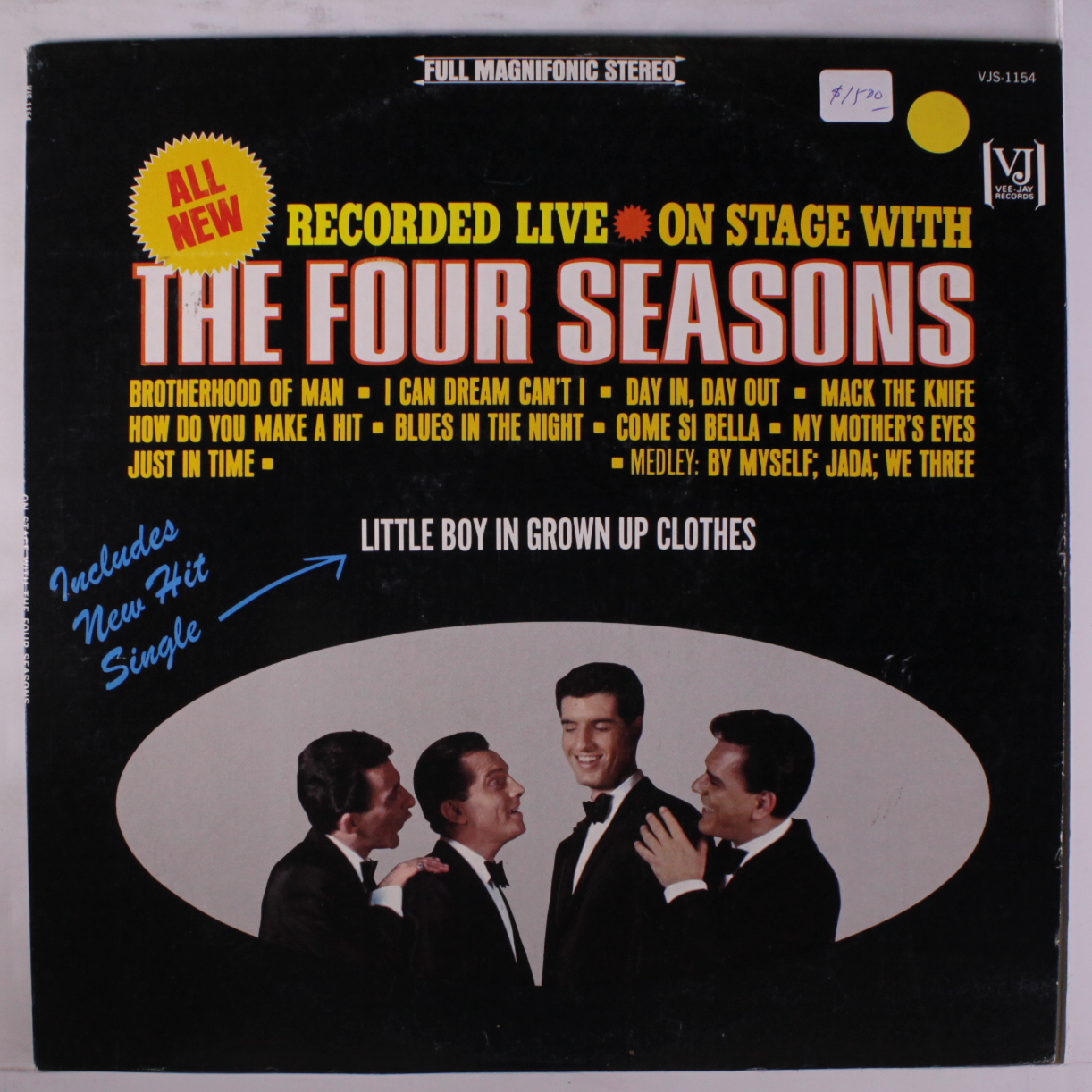
The Four Seasons Live on Stage (music)


Image result for four seasons live on stage album
(1966)
One artifact of the music business is the contractual obligation album, where an artist has to produce music for a record company after leaving it. If the breakup was ugly, the musician doesn’t want to have the record company making money from him, so they have to deal with it. The most infamous case was Van Morrison, who improvised 31 ridiculously short (and deliberately awful) songs in one day at the studio.*

The Four Seasons were caught in the same bind when their original label, Vee-Jay stopped paying royalties.  After a lawsuit, they moved on, but Vee-Jay wanted a final album. The result was The Four Seasons Live on Stage.
Despite its name, it is not a live album. It’s recorded entirely in a studio with live audience reactions added – applause, cheering, and everything. There even was banter between songs, to appreciative reactions. It’s actually pretty well done in that respect.
The rest, however, is not what fans would have expected. It contained none of their hits, and was not in their signature sound. Most of it are reworkings of classic 50s lounge songs, probably the type of songs they performed when they were starting out. The titles show this:  “Blues in the Night,” “Just in Time,” “Mack the Knife,” and “Brotherhood of Man” from How to Succeed in Business are  the best known these days.
If you’re expecting the Four Seasons, you’ll probably be disappointed. But if you listen not expecting them, the album is quite good.  The Jersey Boys don’t give the songs short shrift and give enthusiastic performances and actually sell not only the songs but the pretend concert. It’s very Sinatra influenced and has a jazzy vibe that is unusual for the group.
The album done, the group was free to move to Phillips Records.**  Vee-Jay released and almost immediately folded, so it got very poor distribution and was quickly forgotten.
Still, it’s an interesting curiosity.
Note: If you listen to it on Spotify, beware. The tracks are mislabeled. The three-song medley on Track Six is spread across tracks 6-8 and the titles of track 9-11 are really two songs behind their titles – and the final two songs are omitted.
_____________________________________________________________
*I’ve written about John Sebastian’s issue with his record company before
**Vee-Jan introduced the Beatles in the US, but couldn’t handle the demand and started shorting all their artists. And if you can’t make money selling records by the Beatles and the Four Seasons, you’re probably not going to survive.

Sunday, February 10, 2019

Vanity Record Labels (music)

(c1960 –  c1974)
One trend in the rock era of the 60s was the creation of vanity record labels. These were record companies* created primarily for a single artist, allowing them to keep more creative control of their work. The trend took off when the Beatles founded Apple records, and other major groups of the 70s had their own label. Generally, they also included other artists, most of whom never caught on. 
The labels handled the recording side, but distribution was usually still held by an established record company. This post will talk about some of the better-known groups who had time.
Reprise Records – probably the first. It was founded by Frank Sinatra in 1960. Frank was big enough then to set it up, and he signed many of his friends. Eventually, Warner Brothers bought them and Reprise was a major label into the mid-70s.
A&M Records – something of an exception. The company was founded by Herb Alpert and Jerry Moss in order to release Alpert’s single, “The Lonely Bull.”  The song was a major hit, and Alpert’s Tijuana Brass – a group of studio musicians  backing him – was one of the best selling acts of the early 60s. The company branched out and eventually became a major label itself.
Apple Records – The one that really started the trend. The Beatles wanted control of their records and used their clout to get Capitol/EMI to give them their own company. The group also signed other acts, most notably Mary Hopkin, Badfinger, Billy Preston, and James Taylor.**
Once the Beatles broke through, others began to follow.
  • Rolling Stones Records
  • Threshold Records (Moody Blues)
  • Bizarre Records/Straight Records (both by Frank Zappa). Zappa originally wanted to use Bizarre for his less mainstream acts, and Straight for more popular groups. For various reasons, the avant garde (notably Captain Beefheart) acts ended up being released on Straight Records, with Bizarre leaning toward releases from Zappa and the Mothers.
  • DiskReet (also Zappa)
  • Brother Records (The Beach Boys)
  • Grunt Records (Jefferson Airplane)
  • Swan Song Records (Led Zeppelin)
  • Ode Records/Ode 70 Records – these were two labels run by producer Lou Adler. Ode was distributed by Columbia/Epic. Adler switched distributors to A&M in 1970 and the name was changed to Ode 70, which released Carole King’s multiplatinum Tapestry as well as albums by Cheech and Chong. While he was still at Columbia/Epic, he signed Spirit
  • Grateful Dead Records – One of the few to try to handle distribution themselves (at least at first). They had problems because, unlike all other record companies, their albums weren’t fully returnable by record stores.***
The trend faded out in the mid-70s. The issue was that the artists were not really treated like equals: it was a title change, and they could record what they wanted instead of having the record company direct them.  But full control was rare and the original wave of vanity record companies faded out by 1974.****
________________________________________________________________
*Usually a subsidiary of an established company.
**Taylor, of course, was their greatest long-term success, but that was after he moved on. He recorded one album for them, but ended up recording for Warner Brothers, which released Sweet Baby James, the foundation of his career.
***All records and (later) CDs in stores were fully returnable for credit, a practice also common for bookstores. This allowed the stores to try new artists risk-free. There were a few exceptions:  The Concert for Bangladesh was only 90% returnable:  if you got ten copies, you could only return 9 for credit. Since it was a one-time thing, and the album sold well (and won a Grammy), it wasn’t a deal killer, but the Dead originally wanted 0% returnable, though they quickly ended that policy.
****They started cropping up again in the 90s.

Sunday, January 20, 2019

Jamming with Edward (music)

Jamming with Edward
(1972)
Personnnel:
Nicky Hopkins (piano), Ry Cooder (guitar), Mick Jagger (vocals, harmonica), Bill Wyman (bass), Charlie Watts (drums)
Wikipedia Page

Some albums are meticulously planned out, with multiple takes and overdubs to get just the right sound. Jamming with Edward was just the opposite: it just happened and was released almost as an afterthought.

It grew out of the Rolling Stones’ Let it Bleed sessions. The Stones had brought in Nicky Hopkins, the premier sessions pianist of his time,* and guitarist Ry Cooder.**  But when Keith Richards left the studio, they sat around with the rest of the Stones and just started to jam.

The result was Jamming with Edward.***  It was just the group playing, with Hopkins and Cooder improvising on the drums and bass line, and Jagger joining in. The blues classic “It Hurts Me Too” was part of the mix. When the session was over, it was forgotten.

But a couple of years later, Jagger stumbled upon the tape, cleaned it up a bit and released it as an album on their newly formed Rolling Stone records. But it was clear that he didn’t think it was great work. The album was sold at a discount**** with very little promotion.

Some thought at the time that this was a form of revenge.  Cooder had charged that Jagger had stolen the riff of “Honky Tonk Woman” from him and was extremely disdainful.  This was thought to be Jagger’s way of getting back.  Jagger has always damned the album with faint praise, calling it “just a laugh. . . It didn’t really warrant releasing, really, but it was okay, a bit of fun, and there’s some good playing on it.”

It suffers from the drawbacks of any impromptu jam session:  lack of focus, and the musicians deferring to each other a bit too much.  Still, when you have five high-quality musicians playing together, the results are fine to listen to.
___________________________________________________________
*Hopkins, who had health issues that often prevented him from touring, was a session man used by the Kinks, the Pretty Things, the Move, the Who, Jefferson Airplane (at Woodstock), the Beatles (“Revolution”), and was a member of the original Jeff Beck Group and Quicksilver Messenger Service. He also worked extensively with the Rolling Stones.
**Cooder is known today for his interest in roots music, but in the 60s and 70s, also was a busy session man with Captain Beefheart, Eric Clapton, Van Morrison, Neil Young, Randy Newman, and many other groups and is considered a guitar great by those in the industry.
***Hopkins was nicknamed “Edward” by Brian Jones. The name was used in one of his best compositions, “Edward, the Mad Shirt Grinder.”
****In small record stores, albums were priced by the wholesaler, using a letter system. Stores could decide how much to charge for each letter.  At the time Jamming With Edward came out, records usually had a “B” classification.  “C” was used occasionally, and double albums were “AA,” which meant they cost twice the “A” price. Jamming with Edward was released as an “A,” something only used for bargain records.

Sunday, January 13, 2019

Dave Clark Five (music)

image(1964-1970)
Members: 
Dave Clark (drums), Mike Smith (keyboards, vocals), Rick Huxley (bass), Lenny Davidson (lead guitar), Denny Payton (sax, harmonica, guitar)
Wikipedia Page

Back in the days of the British Invasion, the main debate as to who was the best of the many groups that were part of it. Nowadays, the two main contenders are the Beatles and the Rolling Stones,* but at the time, there was a third contender who gets little notice today:  the Dave Clark Five.

Clark started the group in the late 50s as the Dave Clark Quintet. After the usual changes of personnel, the group was renamed in 1962 and started gaining success.

Part of this was due to the search for the next big thing after the Beatles. “The Liverpool Sound” stormed the charts and record companies tried hard to find something similar.**  The Five were from North London – Tottenham – so they were promoted as the “Tottenham Sound.”

No matter what the promotion, the Dave Clark Five was a hit.  Their first single, “Glad All Over” knocked the Beatles out of number 1 in the UK and became the first non-Beatles British Invasion song to hit the US hot 100.  It led to an appearance on The Ed Sullivan Show, again, the second British Invasion group to appear there.

The group continued with hits like “Bits and Pieces,” “Can’t You See That She’s Mine.” “I LIke It Like That,” “Catch Us If You Can,” “Over and Over,” and “You Got What It Takes.”  Ed Sullivan liked them so much that the appeared on his show 18 times – more than any other UK music at at the time.  Their songs had a heavy beat and catchy hooks.

The group also followed the Beatles with a movie of their own:  Catch Us If You Can/Having a Wild Weekend. I haven’t seen it, but it looks like it was an ambitious attempt to tell a story other than just being an excuse for the group to perform its hits, but it didn’t make much of an impression.

By 1970, after a string of non-hits, the group broke up.  Unfortunately the story didn’t go on.  Dave Clark managed the band himself and made the smart move of keeping control of their tapes.  Unfortunately, he kept a very close control of them, rarely allowing people to rerelease their material. Clark was a multi-millionaire from other sources, so he didn’t need the money and it was hard to persuade him to release the songs.

It also didn’t help that the band never really projected a personality. Only a die-hard fan could name anyone other than Clark during their heyday, and many people believed it was the name of the singer, not the drummer. So when Clark took the songs off the market after they broke up, they were forgotten, and their influence on the music scene faded to nothing.

Still, they leave a legacy of a string of hits that helped define the musical era.

___________________________________________________________
*With some support for the Kinks, the Who, and the Animals, though none of these were as successful..

**The only real successful one was the “San Francisco Sound,” which developed organically.  Indeed, when they tried to create a “sound” of their own in the “Bosstown Sound,” it failed miserably.

Sunday, October 7, 2018

Louis Jordan (music)

image(1908-1975)
Wikipedia Entry

I may have mentioned this before, but I’m a fan of the blues. And of course, that mean I was a fan of B.B. King. So one day, when I saw a CD in a bookstore titled Let the Good Times Roll: The Music of Louis Jordan, I picked it up, and immediately added Jordan to my favorites.*

Jordan was born in Arkansas in 1908 and grew up to be a musician, performing in various local bands until he got his big break in 1936, when he was hired primarily as a saxophone player for the Savoy Ballroom Orchestra. He quickly showed off his talent for singing and showmanship, overshadowing the band’s nominal leader.**  In 1938, he started out on his own.

He started recording songs in 1939, a combination of new songs and covers.In 1942, he had his first R&B chart hit, “I’m Gonna Leave You on the Outskirts of Town.” It was a breakthrough. The next year was a big one.  His cover of “Ration Blues” was #1 on the R&B chart and crossed over to the pop chart (and C&W). The hits continued the next year with “G.I. Jive” and “Is You Is or Is You Ain’t My Baby?” and by 1946 he was a regular on the R&B and pop charts, with songs like “Caldonia,” “Choo Choo Ch’Boogie,” and “Jack, You’re Dead.” 

In 1949, he recorded “Saturday Night Fish Fry,” which is often cited as one of the first rock ‘n roll records, partly because the chorus include the lines “And it was rockin’”

Over his career, Jordan had 18 Number one R&B hits, a record beaten only by Stevie Wonder and Aretha Franklin.

Jordan’s style is usually described as “jump blues,” and consisted of catchy tunes and tons of energy. At a time when music was segregated, he managed to cross over and sell to white audiences. He was often called “King of the Jukebox” during his time; you want wanted something to dance to, Jordan was the man you’d choose. Jordan also made short films of him performing as a way to boost his image.

By the mid-50s, Jordan suffered a loss in popularity, though he still continued to record, often reworking early songs to fit better into the modern styles. He stopped getting a chance to record in the 60s and died in 1974.

Jordan was recognized as a pioneer by musicians and was even honored with a Broadway Show. Five Guys Named Moe ran over a year and has spawned revivals over the years. And he was inducted into the Rock and Roll Hall of Fame in 1987.

______________________________________________________
*I had heard other songs by him, but hadn’t made the connection.  I also was a bit confused at first, thinking they meant French actor Louis Jourdain.

**He often sang with Ella Fitzgerald.

Sunday, April 29, 2018

East-West (music)

(1966)
The Paul Butterfield Blues Band
: Paul Butterfield (vocals, harmonica), Mike Bloomfield (electric guitar), Elvin Bishop (electric guitar & vocals), Mark Naftalin (piano, organ), Jerome Arnold (bass), Billy Davenport (drums)
Wikipedia Entry

The Paul Butterfield Blues Band were pioneers in the melding of blues, jazz, and rock in the early 60s. Led by three extremely talented musicians, the band started marking new territory in blues and rock with their first, self-titled album,* a combination of traditional blues and new material.  Their second effort, East-West, is a classic.

Butterfield, of course, led the band and did most of the vocals, but he knew how to pick talent.  His primary lead guitarist, Mike Bloomfield was an early guitar god, developing his reputation with the band. And Elvin Bishop also made his mark on the rock pantheon.

East-West uses many musical styles.  “Walkin’ Blues” is from the great Robert Johnson, while “Get Out of My Life Woman” features the New Orleans based sound of Allen Toussaint. And jazz great Nat Adderley was covered with the instrumental “Work Song.”

But it is the title song that gets all the praise. Developed by Bloomfield, it’s a 13-minute opus that’s based upon Indian classical music mixed with modal jazz, and with a memorable tune to boot.  The song was a fascinating exploration of new ways where music can go.  It became an influence for the budding jam band scene.

It was unusual for an rock albums of the time to have two long instrumental tracks. Also notable is the inclusion of the song “Mary, Mary,” written by Michael Nasmith of the Monkees.

The album was a critical success. But Bloomfield moved on soon after it was released.  He formed The Electric Flag, which put out a single album, played with Bob Dylan, and then with Al Kooper for the album Super Session. But he seemed to have develop a problem with drugs.**  he recorded various solo albums and projects in the 70s, but, while well-received, nothing really gelled for him.  He died in 1981 of a drug overdose.

Bishop took over as guitarist for the group when Bloomfield left; their next album, The Resurrection of Pigboy Crabshaw*** featured him taking over the guitar parts. Eventually, he moved on to a solo career, with the hit single “Fooled Around and Fell in Love,” which wasn’t really typical of his blues-based music.

Butterfield kept going, breaking up the Blues Band and recording as Paul Butterfield’s Better Days before going solo. His harmonica playing was highly influential in the field.

The album is one of the great landmarks of the era.

______________________________________________________
*Reportedly, the first album to have the liner instructions, “This record should be played loud.”  The exhortation later became a punchline and a sign of a no-talent group, but in this case it was sincere.

**The Super Session was released with one side of Bloomfield material and another with Steve Stills. Bloomfield had been scheduled to appear on both sides, but didn’t show up for the second recording session.

***The name referred to Bishop.

Sunday, January 28, 2018

Rhinoceros (music)

Rhinoceros(1968-69)
Members:
John Finley (vocals), Michael Fonfara (keyboards), Danny Weis (guitar), Doug Hastings (guitar), Alan Gerber (keyboards, vocals), Jerry "The Bear" Penrod (bass), Billy Mundi (drums)
Wikipedia Entry
In the mid-60s, the phenomenon of the supergroup came to pass. The basic definition was a group made up of musicians who had been successful with other groups. The first was probably Cream, where Clapton, Bruce, and Baker had already established themselves with John Mayall and Graham Bond. Later, of course, Clapton and Baker joined forces with Steve Winwood and Ric Grech to form the superest of supergroups, Blind Faith (along with Crosby, Stills, Nash, and Young).
Rhinoceros was an attempt to manufacture a supergroup.
Elektra Records producer Paul Rothschild decided to create a group of semiestablished rock musicians and promote them heavily. After a series of auditions, the nucleus of the group was formed,
The problem was that people with successful groups didn’t usually want to leave them, so the original members were not exactly household names.  Danny Weis and Jerry Penrod had been with Iron Butterfly, but had left before they hit it big. Billy Mundi was the original drummer for Frank Zappa’s Mothers.  The rest were talented musicians who had never quite hit it big.
Rothschild got the group together and they recorded their self-titled album. The album is decent, though without any of the standout songs that turn unknowns into stars.  A second album. Satin Chickens, was released, but did even worse and the group disbanded. 
About the only recognition the group got was for the funky instrumental, “Apricot Brandy,” which was used as a theme song for the BBC.

It’s tough enough to keep a group together when you worked together for years to make it to the top, and when you’re basically thrown into a room and told you were bandmates, it’s not surprising they didn’t last long.
But it’s a bit unfair. If they hadn’t had the “supergroup” label*, people might have taken them more seriously. The pretentiousness of it made people skeptical, and they wanted something spectacular. The quality of the band was secondary to its hype, and they’ve been forgotten.
___________________________________________________
*Lillian Roxon’s Rock Encyclopedia talked about how they should have been called “Supergroup.”

Sunday, January 21, 2018

David Bromberg (music)

(1945-)
Wikipedia Entry
David Bromberg Website

Sometimes you come across a musician from your youth who you knew about vaguely, but never followed closely. And now you discover he made just the type of music you loved then (and still do today). That happened recently when I was reintroduced to David Bromberg.

Bromberg grew up in the suburbs of New York city, learning to play guitar and just about any type of stringed instrument.  He started doing studio work and appeared on albums by Jerry Jeff Walker, Tom Paxton, Richie Havens, Bob Dylan, and Carly Simon, among others before finally putting out a solo album in 1972.

The album helped define Bromberg’s style, which was so eclectic as to be indefinable. He mixed blues, country, jazz, folk, bluegrass, and anything else that came his way.  It starts out with what was probably his best-known tune: “The Holdup” (co-written with George Harrison). Here’s the song with Harrison on guitar*.

The follow up album, Demon in Disguise, was another triumph,** with the equally delightful “Sharon,” about a man’s infatuation with a hoochie coochie dancer.

But Bromberg wasn’t just a funnyman. The album also contained a version of Jerry Jeff Walker’s “Mr.Bojangles,” where Bromberg talking about the origins of the song*** that made a poignant song even more so.

In addition to his musicianship, Bromberg had a distinctive voice.  Not rough, but not smooth, either, with a tone that’s partway between a growl and a moan.

Bromberg continued to record albums regularly throughout the 70s, then sporadically after that. It’s a sign of his regard among musicians that so many established names shows up on them. And he was also doing studio work and toured with other names like Ringo Starr, the Eagles, and others.

He’s still active, though performing less these days. But he’s really a musician who deserves more credit with the general public.

______________________________________________________
*Bromberg recorded several different variations on the song over the years.

**He was backed by most of the Grateful Dead.

***He had played on the original version.

Sunday, April 23, 2017

Chicken Fat (song)

(1962)
Written by
Meredith Willson
Performed by Robert Preston
Wikipedia Entry

In the late 50s and early 60s, the US was in the middle of the Cold War panic, afraid that the Soviets would bury us. And when JFK became president, one of the big concerns was that American youth were not getting enough exercise.  To combat this, “Chicken Fat” was created.

The song was written by Meredith Willson, then riding high with the success of The Music Man.  It seems to be his idea to write a song that could be used in gym classes to promote exercising. He wrote the song, and, in the same sessions where they recorded the soundtrack for the movie of The Music Man, they took time to get Robert Preston, star of the show, to record the song.

The result was a catchy tune that was fun to exercise to and included exercises to be done while the music played.*

I remember our gym teacher playing it, and it was a lot of fun to have a song to do our exercises to. Part of the appeal was that the concept was so unusual:  you didn’t do exercises in school to music.

The song was released as a public service.  No one took any money or royalties, and the record company paid for the session and recording and distributed million of copies to gym classes around the country.

It’s a most a forgotten novelty these days, but there are many people my age who can remember doing sit-ups at Professor Harold Hill cheered you on.

____________________________________________
*The exercises were devised by Bud Wilkerson, who, at the time, was arguable the best regarded college football coach in the US.