Showing posts with label musicals. Show all posts

Sunday, March 29, 2026

Royal Wedding

Royal Wedding

 (1951)
Directed by
Stanley Donen
Written by Alan Jay Lerner
Starring Fred Astaire, Jane Powell, Peter Lawford, Sarah Churchill, Keenan Wynn
IMDB Entry 

Some movies are known only for one classic scene. The most obvious is Five Easy Pieces, for Jack Nicholson ordering in a diner: that's been shown often, but far fewer people have seen the entire movie. Another example is Royal Wedding. 

Tom (Fred Astaire) and Ellen (Jane Powell) Bowen are Broadway stars who take their show to London around the time when Elizabeth marries Prince Phillip. On the voyage over, Ellen falls for Lord John Brindale (Peter Lawford). Later, in the UK, Tom meets Anne Ashmond (Sarah Churchill) and falls for her. Complications ensue:  Brindale, despite being a lord, is a playboy who's unwilling to settle down, and has very little money. Anne is engaged to be married to a man who has moved to the US, but still keeps up the long distance relationship.

This is a romantic comedy and the story is a very slight one. It's sabotaged by having the romantic couples join up early on, which leaves little room for conflict. Lots of movie musicals used a similar plot, but in this it seems very tired.

But the movie achieved immortality due to Astaire's "Dancing on the Ceiling" routine, which shows up in any compilation of his work. It is still technically impressive today, and probably even more so when it first came out. This is also the movie where Astaire danced with a hat rack, and where he and Powell performed "How Could You Believe Me when I tell You that I Loved You when you Know I've been a Liar All My Life?"  There's also the technical challenge of "Open Your Eyes," where Astaire and Powel dance on the ship as it goes through a storm. Its rocking causes them to slip and fall, and musical instruments to roll behind them.

Astaire is Astaire, performing his usual light romantic comedy to perfection. Powell is also quite good.* Lawford is a bit too stiff as a romantic lead, but manages all right.

Sarah Churchill was primarily a stage actress and doesn't have much chemistry with Astaire. She is the daughter of Winston Churchill and was successful at that despite having a British national hero as a father.

Also of note is Keenan Wynn as their American theatrical agent, Irving Klinger, and his English twin brother agent, Edgar Klinger.

Alan Jay Lerner wrote the script and lyrics. He did better when he joined with Fredric Lowe a couple of years later.

The movie had a difficult production history. June Allyson was first hired to play opposite Astaire,  under the direction of Charles Walters. Allyson got pregnant and Judy Garland was tapped for the role. Garland was in a troubled state of mind and missed rehearsals until she was fired and replaced by Powell. Walters left at about this time (possibly due to Garland's firing) and Stanley Donen took over.**

_________________________________________________________________

*It's interesting that her character dates several different men, sometimes going from one to another an back in a few days, much like Lawford's character going through women,  The the movie's credit, this is treated lightheartedly, with no shame attached.

*Donen directed Singin' in the Rain the next year.

Sunday, May 25, 2025

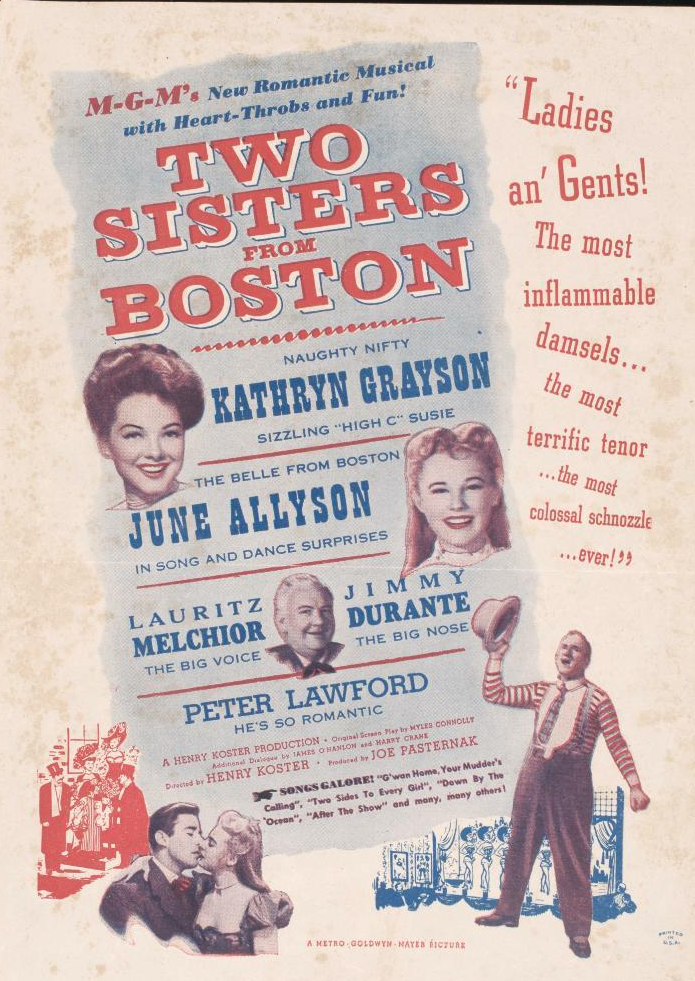
Two Sisters from Boston

 
(1946)
Directed by
Henry Koster
Written by Myles Connolly
Starring Kathryn Grayson, June Allyson, Jimmy Durante, Lauritz Melchior, Peter Lawford
IMDB
Entry

I stumbled upon a list of movies that Martin Scorsese thinks everyone should see. It's an eclectic list, but the one that stood out for me --  because it seemed so far from what Scorsese was known for -- was Two Sisters from Boston. So I had to check it out.

The story is set in the early 1900s. The Chandler family, a group of snooty Boston Brahmins, is scandalized to hear their daughter Abagail (Kathryn Grayson) is working as a singer at a saloon on the Bowery in New York (and -- even worse -- showing her legs!). They go to see her. Abagail tells them that she is actually performing at the Metropolitan Opera. The next day.  She gets help from her stage partner Spike (Jimmy Durante), who takes it upon himself to get her onto the stage, which he does by implying that she is the mistress of the opera manager. She sings, but incites the wrath of the company's tenor, Olaf Olstrom (Lauritz Melchior). Her sister Martha (June Allyson) discovers the truth, and goes to the opera manager, but meets with his son Lawrence (Peter Lawford), who believes in Jimmy's rumor and thinks it's  a blackmail attempt. 

The movie is inarguably fun. It plays with the stuffy Bostonian stereotype and the reaction to the rumor about Abagail. It's notable that they can imply that she's the opera manager's mistress, but it's never actually stated, so younger viewers of the time wouldn't catch it. The songs are also quite good and all of them are performed where they would naturally be singing.

Jimmy Durante, of course, plays Jimmy Durante. He has several amusing scenes where he convinces someone that he's a long lost friend so he can help Abagail. Kathryn Grayson was a leading star in MGM musicals of the 40s.  June Allyson* was also busy with musicals of the era. The two women are both overlooked today. 

Director Henry Koster has a long career in Hollywood, helming a lot of musicals. His best-known film these days is probably the classic Jimmy Stewart vehicle, Harvey.

_________________________________________________________________

*Cast as a replacement for Judy Garland

Sunday, May 11, 2025

The Mystery of Mr. E


The Mystery of Mr. E

(2023)
Directed by
Martyn Tott
Written by Sophie Hannah, Martyn Tott, Annette Armitage (music)
Starring Harry W. Knight, James N. Knight, Kevin Dixon, Martin Spendlove, Martyn Tott, Rachel Dobell. Anna Macleod Franklin, Nicola Wright
IMDB Entry

Finding things to write about here often includes a bit of serendipity. After I finished watching Nando Fodor and the Talking Mongoose, Youtube suggested The Mystery of Mr. E. I've been enjoying a lot of UK cosy mysteries and thought I'd give it a chance.  

But this wasn't just a mystery. It was a musical, and I love musicals.

George and John Danes (James N. Knight and Harry W. Knight) are generalists -- the opposite of specialists (it's explained in the first song) who are called to Idlewyld House, a country house and the home of the late Harriet Landrigan (Nicola Wright). Landrigan was a wildly successful romance novelist who died after falling down stairs. As they're about to go to the British manor, they are approached by the mysterious Mr. E (Kevin Dixon), who introduces himself as the murderer, then leaves. When the Daneses reach Idlewyld, they find that no murder has been committed. The house is run by Harriet's son Peter (Martyn Spendlove) and his wife, the overbearing Clemence (Anna Macleod Franklin), and their son Oscar (Aidan Broderick). There are also three obnoxious houseguests, Swithun Kirk (Martyn Tott), a hammy actor; Irene Coggins (Rachel Dobell), a fan who knows everything about Harriet's books; Max Russell (Judson Vaughan), her publisher; and several others to fill out the requirements of the cozy mystery. 

We find out that Harriet suddenly stopped publishing her novels. She wrote them, bound them secretly, and put them under glass for no one to read. The guests all had reason to want to see them.

Then there's a murder (of course).

This is just another iteration of the cozy mystery form, but the songs add an extra dimension. Sophie Hannah, who wrote the lyrics, is an accomplished poet and mystery writer.* Annette Armatage's music is just right.

As a quibble, the final scene where everyone gathers together and the murderer's true identity is revealed,** goes on too long, and the reason for Harriet's death is pretty tenuous.

But the movie is a lot of fun if you love mysteries and musicals.

________________________________________________________________
*The Agatha Christie estate has had her write new novels featuring Hercule Poirot. 

**As is the motive for Harriet stopping publication of her books.

Sunday, March 17, 2024

Roman Scandals

Roman Scandals

 (1933)
Directed by
Frank Tuttle
Written by William Anthony McGuire, based on a story by William F. Kaufmann
Starring Eddie Cantor, Ruth Etting, Gloria Stuart, Edward Arnold, David Manners, Verree Teasdale, Willard Robinson
IMDB Entry

Eddie Cantor was a big film star of the early 1930s, best know for his big eyes.* And one of his biggest hits was Roman Scandals.

Eddie (Eddie Cantor) is a jack-of-all-trades living in the midwest city of  West Rome. Warren Finley Cooper (Willard Robinson) is a millionaire who runs the town by bribery, and who had a fixation on ancient Rome. Eddie stays in one of his museums and becomes an expert on Rome. When he crosses Cooper by stopping his attempt to tear down peoples' homes to build a jail, he is kicked out of town. As he walks away, he suddenly finds himself in ancient Rome. He is sold as a slave to Josephus (David Manners), who frees him and needs his help to rescue Princess Sylvia (Gloria Stuart). Eddie -- now called Oedepus -- runs afoul of the Emperor Valerius (Edward Arnold) and is appointed his food taster, a very risky job, since the Empress Agrippa (Verree Teasdale) keeps trying to poison her husband.

The plot is slight, mostly a vehicle for Cantor's jokes, some dated, others still funny. You can see this as his star turn and he makes the most of it.

Slave Auction Scene
One of the best known sequences is the musical number portraying a Roman slave auction. Choreographed by the great Busby Berkeley, it shows a group of woman chained and nude and looking very distressed. Their long blonde wigs keeps things PG rated and the woman -- billed as the Goldwyn Girls -- included future stars Lucille Ball** and Paulette Goddard. Another Berkeley touch was that a woman falls to her death at the end, presaging "Lullaby of Broadway."

Given the time, it's not surprising that there is a blackface number. This one, however, is relatively innocuous other than the makeup itself. Cantor doesn't attempt any of the demeaning mannerisms usually portrayed and it really wouldn't have been any different if he hadn't smeared on the makeup.

Edward Arnold had a long career, often playing heavies, but occasionally the hero. Gloria Stuart, a

The songs were written by the great but underappreciated team of Harry Warren and Al Dubin.

__________________________________________________________________

*He often showed up in Warner Brothers cartoons

**Lucy has recounted that they actually were nude during the scene.

Sunday, October 22, 2017

Stop the World, I Want to Get Off (musical)

Stop the world(1962)
Music, Book, and Lyrics by
Leslie Bricusse and Anthony Newley
Starrting Anthony Newley and Anna Quayle
Wikipedia Page

I’m a big fan of Broadway musicals and one of the best things about them is that they’re constantly reimagined and restaged, both in New York and on the road, so new audiences can find them. At the same time, small theater company and school dramatic groups will put on the classics. It’s rare that a major musical seems to disappear, but that’s what happed to one musical with one of the best scores of all time, Stop the World, I Want to Get Off!

The play is the brainchild of Anthony Newley and Leslie Bricusse, who wore most of the hats when creating it. It’s the story of Littlechap (Newley), who, as his name suggests, is an everyman character.  He marries Evie (Anna Quayle) after she becomes pregnant and is soon disillusioned, having affairs with a Russian woman Anya (Quayle), Ilse (Quayle) from Germany, and the All American Ginnie (Quayle). It wasn’t until the end that he begins to realize just how much he wasted his life.

The strength of the play is the music, with one of the best scores of all time. “Once in a Lifetime,” “Gonna Build a Mountain,” and especially “What Kind of Fool Am I?” are standards, but the rest of the score is excellent.  One song – “Typically English/Glorious Russian/Typische Deuche/All American” – is sung, with different lyrics by all four of the women.  “Family Fugue/Nag! Nag! Nag!” is a hilarious narrative of a deteriorating marriage.  “Mumbo Jumbo” makes fun of politicians, while “Lumbered” shows Littlechap’s second thoughts about his marriage.

The  play was a hit in the UK, and moved to the US, partly because its small cast – four main characters and a chorus, all performed on a single set – made it cheap to produce.  It was nominated for four Tonys, and won one, for Anna Quayle.

But the play seems to have faded away. Much of the plot to too topical about the Cold War and politics of the time. But certainly it has nothing to do with the score. There were two revivals, one with Sammy Davis, Jr. (who love the score) in 1978, and another starring Newley in London in 1989, which did poorly.

Newley and Bricusse continued to work together. Their next attempt, The Roar of the Greasepaint, the Smell of the Crowd, did adequately and produced a couple of standards, but their best known work was writing the songs for Willy Wonka and the Chocolate Factory. 

Newley died in 1999.