Showing posts with label foreign. Show all posts

Sunday, January 11, 2026

Perfect Murders (Crimes Perfait) (TV)


Perfect Murders

(2017-2023)
Starring
Isabel Gélinas, Arthur Mazet, et al.
IMDB Entry

My local library offers Hoopla as a service to patrons where you can borrow books and video on your library card. That was how I stumbled upon Perfect Murders*, an interesting addition to the detective genre.

Its structure is similar to Columbo: we first see the meticulously planned murder take place. The police are called in to investigate. Like Columbo, the detective latches onto the clues until they prove what happens, but one twist is that the motive is not revealed until the end. The police are often quite blunt as to who they suspect, but they have to add up the clues.

Another twist is that there are multiple detectives. I have trouble keeping them straight, partly because the show is a French/Belgium co-production and they are all unfamiliar.** They are all nicely drawn, smart detectives, with interesting outside lives. The one that stood out best for me was Agnès Gélinas (Isabel Gélinas) and Thibaud (Arthur Mazet). Agnès refuses to used computers or cell phones, and has two husbands. Thibaud is more straitlaced and a bit nonplussed by her attitudes, but she is a crackerjack detective.

This doesn't give short shrift to the other detectives, all of whom have their own quirks, but the multiple detectives do make it hard to keep them straight.

The plots are cleverly done and the motives, once revealed, are cleverly constructed. 

Read my novel, The Cadaver Princess, a tale of body snatchers in early Victorian London.


_________________________________________________________________

*The French title translates to "Perfect Crimes," so I think they decided to jazz it up for English speaking audiences.  Of course, the crime is usually a murder, but not always.

**The show is in French with subtitles.


Sunday, January 1, 2023

Jour de Fete

Jour de Fete
 (1949)
Written, Directed, and Starring
Jacques Tati
IMDB Entry

I've mentioned before that I consider Jacques Tati as one of the great film comedians, and the last one to work in essentially silent cinema. His output was small -- five full-length films in twenty-two years -- but it was all classic. And it started out with Jour de Fete*.

It's set in a small farming town in France. A tractor arrives, bringing a merry-go-round and other parts of a small fair -- some games, a small theater, and other attractions that everyone in the village comes by to take part in.  The town's postman, Francois (Jacques Tati) is conscientious and hardworking, but a bit clumsy and simple and the butt of jokes. When he sees a satirical movie about postmen in America, he vows to take up their methods.

Francois is an proto-Hulot, Tati's great comic creation. In this case, he even speaks to advance the plot.** The gags are well constructed -- Keatonesque in his
use of objects behaving badly. Most of it is plotless -- just vignettes about the people who are at the fair. The part about the postmen doesn't show up until around 45 minutes in. That is the sequence that is usually listed as the plot of the movie, and it is impressive -- a series of sight gags and Francois delivers the mail. The movie also showed the main theme that runs through Tati's work -- a wariness about the new.

Tati is, as always, brilliant. Francois is an early version of M. Hulot, though for this he sports a moustache.  I suspect Tati didn't keep it so that you could see his entire face.

The film was originally shot both in color and black and white. The color process used worked poorly, so it was released as a black and white film, though a color version was recreated by his daughter in 1995. It was an immediate success and started Tati's career.

____________________________________________________________________
*Festival Day in French.

**Hulot was not a completely silent character, but he was a man of few words and got most of his points across with gestures.


Sunday, December 17, 2017

Ponette

image(1996)
Directed by
Jacques Doillon
Written by Jacquest Doillon (with first draft collaboration of Brune Compagnon
Starring Victoire Thivisol
IMDB Entry

Child actors in American films are often problematic. There is a tendency to make them precocious or stagy, removing any sign of the natural. Non-Hollywood films, though, often find ways to get strong and natural performances from children, and one of the best examples of this is Ponette.

Ponette (Victoire Thivisol) is a four-year-old girl whose mother dies in a car accident. She goes to live with her aunt, who later sends her off to boarding school. Ponette is too young to understand the concept of death and keeps looking for her mother to return. Other children are helpful and cruel in addressing her hopes.

The movie succeeds on the performance of Thivisol. She was only four when the film was shot and is just wonderful. Her search for her mother is filled with pathos and is mesmerizing.

Thivisol was nominated and won several acting awards for the film. There was some complaints – can we really call what she did on the screen “acting”? – but that doesn’t matter.  The result is a sad a beautiful film about moving on.

Saturday, November 24, 2012

Ikiru

image(1952)
Directed by
Akira Kurosawa
Written by Akira Kurosawa, Shinobu Hashimoto & Hideo Oguni
Starring Takashi Shimura, Shinichi Himori, Haruo Tanaka, Minoru Chiaki, Bokuzen Hidari, Kamatari Fujiwara
IMDB Entry

Akira Kurosawa is known as Japan’s greatest film director,* known primarily for action-filled films like Seven Samurai, Yojimbo, Roshomon, and Ran.  But early in his career, he showed a different side with Ikiru.

It’s the story about Kanji Watanabe (Takashi Shimura), a love-level government official toiling at a dull and boring job.  His life is empty, his wife dead, his son not all that interested in him.  When he discovers he has stomach cancer and only a year to live, he is lost in depression.  When he finds a former co-worker, who is now on her own and enjoying life, he realizes he has to break out of his depression and decides to take on small but difficult project:  to convert a vacant lot into a children’s playground.

Takashi ShimuraWatanabe has to battle bureaucracy and the calendar in order to get the playground finished.  Shimura is heartbreakingly good in the role, sad without being maudlin.

The movie has an important message:  that one man can make a difference, even in a small way.  Much of the film shows Watanabe becoming more and more despondent, until he take on his project with the clock running out for him.

Ikiru is often considered one of Kurosawa’s best, but it is not well-known in the US.  It was overshadowed by Roshomon and his next film, The Seven Samurai, and I suspect its long downbeat section turned off audiences who didn’t stick it out to the end.  It also didn’t have Kurosawa’s best-known actor, Toshiro Mifume.  So with an unknown cast, Kurosawa’s reputation was not enough for it to be noticed in the US.

_________________________________________
*Other claimants are Yashijiro Ozu and, if you consider animation (and I do), Hayao Miyazaki

Friday, July 24, 2009

Osama

Osama (2003)
Written and Directed by
Siddiq Barmak
Starring Marina Golbahari, Arif Herati, Zubaida Sahar, Khwaja Nader
IMDB Entry

I've always had a liking for foreign films*. They often have a different point of view than US films, and I am especially interested when I start discovering films from a country that is just joining the world cinema stage.

So, when I heard about Osama, the first film from post-Taliban Afghanistan to make it to the US, I knew I wanted to check it out.  And I wasn't disappointed.

Of course, given the time frame of the film, it should be obvious that it would be about life under the Taliban. We know in the West about some of their abuses, but this brings to light things that we probably never considered.  Under the Taliban, not only were women forbidden to hold jobs, but they could not go out of their houses without a husband or male escort.

This hits a 12-year-old girl (Marina Golbahari) and her mother (Zubaida Sahar) hard.  The mother is fired from her job in a hospital. Worse, because her husband and father have been killed in fighting, they are not allowed to leave their house.  Given the rules, they would have stayed "virtuous" -- and starved to death.

Desperate, they form a plan.  The girl is to disguise herself as a boy and get a job.  It works for awhile, but she is caught up in a sweep to recruit boys as soldiers and ends up in a training camp, where she is given the nickname Osama**.  She befriends Espandi (Arif Herati) a boy in the camp and is also singled out for her zeal by one of the teachers (Khwaja Nader).

Marina Golbahari as Osama The actors in the film are uniformly excellent. They were not professionals, but were found in Kabul.  Marina Golbahari is heartbreakingly good in the title role, and Kwaja Nader is a type of movie villain rarely seen:  a gentle monster.  He seems so sweet as he also shows the dark side of religious fanaticism.

The final scene is one of the saddest in the history of film***.  Out of context, it means nothing, but as you see the entire film, you understand exactly what it means and are horrified.

The film did well enough**** and won awards all over the world, including a Golden Globe.  Director Barmak remains working in the Afghan film industry.  Golbahari has made several other films since then. Calling her a major Afghan film star may be faint praise, but it fits her.

There isn't a cheerful film and has no happy ending. But sometimes tragedy must be told, too.

_______________________________________________

*I'm not one to dogmatically state foreign films are always better than US films, but I do recognize that if a foreign language film gets to the US, it is among the best that country has to offer.  Bad foreign films never make it to America, which is why it seems like so many are critical faves.

**Given the circumstances, how could it not be?  The director did want to have a more hopeful ending, but decided that wouldn't be right.

***Yes, named after that Osama

****It was shot for less than $50,000, which helped.

Sunday, March 29, 2009

Men with Guns

Men with guns (1997)
Written and Directed by
John Sayles
Starring Fredrico Luppi, Damien Delgado, Damián Alcázar, Dan Rivera Gonzalez, Tania Cruz.
IMDB Entry

I live in Schenectady, NY. And Schenectady's biggest contribution to movies is John Sayles.

Sayles is one of the top independent filmmakers.  He started as a writer, and began working with Roger Corman on Piranha and Battle Beyond the Stars. He also wrote and directed his first independent feature about this time with Return of the Secaucus Seven, sort of a template for The Big Chill. He continued with many indie successes in 80s and 90s.

Sayles never looked to be popular.  So when he had his a moderate success with Lone Star -- probably enough to go Hollywood -- he followed it up with as un-Hollywood a film as could be made:  Men with Guns.

The film is set in an unnamed Latin American country.  After the death of his wife, Dr. Humberto Fuentes (Fredrico Luppi) goes into a remote village to search for some former students who are reported lost.  As he travels, he meets with other along the way through the war-torn countryside, showing things to the doctor that he never imagined in his comfortable life. The title refers to the facts of life in the countryside:  men with guns come and order people around.

Sayles went far off the beaten path for this. First of all, the movie was shot in Spanish, with actors unknown to US audiences (other than a small role for Mandy Patankin, probably to get funding).  And he suffered the consequences:  poor box office, of course.  Despite some very good reviews, there was little interest in the US in a foreign language film by an American director.

Sayles, of course, isn't interested in making blockbusters.  He continues to work, scraping up money writing screenplays and occasionally acting, as he finances some of the best independent films you'll ever see.

But the result is stunning.  The ending especially is a very surprising twist, and Sayles leads you to it perfectly.

Important Note: There is a second Men with Guns -- a routine ultraviolent gangster shootup film.  Don't be confused.

Monday, December 31, 2007

La Belle et la bete

(Beauty and the Beast) (1946)
Directed by Jean Cocteau
Written by Cocteau and Jeanne-Marie Leprince de Beaumont
Starring Jean Marais, Josette Day
IMDB Entry

Myths are often retold. And Beauty and the Beast is no exception. The problem with retellings and remakes is that if there is a perfect version, they get forgotten by OK but inferior versions. That's why Jean Cocteau's La Belle et la bête deserves memorialization.

I don't have to tell you the story. You've probably seen the Disney version -- which is a pretty good movie in its own right. Gaston is one of my favorite Disney villains, because he doesn't see himself as a villain. He's going to save Belle, and do good. The movie also has some fine Howard Ashman/Alan Menken songs.

But it doesn't hold a candle to Cocteau's.

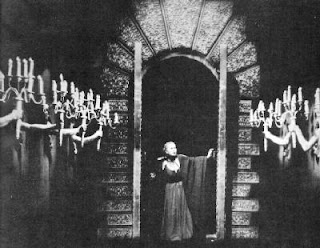
Jean Cocteau was a poet. This isn't hyperbole: Cocteau actually made his reputation as a poet (and playwright) before turning to films. He certainly had a poet's eye for beauty. La Belle et la bête is filled with beautiful, poetic imagery. For instance, when Beauty arrives at the Beast's castle, her way is lit by candelabra along the wall held by human hands. She glides down the hallway in a dreamlike movement, and the candles magically light as she passes.

The Beast's Hallway

Jean Marais is also memorable as the Beast. He appears like a lion, and his nobility makes him a perfect romantic hero. Legend has it that when the Beast was changed into a prince, Greta Garbo shouted out, "Give me back my beast!" Certainly the Beast is more romantic than any prince could be.

La Belle et la Bete

The film was made under difficult circumstances. World War II had just ended, and France was suffering from shortages of film and food. Cocteau made do with whatever film stock he could scrounge up, and the sumptuous banquets in the film were devoured by the crew and extras as soon as the scene was complete. Marais had to spend five hours a day for his make up, and Cocteau had to be hospitalized due to illness during shooting.

But none of the problems show up on the screen. The results are one of the most beautiful and romantic movies ever made.

Sunday, June 10, 2007

Riding Alone for Thousands of Miles (Qian li zou dan qi)

Riding Alone for Thousands of Miles(2005)
Directed by Zhang Yimou
Written by Zhang Yimou (screenplay and story) and Zou Jingzhi and Wang Bin (story)
Starring: Takakura Ken, Zhembo Yang, Lin Qiu, Li Jaimin, Jiang Weng
IMDB Entry

Sometimes you pick up a film at random and are just plain blown away.  We rentedRiding Alone for Thousands of Miles on a whim:  we liked foreign films, and lately have been picking up a lot of very good Chinese movies.  This looked like an interesting one, so we decided to give it a shot.

We were familiar with the work of director Zhang Yimou -- and you might be, too.  He made two impressive martial arts films, Hero and The House of Flying Daggers, movies that had a great deal of depth in among the action.  However, we didn't recognize the name (all Chinese might not look alike, but Chinese names are often hard for westerners to grasp).  That might have been a good thing, since the film is much different, one that concentrates on character instead of plot, with nary a bit of violence.  In fact, everyone in the film is just so nice.  That's very refreshing.

Takakura Ken (I'm sticking with the Chinese tradition of putting the family name first, though he's also been billed at Ken Takakura) plays Mr. Takata, a man estranged from his dying son. The son was a documentarian, and, in a film he made, he talked about going to China to see a local singer perform the Chinese Opera that gives the film its title. Takata decides to travel to China to film the performance.  But there are problems. . . .

This is a film that is clearly an unfolding. Takata's journey takes him to a small village in Yunnan Province in southwestern China and a meeting with the singer's five-year-old son, Yang Yang.  In it Takata learns more about people, himself, his own son, and his life.

Takakura Ken is superb as Takata, a taciturn man who goes upon this journey to try to connect. The rest of the cast were not professional actors, but you'd never know it.  Especially good is Zhembo Yang as Yang Yang and Lin Qiu as Lingo, Takata's guide and non-interpreter.

The film also deals with an issue you rarely see:  language barriers.  Takata speaks no Chinese and is dependent on others to translate and understand others. Lingo (interesting coincidence of a name) knows very little Japanese and is always struggling to figure out what Takata is saying. It manages to work out with some strategic cell phone calls to a real interpreter, Jasmine (Jiang Weng). The barrier is constant, but Takata manages to work his way around the country.

The film is beautiful, with some amazing scenery as background. This is definitely a wonderful opportunity to see life in other cultures and the importance of family.