Showing posts with label Food. Show all posts

Sunday, April 15, 2018

TV Time/Jiffy Pop Popcorn (food)

(1950s-60s)

TV TimeThe 1950s were a time for food experiments, not so much in new flavors, like today, but in new and more convenient ways to prepare it. And in the time when a TV Dinner was the rage, it was unsurprising that TV Time popcorn was made.

Popcorn before this required that you pour oil into a pot (or popper if you had one and wanted to do it over a fire), heat it up, add the corn, and then shake it until it stopped popping.  Not a complicated process, but too much for the time

TV Time made the process simple.  It was a plastic container with a two-pocket pouch. The right pouch held nut oil (in solid form); the left held popcorn grains and salt.*

You’d squeeze the oil into the pan, heat it, and then add the popcorn.  You’d shake it until it stopped popcorn and ended up with a bowl of it.

Not much different from the traditional method, but it saved the step of measuring out the oil. Plus the nut oil was more flavorful than vegetable oil, so the end result was very satisfying.. 

This was our go-to for many years, up until Jiffy Pop came in 1959.  It was an aluminum pan that you just put on the heat. As a bonus, the foil covering the popcorn expanded as it popped, turning a flat pan into a big ball of aluminum-covered snack.
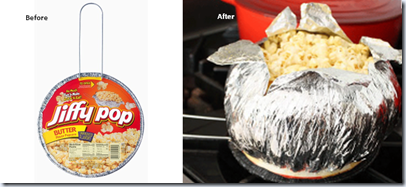
Jiffy Pop Before and After

TV Time couldn’t compete in the convenience game, and and Jiffy Pop popped it out of the water for spectacular presentation.  And later popcorn makers and microwaves made stovetop cooking of popcorn as obsolete as home churning butter. 

Like most products, there’s little information on what happened to it. It went through various owners.  The last seems to have been Great Western Foods, which still seems to sell similar products called “Portion Packs,” but which use canola oil, so it’s not the same.**

Jiffy Pop is still around, since it’s owned by agricultural giant ConAgra. 

But for many years, TV Time was what we mean when we wanted popcorn at home.

________________________________________________________

*Later iterations had a place to cut off one corner to pour out the excess salt. For some reason, that always impressed me.

**It also looks like the sell primarily in bulk.

Sunday, November 15, 2015

Mandarin Chocolate Sherbet (food)

By Baskin-Robbins
????-????

I’ve written before about foods that were no longer made, such as Regal Crown Sours and Screaming Yellow Zonkers.*  Usually, it was because the manufacturer was out of business and the recipe lost.  Mandarin Chocolate Sherbet was made by Baskin-Robbins, which is still in business and presumably knows the recipe.  Yet as far as I can see, it hasn’t been made in years.

It’s a shame.  The flavor has never been seen elsewhere.  It’s a dark chocolate sherbet with just a hint of orange, that you don’t notice until you swallow.  Despite the fact it’s somewhat light – sherbet instead of ice cream – there was a rich, dark chocolate taste that melts on the tongue.

There were many fans.  It was named the best Baskin-Robbins ice cream by Paul Passell and Leonard Ross and it deserves to be.  Yet even though it was discontinued years ago, there was no sign of them being willing to bring it back.

Which is a shame.  There was no other ice cream like it.

____________________________________________
*Both have come back, if only for a short time.  I’d like to think this blog had something to do with it.

Sunday, January 25, 2015

Wagner and Sons Tea (food)

(1847-2000?)

imageBack in the 60s, if you wanted tea, your had only one choice:  orange pekoe,* and in most cases, that meant Lipton.**  Chinese restaurants had their own blends, but they were never sold unbrewed.  Celestial seasonings could be found in hippie stores, but nowhere else. It was Wagner and Sons Tea that showed me there was more to life than flo-thru tea bags.

Wagner’s was loose tea, and sold in a distinctive square tin.  Most were 3/4 oz., with a tin about 2 in. high.**  The tins were colorful, with each tea having a different color, with its name emblazoned on the front.

imageAnd the types of tea were things you never saw in supermarkets.  Orange pekoe, of course (orange tin), but Keemun (black), Jasmine (yellow), English breakfast (red), Formosa Oolong (light green), Imperial gunpowder (medium green), Irish (kelly green), Earl Gray (purple) Rare Mandarin (lavender), Pan fired green (blue), and Ch’a Ching Chinese restaurant (white).

The flavors let you experience a world of tea – and fairly cheaply.  The variety was appealing and soon you would get tea infusers to try out all the flavors.

The company was founded in 1847.  The teas were usually sold in gift stores and specialty food stores.  I knew of one not far from us where I’d go every few weeks to pick out old favorites and try things that sounded interesting.

Then, at some point, Wagner teas vanished. The company, around for almost a century and a half, sold out to a company named “Rose Spice” in 1996.  The company seems to have vanished, and with it, Wagner: the trademark lapsed in 2000.

At this point, all that is left are the tins, which are collectors items.  I can see why:  it must be fun to try to collect all the colors.  But the tea inside probably introduced many Americans to the idea that there was a world of tea to explore.

________________________________________________
*Which is not named for a growing region or drying method or variety:  it’s part of a grading system for black tea with leaves of a certain size and the tea can come from anywhere.

**Red Rose, Tetley, and other teas were available, but if you ordered tea in a restaurant, Lipton was what you got.

**There were also full-size tins of 4.5 oz.

Sunday, April 21, 2013

MilkShake (candy)

imageThe Hollywood Candy Company was a minor but successful national candy chain for much of the 20th century.  Named after their home base in Hollywood, MN, they successfully introduced the first fluffy nougat bar, MilkShake.  It was so successful that the Mars Candy Company put out their own version:  Milky Way.*

I first discovered MilkShake in the late 50s.  By this time, Milky Way was one of the most  popular candy bars in the US, and MilkShake looked like a cheap knockoff.  I didn’t like it as much:  it didn’t have as good a flavor or texture.  But in the summer, MilkShake was more than just a candy bar:  it was a frozen treat.

Just about every place that sold ice cream novelties also sold frozen MilkShakes.  This was not like today, when a novelty is created from ice cream that tastes vaguely like its namesake.  No, they would put a bunch of MilkShake bars in the freezer and sell them (for a premium) as a treat in hot weather.

A frozen MilkShake came out of the freezer too hard to bite into.  But, with a little work and patience and, of course, thawing, it would slowly begin to warm up just enough to be eaten.  The combination of the chill and the candy rush made it a treat.

Around the mid-60s, the treat vanished.  Maybe the MilkShake was taken off the market,** but I remember asking for one and they had no idea what I was talking about.  Milky Way was a poor substitute, mostly because it was denser.  And while that made it better eaten straight, it meant it was ever harder to bite into.  The practice of freezing candy bars faded away.

Hollywood Candy remained around, but the company was bought by a series of different candy companies starting in 1967, about the time MilkShake vanished.  Their two most successful brands – Zero and Payday -- are still around and now owned by Hershey.

The MilkShake was not a great candy until frozen.  Then, they were at the top of my list.

_______________________________________________
*Candy recipes are not patented, so if you can figure out how your competitor made theirs, you can easily make a knockoff.

**The history of trademark foods, especially forgotten brands, is not easy to piece together.  No one really keeps track or pays much attention.

Sunday, February 24, 2013

Schweppes Bitter Lemon (food)

1957-???

imageWhen I was a kid, I had oddball taste in food.  Among other things, I didn’t care for soda.  I didn’t like the carbonation – it stung – and was used to drinking milk, so the sweetness had no appeal.  But in my early teens, I discovered a soda I actually enjoyed drinking:  Schweppes Bitter Lemon.

Bitter lemon had a long history, first developed in the 1830s as a mixer.  It was a combination of lemon juice and tonic.  It’s name described it:  it had a slightly bitter taste and the tang of lemon juice. 

It was a change from the usual sugary sodas for me.  One difference was the presence of a little bit of lemon pulp. Even though I wasn’t concerned about “all-natural” in those days, the little bits of lemon floating made it seem more real to me, and the fact that it wasn’t cloyingly sweet made it very refreshing.

It was never a very popular brand in the US.  If you found it in a supermarket, it would be with the cocktail mixers with bloody mary mix and swizzle sticks.  You had better luck in a beverage store and, possibly, in liquor stores in states that allowed for its sale. For me, it was a real treat.

There was also a Bitter Orange, which was the same thing, only the orange juice was sweeter.  I haven’t seen it in years, and it seems that they stopped making it in the US in 2011.* 

There are some attempts to market the flavor in the US, though it’s limited to knockoffs of Bitter Orange.  Polar, for instance, has Orange Dry, which is a less-sweet orange soda, but with no tonic, and it was the taste of quinine that made Bitter Lemon so good.

I probably wouldn’t drink it enough now to support the brand if it came back, but I hope that someone might try.

_____________________________________________
*It’s still available in the UK, Germany, and Canada.

Saturday, April 30, 2011

Fizzies (drink)

(1957-197???)
Wikipedia Entry

Fizzies In general, soft drinks are developed by soft drink companies.  Fizzies was a soft drink developed by a drug company. 

Fizzies were developed by Lem Billings, a chemist.  He probably got his inspiration from Alka-Seltzer, which came in a tablet the effervesced when dropped in water*  Billings developed a tablet that did the same thing -- but turned into a fruit-flavored carbonated soft drink.  The product was introduced by the Emerson Drug Company and eventually bought and marketed nationally by Warner Lambert.

Fizzies came in six main flavors:  orange, cherry, grape, lemon-lime, strawberry, and root beer.**  Each package contained eight tablets.  You'd just drop them into a glass of water and you'd have an instant soft drink.

At least, that was how they were supposed to work.  The problem was that the tablet was not big enough to flavor a full glass of water***.  So, as a kid, you'd drop a tablet into the water and watch it fizz and color the water, but it tasted only vaguely of fruit and the carbonation lasted about 30 seconds after the tablet dissolved.  Sometimes you'd drop in two tablets in the hope of actually getting some flavor out of it; that rarely worked.  Occasionally, on a dare, a kid would put a tablet in his mouth to see what happened.  I never did, but I suspect the result would have been similar to Zotz -- only 20-fold.

Part of it was probably due to one of the things the bragged about in their ads:  Fizzies had no sugar.  Instead, it used saccharine and cyclamates to flavor it.  I would say the chemical taste was a turn off, but I really don't recall much taste at all.

Here is a look at a Fizzies ad, though the one I remember was an on-air plug by Shari Lewis who talked about a boy who had some Fizzies in his bathing suit.  When he went swimming, it was the day Lake Michigan became superior.  The pun was about as good as the drink.

Fizzies died out in the 70s as kids finally caught on, and were probably killed when cyclamates were banned.  It seems to be available online, its sales fueled by nostalgia and selective memory.  Still, there is something great about the concept of soda-in-a-pill, even if it never matched its expectations.

______________________________________________
*The chemicals in Alka-Seltzer that cause the fizz are just baking soda and citric acid; the actual medicine has nothing to do with the carbonation.

**Cola was occasionally added as a flavor.

***At least, not the size shown on the commercials.  Compare the size of the glass where the tablet is dropped (along with the fact that some of the bubbles are animated to make it seem more effervescent) with that the clown drinks from.  Back then, of course, it was considered fair play to do anything in a commercial to make the product look better.

Tuesday, November 30, 2010

Screaming Yellow Zonkers (food)

c1966-2007
Wikipedia Page

Screaming Yellow ZonkersUsually, I buy snack food for the taste.  With Screaming Yellow Zonkers, I bought them for the box.
Not that they were bad.  Screaming Yellow Zonkers were candy-coated popcorn -- like Crackerjack without the peanuts and the prize. Since I didn't care for peanuts, and the prizes in my day were cheap plastic toys about the size to choke a two-year-old, that meant they were the best part.
And then there was the box.
Like the Morning Chex Press, the box was covered with strange and witty comments.  My favorite was at the spot where grocers stamped the price:  "Easily cheaper than diamonds of equal weight."  There were oddball lists and strange directions, like the words printed on the bottom of the box: "This might be the bottom of the box.  To find out, open the top, and turn the box upside down. If the Zonkers fall out, this is the bottom. If they fall up, this is the top. If nothing happens, this box is empty.”
The boxes also featured cartoons and oddball art*. It was as much fun reading the box as it was eating the food.  And the boxes changed every few months, giving you a reason to buy more.
They also has some impressively strange ads:
Screaming Yellow Zonkers were produced for a surprisingly long time.  I used to find them on grocery shelves even in the 90s.  But when your main selling point is the words on the box, and that has to change every few months, it's hard to keep things going.  I also suspect the packaging cut into the profits.  In any case, a conglomerate bought their original manufacturer and stopped making them in 2007. 

Addendum: Good News! (4/18/12)

Screaming Yellow Zonkers are coming back!  ConAgra, who now owns them, will be making them available in Walgreen stores starting May 15 (for a limited time).  

________________________________________________
*It's also billed as the first product to use predominantly black packaging.  That may be so.  It was tricky to print all black; you had to cover the package with black ink and the white-on-black text required it be done perfectly.

Sunday, September 19, 2010

Ebinger's Chocolate Blackout Cake (food)

(1898-1972)

I grew up on the eastern end of Long Island, but my mother and grandmother came from Brooklyn. As a kid, it was a big deal when my grandmother drove out to visit. Certainly it was great seeing her, but one thing made ever visit special:  she always brought cakes from Ebinger's. I don't think I ever set foot in any of their stores, and if you weren't from the New York City area, you've never heard of them, but they were bakery perfection.

The chain was founded in 1898 by George and Catherine Ebinger and quickly thrived. What I remember most are three cakes that no one has ever duplicated:

  • A yellow cake with a hard, dark chocolate icing, the two layers separated by a milk chocolate buttercream.
  • A chocolate cake, much like a torte in a small loaf, with the hard, dark chocolate icing. It had a pattern of green lines running over the top, dividing it into squares.  My brothers and I used to fight over who got the end pieces (with more of the delectable icing).
  • The chocolate blackout cake.

The latter is what people remember today. It was a dark devil's food cake, with dark chocolate icing between layers and on the top. But icing was sprinkled with crumbs of the cake, turning the smoothness into a great texture.  It was a chocolate addict's dream and called by many "the best cake on Earth."

I think the key to all the Ebingers cakes were their chocolate icing. It was relatively thin and made of dark chocolate, and were thin and hard, more like candy than cake.  I've never found anything like it on any cake since. The Chocolate Blackout Cake's crumbs of cake only made it even better.

In 1972, Ebingers went bankrupt and the recipe for the cake was lost.* There have been attempts at recreating it, but I'm not sure anyone has gotten it right.**

I haven't tried them.  I'm not sure if I want to, since I doubt they would measure up to my memories.

______________________________________________

*Word has it that the heirs have it, but refuse to sell.

**The cake on the link looks very close, and only misses by having too much cake sprinkled on the frosting.  The true Ebinger's Chocolate Blackout Cake had only a thin sprinkling that let the gloss of the icing come through. It's from a recipe at CooksCountry.com.  The picture on the Cooks County website looks less like the real cake than this one.

Wednesday, February 25, 2009

Zotz (candy)

image It's a candy!  It's a practical joke!  It's both -- It's Zotz.

I don't think Zotz were ever all that popular; they were more of a novelty than serious candy.  But there was (and still is) no candy like them.

Zotz were basically fruit-flavored hard candy: good, but not out of the ordinary -- until you got to the center.

I first discovered them in college.  One of the other guys in the dorm had me try one.  It was early on in the joke, so they didn't think to give me one vital instruction: bite down on it.  I didn't react the way they hoped, but they later realized the issue.

You see, the center of the Zotz was baking soda.*  This doesn't sound like a particularly good ingredient for candy, but, as your high school science teacher showed you, when you mix baking soda with an acid (in this case, probably citric acid), everything fizzes.**

Which is what Zotz did.  One bite, and your mouth filled with fizziness. It was a lot of fun, even if you were in on the joke.  And I got to enjoy them a lot.

The candy seemed to have originated in Italy.  The name may have come from a book (and movie) about a professor who finds an ancient coin which gives him special powers: if he points at someone, they feel pain; if he says "zotz," they move in slow motion; and if he points and says "zotz!", they die.  It was a comedy.

In any case, Zotz still can be purchased online.  Just search for "Zotz candy" and you'll find it.  It's worth a try, just for fun.

_______________________________________________

* Perhaps it was baking powder, only I remember seeing "sodium bicarbonate" on the ingredients label.  Zotz called it "fizz powder," but no one was fooled.

** Usually.  If there was a crack in the candy, the powder leaked out and you got a sensation that some sort of liquid center was in the middle.

Wednesday, July 23, 2008

Regal Crown Sours (candy)

The biggest problem about writing about forgotten brands of food is that there is often no way of getting them back.*  Many of the things I'm writing about can be found in some way -- DVDs, CDs, old videotapes, etc.  But once food and candy goes, there's no way to get it back.

Which brings us to Regal Crown Sours.

I first saw them in the late 60s.  Large tubes (maybe about 5 inches and about 3/4 in in diameter) with hard candy.  They were made of up individual candies, each wrapped in wax paper, in sort of a flying saucer shape.  And they were sour.

Oh, not as puckeringly sour as things like Sour Patch Kids today. But compared to the usual hard candy fare -- Life Savers, lemon drops -- pretty sour.

The candy was imported from the UK, though I believe they originated in Denmark.  They came in several flavors:  Sour Cherry, Sour Orange, Sour Grapes (yes), and, my favorite, Sour Lemon.  As least twice the size of a Life Saver, they were a great bargain.  I tend to like things tart, and these were just wonderful.

Over time, though, they vanished.  I haven't seen them in a candy story in about 30 years and the last time I tried them was nearly 20  years ago, where I found them in the United Kingdom pavilion at the Epcot Center.  In among the faux-British shops was a candy store, and which sold -- yes -- Regal Crown Sour Lemon.

They were just as good as ever.

After the Internet came along, I learned about various old time candy sites and went to see if any of them had it.  Alas, the only place I've been able to see the Regal Crown sours are on lists of discontinued candy no longer available.

At least there is a possibility, with the interest in sour candy, that someone might bring it back. Of course, they'd have to deal with old folks like me saying "It's not the way I remember it," but I think it'd be worth it for another taste.

*Sometimes even the recipe is lost forever. Leiderkrantz cheese was discontinued by their last owner, Borden Foods, a couple of decades ago, and it would be impossible to get it back. The cheese's flavor depended on a specific culture of bacteria that was in the original factory (when they moved to a new one, they had to scrape the walls so that it could establish itself) that gave it its flavor. No one analyzed what the bacteria was, and it is impossible to duplicate, so even if someone wanted to bring it back, they're out of luck.

Saturday, May 24, 2008

Morning Chex Press

(1960s)
By Ron Goulart

If you're like me, you read the back of cereal boxes.  When I was a kid, they were colorful things, filled with offers for toys (send in your boxtops) and other things.  Definitely kid's territory.

Which could be a problem if you had a cereal for adults. This was long before nutrition was a selling point, so the question was what to put on the box?

Ralston-Purina, makers of Chex Cereal (and Purina Dog Chow) decided to do something different.  They hired an ad copywriter (Ron Goulart) to write a newspaper parody on the back of their boxes.  Thus, the Morning Chex Press was born.

Every few months, a new box would come out. They were filled with jokes, oddball stories, a weather report, and the "No Pictures Comic Strip."  The results were a delight.  I think one reason I still love Corn Chex and Rice Chex is thinking about the old Chex Press.  I'll admit I don't remember too many details (even the Internet gives no specifics), but I do remember looking forward to reading the box each time we bought a new one.

Goulart was just starting his career as a writer. He later developed into one of the funniest writers in science fiction before branching out to write mysteries, including a fairly recent series featuring Groucho Marx as a detective. He's also well known for his various books on popular culture.

It seems unlikely that the Chex Press will be seen again. Cereal boxes are even more ephemeral than regular newspapers (which at least have microfilm). And Ralston-Purina spun off its human food division, which was then sold to General Mills in 1997, as Ralston decided to concentrate on manufacturing store brand cereals instead of their own (which leads to an interesting point:  if you buy store brand Chex-equivalent, you're buying from the original manufacturer; if you buy Chex, you are not).

In any case, the Chex Press seems gone for good. I'm somewhat saddened that I can't go back and see what I liked so much.