Sunday, January 29, 2012

S. Z. "Cuddles" Sakall (actor)

(1883-1955)
IMDb Entry

S. Z. Sakall S. Z. Sakall only had to appear on screen, and everyone in the audience would smile, even before he said a thing.  He appeared in almost 50 US films, always playing the same character and always charming the audience.

He was born Gerő Jenő in Hungary and became a successful sketch writer there under the pen name of Szőke Szakáll.*  He moved to the stage in the 1910s, then appeared in Austria and Germany, moving back home when Hitler came to power, and finally moving to the US when World War II began.  His friendship with Joe Pasternak got him work, where he changed his stage name to S. Z. Sakall.

He quickly got work in some of the best films of the early 40s, appearing in Ball of Fire, The Devil and Miss Jones, and Yankee Doodle Dandy (as a prospective Broadway "angel" that is conned into investing in George M. Cohan's first show).  In 1942, he made his best-known appearance as the head waiter Carl in Casablanca. In the late 40s, "Cuddles" was added to his billing by the studio (Sakall didn't like it) and it seemed to fit him perfectly.  When a studio wanted a Germanic comic grandfather figure, Sakall got the call.

His great advantage was his appearance.  He had a chubby face and rotund form and his characters were so charming that it turned him into the loving grandparent most people would want to have.  His accent gave him further personality.  From all accounts, the image of niceness he portrayed was the way he acted in real life.

Sakall continued to work until his death in 1955, playing put-upon Germanic grandfathers to the delight of movie audiences.

_______________________________________________
*Hungarian for "blonde beard."

Sunday, January 22, 2012

Rick Brant Series (books)

Whispering Box Mystery(1947-1968)
By John Blaine
Rick Brant Web Page

There were many series of "boys books" (as YA novels were called back then) as people tried to find the next Hardy Boys or Tom Swift.  I was a fan of both, first starting with Tom Swift, Jr. and moving on to Frank and Joe Hardy.  I read extensively in them, but my favorite book of this genre was in neither series.  It was a book I inherited from my cousin, who outgrew it: The Whispering Box Mystery, featuring Rick Brant.

The Rick Brant series leaned toward a hard science version of Tom Swift, Jr., with elements of the Hardy Boys.  Rick Brant was the son of scientist Hartson Brant, who ran his own personal research facility on Spindrift Island, just off the New Jersey coast.  Brant went off on various adventures, sometimes on the island and other times in exotic places around the world.*  He had the usual entourage of friends and family that was typical of the genre.

The Whispering Box Mystery was truly top-notch.  The concept was that a device was created that used ultrasound to paralyze.  Brant and friends have to stop a gang of crooks who use it to steal government secrets.  The concept of the whispering box really captured my imagination.

The author, as was standard for this type of book, was a house name, though all the books were written by Harold L. Goodwin.**  Goodwin was a scientist himself and eventually became a high-ranking official for NASA.  He wanted to keep the stories as scientifically accurate as possible.  While there were some elements that pushed the envelope on what was known,*** the stories tried to avoid the more fantastic elements of SF**** and tried to accurately describe the work in the lab.

There were 23 books in the series over twenty years.  A 24th was never published until it came out in a limited edition about 20 years ago.  And by the time I discovered The Whispering Box Mystery, the series was beginning to wind down, and was being pushed off the shelves by the more popular Hardy Boys/Tom Swift books.  I wish I could have found more.

________________________________________________
*There are certain similarities between the series and the TV show Jonny Quest.  While Hanna-Barbara is well-known for ripping off concepts for their cartoons from other sources, the similarities are not conclusive enough to prove they used it as an inspiration.

**In the first three, he shared writing chores with Peter J. Harkins.

***Like the Whispering Box.

****Compared to Tom Swift, Jr., who was using antigravity and meeting aliens.

Saturday, January 14, 2012

Time Machine series (books)

Novel version   By Donald Keith
(1959-1989)
Wikipedia Page, with links to the original stories.

I was the world's worst Cub Scout. In four years, I never earned a single badge.* Every year, we'd get the activity books.  There would be ten tasks to do to get your badge, and I'd be lucky if I got five of them.  And forget the little arrowheads.  I did finish second in the Pinewood Derby, but that's because my father built the car.

About the only thing I got out of it was my subscription to Boys' Life. And my favorite part of my subscription to Boys' Life were the Time Machine series.

The concept was hardly new even back in 1959, when it started. A Boy Scout troop, led by Bob Tucker,**  along with Ellsworth "Brains" Baines, discovered a time machine while out hiking.  Brains figured out how to run it in about five minutes, and off they went forward and backward in time.  Later other people joined the crew, like Kai, a boy from the future, and Dion from ancient Sparta.

The stories were simple.  No time paradoxes here -- just a visit to a time in the past or future where an adventure could happen.  Occasionally, they'd make minor changes to the course of history.

The series was conceived as something of an educational exercise, where the trips to the past would be history lessons.***  And they were excellent adventures; I still remember the excitement when they ended up at the Johnstown Flood. 

The author was a pseudonym for a father-and-son team, Donald and Keith Monroe, though Keith wrote solo after 1974. All and all, 23 stories were published, including three serials.  Two of the serials were turned into fix-up novels:  Mutiny on the Time Machine and Time Machine to the Rescue. 

The stories have faded into the recycling bin, but, for those interested, Google Books has many back issues of Boys' Life, including those that featured the stories.  The wikipedia page gives links to them.****

____________________________________________
*Except the Bobcat, which you got basically for just showing up.

**A name that leads to some interesting speculation. You see, back then, Wilson "Bob" Tucker was a big name in SF fandom, creator of one of the first fanzines, Le Zombie. He also published some SF and mystery novels and stories. One of his habits was to take the names of real people (usually other fans) and put them into his stories; he did it so much that fans called the practice "Tuckerization."  So, was Bob Tucker tuckerized in the book?  Hard to say.  But Donald Keith has published SF in Galaxy before appearing in Boy's Life, and it's certainly possible he knew of fandom and Bob Tucker.

***Just like the original Doctor Who, but four years earlier.  Since it was also quickly established the Time Machine could also travel in space, it looks like it was a precursor to the TARDIS.  I doubt the creators of Doctor Who knew anything about the stories -- Boys' Life probably never made it to the UK -- but it's a fun coincidence.

****But only to the first episode of the serials.  You'll need to root around to find the rest.

Tuesday, January 10, 2012

Virginia O'Brien (actress)

(1919-2001)
IMDB Entry

As the song goes, "You Gotta Have a Gimmick." Virginia O'Brien had a gimmick, and it started her on a successful run of movies.

It all started with stage fright. O'Brien grew up on Los Angeles* and developed a desire to act and sing. In 1940, she was cast in a stage musical, Meet the People, when disaster struck.  When she went on stage to sing her number, she was overcome with fright and froze completely. But the show had to go on, and she sung the number, unable to keep from staring at the audience with a "deer in the headlights" expression.  She left the stage thinking her acting career had ended before it started.

But audiences are strange.  When you're on stage, you know when a disaster is happening, but when watching it, you might just think it's part of the show.**  The audience thought it was part of the show, and the deadpan expression O'Brien held during the number was hilarious.

It got her a screen test and a contract with MGM.

She appeared in 14 movies in the 1940s usually as a novelty act.  Here is her appearance in The Big Store.

O'Brien appeared in such classic MGM musicals as DuBarry was a Lady (with Red Skelton, Gene Kelly and Lucille Ball and a Cole Porter score), Panama Hattie (Skelton and Cole Porter again), The Harvey Girls (with Judy Garland, and a score by Harry Warren), and Till the Clouds Go Rolling By (an all-star cast singing the songs of Jerome Kern***).

In 1947, though, as the studio system died, O'Brien's contract with MGM was not renewed.  It was possible that they figured her gimmick was growing tired (though she started singing normally in her later films).  She worked in nightclubs and on TV as a welcome guest star.

Her last film was in 1976.

____________________________________________
*Her uncle was thirties musical director Lloyd Bacon.

**Years ago, in college, I was in a production of South Pacific.  As we were hitting the final notes of "Nothing Like a Dame," the circuit breaker for the entire theater blew, plunging it all into darkness.  We were all upset by the problem, but the audience never realized it wasn't planned.

***Not always well.  The idea of having Frank Sinatra -- then only 31 -- singing "Old May River" seems like a bad joke.  I don't think Sinatra liked it much, either, knowing that not only was he much too young (and too white) to be singing it, but that he had the wrong type of voice for the role.

Wednesday, January 4, 2012

The Sandbaggers (TV)

Sandbaggers(1978-80)
Written by
Ian Mackintosh
Starring Roy Marsden, Ray Lonnen, Jerome Willis, Bob Sherman, Alan McNaughtan, Elizabeth Bennett, Richard Vernon
IMDB Entry

You can have your 24, your men and women from U.N.C.L.E., your impossible mission force, Control, Avengers, your secret agent men, your burn notices, hell, even your James Bond.  The best spy show ever to appear on TV was The Sandbaggers.

The Sandbaggers had no fancy spy technology. There were no evil supervillains.  No climbing up the side of buildings.  Only one explosion in the entire series (in the first episode).  The fate of the world was never in the balance, and the missions were often botched.  The main character didn't drink, and if there were treacherous female spies, you could bet that they wouldn't want to sleep with you.  You had to worry about budgets, finding replacement spies, and government approval.  Most of the scenes took place in small offices as people argued how to handle a situation. 

Yet all this was far more exciting than any other attempts to portray the spy business on TV.

It was a creation of Ian Mackintosh, a lifelong naval officer who developed a talent for writing. There is some evidence that he was actually involved in spying, and he set out to write a realistic look at how things are actually done in the real world. 

The show focuses on Neil Burnside (Roy Marsden), Director of Operations of the UK Special Intelligence Service, and especially their Special Operations Section, known as "Sandbaggers.*"  Burnside is shorthanded; there are never more than three Sandbaggers, and often less due to them being killed while on a mission.  And though there are plenty of sensitive secret missions, Burnside is forced to spend most of his time dealing with political issues from his own government, in the form of the director of SIS, C (Richard Vernon); the deputy director, Matthew Peele (Jerome Willis), who mistrusts Burnside deeply; and the Permanent Undersecretary of State (and Burnside's ex-father-in-law), Sir Geoffrey Willingham (Alan McNaughtan). 

This may sound dull, but it's far from it.  Burnside tries to run his department free of interference, and to keep his agents from going on missions where the risks outweigh the rewards, but it often isn't possible.  Things screw up, and sometimes Sandbaggers die.  The threat isn't the end of the world as in most spy shows, but rather a threat to the British government and to Burnside's job.

Burnside sometimes has to do things he doesn't want, and that is what makes the show so fascinating.  In most spy films, you know the good guys will win at the end.  In The Sandbaggers, you don't. Often they win.  Sometimes they don't -- with disastrous consequences.  And you can never be sure.  Here, Burnside lays out the principles of what makes for a successful spy mission.

Burnside is helped by Sandbagger #1, Willy Caine (Ray Lonnen), who has a great distaste for adventure and guns.  He also relies on Jeff Ross (Bob Sherman), the head of the CIA in London, who he shares information with and who can bring in help when needed.  The office is run by Diane Lawyer (Elizabeth Bennett), who has a dry sense of humor about the goings on.

What makes the show great are four elements:

  • Mystery.  Burnside is often trying to make life-or-death decisions with a lack of information.  What they have is ambiguous and there is rarely any time to know the details of the situation.  Is the Bulgarian official changing sides, or is it a trap?  No one can be sure until the mission begins.
  • Realism.**  Everything sounds like how spies really do behave.  Missions are carefully planned, strategies are discussed (often heatedly), there are miscommunications, bad luck hits (for example, people getting into auto accidents), Burnside is unable to get what he needs.  It all ramps up the drama. 
  • Tension.  Every show keeps twisting the screws on Burnside.  Whenever there is an opportunity for further tension, it's added. 
  • Uncertainty.  The show confounds standard TV storytelling.  You never know what to expect.  Characters can be killed off and you can never be sure if it will happen this episode or not. Missions fail, sometimes spectacularly.  Even successful missions have collateral damage.  Everyone, including your friends, have an agenda and you can never be sure what it is.
  • The Cold War. The show was run at the height of the Cold War, with the concerns of the era written into it. Since the scripts usually dealt with events in real countries, it gave a greater sense of urgency that everything involved was important.  The game being played at that time in history was intense, with high stakes, setting the basic tension level pretty high.***

The result is great TV.  I would even say that the season one finale, "Special Relationship," is the most tense single episode of any show ever on TV.

Roy Marsden as Neil BurnsideBut the biggest part of the show is Burnside.  He's smart, obsessed with his work, passionate about protecting his department, and willing to do anything -- no matter how much of a dirty trick -- to get the mission completed.  It gets him in trouble all the time, and Roy Marsden is absolutely unforgettable in the role.  Always wearing three-piece suits like armor, he portrays a man who is completely dedicated, and is ruthless in getting what he wants, even when that blows

The show ran for three seasons in the UK.  It would have run more, but, in the middle of season three, Mackintosh disappeared.  In what sounds like a Sandbagger episode, his small plane vanished over the ocean.  He had left behind four scripts, including the finale, and others added more to finish the season, but the producers felt that, without him, there was no point in continuing.  The show was canceled. 

The episodes showed up on in the US on scattered PBS stations in the 80s, but it never received the popularity and acclaim it deserved.  Those who saw it knew it was something special, but too many people never had the chance.

It's out on DVD.  Get it and prepare for greatness.

__________________________________________
*The origin of the term "sandbagger" was never explained, but it fits as well as John Le Carre's term "mole" (which he made up for his novels and was taken by the secret services)

**Mackintosh clearly knew much about how the spy service works in the UK.  In fact, every episode had to be given security clearance and one was never filmed because it infringed on the Official Secrets Act.

**Though nowadays you can't help noticing that things would have been much better with cell phones.

Saturday, December 31, 2011

The Great Rupert

The Great Rupert

(1950)
Directed by
Irving Pichel
Written by Ted Allen (story), Laszlo Vadnay (screenplay), and James O'Hanlon and Harry Crane (additional dialog).
Starrring Jimmy Durante, Terry Moore, Tom Drake, Frank Orth, Queenie Smith, Jimmy Conlin.
IMDB Entry

I've mentioned before how some movie titles are misleading. Now, you might think, for instance, that The Great Rupert* was a movie about someone called "The Great Rupert," and, to some extent, it is.  But Rupert is more of a combination Mcguffin and deus ex machina in the middle of a film that really focuses on the importance of helping others.

The movie was an early George Pal production.  I first heard of it when writing up my entry on Pal, and realized that it was among the films in a Mill Creek Entertainment** collection of Christmas movies and TV shows.  So this Christmas, I watched.

The movie starts showing Joe Mahoney (Jimmy Conlin), and old vaudevillian, who has trained a squirrel, the Great Rupert, to do the highland fling. His agent turns him down and he is evicted from his apartment.  After setting Rupert free, he runs into Louie Amendola (Jimmy Durante), another vaudeville act on hard times.  Louie decides to move his family into the empty apartment and cons his way past the landlord's son Pete Dingle (Tom Drake), partly because Pete is enamored of Louie's daughter Rosalina (Terry Moore).

But Pete's father Frank (Frank Orth) insists the Amendolas pay rent on the apartment. Frank is a miser, who doesn't trust banks and, when he starts getting a windfall from some mining stock he owns, he puts it into a hole in the wall.

Meanwhile, Rupert has moved back to the apartment and, discovering the money, he showers the $1500 a week on the Amendolas every week.  It's money from heaven as far as they are concerned.  But there are consequences.

The film was supposed to be a straight romance between Tom Drake*** and Terry Moore, but it appears Durante was added to the cast at the last minute and the part beefed up.  He gets to perform a couple of musical numbers.

What's also interesting is the contrast between Amendola and Dingle.  Amendola takes the money and invests in the community, while Dingle was content to just squirrel it away. 

As for Rupert, he really does very little in the film other than redistribute the money.  He also helps everything to be resolved****.

The animation for Rupert doesn't hold up all that well, though it was a sensation in 1950 and the film did well enough for Pal to continue his career as producer.  It's quiet little charmer with plenty of heart.

_________________________________________________
*Also titled The Christmas Wish as a Christmas film.  The title is actually a bit less misleading, but only a small portion of the film in the beginning is set at Christmas.

**Mill Creek packages older public domain films on DVD.  Their output is uneven, but you can often find a few gems.

***Judy Garland's romance in Meet Me in St. Louis.

****Sharp-eyed viewer may notice Frank Cady, from Green Acres and Petticoat Junction as an IRS agent who is curious about how the Amendolas got their money.

Friday, December 23, 2011

Comfort and Joy

Comfort and Joy (1984)
Written and Directed by
Bill Forsyth
Starring Bill Paterson, Clare Grogan, Alex Norton, Roberto Bernardi, Eleanor David
IMDB Entry

Bill Forsyth made his reputation in the early 80s as the king of quirky characters.  His movies Gregory's Girl and Local Hero were set in his home -- Scotland -- and were memorable for offbeat characters who never did what was expected.  The latter was a nice success and he followed up with the delightful Comfort and Joy.

It's a movie about Allan "Dicky" Bird (Bill Paterson), a Glasgow radio DJ  whose life is falling apart because his long-term girlfriend left him.  While driving around morosely, he spots Charlotte (Clare Grogan*) on the back of a "Mr. Bunny" ice cream truck and impulsively follow it, only to witness two mask thugs smash up the truck with lead pipes.  He finds himself in the middle of a battle between two rival gangs -- of ice cream vendors:  Trevor ("Mr. Bunny") and the Godfather-like Mr. McCool.  In order to impress Charlotte, he decides to mediate between the two factions.

The movie abounds in Forsyth's small comic moments.  The attack on the truck, for instance, has the driver defend himself by squirting raspberry sauce in the attackers eyes.  Then, just before leaving, one of the thugs recognizes Bird and requests he play a song on his next show.  I especially loved the revelation of how they recorded the "Hello, folks!" music that was Mr. Bunny's theme (at about 1:10).

The movie is set around Christmas, which gives Bird a way to resolve the feud.

The movie got decent reviews when it came out, but did only so-so in the box office, and far less than Forsyth's previous Local Hero.  Forsyth made the mistake of moving to Hollywood; his next film, Housekeeping, didn't make much of a splash** and his other US films were disappointing.  He tried a sequel to Gregory's Girl in 1999, but could not recapture the magic.

________________________________________________
*Grogan later played another object of a man's romantic obsession as the original Kristine Kochansky in Red Dwarf.

**I haven't seen the film, but I have read the book.  A real downer, especially compared to the humor that caused Forsyth to be noticed.

Wednesday, December 21, 2011

In memory of Bob Rothman (1927-2011)

In memory of my father, who passed away last week, here are my comments on his favorite movie, Support Your Local Sheriff.

Wednesday, December 14, 2011

Dead of Night

(1945)
Directed by
Alberto Calvacanti, Charles Chrichton, Basil Deardon, and Robert Hamer
Written by H.G. Wells, E.F. Benson, John Baines, and Angus MacPhail (original stories and screenplay); T.E.B. Clarke (additional dialogue)
Starring Mervyn Johns, Michael Redgrave, Roland Culver, Frederick Valk, Sally Ann Howes, Googie Withers, Basil Radford, Naughton Wayne.
IMDB Entry

I like my horror subtle.  Blood and gore are far less unnerving than something that engages your mind and scares you by what it implies. This is a characteristic of one of the best horror films to come out of Britain:  Dead of Night.

The movie is an omnibus film, which tells several different stories instead and one narrative.*  There was a handful of this type of film the late 30s and early 40s, and Ealing Studios -- who now are better known for their comedies -- tried it with this film.  Five directors directed five different stories by many writers, with a frame tale that tied the all together, and the frame tale is the scariest of them all.

Walter Craig (Mervyn Johns) is invited to a British country house party.  When he gets there, he reveals a strange sense of deja vu:  even though he has never been there nor met anyone there before, he knows them all from a recurring dream he keeps having, a dream he always forgets upon waking, but which is slowly unveiling itself to him here.  Dr. Van Staten (Frederick Valk) scoffs at the idea of deja vu, but the others begin to tell stories of their own encounters with the supernatural. They show

  • A race driver who has a mysterious and deadly premonition.
  • A mysterious young child who may be a ghost.
  • A mirror that shows a scene from the past that catches the viewer in its spell
  • A golf bet that goes wrong.
  • A ventriloquist's dummy that takes on a life of its own.

Some of these, of course, are familiar stories.  But they are all dramatized with them hitting all the right notes.  The ventriloquist's dummy story is probably the best of that subgenre, as Michael Redgrave makes it seem fresh and more terrifying that most.  The golf episode is pure comic relief** (and is considered the weakest of the five), but the others have the tension of a good Twilight Zone episode.

The movie returns to the main narrative in between all these, and at the end, where Craig remembers the source of his unease about the dream.  And just as it happens -- he wakes up.  That's usually the lamest ending in fiction, but in this case, there's a twist.

Spoiler (to read it drag your cursor over the text).

After he wakes up, Craig gets a phone call and is invited to a garden party.  It seems a bit like the nearly as lame "Oh, no, not again!" ending.  But, for the first time, there is a shot that shows something that is not Craig's point of view.  The implication is that this is no longer a dream, and the horrifying events he dreamed of is about to come true.

The film is performed by a first-class cast. It was successful in the UK, but two of the segments were cut out of the American release, which probably didn't help.

Still the movie has its adherents and fans even today. It even had an influence on the world of science: astronomer Fred Hoyle developed his steady state theory of the universe*** after seeing the film's circular structure.

The film is still a landmark of horror.

______________________________________________
*Nowadays, you usually tell multiple stories intertwined (e.g., Crash or Love, Actually).

**The director, Charles Chrichton, is best known to modern audiences for the classic A Fish Called Wanda.  It features Basil Radford and Naughton Wayne, who made a name for themselves in Hitchcock's The Lady Vanishes as a couple of English sports fanatics -- a type of part they continued to play for years.

***Now discredited, but a legitimate idea for some time.

Monday, November 28, 2011

Grey Owl

(1999)
Directed by
Richard Attenborough
Written by William Nicholson
Starrring Pierce Brosnan, Stewart Bick, Vlasta Vrana,  Annie Galipeau
IMDB Link

Grey Owl is the story of a real-life fraud.  Yet it is a fraud in such a charming and positive way that it becomes the story of a hero.

The movie introduces us to Grey Owl (Pierce Brosnan), a solitary trapper in the Canadian woods in the 1934s.  He's sought out by an Objibway woman Anahareo (Annie Galipeau), who sees her people living in modern society and losing their identity.  She wants Grey Owl to teach her how to be an Indian.  He agrees, and, as time goes by, she urges him to show what he knows about Native American lore to the rest of the world.

Reluctant at first, Grey Owl becomes a major early voice for nature and conservation.  His lectures were highly influential* and he was eventually asked to speak in the UK, where his secret is discovered.

It turns out that Grey Owl was no native American; he was born in the UK and emigrated to Canada, where he became enamored of the wilderness life.  The fraud was not revealed until his death** though afterwards his reputation suffered, even though most of what he said is basic conservation common sense, whoever says it.

Pierce Brosnan like these opportunities to play someone other than James Bond, and brings out Grey Owl's sincerity. If anything, the film is a bit too sincere, but it is a nice look at an early environmentalist.

________________________________________________
*Richard Attenborough, who directed, said he was drawn to the story because his brother David, a well-known naturalist, became interested in learning about nature after hearing Gray Owl speak.

**When a newspaper that had been sitting on the story for three years, felt free to reveal the truth.  Journalistic ethics were different back then, and not necessarily worse than they are today.

Sunday, November 20, 2011

A Simple Plan

A Simple Plan(1998)
Directed by
Sam Raimi
Written by Scott B. Smith
Starring Bill Paxton, Bridget Fonda, Billy Bob Thornton, Brent Briscoe.
IMDB Entry

I always like the offbeat.  And when a director is known for the off-beat, I like it when he tries something normal.  Sam Raimi is best known for horror, action and superhero films, but in 1998, he did a detour into serious drama.  A Simple Plan was one of the results.

The title is ironic.  Hank Mitchell (Bill Paxton) is hunting in the woods with his brother Jacob (Billy Bob Thornton) and Jacob's friend Lou (Brent Briscoe) when they stumble upon a crashed airplane.  It's been there for months, as has its cargo -- $4.4 million dollars.

The question is what to do with it.  Hank wants to report it to the authorities, but Jacob and Lou insist they keep it.  Hank gives in, on the condition he holds the money.  That's the simple plan.

But, of course, the plan quickly starts going awry.  The three men have to continually change the plan, making it more complicated and having it turn deadly.  The money -- which the men and Hank's wife Sarah (Bridget Fonda) think is the answer to their problems -- turns out to create new problems at every turn, as actions and emotions spiral out of control.  It's reminiscent of The Treasure of the Sierra Madre, ultimately a tragedy caused by the characters' greed.

The movie got great reviews* and a couple of Oscar nominations, but the box office was mediocre.  Raimi tried one more serious drama -- For the Love of the Game -- before returning to more fantastic subjects, and later hitting it big with Spider-Man. 

_____________________________________________
*90% at Rottentomatoes.com

Sunday, November 13, 2011

Gardner F. Fox (comics)

(1911-1986)

Gardner F. Fox (art by Gil Kane)The names of the creators of most long-running comics are well known.  Jerry Siegel and Jerome Schuster created Superman; Bob Kane created Batman; Stan Lee and Jack Kirby created most of the Marvel superheroes.  But one of the greatest of comic creators, a man whose output ran into thousands of comics, is often overlooked.  That man is Gardner F. Fox.

Fox grew up in Brooklyn and went to college to get a law degree.  However, during the Depression, he realized he needed to supplement his income, so he began writing, hooking up with DC Comics and writing stories almost from the beginning of comic books.  He quickly became a top writer for DC, since he wrote well and met deadlines.  His first assignments was on the long-forgotten Speed Saunders, but he very quickly started writing for Batman, where he reached comic book immortality in his first story, where he created the utility belt. 

At about the same time, he created his first well-known characters, the Sandman.  This isn't the same one Neil Gaiman made famous, though Gaiman did include references to the original, but it was successful enough.

FlashHe came into his own in 1940, when he developed the Flash. The idea of a fast-running superhero caught people's imagination* and the Flash became one of the stalwarts of the Golden Age of comics.  He followed that up with creating another of the great names of DC comics:  Hawkman.  Other characters followed, including Dr. Fate and Starman (co-creator of both).

These read like a roll call of all the great characters of the 40s, but soon Fox topped them all by the simple expedient of showing them all together. Taking a group of characters from All-American Comics,** Fox put them all together and created the Justice Society of America. He wrote most of the JSA stories, and made it into one of the great name of the Golden Age.

But the Golden Age ended and the comics began to suffer.  Fox switched from superhero strips to western and science fiction comics and managed to keep working during the hiatus after Seduction of the Innocent.

But Fox wasn't through with superheros.  In the mid-50s, when editor Julius Schwartz decided that the time was right for more superhero comics, one of the first people he contacted was Fox, who helped with the revamp of the Flash, Hawkman, and the Atom and eventually, wrote the new version of the Justice Society, the Justice League.  He also came up with the Earth-1 and Earth-2 concept, which allowed the heroes from the Silver Age (Earth-1) to interact with the heroes of the Golden Age (Earth-2) to meet and interact. 

Fox's interest in science fiction also continued, and he wrote many of DC's SF titles, eventually creating their best-know SF heron, Adam Strange, in 1958.  In the 60s, he went back to writing Batman again, taking two obscure Golden Age villains -- the Riddler and the Scarecrow -- an turning them into important members of the Batman's rogue's gallery.

Fox left DC in 1968 over a dispute about benefits, and did a little bit of comic book work, but primarily wrote SF novels full time.***

Over the years, Fox wrote an estimated 4000 comic book stories**** and he was revered in the field.  So much so that when they created a new Green Lantern, he was named Guy Gardner in his honor.

Fox worked regularly up until his death in 1985.  His work is a bit dated, and even silly today, but that's due to a change in critical opinion, not because they weren't good stories in their time.  Probably no one else wrote more comic books.

_______________________________________________

*Even though the original story was awful by any measurement, other than the concept of the character.

**A part of DC, which in that time was split between All-American and National Periodicals Publications.  Eventually the two merged into National Periodicals, which became DC, the letters coming from their oldest title, Detective Comics.

***One of his novels, Escape Across the Cosmos was actually plagiarized twice and published as Titans of the Universe and Star Chase by different authors.

****The Grand Comics Database lists well over 3000, and there were probably more, since he was often uncredited. 

Sunday, November 6, 2011

John Brunner (author)

(1934-1995)
Wikipedia Entry

John BrunnerIn the late 70s, I was growing tired of science fiction.  I had been devouring it since I saw The Space Explorers  when I was seven.  I would occasionally get away from it for a few months, usually during the school year when I didn't have time for non-school books, but always come back in the summer to read anything I could get my hands on.* But I was feeling that the genre was getting stale, with too much of it things I had seen before.  The ideas and sense of wonder were gone.

Then I happened upon The Shockwave Rider by John Brunner, and my faith in the genre was restored.

Brunner was an incredibly prolific SF novelist, with well over 100 books to his credit.**  He was born in the UK and published his first novel at age 17, and began to crank out books until he could begin writing full time in 1958.  His earlier works were competent space opera -- good reads and nothing more.  But by the mid-60s, he started adding far more depth of characterization and more intriguing ideas into his novels.***

The turning point was The Whole Man, about a telepathic individual who has to deal with his new power and about how the world looks at him.  It showed a new depth of characterization, and gave Brunner his first Hugo nomination.

By 1970, John Brunner was on the list of the top SF writers.  He reached stardom in the field in 1968 with his classic Stand on Zanzibar, a novel about an overpopulated world that uses a complex structure to not only tell the main story, but to give details about the world by small sections that illuminated particular aspects.****  It won a Hugo Award for Best Novel.

Brunner continued with his complex futures and narrative drive on other of his major works, like The Jagged Orbit and The Sheep Look Up. 

image The Shockwave Rider in 1975 was his last classic novel (though he continued with several very good ones).  It probably impressed me because it was cyberpunk before cyberpunk was invented, the story about a man caught up in a fight against an oppressive US government and surviving because of his computer skills.  The technology is dated (he uses touchtone landline phones), but it was far advanced for the time, and like nothing I had ever read.  Brunner even coined the term "computer worm" for the novel.

I am also a fan of his Total Eclipse, about an attempt to discover why an alien race went extinct, and which has some rather frightening implications for the human race.  In addition, his lighter The Infinitive of Go was a great concept and story using the idea of the transporter that doesn't work quite the way it does in Star Trek.

Brunner died in 1995, suffering a heart attack while attending the World Science Fiction Convention in Glasgow.  It was a sad loss to the field and to the cause of imagination.

________________________________________________
*I'm perversely proud that, when I took the New York State English Regents (a statewide exam for high school students), I answered one question by using Jack Vance's Emphyrio, which had been serialized but not yet published as a book.  I knew the teachers wouldn't have read the book, but I could always show them a copy if they called me on it.

**Asimov's of course, reached nearly 500 books, but Brunner had far more novels.  Asimov also padded his total by being the editor of a book, where his main contribution was writing an introduction and lending his name.  Brunner tended to repacking his books under different titles, but I'm pretty sure he's still ahead of Asimov.

***In a way, his career path paralleled Robert Silverberg, who had the reputation of being something of a hack in his early days.  At a certain point, Silverberg decided he had made enough on hackwork to live comfortably, and announced he would write more serious sf novels.  Some people in the field thought it a joke, but he quickly became a multiple award winner for some great short stories and novels like "Passengers" and Dying Inside.

****He took the technique from John Dos Passos's USA Trilogy. For those who think that science fiction is about prediction, he predicted that Earth would have a population of 7 billion by 2010 -- only a year off from the actual date.

Tuesday, November 1, 2011

Richard Adler and Jerry Ross (music)

(1955-1957) Wikipedia Entry for Richard Adler Wikipedia Entry for Jerry Ross
Adler and RossThey collaborated on only two musicals and one revue, but Richard Adler and Jerry Ross were two of the greatest composers for Broadway in the 1950s. Their scores were memorable, exciting, and popular and critical successes.  But their reputation has faded.  Part of that is because showtunes are no longer a popular form of music.  But even among Broadway aficionados, they were hurt because of their small output.
Adler and Ross grew up in New York City and soon took to composing music.  They met in 1950 and, under the mentoring of Frank Loesser, became a songwriting team.
They were different from most other songwriters working together.  Usually, when two people collaborated, one did music and the other did lyrics.  But Adler and Ross were both composers and both could write lyrics. The result allowed them to let the other have a go at it if they were stuck.  It seems a logical way to go, though most composers are probably not willing to let anyone else work on a song of theirs.
Their first success was in a few popular songs, which led to them contributing songs to the revue, John Murray Anderson's Almanac. It was successful enough to have the start on their first book musical.  Teaming up with Broadway great George Abbott, who wrote the book, the result was The Pajama Game.
The Pajama Game is an unusual musical, one of the few where the boy gets the girl halfway though the first act.  It's set in Sleepy-Time Pajama factory, it deals with the unlikely subject of labor-management relations.  The plot is not all that much, but the songs make it into one of Broadway's greatest musicals.
Here's an example (Broadway buffs should recognize who choreographed it by about 25 seconds in):
The show was a smash.  It won the Tony for Best Musical, Best Actress, and Best Choreography.  It was then turned into a movie starring Doris Day and John Raitt.
But Adler and Ross were just getting started.  The next year, the same team produced their best-known musical Damn Yankees, the story about how the upstart Washington Senators finally won the pennant, with a little help from the devil himself and his female demon Lola, who gets whatever she wants.
That is the great Gwen Verdon in the role, repeating her stage role.
Damn Yankees cleaned up at the Tonys, winning the three awards The Pajama Game won the year before, plus Best Actor* , Best Featured Actor and Actress, and other technical awards.
Winning consecutive Tonys in your first two book musicals should have been the beginning of a superb career, but, alas, a few months after Damn Yankees premiered, Jerry Ross had died at age 29.**
Adler could never recapture the magic.  Though he did provide musicals for a couple of shows, they flopped (though he did have some success doing musicals for TV).  He returned to advertising and wrote some very successful jingles.*** 
Their two musicals are perennials in community theater circuit,**** but though people remember the shows, the names of Adler and Ross don't create any connection.  But they deserve to be remembered as two of Broadway's greatest composers.
________________________________________________
* Given to Ray Walston, later of My Favorite Martian and Picket Fences.
**Accounts differ as to whether it was due to leukemia or bronchiectasis, a lung disorder.
*** Including jingles for Kent Cigarettes, and "Let Hertz Put You in the Driver's Seat" (If you're unfamiliar with the ad, watch it to the end).
****Especially Damn Yankees; The Pajama Game is hurt by the effect of inflation:  the plot involves trying to get a 7 1/2 cent an hour raise from the company, something that seems pretty paltry today.

Sunday, October 23, 2011

Twentieth Century

20th Century (1934)
Directed by
Howard Hawks
Screenplay by Ben Hecht and Charles Macarthur (with uncredited help from Gene Fowler and Preston Sturges), based on an unproduced play by Charles Bruce Millholland.
Starring John Barrymore, Carole Lombard, Walter Connolly, Roscoe Karnes, Charles Lane
IMDB Entry

There isn't a really good definition of "screwball comedy" other than the classic, "It's what I'm pointing at when I say, 'That's a screwball comedy.'"  The genre thrived in the 30s and was a combination of romantic comedy and farce, only with more fast-talking verbal wit.  Twentieth Century is one of the earliest examples of the form, and still a very funny film.

The story hints at its stage origins in that it can be divided into three acts. The first shows Broadway director Oscar Jaffe (John Barrymore) starting rehearsal for his new play.  He had unveiled his new discovery, Lily Garland (Carole Lombard) -- actually a first-time actress named Mildred Plotka, who is just terrible in the early rehearsals, much to the dismay of his accountant, Oliver Webb (Walter Connolly) and to the amusement of his wisecracking publicist Owen O'Malley (Roscoe Karns). But Jaffe insists he can make her into a star and we see him bully, cajole, trick, and seduce her into a successful performance.

The play opens and Lily becomes a star.  She as Oscar are a great team, but Lily decides that she needs to get away from him and his control.  She quits and goes to Hollywood.  Oscar says she'll never amount to much.

Of course she does, and, at the same time, Oscar's fortunes flag.  After a few years, it reaches the point where he desperately needs to hire her back as his lead actress or end up in jail for all the money he owes.  After a disastrous performance in Chicago, Oscar has to sneak out of town on the Twentieth Century Limited, the express to New York.  And, of course, Lily Garland is aboard, ready to sign a contract with Max Jacobs (Charles Lane*), Jaffee's main competitor.  Oscar has to try to convince Lily to sign with him.

Lily and OscarThe script is funny to begin with, but what really makes the movie special are the performances of the leads.  John Barrymore may be the only of the Barrymore siblings not to win an Oscar, but he was the biggest star and arguably the best actor of the three.**  He was a matinee idol of his time -- the Great Profile -- but seems to enjoy playing comedy and even kidding his own image***. 

Carole Lombard was chosen by director Howard Hawks for the role. She was an unknown at the time and Hawks fought to get her the part.  She is wonderful, starting as the scared and timid Mildred and evolving into Lily, who is a female version of Oscar -- just as strong and sure of herself as he is. 

One of the main jokes of the film is that Oscar is always playing a part, acting and overacting to get what he wants.  Lily also starts playing that game, and there are several delightful scenes where the two of them are acting at each other and reacting as though they don't realize the other is playing a role.  Both Barrymore and Lombard manage to walk the tightrope of making their overacting seem realistic and very funny. 

Despite everything, they make it clear they love each other, even though they would never lower their guard long enough to admit it honestly, or to believe it if they heard it.  And all they know about love, really, is theatrical melodrama, not honest emotion.

Roscoe Karns is also delightful.  He is the Greek chorus of the movie, commenting on events with the cynical wisecracks of the 30s. 

Howard Hawks directs in his usual matter-of-fact style, ensuring the each scene moves along to gain the maximum effect.

The movie was a big success, and created Lombard's career.  It was later turned into a successful Broadway musical.

______________________________________________
*Charles Lane was one of the great character actors in Hollywood, appearing in hundreds of movies and TV shows, usually as a sharp-voice nasty man whose distinctive voice made him easily identifiable.  In 1937, just to pick a year, he appeared in sixteen films, often with no more than one or two lines, and he talked about showing up on one set in the morning, saying his line, and then going to another set in the afternoon. He is best know for his recurring role in Petticoat Junction, but also was one of Potter's assistants in It's a Wonderful Life. He lived to be 102, and never officially retired.

**Lionel, of course, is best remembered as Mr. Potter in It's a Wonderful Life, but most of his roles were similar: an irascible old man, either mean, or kindly.

***At one point, he is forced to don a putty nose to hide his identity.  Later, he starts playing with the putty, stretching it out like Pinocchio, and making sure it is seen in profile.

Saturday, October 15, 2011

Howard Hawks

(1896-1977)
IMDB Entry

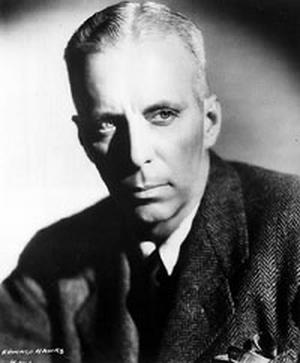
Howard HawksIt's odd how critical opinion waxes and wanes.  And no one shows this as much as Howard Hawks.  He directed as many classics as any filmmaker you can name, and Andrew Sarris named him as one of his pantheon directors in The American Cinema in 1968.  Yet during most of his career, he was ignored.  He only got one Oscar nomination, and his name was overlooked by most American and UK  critical film studies before Sarris.  But Sarris started a boom in his reputation, which put him among the front line of directors.
Now, not so much.  When people think of directors of his era, they think of Hitchcock, or John Ford, or maybe Orson Welles, of William Wyler or John Huston.  Hawks being overlooked.
Why?  Most likely because he switched genres and studios so often that it's hard to keep track of him.  A Hitchcock film is nearly always a thriller, but a Hawks film could be a comedy, or a western, or a drama, a gangster film, and action-adventure film, or even science fiction.  But he's managed to direct so many films that make list of tops in their genre, that he rates plenty of attention.
Hawks entered the movie industry in 1924, and started directing films the next year.  He went on to direct 47 films, many of which are classics.  Some of the better-known ones include: 
Comedies
  • Twentieth Century (1935). One of the earliest screwball comedies, this stars John Barrymore as the vain theater director Oscar Jaffe and Carole Lombarde as his star Lily Garland (born Mildred Plotka). 
  • Bringing Up Baby (1938).  The greatest of screwball comedies, with Cary Grant* and Katherine Hepburn as two people whose paths cross while searching for dinosaur bones and a pet leopard.
  • His Girl Friday (1939).  A reworking of The Front Page with Cary Grant as Walter Burns and Rosalind Russell as Hildy Johnson.  Hawks got the idea of making Hildy a woman when he noticed his secretary running lines for the movie.
  • Ball of Fire (1941).  Gary Cooper as the head of a group of seven professors compiling a dictionary of slang and Barbara Stanwyck as a chorus girl who shows that the need to widen their search.
  • I Was a Male War Bride (1949).  Cary Grant again, as a French officer who marries Ann Sheriden, an American officer, and has to come to the US under the war brides act -- which is not used to dealing with the reversal of roles.
  • Monkey Business (1951).  Cary Grant as a professor who develops a "fountain of youth" serum, which turns his behavior  into that of a wild teenager.
  • Gentlemen Prefer Blondes (1953).  Marilyn Monroe and Jane Russell as two women out to find a rich husband.  One of Marilyn's best roles.
Drama
  • Scarface (1932).  Not to be confused with the later semi-remake, this is one of the best of the 30s gangster films, with Paul Muni as the gangster, and where George Raft got his image.  More information here.
  • Only Angels Have Wings (1939).  Cary Grant starring as the head of a South American air service.**
  • Sergeant York (1941).  His only Oscar nomination, in this biopic of the World War I hero.
  • To Have and Have Not (1944). A vehicle of Lauren Bacall, who Hawks discovered.  It's probably the only film of a book by a Pulitzer Prize winning author (Ernest Hemingway***) with a screenplay by another Pulitzer Prize winning author (William Faulkner). The team of Bogart and Bacall became a screen legend.
  • The Big Sleep (1946). Next to Casablanca, Bogart's best film, and his work with Bacall was terrific.
Westerns
  • The Outlaw (1943).  Not really a good film, but infamous for turning Jane Russell into a star, thought that had little to do with Hawks.
  • Red River (1948).  One of the top ten westerns of all time, with John Wayne and Montgomery Clift.
  • Rio Bravo (1959).  John Wayne again as a marshal fighting against lawlessness.
  • El Dorado (1966). John Wayne again as a marshal fighting against lawlessness.
  • Rio Lobo (1970). John Wayne again as a marshal fighting against lawlessness.
Other
  • The Thing from Another World (1951). The classic sf horror film, and one that's to be praised for the intelligence of its conception.****
So why was Hawks ignored for so long?  I think his versatility counted against him.  He also wasn't a particularly "stylish" director.  I don't mean to say he didn't have a style all his own:  he was the master of overlapping dialog***** and he tended to focus on smart and competent men and women doing difficult tasks.  But his style didn't call attention to itself and was so simple and direct that it looked easy.
In his career, Hawks helmed 48 films, with a track record that put him among the greats.  I plan to highlight a few of these films in the future.
____________________________________________
*Grant appeared in may of Hawks comedies, happy to play something that subverted his usual screen image of debonair charm.
**There is a character named "Judy" and Grant say her name a lot, though not three times in a row.  Probably at least part of the origin of "Judy, Judy, Judy" as the Grant imitators catchphrase.
***Hawks claimed he was fishing with Hemingway and tried to persuade him to write for the movies.  Hemingway wasn't interested, but Hawks claimed he could take Hemingway's worst book and turn it into a film.  Hemingway asked him what his worst book was, and Hawks told him, "To Have and Have Not." Luckily for Hawks, Hemingway agreed.
****The film is credited to Christian Nyby, Hawks's long-term film editor.  But Hawks produced and everyone agrees that he had a strong hand in the production. Hawks said he let Nyby get the credit as a favor so he could join the screen directors guild. 
*****Where characters don't wait for others to stop talking before they speak.

Monday, October 10, 2011

The Pentangle (music)

(1968-1972)
The Pentangle: Renbourne, Thompson, Cox, McShee, Jansch Bert Jansch (guitar), John Renbourne (guitar), Jacqui McShee (vocals), Danny Thompson (bass), Terry Cox (drums)
All Music Guide Page

In memory of Bert Jansch.

The Pentangle was one of the most acclaimed groups of the British folk-rock scene in the 60s because they included five virtuoso musicians playing an eclectic mix of folk, blues, pop, and whatever else. 

The group started with Bert Jansch and John Renbourne.  Both were already highly accomplished and influential acoustic guitarists when they met and became roommates.  They loved playing music together and their album Bert and John showed a strong talent for writing and arranging songs.

While playing, singer Jacqui McShee sat in and they soon discovered that her voice meshed perfectly with Jansch's.*  They soon added bassist Danny Thompson and drummer Terry Cox, who had played together in the Alexis Korner Band.  With five members, the name Pentangle seemed natural.

The group was unusual for the time in that they played only acoustic instruments.  But they were amazing at it.  McShee had a sweet and pure soprano that worked so well with Jansch's rougher tones.  Both Jansch and Renbourne were masters of their instrument, as was Thompson, whose upright bass playing was perfection itself.

The group's first two albums -- The Pentangle and Sweet Child**  -- were critical successes, and their third, Basket of Light, also was popular enough to reach #5 on the British charts.   Here's "Light Flight," from that album:

After the success of Basket of Light, though, the group made the mistake of switching producers and recording an album of traditional folk music. Cruel Sister flopped.  The album didn't sell, since it it stuck with an area that was far less popular than the combined genres of their first three albums and, with only five songs on it, there was just not enough variation for continued success.

The group released two more albums, but their hearts weren't in it.  Jansch and Renbourne had been releasing solo albums during this time and Pentangle was more of a side project with them.  The group broke up in 1972, with occasional reunions.

_______________________________________________
*To me, "meshing" means the voices, while not necessarily singing harmony, always sound great together.  Steve Winwood and Jim Capaldi of Traffic is another example.

**I just noticed that Sweet Child has a version of "The Trees They Are So High," a traditional folk song. The song has special meaning to me, since one version, arranged by composer Benjamin Brittin, was dedicated to my father.  See here for details.

Sunday, October 2, 2011

Blake's 7 (TV)

Blake's 7 (1978-81)
Created by
Terry Nation
Starring Gareth Thomas, Paul Darrow, Michael Keating, Peter Tuddenham, Jan Chappell, Jacqueline Pearce, Sally Knyvette, Steven Pacey, Josette Simon, David Jackson, Brian Croucher, Stephen Grief
IMDB Entry

During its run, it was considered one of the best British SF series ever, but now it's mostly remembered for the awful way it ended.  But Blake's 7 is still first-class science fiction.

It's set in the future where the Federation is in charge.  But this isn't the Star Trek Federation -- is an evil dictatorship.  Roj Blake (Gareth Thomas) was a revolutionary who has been drugged to remain docile.  As he starts to remember, he's charged with pedophilia, and put on a prison ship.  Of course, he manages to overpower the guards and -- luckily -- find a passing alien spaceship of very advanced design.  Blake dubs the ship "The Liberator" and gathers a motley crew of criminals who try to overthrow the Federation.  They are known as Blake's 7.

The members of the original crew were:

  • Blake.  An out-and-out revolutionary -- smart but willing to do what was necessary to destroy the Federation.
  • Avon (Paul Darrow).  He had no interest in revolution and in little else other than his own self-interest. 
  • Vila (Michael Keating). A petty thief who wants to avoid danger as much as possible. 
  • Jenna (Sally Knyvette). A trained spaceship pilot and smuggler.
  • Gan (David Jackson) is a murderer with aggressive impulses, controlled by a chip in his brain.
  • Zen (voice of Peter Tuddenham).  The computer controlling the Liberator.
  • Cally (Jan Chappell), a telepath and the last to join the original crew.

Gan, Avon, Calley, Blake, Jenna, Vila Blake starts causing trouble with the Federation, and their Supreme Commander, Servalan (Jacqueline Pearce) makes it her business to take him down, using her best soldier, Travis (Stephen Greif, later replaced by Brian Croucher*) to find him.  So it becomes a battle between the Federation and the Seven.

The series was created by Terry Nation, the writer who launched the Daleks into the world. The mood was dark -- that Blake was fighting a gallant but possibly losing battle, not just against the Federation, but with his crew.  This is no Star Trek.  Vila is not interested in fighting, and Avon has no intention of being a hero.**  The group quarrels, disagrees, and commanding them is like herding wildcats -- though Blake manages to get his way most of the time.

The characters are all memorable, but the standouts are Paul Darrow's charismatic Avon and especially Jacqueline Pearce's Servalan. She is a wonderful villain -- clever, subtle, sexy, and dressed all in white.

And the show had a very dark side.  Main cast members died, starting with Gan in the second season.  But there are always seven, so he was replaced with Orac*** (Tuddenham again), a super smart computer that might be able to predict the future, and with a testy personality. 

And later, Blake himself is missing.  Avon has the Liberator, but starts fighting the Federation, though keeping his acid tongue and superior air.

The show had three great seasons, but started dropping in quality by season four.  Part of this was that they has planned to end thing after three seasons and had to scramble to build a plotline.  Also, Servalan changed, losing the qualities that made her a great villain (her wardrobe changed from white to red to black, a clear signal that she was becoming less interesting).  She became more standard, though there are hints of romance between her and Avon.

The show had a painfully low budget, even by BBC standard (see the logo, for instance), but the end was a complete shock -- the entire crew of the Liberator was gunned down, and even the ones who were still alive elsewhere were reported dead.  There is a little wiggle room***, but it was clear that the show wasn't going to be back.  Fans were outraged and blamed the BBC's general dislike for science fiction as the cause, though it does look like it was the creators' idea. And, strangely, the ending did seem to fit in with the series' streak of pessimism.

In any case, Blake's 7 was one of the gems of televised SF.

____________________________________________
*The change hurt the show.  Croucher's Travis was far more strident and less interesting.

**One of my favorite exchanges happen when something explodes and Avon pushed Blake out of danger.  Afterwards, Blake says, "Thank you... why?"  Avon replies, "Automatic reaction. I'm as surprised as you are."  His line, "I'm not stupid; I'm not expendable; and I'm not going" was a great catchphrase.

***I used to use Orac as the shutdown sound for my computer:  "I am closing down. I have much to do. You have engaged my circuits on your petty affairs for far too long."

****They cut to black before Avon was shot, and it's possible the Federation guards had their phasers on stun.

Tuesday, September 27, 2011

Those Lips, Those Eyes

Those Lips, Those Eyes (1980)
Directed by
Michael Pressman
Written by David Schaber
Starring Frank Langiella, Tom Hulce, Glynnis O'Connor, Jerry Stiller, Kevin McCarthy
IMDB Entry

In 1980, Frank Langiella was primarily a stage actor who hadn't made (and didn't seem interested in making) the jump to films.  He had made a version of Dracula that didn't set the world on fire and which nobody remembers, but little else.  Perhaps his love of the stage was why he appeared in Those Lips, Those Eyes.

It's the story of Artie Shoemaker (Tom Hulce), a young man who was bitten by the acting bug and got a job running props for a summer stock theater in the 1950s.  But Artie is inept and nearly loses his job when actor Harry Crystal (Frank Langiella) rescues him and take him under his wing.  Harry helps Artie get back on his feet and also provides a little assistance with his crush on chorine Ramona (Glynnis O'Connor).

The film is mostly a charming slice of life, and affectionate look at the stock theater of the time.  Artie's father (Jerry Stiller) tries to discourage him and get him to finish med school, while Harry shows him the glamour of the stage.

Langiella is at his best.  His Harry is a born showman, a man with enough talent to dream about Broadway roles, but not enough to actually get them. He dominates every scene he's in.*

My favorite was toward the end of the movie.  The play is being performed, and Harry is phoning in a performance, tired and feeling the work isn't worthy of his talents.  Then he hears word that a Broadway agent is in the audience.  He immediately turns it on, becoming mesmerizing on stage.

Despite good reviews, the movie did poorly.  It was the high point of Michael Pressman's directorial career, though he has worked steadily in TV ever since. 

______________________________________________
*Though, even at his best, Hulce was not a dominating actor.  He usually played a schlub, becoming known on the big screen as Larry Kroger in Animal House.  Larry was a recurring character in National Lampoon's Dacron, Ohio, stories -- the owner of the yearbook in their High School Yearbook Parody -- and always very put upon.  As a matter of fact, when I heard he was cast as Mozart in Amadeus, I thought it a horrible choice, but I didn't know what the play was about, and he did an excellent job.

Sunday, September 18, 2011

Dinosaurs (TV)

(1991-94)
Created by
Michael Jacobs, Bob Young
Voices by Stewart Pankin, Jessica Walter, Jason Willinger, Sally Struthers, Kevin Clash, Sherman Helmsley, Florence Stanley
IMDB Entry

Any description gives the wrong impression.  A show by Jim Henson Associates and Disney, about walking and talking dinosaurs, with cute catchphrases and a view of family life.  It certainly sounds like a children's show, and was marketed as such.  But Dinosaurs was something much more:  an often pointed satire about just about anything it could get its sights on.

The basic concept for the show came from Muppet creator Jim Henson, who wanted to do a show with puppets about dinosaurs living in a 50-style TV sitcom family.  Henson died (far too young) before the concept was developed, but Michael Jacobs and Bob Young fleshed it out and sole the concept to Disney to be aired on ABC.

The Sinclair family. The show follows the adventures of the Sinclair* family:  Earl (voice of Stewart Pankin), the put-upon father**, his wife Fran (Jessica Walter), son Robbie (Jason Williger), daughter Charlene (Sally Struthers), and their baby, Baby (Kevin Clash).  Earl was a blue-collar traditionalist, while Robbie would often question the values.  Baby was aggressively cute,*** though he would always torture his father.

Other character included Earl's boss at the Wesayso Corporation, the despotic B.P. Richfield (Sherman Hensley), Earl's best friend Roy Hess (Sam McMurray), and his mother-in-law Ethyl Phillips (Florence Stanley).

The voice actors on the show were all just fine, and the puppeteers were amazing.  The characters faces were capable of a wide range of expressions, and their movement is so natural that you forget that these are people surrounded by pounds of foam rubber.

The show was similar to many other sitcoms, but always had a satirical edge, mocking fame, religion, TV shows (sometimes with direct parodies), prejudice, politics, fashion and other issues in a way that was surprisingly pointed.  One of my favorites was the two-part episode "Nuts to War," where the dinosaurs go to war with each other over the years crop of pistachio nuts. 

And then there was the final episode, one of the most surprising finales in TV history.  It had an ecological theme, where the actions of the WeSaySo Corporation leads to the extinction of a beetle, which is the only thing that keeps a certain creeper vine in check.  Fiasco leads to fiasco until Earth is blanketed in clouds, cooling down and becoming uninhabitable.  The last scenes show the Sinclair family in their house as winter arrives, waiting to die.  It's a chilling episode of what always had been a comedy and one of TVs most downbeat moments.  Few shows had had the nerve to end by killing off the entire cast, and this is the only one where it's genuinely tragic and not a gimmick.

The show has been out on DVD, marketed as a children's show.  And though it works on that level, like most Henson projects, it's aimed for a fare more grown-up audience.

_______________________________________________
*One of the subtle jokes on the show was naming the characters for oil companies.  "Sinclair" is an especially appropriate choice, since Sinclair Oil used a brontosaurus as its logo on its service stations.

**A redundant description for all 50s sitcoms.

***His voice was the same guy who did Elmo on Sesame Street.

Sunday, September 11, 2011

Swamp Thing (comic book)

image (1972-1976)
Created by
Len Wein and Bernie Wrightson
Wikipedia Entry

Back in 1971, it was  slow day at work. One of my co-workers suggested I run down to the local drugstore and pick up a couple of comic books.*  He gave me money for one, so I went out and searched for titles.  Among them, was something called Swamp Thing.  I thought it was the stupidest sounding title ever, and knew I had to have it.  Not only was I pleasantly surprised, but the book quickly became a comic book classic.

The origin** was the story of Alec Holland, a scientist working with his wife Linda in the swamp to develop his "bio-restorative formula," sort of a super fertilizer. When enemy agents try to steal the formula, Alec resists, and, for his trouble, is left unconscious in his laboratory with a ticking bomb.  He wakes up just as it explodes and, drenched in the formula and burning up, he runs into the swamp.

The bad guys go after Linda, just as up from the swamp rises a muck-encrusted mockery of a man (love that phrase) -- Alec, turned part man, part plant.  He kills some of the bad guys, but Linda dies, too.  He then goes off to find the people responsible.

On the way, he meets Abigail Arcane, who begins to understand that the creature is human, and his friend Matt Cable, who blames the monster for the death of his friend Alec***.  The concept of a monster who was human, told from the monster's point of view, seemed very fresh at the time.****

The first series had the Swamp Thing meeting up with versions of classic movie monsters like the Patchwork Man (i.e., Frankenstein's monster) and even superheroes like Batman.  Len Wein had a real flair for dramatic writing and powerful incidents so it became more than just a tour of monsters. 

And the art by Berni Wrightson was spectacular.  Wrightson was a master of horror comic art.  His work is finely detailed and very creepy.

After ten issues, though, Wrightson left.  He was replaced with artist Nestor Redondo.  Many didn't notice the change, but while Wrightson's art is appreciated today, Redondo is only the guy who replaced him.  The two were similar in style, but Wrightson was clearly better.

After the first story arc of 13 episodes, Wein left, too, replaced by David Micheline.  The comic, though still a good one, slowly lost readers and a bit of its freshness.  After 24 issues, the series died.

It remained forgotten for six years.  But Wes Craven directed a Swamp Thing film in 1982, and, to cash in, DC started the new Saga of the Swamp Thing comic,  It limped along for a year and a half until they hired a successful UK writer who had never done work in the US -- Alan Moore. Moore completely revamped the character, changing him from a man/plant hybrid to a "plant elemental," and the book became a critical and popular success.*****

People still remember the Alan Moore version, and much of it has been reprinted.  The original run, however, has gotten short shrift. One reprint book stopped at issue 10, to showcase Wrightson's art, but leaves off the last three issues the Wein wrote, essentially leaving out the conclusion of the arc. 

The original Swamp Thing was a landmark in the history of comics, and still stands up well today.

________________________________________________
*Yes, comics were sold in drugstores back then. Also, believe it or not, Marvel Comics were hard to find:  you either got DC or inferior brands like Charlton Comics.

**Actually, Swamp Thing was based upon a one-shot story by the same creative team that appeared in House of Secrets, set in the early 20th century.  In it, Alex Olson makes the discovery.  When he returns from the swamp, his partner is trying to kill Alex's wife.  The Swamp Thing protects her, but, unable to communicate who he was, returns sadly to the swamp. 

***A neat trick that they became such close friends -- they first met in the beginning of the origin issue.

****Sort of.  A few months earlier, Marvel had come out with Man-Thing, who seemed very similar, probably because Len Wein wrote the origin story.  There were no lawsuits, though, since the two comics quickly went off in different directions.  Man-Thing now is best remembered for its Annual -- called Giant Sized Man-Thing.  At the time, all Marvel's double issues were called "Giant Sized," and the obvious double entendre was missed.  In addition to laughs at the name of the issue, the comic featured the debut of Marvel's strangest hero, Howard the Duck.

*****It's probably the only work by Moore I don't particularly care for, though.  There are certainly some excellent episodes, but the entire concept of "plant elemental" just was too labored for me, and I missed the pathos of Alec losing his humanity, the central concept of the original run.

Sunday, September 4, 2011

Misfits (TV)

(2009 - )
Written by
Howard Overman
Starring Iwan Rheon, Robert Sheehan, Lauren Socha, Nathan Stewart-Jarrett, Antonia Thomas
IMBD Entry
Complete Episodes Available at Hulu

Alicia, Curtis, Kelly, Nathan, Simon
Misfits
is not forgotten, of course.  In the UK, it won the BAFTA award for best drama in its first season, and is currently getting ready for Season 3. In the US, however, it is completely unknown.  I stumbled upon it by accident on Hulu and soon came to realize it was one of the greatest TV shows ever.  It is clearly the best to feature characters with super powers.

The premise is that a mysterious storm travels through an English urban neighborhood, giving people strange abilities.  What makes this different is two things.  First, the characters don't automatically become heroes or villains.  In many cases, their powers have limited use, anyway, and they have to go about their lives. And second, the powers are tied in with the characters fears and desires.  Thus, the nerdy boy who want to be left alone develops the ability to turn invisible.  The girl who's always worried about what people think about her can now read minds.  

The show focuses on five young men and women in a community service program for minor crimes. 

  • Simon (Iwon Rehon), a somewhat creepy guy who clearly wants to be left alone.  He's also the smartest of the group, though the others dislike him at first.
  • Nathan (Robert Sheehan).  He's the most outrageous personality, someone for whom the phrase "anything for a laugh" is far too tame. He crosses over the line and then continues.  But he gets the funniest lines, and you do get to know the reason for his attitude; it's a strange combination of utter asshole and sweet guy, sometimes all at once.*
  • Kelly (Lauren Socha).  She has serious anger management issues and speaks in an accent that US viewers might be hard to follow.  But ultimately, she is worried about what people think of her.
  • Curtis (Nathan Stewart-Jarrett). A near world-class athlete, but whose career was derailed when he was caught with drugs.  He's the most decent person of the bunch, though he is filled with regrets.
  • Lauren (Antonia Thomas).  Party girl supreme, who is not afraid to use her sexuality and good looks to get what she wants.  Her power is actually more a curse than anything useful.

They're basically good, but screwed up just a little, unhappy with their lives and lack of direction.

The gang gets into hot water the very first episode, and things start exploding from there.  Things get dark and scary for them, not only due to their actions, but as they meet up with others with powers.  One of the subplots of the first season is that Nathan seems to have no superpower, though he is sure he must.  When it's revealed, it's a scene that manages to be equally hilarious and horrifying.**

No one tries to take over the world.  No government agency uses the group for spying and derring-do.  This is not that sort of show, and it survives due its plotting and characterization.  We see the main characters change over the events, and things that seem to be heading in one direction often veer off into another.  All the characters have great depth, their actions and powers working in strange ways that almost always contradict your first impression of them.  There are scenes of great sadness and pathos, other scenes that are wildly funny, others that are horrifying.  Often at the same time.

So why is the show on Hulu and not some cable network?  Part of it is that it's made on a British schedule:  six episodes per season; currently only 13*** are available.  But I think the bigger issue is the fact that the show is definitely R-rated.  The language is explicit and there are some blatant sex scenes and there is no good way to censor them for US audiences without losing most of the point. 

If you're looking for something new and different in your TV watching, go to Hulu and start watching Misfits.  By episode two, you'll be hooked.

___________________________________________
*One of the questions about the third series of the show is due to the fact Sheehan has quit; it is a big role to drop.

**And I don't mean this is a horror comedy.  You laugh, but the situation is not played for laughs in the slightest.  Overman does this sort of balancing act all the time:  things that seem utterly stupid, but also menacing and horrifying.

***12 regular, plus a Christmas episode, though the idea of the show doing a sweetness-and-light Christmas seems surprising.

Sunday, August 21, 2011

Good Neighbors (TV)

(UK Title:  The Good Life)
(1975-1978)
Written by
John Esmonde & Bob Larby
Starring Richard Briers, Felicity Kendal, Paul Eddington, Penelope Keith
IMDB Page

Chemistry between the cast can be a big factor in the success of a TV show, and it was the cast of The Good Neighbors that helped turned it into one of the greatest of British comedies.

At the time, Richard Briers was a star of British TV, starring in a handful of shows in for almost 15 years.  A comment of his about turning 40 got writers Esmonde and Larby to thinking, and the results was The Good Neighbors.

Briers was Tom Good, a draftsman working on such important projects as designing a hippopotamus to be given away as a toy in cereal boxes. Tom has just turned 40, and is tired of work and wondering what to do with his wife.  So he decides to chuck it all and live self-sufficiently.  In Surbiton, a suburb of London.  Out goes the back lawn and in comes a garden, chickens, goats and other animals.  He uses the dung to power the house and his excess crops to barter to get other items.  His wife Barbara (Felicity Kendal) joins in.  Though this does cause conflict with their best friends and neighbors Jerry and Margo Leadbetter (Paul Eddington and Penelope Keith).  Jerry thinks the idea is bound to fail, but is happy to put up with Tom's madness.  Margo, on the other hand, thinks the others are crazy, and is worried that the farm next door will ruin the quality of the neighborhood.

Penelope Keith, Richard Briers, Paul Eddington, Felicity Kendall The show is funny due to the characters.  Tom is gung ho on living self-sufficiently and is constantly coming up with way to make it work.  Barbara is a bit more skeptical, but seems to get a kick out of the effort and its little triumphs and setbacks.  The two of them have one of the most ideal marriages in TV history -- they're both smart, witty, sexy, and deeply in love with each other. 

Margo is the opposite.  She's is a strong believer in proper behavior, the type who wants everything to be just so.  She feels that the whole enterprise is doomed to failure.  Not that she won't help if called upon -- the Goods are her friends -- but she does get a bit uptight about the idea of pig dung.  Jerry is used to her quirks and perhaps secretly admires what Tom is doing, even if he knows he could never do it.

The acting is perfect.  Tom is a man with an idee fixe, but he's self-aware enough to know that sometimes he goes too far.  He can also the the humor in the situation.  He and Barbara trade quips that are almost up to the level set in The Thin Man.  Felicity Kendal is delightful at every turn.

Penelope Keith's Margo is often the butt of jokes for her lack of flexibility, but basically she's a good person underneath.  Jerry is more down-to-Earth, but indulges her and the Goods.

The show ran three seasons in the UK as The Good Life, so successful that the taping of the final show was attending by Queen Elizabeth.  A few years later, it started showing up in the US as PBS stations in the early 80s, but the name conflicted with an earlier failed sitcom of the same name, so it was retitled Good Neighbors,* where it became a popular PBS Britcom.

After the run, the cast moved on.  Paul Eddington became Prime Minister (in the classics Yes, Minister and Yes, Prime Minister).  Briers did more sitcoms, and appeared in a Doctor Who episode** among other things.  Penelope Keith went on to BBC stardom in To the Manor Born and other shows.  Felicity Kendal did stage work with Tom Stoppard*** and recently appeared in the Rosemary and Thyme mystery series and a Doctor Who Episode.****

While still well regarded in the UK, the show is forgotten in the US, partly because it only appeared in syndication on PBS, so the audience was small. But it's one of the delights of British comedy.

_____________________________________________
*The only difference is the title in the opening credits.

**"Paradise Towers," one of my favorites.

***I enjoyed her performance as Christopher in a televised version of Stoppard's farce On the Razzle. "Catch me a half-witted cab, you hansom fool."

****"The Unicorn and the Wasp"