Showing posts with label comic books. Show all posts

Sunday, August 8, 2021

Star Hunters (comic book)

Star Hunters

1977-78
Written by
David Michelinie
Art by Don Newton, Don Newton, Bob Layton

Comic books are an iffy medium and there were many times where a comic died early due to lack of interest. One interesting failure was DC’s Star Hunters.

It was an attempt to cash in on the popularity of Star Wars.  Marvel had gotten the rights to the Star Wars characters, so DC created their own. The Star Hunters were a group of space adventurers* who were sent off on a mission by the Corporation to find the origins of human life. Their leader was Donovan Flint,** who tried to complete the mission.  He has no choice:  they’ve all be infected with a virus that will kill them if they ever set foot on Earth again.

The seven issues saw the crew finding out new things about the universe, each other, and the Corporation.

I picked up the first issue because of my love of science fiction and the idea of a space opera series that presented something a bit different and I had liked Michelinie’s continuation of Swamp Thing, which managed to pick up the story and take it in new directions. But this story never actually caught fire.

What I do remember best from it was the cover of the fourth issue.  In issue 3, some danger overtook Fint. And the cover of issue 4 says, “What happens when a hero dies?”

Well, the first rule of advertising is to never lead with a question and my thought at once was “He comes back to life again.’

Still, I think the comic was an interesting attempt at comic book space opera, even though it was ultimately unsuccessful. The title folded after seven issues. The characters have made very sporadic appearances, but lay in the forgotten corner of comic book history. Maybe one day someone will try to bring them back.

_________________________________________________________

*Akin to the crew of the Liberator in Blake’s 7

*Clearly with a nod toward Errol Flynn

Sunday, November 1, 2020

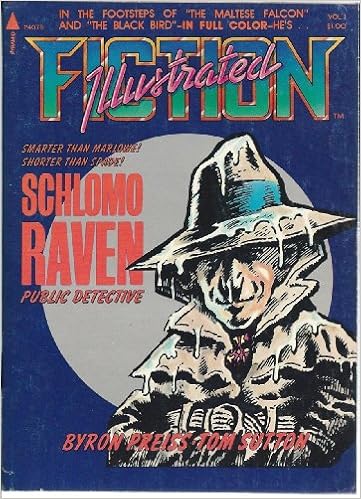
Schlomo Raven, Public Detective

(1976)
Written by
Byron Preiss
Illustrated by Tom Sutton

Byron Preiss was a book packager. He would put together books and series and sell them to publishers, saving them the effort of finding writers and coming up with themes. Preiss was a little different in that he was also an accomplished author, and one of his strangest projects was Schlomo Raven, Public Detective in the first issue of an intended series Fiction Illustrated.

The book was in graphic form, showing the adventures of Raven, who was based in Hollywood. It  consisted of two stories.In the first, “The Farx Job,”  where the Farx Brothers are kidnapped, possibly by monsters. The second story, “Rosebug,” has a more serious tone, as it shows an Orson Welles character working to save his film, American.

The names throughout are parodies of the real people. “The Farx Job” tries for a slapstick feel, while “Rosebug” is played a bit more straight.

Raven is short and with a prominent nose, part parody of the hard-boiled detective trope, and part pure slapstick. Tom Sutton’s art is reminiscent of 50s Mad Magazine. He shows a strong talent for caricature.

Fiction Illustrated format was strange. The book itself was an odd size (5 x 6 1/2”) and the pages were on newsprint, like a comic book. I wonder if the size hurt the distribution.

The magazine only ran four issues. Number two, Starfawn, had art by Stephen Fabien, but the story didn’t really go anywhere; I think they were hoping for a series.  Two more issues were produced before the series ended.

Schlomo Raven was an interesting experiment, but I think it might have had a better chance of catching on if there had been more issues of Fiction Illustrated featuring him.

Sunday, February 17, 2019

The Adventures of Jimmie Dale (books)

 adventures of Jimmie dale(1914)
By Frank L. Packard
Superheroes didn’t come into being in a vacuum. The tropes of the genre slowly evolved long before comics were invented. I’ve talked about the Scarlet Pimpernel, who was probably the first time a hero took on on a secret identity and much else. But I recently discovered another source, one that further refined the tropes that showed up in the early superhero comics: The Adventures of Jimmie Dale.
Jimmie Dale is a wealthy man-about-New-York, heir to his father’s fortune made from the development of office safes. But, Jimmie (as you’ve guessed) isn’t just a rich playboy. He also masquerades at the Grey Seal, the slickest thief in New York, known for emptying safes (usually from his father’s company) and leaving a gray sticker to mark his passage. The Grey Seal takes his orders from a mysterious woman, who sends him information on what to steal, and the crime hides that fact that he is actually helping others out: his real objective isn’t the flashy item he stole, but often something small and innocuous that saves someone from ruin.
Packard invented or expanded on may tropes of the superhero. Dale is probably the first superhero character to wear a mask.*  He also had a special sanctum, in this case a cheap room on the Bowery that he rents in a second alter ego: the dope fiend Larry the Bat.
The first novel is a series of adventures where the Grey Seal returns after a hiatus as his mysterious mentor tells him what he need to do. One story invents the common trope of a superhero protecting his identity, as one of the woman’s letters is stolen along with Jimmie’s purse. The stories are cleverly plotted, though sometimes they don’t play fair according to how stories are supposed to to now.
The series first appeared in magazines and then was collected into books between their introduction and 1935.  A silent serial was made in 1917, now lost.
Author Frank L. Packard had written several successful mysteries before Jimmy Dale, and continued to put out books throughout the 20s and 30s.
It’s certainly likely that Bob Kane and Bill Finger knew about Jimmie Dale when they created Batman in 1939 and with a major character named “Larry the Bat,” you kind of wonder how much of an influence it is. I’d never come across Jimmie Dale in reading about the history of comics. Bob Kane never seemed to mention it, though Kane was well-known for downplaying influences.  One point is that the Grey Seal had a small domino mask which he could keep in his pocket and Kane’s original concept of Batman used the same mask. Probably a coincidence, but It would seem likely he knew about Jimmie Dale, since he was still appearing in adventures in Kane’s teen years.
In any case, the books faded from the popular culture mindset in the 30s. The comic books preferred to create new characters and as time went by, Jimmie Dale and the Grey Seal were forgotten. The stories are still first-class adventures, though, and work seeking out.
_____________________________________________________
* Zorro showed up five years later.

Sunday, May 27, 2018

Sugar and Spike (comic book)

Sugar and Spike(1956-71)
Created by
Sheldon Mayer
Wikipedia Entry

Believe it or not, at one time comic books actually were comic. Nowadays you’re hard pressed to find something other than superhero or adventure comics, but in the early days, comic book publishers covered all bases.  Romance was big for the (perceived) female audience.  And there were several humor titles.  Sugar and Spike was one of the longest running and one of the best.

The book was a creation of Sheldon Mayer, whose career coincided with the invention of the modern comic book. Indeed, it was due to his persistence that DC reluctantly published Superman. He became an editor at DC’s sister compsny, All-American Comics, and was involved in the creation of icons like the Flash, Green Lantern, Hawkman, Wonder Woman, and the Justice Society of America. But Mayer preferred to be a creator, not an editor, so he left the editor’s chair to write and draw full time in 1948, where he concentrated on humor.  And in 1956, he created Sugar and Spike.

The book is about two babies, Sugar Plumm and Spike Wilson. It was told from their point of view, with the individual conceit that they two could talk to each other in baby talk, while they could barely comprehend what adults would say*. They could also talk to baby animals.

The stories often revolved around their misadventures, with the two of them getting into trouble and dealing with the consequences. Mayer kept things inventive and fun with these twin Dennis the Menaces. Many of the jokes involved their not understanding how the real world worked.

But the adventure bug was everywhere, so by the mid-60s, Mayer started sending them on various comic adventures, usually involving their friend, the baby genius Bernie the Brain.

Paper dollsAnother popular feature of the book was the Sugar and Spike paper dolls. Each issue would show a new set of costumes you could cut out and dress the two babies in. The designs were sent it by readers, who could see their name and age immortalized in the pages.

The book ran until 1971, when Mayer was unable to draw it any more due to eye problems. Since Mayer’s contract prohibited DC from using another creative team, there was no way for it to go on even if they wanted it to.

When cataract surgery gave him his eyesight back a few years later, however, Mayer went back to drawing the characters, but by that time DC was not interested in running a humor book. Mayer continued to draw new stories, though. They were published internationally and were rarely reprinted in the US.

The strip ended everywhere when Mayer retired, though it’s fondly remembered by people who read comics of that era. Some attempts have been made to revive it,** but no one has figured out how to replace Mayer’s art and sense of humor.

________________________________________________________

*One exception was one of their grandfathers, who was in his “second childhood” and thus understood them perfectly.

**Including one where the two have grown up to be detectives.

Sunday, January 4, 2015

Captain Marvel (comics)

image(1939-1954)
Created by
Bill Parker and C. C. Beck
Written by Otto Binder
Wikipedia Page

His name and catchphrase are an important part of comic book history, but the original Captain Marvel has been overlooked by even those who love comics.  The Big Red Cheese was something that was far different from the other comics of the time, and something that has been completely lost today.

Everyone knows his origin story:  Billy Batson, a lame newspaper boy, is taken into a mysterious cave by a wizard and taught a magic word:  Shazam.  This changes him into the superhero, who then goes to fight crime and evil villains.  Saying “Shazam” again would turn him back to Billy.  He first appeared in Fawcett’s Whiz Comics* in 1939.

But the Captain was different from any other superhero of the time (or since).  It was more cartoony, and the captain really acted like a 12-year-old boy.

imageMost of the stories were written by Otto Binder.  Binder had been a veteran of science fiction pulps** and he worked to create a mythology that was both fun and entertaining.  As time went on, he added an entire mythology of characters, becoming the Marvel Family.  These included:

  • Mary Marvel -- Billy’s sister, who turned out to have the same magic word.
  • Captain Marvel, Jr. – Freddy Freeman, whose magic words were “Captain Marvel”*** and who wore a blue uniform.
  • Uncle Marvel – Dudley H. Dudley, a chubby old man who discovered Mary Marvel’s secret.  He claimed to be her uncle, and helped them fight crime, mostly as comic relief.  When he tried to use superpowers, it turned out his shazambago was acting up and nothing worked.  The rest saw through the fraud, but humored him.
  • Hoppy the Marvel Bunny – the funny animal version of the family, who showed up in Fawcett’s animal comics.
  • Tawky Tawny – a tiger (and natty dresser) who had been given a potion that gave him the power of speech.

imageOf course, you can’t be a superhero without an arch enemy, and the Captain’s was world’s maddest mad scientist, Dr. Thaddeus Bodog Sivana, a bald evil genius out to rule the world.****  Sivana was sometimes assisted by his son and daughter, Sivana, Jr. and Georgia; there were two other children, Beautia and Magnificus who worked on the side of good.

Other villains included Captain Nazi, Black Adam, and Ibac (the evil version of the Marvel superpowers).  A favorite of mine was Mister Mind, and evil worm from another planet.

The stories were usually more cartoony than the more serious superhero strips.  Beck’s art was deceptively simple, with bright colors and large swaths of color.  It worked well:  in the 1940s, Captain Marvel was the most popular comic book out there, and was the first to be made into a movie serial.

But all was not well.  In 1941, National Periodicals sued Fawcett, claiming that Captain Marvel infringed on Superman.  The court ruled in 1948 that it did not infringe, but National (later DC) appealed and the court found in 1952 that some elements of the stories did infringe.  And sent it back to make a final determination.

By this time, though, Superhero comics – and comics in general – were losing popularity.  Captain Marvel was selling at only half its peak, and, in 1953, Fawcett settled out of court and let the character die.  The agreement forbid Fawcett from publishing comics, so they licensed it to DC.  Unfortunately, in the meantime, Marvel Comics had created their own Captain Marvel character.  DC had to name the revived version “Shazam,” though the character was referred to in the book as Captain Marvel, and they were able to reprint many of the old Beck and Binder stories.  Eventually, the character moved away from the original concept.

Of course, comics and their characters constantly evolve, so one wouldn’t expect the Captain to remain as he was.  But the original version is one of the greats of the comic book world.

___________________________________________
*Founded by Bill Fawcett.  Fawcett made a name for himself for a magazine that everyone who has ever seen The Music Man has heard of:  Captain Billy’s Whiz Bang.  “Whiz Comics” refers to that.

**Originally co-written with his brother Earl, and billed as Eando Binder.  Their “I, Robot” (no connection to Asimov) was considered a landmark in the field.

***Making him incapable of saying his superhero name, or that of the Captain without changing.  “Shazam” wasn’t used because the publisher felt he should be promoting the Big Red Cheese.

****He appeared before Lex Luthor, and Luthor wasn’t bald in the beginning.

Sunday, August 10, 2014

Metamorpho (comics)

image(1965 – 68)
Created by
Bob Haney (writer) and Ramona Fradon (artist)
Wikipedia Page

Comic book heroes come and go, and it’s hard to keep track of which of the older ones are still around, but one of the most interesting heroes of the early 60s was Metamorpho, since it didn’t follow the usual tropes.

Metamorpho was created by Bob Haney.  DC at the time was trying to create offbeat and “different” superheroes, and Metamorpho certainly fit.

Rex Mason was an adventurer hired by unscrupulous millionaire Simon Stagg to retrieve the “Orb of Ra” – a one-of-a-kind Egyptian artifact hidden in a pyramid.  On the way to Egypt, Rex fell for Stagg’s daughter, Sapphire, giving Stagg a reason to dislike him.  When trying to steal the orb, Rex is knocked out by Simon’s henchman Java* and exposed to the Orb.

As everyone knows, being exposed to magical devices causes great changes and Rex turned into a strange looking man with a chest that was half orange and half purple, with a ghostly white head and legs of mismatched colors.  He also developed the ability to change into any element.

Unlike most heroes, Rex hated the transformation and wanted to return to being human.  He also wanted to leave Simon Stagg’s employ, but Stagg discovered that Rex’s only weakness was the Orb, and used that to control him.  So Rex took on the name Metamorpho and reluctantly became a superhero.

The series premiered in The Brave and the Bold** in January 1965. It must have been a big hit, since he was given his own comic within a year.  The comic had a high degree of parody in the way it portrayed the villains Metamorpho faced, but Rex’s plight was handled seriously:  he hated being a superhero and looked for ways to become human again, even turning down a membership in the Justice League because he expected to change back.

The comic ran for 17 issues.  A female version, Element Girl, joined him for a few episodes*** and Metamorpho joined the Outsiders over the years. 

______________________________________________
*Supposedly named because he was a “Java man,” a caveman skeleton of the time.  I don’t remember if Java’s origin was ever described.

**Usually new characters were premiered in DC’s Showcase comics; The Brave and the Bold featured Batman team-ups.

***Her most memorable appearance was years later in Sandman #20.

Sunday, November 13, 2011

Gardner F. Fox (comics)

(1911-1986)

Gardner F. Fox (art by Gil Kane)The names of the creators of most long-running comics are well known.  Jerry Siegel and Jerome Schuster created Superman; Bob Kane created Batman; Stan Lee and Jack Kirby created most of the Marvel superheroes.  But one of the greatest of comic creators, a man whose output ran into thousands of comics, is often overlooked.  That man is Gardner F. Fox.

Fox grew up in Brooklyn and went to college to get a law degree.  However, during the Depression, he realized he needed to supplement his income, so he began writing, hooking up with DC Comics and writing stories almost from the beginning of comic books.  He quickly became a top writer for DC, since he wrote well and met deadlines.  His first assignments was on the long-forgotten Speed Saunders, but he very quickly started writing for Batman, where he reached comic book immortality in his first story, where he created the utility belt. 

At about the same time, he created his first well-known characters, the Sandman.  This isn't the same one Neil Gaiman made famous, though Gaiman did include references to the original, but it was successful enough.

FlashHe came into his own in 1940, when he developed the Flash. The idea of a fast-running superhero caught people's imagination* and the Flash became one of the stalwarts of the Golden Age of comics.  He followed that up with creating another of the great names of DC comics:  Hawkman.  Other characters followed, including Dr. Fate and Starman (co-creator of both).

These read like a roll call of all the great characters of the 40s, but soon Fox topped them all by the simple expedient of showing them all together. Taking a group of characters from All-American Comics,** Fox put them all together and created the Justice Society of America. He wrote most of the JSA stories, and made it into one of the great name of the Golden Age.

But the Golden Age ended and the comics began to suffer.  Fox switched from superhero strips to western and science fiction comics and managed to keep working during the hiatus after Seduction of the Innocent.

But Fox wasn't through with superheros.  In the mid-50s, when editor Julius Schwartz decided that the time was right for more superhero comics, one of the first people he contacted was Fox, who helped with the revamp of the Flash, Hawkman, and the Atom and eventually, wrote the new version of the Justice Society, the Justice League.  He also came up with the Earth-1 and Earth-2 concept, which allowed the heroes from the Silver Age (Earth-1) to interact with the heroes of the Golden Age (Earth-2) to meet and interact. 

Fox's interest in science fiction also continued, and he wrote many of DC's SF titles, eventually creating their best-know SF heron, Adam Strange, in 1958.  In the 60s, he went back to writing Batman again, taking two obscure Golden Age villains -- the Riddler and the Scarecrow -- an turning them into important members of the Batman's rogue's gallery.

Fox left DC in 1968 over a dispute about benefits, and did a little bit of comic book work, but primarily wrote SF novels full time.***

Over the years, Fox wrote an estimated 4000 comic book stories**** and he was revered in the field.  So much so that when they created a new Green Lantern, he was named Guy Gardner in his honor.

Fox worked regularly up until his death in 1985.  His work is a bit dated, and even silly today, but that's due to a change in critical opinion, not because they weren't good stories in their time.  Probably no one else wrote more comic books.

_______________________________________________

*Even though the original story was awful by any measurement, other than the concept of the character.

**A part of DC, which in that time was split between All-American and National Periodicals Publications.  Eventually the two merged into National Periodicals, which became DC, the letters coming from their oldest title, Detective Comics.

***One of his novels, Escape Across the Cosmos was actually plagiarized twice and published as Titans of the Universe and Star Chase by different authors.

****The Grand Comics Database lists well over 3000, and there were probably more, since he was often uncredited. 

Sunday, September 11, 2011

Swamp Thing (comic book)

image (1972-1976)
Created by
Len Wein and Bernie Wrightson
Wikipedia Entry

Back in 1971, it was  slow day at work. One of my co-workers suggested I run down to the local drugstore and pick up a couple of comic books.*  He gave me money for one, so I went out and searched for titles.  Among them, was something called Swamp Thing.  I thought it was the stupidest sounding title ever, and knew I had to have it.  Not only was I pleasantly surprised, but the book quickly became a comic book classic.

The origin** was the story of Alec Holland, a scientist working with his wife Linda in the swamp to develop his "bio-restorative formula," sort of a super fertilizer. When enemy agents try to steal the formula, Alec resists, and, for his trouble, is left unconscious in his laboratory with a ticking bomb.  He wakes up just as it explodes and, drenched in the formula and burning up, he runs into the swamp.

The bad guys go after Linda, just as up from the swamp rises a muck-encrusted mockery of a man (love that phrase) -- Alec, turned part man, part plant.  He kills some of the bad guys, but Linda dies, too.  He then goes off to find the people responsible.

On the way, he meets Abigail Arcane, who begins to understand that the creature is human, and his friend Matt Cable, who blames the monster for the death of his friend Alec***.  The concept of a monster who was human, told from the monster's point of view, seemed very fresh at the time.****

The first series had the Swamp Thing meeting up with versions of classic movie monsters like the Patchwork Man (i.e., Frankenstein's monster) and even superheroes like Batman.  Len Wein had a real flair for dramatic writing and powerful incidents so it became more than just a tour of monsters. 

And the art by Berni Wrightson was spectacular.  Wrightson was a master of horror comic art.  His work is finely detailed and very creepy.

After ten issues, though, Wrightson left.  He was replaced with artist Nestor Redondo.  Many didn't notice the change, but while Wrightson's art is appreciated today, Redondo is only the guy who replaced him.  The two were similar in style, but Wrightson was clearly better.

After the first story arc of 13 episodes, Wein left, too, replaced by David Micheline.  The comic, though still a good one, slowly lost readers and a bit of its freshness.  After 24 issues, the series died.

It remained forgotten for six years.  But Wes Craven directed a Swamp Thing film in 1982, and, to cash in, DC started the new Saga of the Swamp Thing comic,  It limped along for a year and a half until they hired a successful UK writer who had never done work in the US -- Alan Moore. Moore completely revamped the character, changing him from a man/plant hybrid to a "plant elemental," and the book became a critical and popular success.*****

People still remember the Alan Moore version, and much of it has been reprinted.  The original run, however, has gotten short shrift. One reprint book stopped at issue 10, to showcase Wrightson's art, but leaves off the last three issues the Wein wrote, essentially leaving out the conclusion of the arc. 

The original Swamp Thing was a landmark in the history of comics, and still stands up well today.

________________________________________________
*Yes, comics were sold in drugstores back then. Also, believe it or not, Marvel Comics were hard to find:  you either got DC or inferior brands like Charlton Comics.

**Actually, Swamp Thing was based upon a one-shot story by the same creative team that appeared in House of Secrets, set in the early 20th century.  In it, Alex Olson makes the discovery.  When he returns from the swamp, his partner is trying to kill Alex's wife.  The Swamp Thing protects her, but, unable to communicate who he was, returns sadly to the swamp. 

***A neat trick that they became such close friends -- they first met in the beginning of the origin issue.

****Sort of.  A few months earlier, Marvel had come out with Man-Thing, who seemed very similar, probably because Len Wein wrote the origin story.  There were no lawsuits, though, since the two comics quickly went off in different directions.  Man-Thing now is best remembered for its Annual -- called Giant Sized Man-Thing.  At the time, all Marvel's double issues were called "Giant Sized," and the obvious double entendre was missed.  In addition to laughs at the name of the issue, the comic featured the debut of Marvel's strangest hero, Howard the Duck.

*****It's probably the only work by Moore I don't particularly care for, though.  There are certainly some excellent episodes, but the entire concept of "plant elemental" just was too labored for me, and I missed the pathos of Alec losing his humanity, the central concept of the original run.

Saturday, March 20, 2010

One Year Affair (Comic)

One Year Affair (1973-1975)
Story by
Byron Preiss
Art by Ralph Reese

The influence of The National Lampoon on modern comedy can't be overstated. People know it for Animal House and the Vacation films, but it was much more.  Saturday Night Live, for instance, owes much to the magazine.*  People like John Hughes, P.J. O'Rourke, Chris Rush, Bruce McCall, Chris Miller, Doug Kenney, Henry Beard, and many others.

One of the Lampoon's features was their comic pages, featuring top comic artists and writers doing some of their best work, with plenty of creative freedom.  And, hidden among people like Gahan Wilson, M.K, Brown, Shari Flennikan, Vaughn Bode, and many others, was a small unassuming strip by Byron Preiss and Ralph Reese titled One Year Affair.

The strip started out with an ominous note:

Just 52 weeks from today, the characters introduced here will terminate their relationship . . . This, then, it the ignominious beginning of a . . . ONE YEAR AFFAIR.

The first strip showed a man picking up a box of tampons in a store, saying, "Miss!  You dropped your box of . . . ah . . . "

Her reply:  "Thanks.  Why don't you take one of these as a reward?"

And so the relationship begins. 

The man is Steve, who finds the woman's name is Jill and gets her phone number off some "For a good time, call Jill," graffiti on a men's room wall.

Jill is a terrific character.  She sexy, uninhibited, happily promiscuous**, and shameless.  Steve is a schlub and know that Jill is out of his league.

The strip appeared each month in the Lampoon, usually four panels showing the latest ups and downs of their relationship.  Steve's insecurity and Jill's past were all fodder for humor, as were landmarks like moving in together.  The relationship flourished, fell apart, got together, all with some wild ideas and and plot twists.

And, as promised, the relationship ended. 

The humor and twists still work, even if the dating world portrayed is long gone.  It often verged on soap opera (especially near the end), but managed to remain fresh and funny.

After the run, Preiss and Reese started a strip new strip for the Lampoon called Two Year Affair, which tried to focus on three people, but it only ran a couple of time before being dropped.  Preiss went on to for Byron Preiss Visual Productions, which collected the strips into book form.  BPVP went on to be a successful publisher of graphic books and then of packaged novels.***  He died in 2005.  Ralph Reese continued to work regularly in comic arts.

________________________________________________

* John Belushi and Chevy Chase joined SNL after a stint on the off-Broadway revue National Lampoon's Lemmings.  They also worked on the National Lampoon Radio Show with Gilda Radner and Bill Murray.  Michael O'Donoghue, a Lampoon stalwart, was an early writer and one of the original Not Ready for Prime Time Players.  Anne Beatts was another NatLamp writer who started writing for SNL.

**Remember, this was after the sexual revolution and before AIDS.

***Preiss would pitch ideas for book series and sell them as a package, hiring authors to then write them.

Sunday, January 11, 2009

The Middleman (TV)

The Middleman (2008)
Created by
Javier Grillo-Marxuach 
Starring Matt Keeslar, Natalie Morales, Brit Morgan, Mary Pat Gleason, Jake Smollett, Brendon Hines.
IMDB Entry

When people think of quality TV, ABC Family Channel does not come to mind. I see that Kyle XY  gets some buzz, but really, it is pretty much a wasteland of "family" comedies and dramas with about as much edge to them as a block of wood, the shows that are not quite good enough for their sister network, The Disney Channel.  So the last thing you'd expect from them is a delight like Middleman.

In a nutshell, the show is The Man from U.N.C.L.E. crossed with Men in Black, with a hint of The Avengers, Buffy the Vampire Slayer, and every comic book you ever loved.  Only funnier and more entertaining.

In the pilot,* we meet Wendy Watson (Natalie Morales), an aspiring artist working as a bored receptionist at a scientific establishment. Something goes wrong and a monster is created.  Wendy is too blasé to be terrified and when the Middleman **(Matt Kesslar),  a Men-in-Black type agent, appears to defeat it, he takes note of her lack of fear and offers her a job.

The Middleman is an agent for O2STK*** and is looking for an assistant. Wendy joins him in fighting aliens and other menaces.   The office is run by Ida (Mary Pat Gleason) a large robot woman in a tacky housedress for whom sarcasm is her primary language.

Wendy's personal life conflicts with her new job, causing problems with her friend and roommate Lacey Thornfield (Brit Morgan). They are both helped by the guy next door, Noser (Jake Smollett).  Naturally, Wendy can't tell them about her top-secret middleman job (though there are hints of romantic sparks between Lacey and the Middleman), which leads to some problems with her friendship and her social life with Tyler Ford (Brendon Hines), who otherwise would be a kindred spirit.

The bare description doesn't do justice to just how entertaining the series was.  Some of the various menaces the Middleman fought included:

  • Giant venomous flying fish whose bite turns victims into zombies.
  • Mexican wrestlers.
  • Gun-toting gorillas.
  • A duck caught in a hole in space and time.
  • Evil alien overlords disguised as the members of a boy band****
  • A succubus who works as a fashion designer.
  • Aliens addicted to plastic surgery.
  • Vampire ventriloquist dummies.
  • A cursed tuba

In addition to the general silliness of plotting, there was also shout outs to adventure series and movies.

Some were obvious -- Titanic, for instance.  Others required a knowledge of popular culture, like in the final episode where Wendy was transported into an evil parallel world.  How did we know that?  Because all the men there wore goatees (and the Middleman looked a lot like Snake Plissken*****).  There was also one episode where the aliens were being investigated by an organization suspiciously similar to U.N.I.T. from Doctor Who.

Some were even more subtle, like when the Middleman introduced him and Wendy as "Alexander Scott and Kelly Robinson."

Note that this wasn't just reference comedy.  If you didn't get the reference, it didn't matter -- the show was still fun.  But getting the reference made you watch very carefully. It was as though the scripts were written first and then people went through them to figure out what media references fit the script.

I also liked the fact that they knew when to hold back. The final episode involved palindromes, and a criminal who left drawings at the scene of his crimes.  The first showed a man.  The next showed a plan. The next showed a canal. And the final one  showed . . . a hat.  "A hat?" Wendy asks.  "How does that fit in?"******

Each scene had a title, a la The X-Files that told time and location. In some episodes they have fun with that, using random time zones from around the world, or using "Lunch Time," "Dinner Time," "Hammer Time," and "Jail Time."

I could go on and on about the great moments in the show. There was the time Noser played "Stump the Band" (people would shout out names of songs, and he'd say, "Yes, I know that one."). The show was just densely packed with humor and strangeness, they type of thing where you had to pay attention every moment for fear of missing something that would have you laughing out loud.

The stories worked because, despite the fact they were off-the-wall, the writers took it all seriously.  Sure, there was slapstick, but the show remained grounded just enough to sell the concept.

Much of that is due to the two leads.  Matt Kessler played the Middleman -- the straightest of straight arrows -- perfectly seriously, even in the most bizarre of situations.  The Middleman could have been like the old Adam West Batman, but Kessler was never jokey.  The Middleman believed in what he was doing, and that helped sell the show.

Natalie Morales was also good as Wendy, a comic book/TV/movie geek whose ironic look at life contrasted nicely with the Middleman's seriousness.  She was often skeptical of what was going on, only to be shown that things were even weirder than she imagined.

Ida Credit also has to be given to Mary Pat Gleason.  Her Ida was always a hoot.  Britt Morgan was nice as Lacey, the type of best friend/roommate most women would love to have.

The whole enterprise was developed as a TV series by creator Javier Grillo-Marxuach, but when that didn't work out, he turned it into a graphic novel until he was able to sell the concept to the network.  Grill-Marxuach is a master of combining story and comedy and getting writers who could see his vision through.

The show ran in the summer of 2008. As of this moment, there is no word on whether it will be back or be canceled, but it seems likely we'll see no more of the Middleman (though it made a few best of 2008 lists). Another network may have had more success for it (though, as some have pointed out, it would probably fit best if Comedy Central and the Sci-Fi Channel merged).

Luckily, the show is available for downloading at iTunes. It's a perfect way to watch the Middleman fight evil -- so you don't have to.

______________________________________________

*"The Pilot Episode Sanction."  All the show titles were over-the-top parodies of The Man from U.N.C.L.E. show titles.

**His real name is never revealed.

*** Organization 2 Secret to Know.  This is just the Middleman's name for the organization; it has no actual name -- because it's too secret to know, of course.

****Varsity Fanclub, to be exact.  I don't know much about them (I'm hardly the usual boy band target audience), but you have to give them credit to appear on a TV show that makes them megalomaniacal alien villains.

*****Star Trek reference, if you need an explanation.  And Snake Plissken was from the movie Escape from New York.

****** A panama hat, but of course, Wendy had never seen one and so was unable to complete the palindrome.

Tuesday, September 9, 2008

1963 (Comic book)

(1993)
Written by
Alan Moore
Art by Rick Veitch, Dave Gibbons, Steve Bissette, Don Simpson, Chester Brown, John Totleben, Jimmy Valentino
Wikipedia Page

Alan Moore is quite rightly considered one of the top writers of comic books written today.  His work has been astounding, with things like V for Vendetta, Watchmen, Swamp Thing*, and The League of Extraordinary Gentlemen.**  But lost within these classics is one of his best, a comic that is not only good on its own, but is a satire on the business of comics in general.

1963 was a limited series of six comic books, all with different titles, that were pastiches of the Marvel comics of the 60s.  Moore takes on the personal of "Affable Al" Moore, whose chatty footnotes and replies to letters are quite reminiscent of a very well known Marvel comic editor of the time. Indeed, the letters mention the "sixty-three sweatshop" and gives out "anti-awards" for letters, as readers comment on previous (nonexistent) episodes of the stories. 

The characters are clearly based on Marvel superheroes of the time and you can see Moore is trying to make a statement about how superheroes were portrayed.  The six books are:

  • Mystery Incorporated ("America's Most Exciting Comic Book") about four fantastic heroes:  the scientist Crystal Man, Neon Queen, Kid Dynamo (who turns into a form of energy) and, of course, the Planet, a man turned ugly and with great super strength.
  • No one escapes the Fury.  This means you! No One Escapes . . . The Fury.  The Fury is a wisecracking superhero who bounces around the city to fight crime and supervillains like a blind arachind. 
  • Tales of the Uncanny.  Two stories here, one featuring U.S.A. -- Ultimate Secret Agent, a red white and blue clad hero, the other with the Hypernaut, with elements like body armor, science fiction, and other issues.
  • Tales from Beyond.  Another two-fer, with N-man, who turned bright red and ugly due to a nuclear explosion, and Johnny Beyond, master of the occult.
  • Horus, Lord of Light. A hero who turns into an ancient god.
  • Tomorrow Syndicate.  An all-star lineup of heroes.

If you know comics at all,you know who Moore is referring to.***

The stories are very much in the mood of 60s Marvel stories, and matching the style of the comics perfectly. It's the same sort of flat art that we all grew up on and there are often the typical ongoing plots that Marvel was so well known for.

One of the more interesting pieces are the "Affable Al" Moore comments. Moore portrays his alter ego as a pure ego, slave driver who grabs all he can get, and who even threatens a fan (named Neal Gaiman) with a lawsuit over copyright violation. 

The series was incomplete.  There was supposed to be an additional comic -- an 80-Page Giant Annual -- where the heroes in the Tomorrow Syndicate would meet with heroes from Image Comics (who published the series). It was clear that Moore wanted to make some statement about the relationship between comics in the 60s with that of the 90s. The final panels have the Tomorrow Syndicate in a world where the flat comic book art had turned to the more three-dimensional art that was the standard of the time.

But the book never came out. The artist -- Jim Lee -- quit comics for a year and never got back to the book.  There were creative differences and eventually too much time lapsed for it to be a viable project.

The comics are hard to find; I don't think they've been collected. But it's a enjoyable look at the past, with a character -- "Affable Al" -- who ranks as one of the great comic book creations.


*Though I prefer the original Len Wein/Bernie Wrightson verson.

** Don't blame Moore for the movie, or any others of his books -- he hates what Hollywood does to his work.

*** Oh, all right.  If you don't get it:

Mystery Incorporated Fantastic Four
The Fury Spider-Man with hints of Daredevil
U.S.A. Captain America
Hypernaut Note entirely clear, with elements from Iron Man/Silver Surfer, Green Lantern & others
N-Man The Incredible Hulk
Johnny Beyond Doctor Strange
Horus The MightyThor
Tomorrow Syndicate The Avengers, and also Moore's own Watchmen series.

Friday, January 25, 2008

Little Lulu

(Comic Book)
Created by Marge (Marjorie Henderson Buell)
Comic book written by John Stanley

As any boy growing up in the 60s, I loved comic book. And by that, I mean superhero comic books.*
So, when I was visiting my female cousins one afternoon and stumbled upon a stack of Little Lulu, I was less than impressed. Clearly, these were girl comics.
But I had an odd trait: show me something in the comic book form, and I'll read it. I can't help myself. So I started reading the back issues of Little Lulu.

They were terrific. I couldn't put my finger on why. There was no action. They were amusing, but not hilarious. But I enjoyed them immensely.

Nowadays, I have a better grasp of why: They were just well-written stories in comic book form.

Little Lulu was created by Marjorie Henderson Buell, who used the pen name of Marge for her work. Lulu started out as a recurring panel in the Saturday Evening Post, and graduated to comic strip and finally comic book. It was the latter where it reached its peak. Marge was a smart businesswoman and managed to syndicate the name all over the place, and even eventually as a TV cartoon.

And, similarly to Walt Disney, she couldn't write everything she had her name on. I get the impression she started hiring others early on, and the real find was John Stanley.
Lulu was originally a mischievous girl who love pulling pranks. But Stanley gave her a personality, a groups of friends to interact with, and rich backstory. Lulu was about grade school age, and her friend and foil was Tubby Tompkins. Lulu and Tubby had a rivalry/friendship that stood out among kid comics. There was also Lulu's best friend Annie; Tubby's friend Iggy; Annie's brother Alvin; and Gloria, Tubby's heartthrob.

Veering off, there were also Witch Hazel and Little Itch. They weren't part of Lulu's suburban world, but rather a real witch and her bratty niece, who tormented the Little Girl who picked Beebleberries. These were all stories within a story that Lulu would tell Alvin. The witches were nasty and always tormenting the girl (who was drawn to look like Lulu -- I'm sure the idea was that she was Lulu in a different continuum), but the girl managed to turn the tables at the end.

The stories were all clever and well plotted. When not concentrating on Witch Hazel, they dealt with kid's issues and never failed to end up a satisfying and fun read.

Stanley eventually quit the comic and it lost its way. Eventually, Marge sold the title to her distributor. Little Lulu limped along, never particularly impressive, and was finally killed in the mid-80s.

Dark Horse Comics is currently republishing the book. While not showing the genius of reprints like Krazy Kat, Pogo, and Peanuts, Little Lulu is a look at a pleasant and unassuming book that only serious comic book fans are aware of.

*To be precise, DC superhero comics. Despite the fact I lived less than 100 miles from Marvel's headquarters, you could not buy Marvel Comics where I was. The only reason I knew about them was because a friend of mine who had lived elsewhere before we met had a collection. You could stump a classroom full of people with the trivia questions "What is Spider-Man's secret identity," or "Name two of the Fantastic Four."

Saturday, January 12, 2008

Howard the Duck

(comic book)(1976-79) Written by Steve Gerber
Pencils by Gene Conlan
Howard the Duck appreciation page
Toonopedia Page.

George Lucas has a lot of answer for. Sure, Star Wars was a great movie, but its success put an end to the age of films for grownups. Hollywood saw that the key to big bucks was to make films for teenage boys, and that's all too often what we're stuck with.

And then there's Howard the Duck.

All anyone remembers is Lucas's movie. The film was a critical and financial disaster (not quite as bad as some say -- so eventually people may start talking about it positively -- but still no great shakes). It is the target of jokes and gives everyone the impression that the comic was no great shakes, either.

That's a mistake.

Howard was really intended to be a one shot. Steve Gerber needed an interesting visual for a story he was writing for the comic book Man-Thing (we were so innocent back then . . . ), so he came up with Howard, a cigar smoking, pistol-packing duck from another dimension. Howard caught on quickly and was soon rewarded with his own title.

Gerber soon was able to let his penchant for weirdness to take over. Howard was often the only sane creature in the situation, as he was faced with madmen, super villains, and assorted strangeness, meanwhile trying to do the mundane tasks of earning a living trapped in a world he never made. He was aided at first by Beverly Switzler, a beautiful redhead, and came up against his nemesis, the Kidney Lady (who thought Howard was out to steal her kidneys).

The stories ranged all over the place. Howard ran for president (with the All-Night Party), suffered a nervous breakdown (where he was visited by the rock group KISS), and generally had crap thrown at him, as he tried to wisecrack his way out of it. There were nice plot twists, like when Beverly was forced to marry the villain Dr. Bong -- and decides she like him.

The strip was extremely popular. Issues of Howard the Duck #1 were selling for $60 or more. There was even a spinoff newspaper strip, probably the oddest newspaper strip this side of Zippy the Pinhead.

It didn't last, of course. Gerber (who was also editing the book, so he had free rein) began to miss deadlines, and the stories got stranger and stranger. He was fired; there were lawsuits, and book started losing its appeal. Eventually, it was switched to a black and white magazine, ostensibly to allow for stories without worrying about the Comics Code, but by that time, it had stopped being relevant.

Various other versions have been revived over the years, with limited success.

And then there was the movie. Now, if you mention Howard, that's all anyone will remember. That's a shame, because at its peak, the comic was among the best ever written, and something of a pioneer in pushing the envelope.

Saturday, July 21, 2007

The Heckler (comics)

(1992-93)

Written by Keith Giffen and Tom & Mary Bierbaum
Art by Keith Giffen and Malcolm Jones III
Wikipedia Entry

In the late 80s, writer/artist Keith Giffen had a radical idea for superhero comics.  He wanted to make them . . . comic.

Giffen's big successes were the various Justice League titles, where his combination of superhero action and slapstick humor was a breath of fresh air.  Sure, superheroes had the obligatory gibes while fighting a villain, but Giffen's went for the belly laugh, and wasn't afraid to show the heroes as cranky and definitely nonheroic in between battles.

Giffen also created the delightfully bizarre Ambush Bug, a comic book character who didn't have a serious moment, even if he did interact with some DC superheroes (as well as with the reader, his editor, and fanboys everywhere).  And Giffen was involved in the creation of Lobo, the most nihilistic character in the DC universe.

Hecker confronts Bushwack'r's Trap --Issue 4

And he cocreated the Heckler (Giffen at this time wrote the plots and did pencils, and had others handle dialog).  It was, perhaps, his weirdest creation. Probably because of this, it only lasted six issues.

The Heckler had a very stylized format:  every page of the comic (except the last pages of issues 5 and 6) was laid out in a nine-panel grid. Since each panel was filled with jokes and bizarreness, this led to a claustrophobic feel.

The Heckler was your average superhero, patrolling Delta City, and dishing out justice and wisecracks.  In some ways, he wasn't much different from Spider-Man, Daredevil, or Bugs Bunny (and there were parallels to all three. Especially Bugs.).  In his regular life, he was Stu Mosely, who ran a diner called "Eats" (or it would be if the sign painter didn't keep screwing up:  "Fats" "Feets," "Yeast," etc.).  Stu was rather put upon: his artiste of a French chef tried to serve all the food in the form of works of art, his quest for a waitress brought in a series of completely unsuitable candidates, and his partner never showed up.

And that was the strength of Heckler: the utterly bizarre and surreal characters that inhabited Delta City.  They included the Minx, a bounty hunter dedicated to bring to justice all the bad dates she had had in her life; X-Ms, the superhero of tinseltown; and Nina, clerk at Dozens O'Donuts (they only sell glazed donuts, but they have dozens of them).  My favorite was Mr. Dude, a greaser who vaguely resembled Elvis and who evidently knew everything (the Pope would ask him for advice).   

The criminals were also a bizarre lot (remember, there were only six issues):

  • Boss Glitter, who ran the town and wore a mask.  Well, he didn't actually wear it:  he held it up on a stick like in a Renaissance costume ball.
  • El Gusano, which means "The Worm" in Spanish, and who has certain Annelid features -- notable, no face.
  • John Doe, the Generic Man, whose touch turned people into generic versions
  • Buckshot, whose freckles were buckshot and could shoot it.
  • Ratchet Jaw, with a machine gun for a mouth (literally).
  • The Cosmic Clown, an intergalactic hit man.
  • C'est Hey, a living scarecrow.
  • The Four Mopeds of the Apocalypse
  • The Flying Buttress (remember -ress is a feminine suffix).

But the greatest villain in the book was Bushwack'r.  He appeared in issue 4 and halfway through, I realized who he really was:  the Coyote from Roadrunner cartoons -- though he makes the cartoon coyote look like someone who knew what he was doing. His elaborate deathtraps for the Heckler -- who is completely unaware of them -- are worthy of Chuck Jones's best (the issue even shows a copy of Jones's autobiography).

The dialog by the Bierbaums was consistently funny.  The Hecker's jokes are funnier and more vicious than any other superhero, and the characters would always be going off on their own personal manias and tangents.  There's also a marvelously understated humor throughout, lines that wouldn't seem funny if I quoted them here, but which are hilarious in context.

It was evidently too weird for comic book buyers, and DC probably took one look at the first issue and said, "What the hell have we commissioned?"  The plug was pulled very rapidly, though it's hard to say it didn't have a chance to find its audience, since its audience probably didn't read comic books.  Since there was no connection or crossover with other strips, it was as though it never existed.  It's not even listed in the DC Comics Encyclopedia.

But if you search eBay and comb the cheapo bins, you may be able to pick some issues up (some people call it a limited series, which it was in a strict definition, but not by design).  It will be well worth the search.

Sunday, May 6, 2007

American Flagg! (Comic Book)

(1983-84)
By Howard Chaykin


I read comics sporadically:  I'll pick them up regularly for awhile, then go ten years or so without reading them at all.  Around one of these times, I happened to attend a local comic book convention featuring Howard Chaykin.

I was impressed by his work on the graphic novel, Empire, written by one of my favorite SF writers, Samuel R. Delany.  With Chaykin in town, I took the book to be autographed and told him I thought it was the best comic book ever (I wouldn't say that today, but it was certainly very sophisticated for its time).  He thought I was referring to his newest project: American Flagg!

It wasn't an unreasonable assumption.

American Flagg! was set in 2033. Reuben Flagg was a Plexus Ranger -- a cop -- sent to a wild and decadent Chicago (in a fragmented US) to keep order.  Flagg had been the star of a popular TV show before being replaced by what would now be called CGI effects.

Chaykin populates Chicago with a wild cast of characters. There's corrupt mayor C. Keenan Blitz and his daughter Medea Blitz (Chaykin liked puns). There's Flagg's boss, Hammerhead Kreiger, and his daughter, Amanda. There's Gretchen Holdstrom, proprietor of the Love Canal brothel franchise ("Love Canal" was very much in the news at the time), William Windsor-Jones (the current Prince William in middle age), and the Russian pilot Crystal Gayle Marakova.  And, of course, there was Raul, the talking cat, and Luther Ironheart, the robot with a holographic head.

But, no, the strip wasn't comedy.  Reuben was trying to keep order in a chaotic and violent society and, while there were jokes, the entire strip was basically an antiestablishment view of society.  It was early cyberpunk.

Chaykin structured the comic into three-issue stories, and the first year was part of one arc, centering on the mysterious Peggy Kreiger, the mother of Amanda and Medea (yes, she got around), who vanished long ago (or did she?). He sprinkled in a bit of social commentary whenever he could.  For instance, in a visit to South America, one of the streets was labeled "United Fruit Boulevard." There were even some protests in the letter column that this was gay bashing until someone explained about the United Fruit Company and what they did in South America.

After completing the first year, Chaykin took a few issues off and when he came back, it was never the same.  There were visits to other areas (like the People's Democratic Prairie, a communist state in western Canada), but once the essential mystery of the first year was solved, it just wasn't the same. Eventually, Chaykin left, and the book lost contact with the world he created.  He came back to try to salvage it (retitling it Howard Chaykin's American Flagg! and renumbering it), but it had lost what had made it great.

The weakness of the later episodes cast a retrospective pall upon the original year. I think that at one point, the first dozen issues were collected into graphic novel form, but that's hard to find. It's a comic that's worth rediscovering.

Sunday, April 23, 2006

Once a Hero

(1987)
Created by
Dusty Kay
Starring Jeff Lester, Milo O'Shea, Robert Forster, Caitlin Clarke, and David Wohl
IMDB Entry

Abner, Captain Justice, and WoodyThere are some TV shows that just don't deserve the treatment they get:  great shows that just never find an audience.  Once a Hero flopped badly, running only three episodes in 1987 (including the two-hour premiere) before cancellation, and racking up the worst ratings of the year.  Yet, in a just world, it would have been seen as the classic it was.

The idea was a brilliant one (and part of its problem):  what happens when a comic book superhero tries to live in the Real World, where there are no superpowers?  The hero in question was Captain Justice (created for the show, though Marvel did a two-issue tie-in).  In the set-up, the Captain realizes that he's repeating adventures, and, in the Real World, his creator, Abner Bevis, realizes he's in a rut.  So the Captain crosses over from his home town of Pleasantville to talk to Abner.

But the Real World is much different than it is in comics.

I watched the show on a whim.  Its two-hour premiere was on a Saturday night and it didn't look promising, but Milo O'Shea -- an actor who I know had a great reputation -- was listed in the cast.  I also had a rule to try to catch every SF TV show I could, since so many came and went, even good ones.  So I sat down to watch.

I was delighted.

What made the show work for me was the sly sort of logical humor that Joss Whedon later made his trademark.  Just like in Buffy, clichéd situations would be turned on their head in perfectly logical manners.  For instance, in the pilot, a kid (Woody -- one of the series regulars, if such a term makes sense here) was being relieved of his lunch money (and more) by a high school extortion racket.  He gives a speech to the head of the gang telling him he'll get even with him one day.  One of the thug's thugs punches Woody.  The leader of the gang chews out the guy who did the punching:  Woody had paid for his protection that week and should not be touched.  He then gives Woody a rebate.

You've got to love touches like that.

Later, there's an exchange that any comic book reader will also enjoy.  To understand, you have to realize that Captain Justice's name in the comic was "Brad Steele."  Woody's mother, Emma (a divorcee and reporter for a great metropolitan newspaper), asks about him, thinking he's the Big Brother who is supposed to help Woody.  And she begins to ask questions.

Emma:  And where do you come from?
Captain Justice:  Pleasantville.
Emma (highly amused):  Pleasantville?  You mean the place where Captain Justice comes from in the comic books?  That's hilarious.  What's your last name, Brad Steele?
Captain Justice:  No. Brad . . . Kent.

The plot of the pilot involved a small-time crook and extortionist named Edward Kybo.  Kybo's son is the one shaking down Woody.  Captain Justice insists that the way to solve the problem is to go to Kybo and tell him what his son is doing.  After all, a parent is supposed to be appalled at this, rPleasantville -- a real nice place to raise your kids upight?  But when he tells Kybo, the gangster looks at his son and asks, "How much do you clear a week?"  When he hears the number, he beams.

Later, Kybo thinks Emma is getting too close; he goes to his boss and says that she's a threat and should be knocked off.  His boss shakes his head.  "We don't knock off reporters anymore."

And finally, when Gumshoe (a hard-boiled detective who follows Captain Justice to keep an eye out for him) meets with Emma, he tells her about a potential story about the extortion in town.  Emma is uninterested, leading to the line, "Lois Lane, you ain't."

Captain Justice has to adjust with not having powers in the Real World.  There was a wonderful scene where he keeps trying to leap in the air like a kid playing Superman. Eventually, he copes, smashing in to rescue Emma (with the help of some explosives).  He grabs Kybo and forces him to repeat after him:

Captain Justice:  Repeat after me.  Crime . . ."
Kybo: Crime . . .
Captain Justice: doesn't. . . .
Kybo: Doesn't.
Captain Justice: (looks at Kybo, expecting him to finish the sentence)
Kybo: (After a long pause)  Pay!  Crime doesn't pay!

And the Captain decides to stay in the Real World.

The second episode involved the Captain's comic book girlfriend going looking for him.  Gaining the help from the Great and Powerful ("I am the Great and Powerful . . ." he begins by way of introduction, to which Gumshoe replies, "Save that for the Munchkins."), she sees the Captain is staying there, so she ties herself to the railroad track to get him to rescue her.  At one point, Gumshoe explains to Woody about women using an analogy, "A girl is like a baseball," that's something out of the hard-boiled world he's from.  Woody thinks it's the stupidest thing he's ever heard. And it was actually quite touching when Rachel returned back to Pleasantville, unable to cope with the real world.

The third episode had the Captain's arch enemy, Lazarus, making the trek to the Real World.  Again, it was sprinkled with clever bits.  For instance, Captain Justice applies for a job as an archeologist (his identity in Pleasantville) and his dressed down by the interviewer for using fictional credentials.

Later, they discover that Lazarus is in the Real World.  Abner and Gumshoe think he's probably going to blow up a dam and flood the city.  Captain Justice insists that Lazarus is probably planning to kidnap the Russian ambassador's daughter.  Kybo (who evidently finally was able to finish that sentence he had trouble with and turned into a cuddly comic relief guy) rushes in saying, "We have to do something!  Lazarus has kidnapped the Russian ambassador's daughter!"  Captain Justice pumps his hand, "Yes!" he says, going into a victory dance to Kybo's mystified look.

Lazarus meets with Abner, furious that he always loses to Captain Justice.  "Why do you hate me?" he asks.  Abner tells him that Lazarus is his favorite character, since it's so much fun writing a villain.  There's a lot of father/son interaction between Abner and Captain Justice, too, and the creator = God angle is clearly present throughout the show, though not enough to create controversy (which may have helped the show, alas).

Later Lazarus captures Captain Justice and, instead of fighting it out, the Captain surrenders.  "You win," he says.  "I've lost." (Certainly one of the few times you've heard that from a comic book character.)Lazarus is delighted.  "Let's do it again," he said.  But the Captain insists that this is the Real World now, and not a game.  That was something of a theme for a show:  the difference between the Real World and the world of comics, with something of a longing for the more uncomplicated past, but a realization that we have to live in the real world. 

Sounds a bit heavy, but it really didn't get in the way of the fun.

The fourth episode of the show never aired.  But in the previews, it was clear that the plot involved an actor who had played Captain Justice on TV and had gotten sick and tired of being associated with the role of a TV superhero and wanted nothing more to get out.  And who did the cast to play this?

Adam West. Just perfect, isn't it?

Why did the show fail?  In StompTokyo's discussion of it (read it:  it's nearly as good as this one), they talk about how Captain Justice was too old fashioned and unsophisticated for the Dark Knight generation of the time.  But if the show were to succeed, it needed to attract more than just the fanboys, and I think the old-style hero was hardly the problem.

It was more complicated.  First of all, the show appeared on Saturday nights.  That's the night with the lowest audience (today, they don't even bother putting on original programming on Saturdays), so the show was in a hole.  It was also going up against The Facts of Life. 

But the main problem is that not all network affiliates showed it (for instance, that it was never shown in the Boston area).  Evidently, after the show was picked up, they fired the actor who played Captain Justice for not playing the part straight enough.  Some affiliates took this as a sign that the show was a disaster waiting to happen, and thus they didn't show it.  It's hard to get ratings when a market like Boston isn't broadcasting your show.

It's also a hard concept to explain.  It was metafiction, after all (and I love metafiction), but that word would certainly scare off most viewers.  It also required a good deal of explanation that couldn't be summarized in a thirty-second spot. 

So the show was cancelled (remember, this was a time that if you got a month to make a ratings splash, it was a long time).  I remember Robert Forster (who played Gumshoe) being interviewed in a newspaper article trying desperately to get people to watch.

It's too bad.  It definitely deserved better.