Showing posts with label Actors. Show all posts

Sunday, December 28, 2025

The Return of Doctor X


The Return of Doctor X


(1939)
Directed by Vincent Sherman
Written by Lee Katz, based on a story by William J. Makin
Starring Wayne Morris, Dennis Morgan, John Litel, Lya Lys, Humphrey Bogart, Rosemary Lane
IMDB Entry

Humphrey Bogart took a long path to reach stardom.  He started in very small (and bland) parts in films, then acted on Broadway* and would have probably stayed there until he gained notice playing gangster Duke Mantee in The Petrified Forest. Warner Brothers bought the film rights and wanted Edward G. Robinson, who was already under contract, for the part. Leslie Howard, the lead and who, importantly, owned the film rights, insisted Bogart play the role.  He was a sensation.

But Warner Brothers didn't know what to do with him, They already had Robinson and James Cagney to play gangsters, so Bogart got a lot of supporting roles. And, in one case, they put him into a horror film:  The Return of Doctor X.

Reporter Walter Garrett (Wayne Morris) gains a plum interview with movie star Angela Merrova (Lya Lys(, but when he arrives, he finds her dead. When the police arrive, though, she is gone and she shows up later, perfectly fine and ready to sue. Garrett is fired and goes to his friend Dr. Mike Rhodes (Dennis Morgan) to try to figure out what happened.  They talk to Dr. Flegg (John Littel), who pooh poohs the idea that Merrova was dead at all, while his assistant Dr. Marshall Quesne (Humphrey Bogart) looks on and acts very suspicious.  Eventually Flegg spills the beans:  Quesne is really the infamous Dr. Maurice Xavier, alias "Doctor X," who was believed dead after his experiments developing an artificial blood failed. Flegg has brought him to life, but he needs a specific rare blood type to stay that way. And Garrett's girlfriend, Joan Vance (Rosemary Lane) just happens to have it.

The movie is not going to scare anyone these days, and probably didn't do it back when it was released. Quesne is too obviously the villain, despite an attempt to try to make Flegg seem that way. Garrett is  a wisecracking reporter of the era with having any gravitas in the role.  Bogart is sinister, but really doesn't show a lot of menace.

The film is a sequel to Doctor X, but that film came out seven years previously and they have little connection other than the title. Also, they were both produced at Warner Brother/First National, a studio not know for any emphasis on horror like Universal was, so it's surprising they decided to film in.

Bogart hated the movie, by the way. He felt at the time that Warner Brothers never gave him roles with any meat in them. 

Of note is a small role for Huntz Hall of the Bowery Boys. Hall had signed with Warners as one of the Dead End Kids and this was one of his few roles of the era outside of the various "tough kid" series that made up his career.

_____________________________________________________________

*Legend has it that, in his early stage days, he was the first to speak the immortal line, "Anyone for tennis?"

Sunday, February 18, 2024

William Boyett (actor)

 (1927-2004)

William Boyett as -- what else? -- a cop
Actors are, more often than not, typecast. Few were typecast more than William Boyett. 

Boyett went into acting around 1950 and started appearing in TV shows. His second role was that of a detective, and he was quickly typecast. Looking at the characters names, you find "Grand Jury Bailiff," "Policeman Cooper," "Agent Lansing," "Special Agent Bob Marshall,""Lt. Keith," "Military Policeman Escort," "Policeman," "Constable Malloy," "State Trooper," "Pier Cop," "Sgt. Geary," "Detective Sergeant Harris," and others (including roles as military officers).

He got his break as a regular in Highway Patrol, where he played Officer Johnson, Broderick Crawford's assistant.* He appeared in over 60 episodes.

When the show ended, he went back to being a cop.  He did several episodes of Dragnet, and Jack Webb liked him enough to give him another regular role as Sgt. "Mac" MacDonald in Adam-12, Mac was the boss of  Malloy and Reed and appeared in more episodes than anyone but them and the woman who did the voice of the despatcher.

After the show ended, he continued to act in TV, including in Star Trek: The Next Generation, where he played a policeman. You kind of wonder if this became a bit of a joke in Hollywood: "We need a cop, let's see if Boyett is available."

But Boyett was clearly a professional, and always was able to do his role believably. Spotting him in old TV shows is plenty of fun.

_________________________________________________________________
*And often carried the narrative, since Crawford was an alcoholic and had troubles playing the part.

Sunday, August 13, 2023

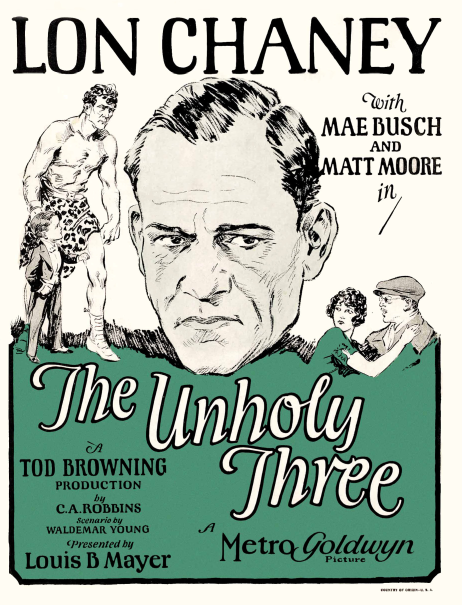
The Unholy Three


The Unholy Three (1925)

(1925)
Directed by
Tod Browning
Written by Waldermar Young, from a novel by Tod Robbins
Starring Lon Chaney, Victor McLaghlen, Harry Earles, Mae Busch, Matt Moore
IMDB Entry  


The Unholy Three


(1931)

Directed by Jack Conway
Written by J.C. Nugent, Elliot Nugent, from a novel by Tod Robbins 
Starring Lon Chaney, Harry Earles, Eliot Nugent, Lila Lee, Ivan Linow

IMDB Entry

In the early days of sound films, occasionally someone would remake an existing sound film as a talkie. The Unholy Three is an interesting example of this, since it was made with some of the original cast and also was the only sound film Lon Chaney made before his early death.

In the original version, Echo (Lon Chaney) is a ventriloquist in a sideshow act. When the show is shut down, he comes up with a scheme with the strongman Hercules (Victor McLaghlen), the midget Tweedledee (Harry Earles), and the pickpocket Rosie (Mae Busch) to steal. Echo dresses in drag as Mrs. O'Malley, the owner of a pet shop. Mrs. O'Malley sells parrots with impressive talking abilities, but they don't talk while taken home. Mrs. O'Malley comes with her infant grandson -- Tweedledee in disguise -- who cases the place as he uses his ventriloquism to make the parrot talk. Later, the two are joined by Hercules to steal whatever they can find.*  Rosie runs the shop, along with Hector (Matt Moore), who knows nothing about the enterprise but who was hired to be a patsy if things went wrong. Despite herself, Rosie falls in love with Hector.

Of course, things go wrong. Echo calls off a job, but Tweedledee and Hercules go anyway, killing the homeowner. The cops start looking into the shop. They frame Hector, but Rosie tries to stop them.

The sound version follows the plot exactly, but to lesser effect. Chaney and Earles reprise their roles, with Lila Lee as Rosie, Ivan Linow as Hercules, and Elliott Nugent, who also had writing credit, as Hector, The difference is the change of director. Tod Browning had a flair for the macabre and certainly liked to portray sideshows and midgets. Jack Conway was workmanlike studio director with little flair.

One interesting difference was the part of Echo's pet gorilla.** In the sound version, it was portrayed by a man in a gorilla suit, but Browning used a chimpanzee and undersized props.  On the other hand, the sound version has Mrs. O'Grady accidentally speaking in Echo's voice, giving away her ruse, something that you couldn't do in a silent film. Also, the characterization of Echo at the end is softened a bit in the sound film, but it does make more sense.

Browning, who started out as an assistant to D.W. Griffith, went on to direct the Bela Lugosi Dracula, but his film after that, Freaks, was both a scandal and a flop and his career petered out. The most successful actor in the cast was Victor McLaghlen, who appeared in many John Ford films and who won an Oscar for The Informer.

__________________________________________________________________
*Echo calls the plan "simple," but it is anything but.

**I told you things were complex.

Sunday, February 27, 2022

Virginia Gregg

Virginia Gregg

(1918-1986)
IMDB Entry

Actors are usually noticed. But some actors can have long careers in small roles and still remain anonymous. And one actor who fits this category is Virginia Gregg.

Gregg was born in Harrisburg, PA, but moved to Hollywood as a child. She started getting parts as a voice actress in radio. There were few shows of the time where she didn’t appear. It seemed like whenever they needed a female actress, she showed up. She played all ages, from ingenues to old women. I kept hearing her name as I listen to Old Time Radio broadcasts.

She also was in many films, and when TV came around, she continued to work. Jack Webb clearly liked her work; she was on Dragnet ten times, his movie The D.I, the 1966 revival of Dragnet, The D.A, Emergency! and Adam-12.  It seems like she was in every dramatic show from the mid-50s to the mid-70s. Then she switched to voicework.  Indeed, her best known movie was the voice of Norman Bates’s mother in Psycho – uncredited.

Why isn’t she well known? Well, first of all it was rare for her to play a recurring character.  Her ten performances in the original Dragnet had her playing a different character each time. And though she was fine at what she did, she did not have the distinctive voice that made someone like William Conrad identifiable. I usually didn’t spot her in a show until they announced the credits. In addition, she did not have the Hollywood looks that got you case in a lead role.  Also, she was in her late 30s when TV came in – too old for a leading actress, especially one whose body of work was small roles.

I don’t think she minded – few people can match her for working steadily for over 40 years.

Sunday, September 22, 2019

William Conrad (actor)

(1920-1994)
Wikipedia Page

One of the joys of having SiriusXM in my car is listening to Old Time Radio. There are some great old radio shows on there, and I began to notice a name popping up all the time in the credits, an actor who made a belated move into TV toward the end of the career, hampered by his appearance. But in the radio days, just about every drama seemed to have an appearance by William Conrad.

Conrad was born in Louisville, KY and, after the war, became a fixture on radio. He estimated he played more than 7500 roles, and I doubt that’s much of an exaggeration.  His deep voice made him a natural for authoritative roles.

His best known role was that of Matt Dillon in the radio version of Gunsmoke. He was perfect in the part, creating a vivid character who fought for law and order, and allowing no nonsense from anyone. Conrad was almost turned down for the part, the producers thinking his voice had been too familiar after all his radio performances, but they changed their mind after the audition.

But when Gunsmoke was adapted for television, Conrad wasn’t considered for the role.

In Hollywood, physical appearance is key, and Conrad was too heavy set. He didn’t fit into the image of a leading man, so was passed over* in favor of the more conventional leading man in James Arness. The radio show continued in parallel, but as radio drama started fading out, Conrad found it harder to get work. His talent got him jobs in movies, usually as a henchman.

But voiceover work became his meal ticket. He was in demand as a narrator for various shows. The most memorable of these were in the various incarnations of Rocky and Bullwinkle, where he narrated their adventures.** Conrad was perfect in the role, and it was one of the times the funny side of him shows.

Finally, in 1971, Conrad made it to TV stardom in the Quinn Martin detective show Cannon, which set up a backstory to explain his physical bulk.  The show was a hit, running five seasons, showing many people the man behind the voice – even if they didn’t know the voice.***

Conrad later starred in a failed Nero Wolfe series, and then had another five-year run with Jake and the Fatman, while still keeping his hand in narration work. He died a couple of years after the show ended, leaving a body of work that anyone would be proud of.
_______________________________________________________
*As was the rest of the radio cast. In his early days, Conrad was just a little bit blocky, but he gained weight as time went on. Photos of him during the Gunsmoke days indicate he was already a bit heavy, plus he was not conventionally handsome at any point.
**Also the adventures of Dudley Do-Right
***Cannon was on a couple of years before I learned that the “Bill Conrad” in the Rocky and Bullwinkle credits was the same guy.

Sunday, April 8, 2018

Buster Crabbe (actor)

image(1908-1983)
IMDB Entry

Buster Crabbe was the king of Saturday morning.  He started out in serials, and when TV came along, he was a success in that, too. If you wanted live-action adventure on Saturday mornings, odds were you saw Buster Crabbe.

Crabbe grew up in Hawaii, where he became a swimming champion, winning a bronze medal in 1928 and a gold in 1932. The latter was held in Los Angeles, so it was natural that he follow in the footsteps of and earlier swimming medalist, Johnny Weissmuller.*  After a few bit parts, he followed in Weissmuller’s footsteps in another way: he played Tarzan in the serial Tarzan the Fearless.

The role didn’t lead to much for several years, until in 1936, when he was cast in the part that he became fully identified with:  Flash Gordon.

Crabbe’s serial became the definitive version of the character, as he faced off against the peril of Charles Middleton’s Ming the Merciless. The special effect were crude, even by the standards of the time.**

The serial was a sensation. A sequel, Flash Gordon’s Trip to Mars was released in 1938, and Flash Gordon Conquers the Universe came on in 1940.In between, he portrayed the other big name of pulp SF, Buck Rogers.

The serials are dated, but you can still see why they were popular and still relatively entertaining.***

Crabbe continued in serials, mostly westerns (including some programmers where he portrayed Billy the Kid as a hero). And when TV came along, he created the role of Captain Gallant of the Foreign Legion.

imageAs the title indicated, Captain Gallant was a commander of a foreign legion fort in Morocco. His son, Cullen Crabbe costarred as the legion’s mascot. The first season was actually shot on location in Morocco with some real legionnaires in bit parts. Gallant would deal with various local villains and uprisings. I remember watching reruns of it on Saturday mornings, long before I had seen the Flash Gordon/Buck Rogers serials.

After Captain Gallant, Crabbe was semiretired, appearing in various guest shots, including playing “Brigadier Gordon” in the TV version of Buck Rogers.

Crabbe died in 1983, leaving behind memories of adventures in young people’s minds.

_____________________________________________________
*Weissmuller’s Tarzan career overshadows the fact that he was a dominant freestyle swimmer, with five gold medals and a bronze.

**Though I must admit I was fascinated by the spaceships – hanging in the air giving off sparks and a strange buzzing sound.  Many of the sets were recycled from earlier productions, as was the music.

***Buck Rogers isn’t quite as good, partly because it had an inferior villain, Killer Kane.  I found it hard to take him seriously, since we used to sell a dandelion killer by that name – a cane filled with weed killer.

Sunday, September 17, 2017

Oscar Levant (actor, musician, wit)

image(1906-1972)
Wikipedia Page

Some people are famous for being famous. That was how I first noticed Oscar Levant in the 60s, most notably from the title of his autobiography, Memoirs of an Amnesiac. All I knew was that he seemed to show up on talk shows and people regarded him well. It wasn’t until much later that I learned about his genius.

Levant was born in Pittsburg, but moved to New York City in his teens, where he studied piano. He became quite good at it, and moved to Hollywood, where he befriended George Gershwin and worked as a composer, writing both film music and hit songs, as well as working on classical pieces.

In the early 30s, he came to public attention as one of the panelists on the radio show Information Please.  Levant became known for his encyclopedic knowledge and his quick wit. He was a master of ad libbing hilarious one-liners.

This became his step toward stardom. He started appearing in movies, usually playing a wisecracking pianist. His most extensive role was probably in The Band Wagon, where he’s songwriting parter with Nanette Fabray.*  He even briefly had a TV show.

His piano playing, though, took him into the classical world. He became known as one of the best interpreters of George Gershwin and his recording of Rhapsody in Blue was for many years considered one of the best.

Through everything, Levant had a rather complicated personal life. He was a massive hypochondriac, and had numerous neuroses, which he was very open about.

He also tended to do his own thing.  Harpo Marx told of how he just showed up on his doorstep one day, announcing he was going to be Harpo’s houseguest and stayed there for months. Levant did that to other of this friends and then, suddenly, announce he was leaving and go somewhere else.

Harpo also praised his piano playing. In one story, he interrupted the performance of a trio, replaced the pianist and finished the piece with them – one he had never played before – so that the others in the group felt like he’d been practicing with them for years.

Levant was a heavy smoker and died of a heart attack in 1972. Much of his radio work has been lost, and the talk show appearances are even harder to find. But I still was able to find one of of his greatest one-liners, the one that showed me he was a comic genius.

There’s not a lot about him on the Internet, and his book is out of print, but he was a man who was always a delight wherever he appeared – neurotic tics and all.

________________________________________________________
*Supposedly, based on Betty Comden and Adolph Green.

Sunday, October 2, 2016

Whit Bissell (actor)

Whit Bissell(1909-1996)
IMDB Entry

Character actors may never be the star, but they are essential to the success of a movie. They have to make an impression that they’re more than just someone walking on and speaking a line, but not be overwhelming.  Sometimes they just fade into the background afterwards.  And Whit Bissell was one of the best.

Bissell took to the theater early, appearing on Broadway in 1933, when he was 24.*  He worked very consistently on the stage for over ten years, then tried his hand a films.  Many of his early roles were uncredited; his first credit was in Brute Force as one of the prison guards.  From then on, there was no stopping him, and he’d appear in 6-10 movies a year.  In the mid-50s, he started to find the niche in which he’s best remembered:  science fiction films.  Starting with Target Earth, he fell into the characterization that became his trademark:  a scientist or other authority figure who was there to help the hero.** 

He had a small but pivotal role in the classic Invasion of the Body Snatchers as one of the two actors in the frame tale.***

His biggest film roles were as a scientist (of course) in the drive-in classics I Was a Teenage Werewolf and I Was a Teenage Frankenstein.

As the studio system died, he switched to TV as an all purpose actor.  Despite being in the medium almost from the beginning, he didn’t have any recurring roles until 1965 (a seven-episode stint in Peyton Place).  His first regular role wasn’t until the next year, where he played General Kirk**** in The Time Tunnel.  He also appeared in Star Trek’s “The Trouble with Tribbles” as the manager of the space station where the trouble began.

Bissell continued to work regularly in TV until the early 80s, when he seemed to retire.  Overall, he appeared in over 300 shows and movies, making his face one of the most familiar of all actors.

_________________________________________
*His debut, appropriately enough, was small -- one of the cards in Eva LaGallienne’s version of Alice in Wonderland.

**I note that in The Atomic Kid, he was billed as “Dr. Edgar Pangborn.”  Pangbourn had a couple of novels out at this time, though not his masterpiece Davy.

***The two scenes – at the beginning and at the end of the movie – were added to the film because the studio wanted a more hopeful ending.  Director Don Siegel hated the change.

****A general was almost the same as a scientist in 50s SF.

Monday, February 2, 2015

Canada Lee (actor)

Canada Lee(1907-1952)
Wikipedia Page
Boxing record
IMDB Entry
Internet Broadway Database Entry

Canada Lee led a remarkable life. In his heyday, he was second only the Paul Robson* as the best Black actor on Broadway.  But the blacklist and health problems cut Lee’s career short, and his insistence on only accepting roles where he was treated with dignity made it difficult for him to get movie roels.

Lee was born Leonard Lionel Cornelius Canegata in New York City.  He knew he wanted to make a lot of himself, and ran away at 14 to be a jockey.  While there were many Black jockeys in the 19th century, they were being squeezed out of the business by the time Lee got involved.  Still, by dint of hard work, he managed to get some mounts and win a handful of races in the New York circuit before he grew too big to get mounts.

That’s when Lee took up boxing.  He had a talent for that, too, and one day a ring announcer, cold reading the name “Canagata, Lee” from a card, billed him ad Canada Lee.  Lee used that name from then on.

Boxing in the early 30s was just as segregated as the rest of society.  After Jack Johnson won the heavyweight crown, white promoters shied away from matching Black boxers with white ones.**  Lee faced the same issues, having success against other Black opponents, but finding it hard to get matches against white ones. Still, he was able to make enough money in the ring to live a prosperous lifestyle – though he never learned how to manage money, and was also very generous with it.

But the boxing came to an end when in 1929 an opponent’s blow led to Lee going blind in one eye.  He kept the injury secret in order to keep fighting, but eventually he had to give up the ring. 

Lee had played the violin as a child with some proficiency, so decided that was his next career.  With the help of columnist Ed Sullivan, he opened a night club, but never was able to make any money at it.

By 1934, Lee was broke.  He realized that he would have to give up his dreams and take a job as a laborer.  He reluctantly headed to the employment office at the Harlem YMCA and stumbled upon his true calling.

A theater group was auditioning .  Lee, to postpone the inevitable, sat in just to watch  Someone asked him to come up and read for a part.  Surprised, Lee got up on stage and got the role.

Lee took to the stage easily.  After one performance, he noticed a young man in the back of the theater being threatened by a couple of men.  He came down and chased them away, to the lasting gratitude of the other, a young man from Kansas named Orson Welles.  Welles later cast Lee as Banquo in his groundbreaking all-Black version of the Scottish Play, which instilled in Lee a love for Shakespeare and classical theater.

Slowly Lee worked his way up, and he finally achieved Broadway stardom as Bigger Thomas in the stage adaptation of Native Son in 1941.*** The play reflected Lee’s penchant for social justice and better treatment for Blacks.  And he also did a lot of radio, his voice making him an ideal announcer and even a DJ.

Lee wanted to do a movie, but he was picky:  he had no interest in playing the sort of menial roles that Blacks were stereotyped in.  Finally, in 1944, he found a role he felt was a good one:  Joe in Alfred Hitchcock’s Lifeboat.  He had to fight to avoid stereotyping even then (the script was changed after he signed on), and racism on the set, but it’s probably his most visible role today.  Even that was an issue: some publicity photos had Lee cropped out.

Lee in LifeboatHe returned to Broadway and continued his success, playing Caliban in The Tempest, and Daniel de Bosola in The Duchess of Malfi.  The latter was a milestone:  the first time a Black actor played a role that had previously only been cast for whites.  Even so, he had to wear special makeup to give him Caucasian skin tones.

Around this time, Lee started getting into trouble.  Always an activist, he often found himself at events where the Communist Party was involved.  The postwar Red Scare was coming into to play, and with it, the blacklist, and Lee was friendly with too many so-called “subversives” to miss notice.  His name appeared on a list of suspected Communists, and from then on, he had trouble finding work.****

Lee traveled to Europe and South Africa to appear in a film version of Cry the Beloved Country.  He continued to speak out against racism, and was particularly outspoken about what he saw under Apartheid.*****  

His health was failing.  He had high blood pressure, probably exacerbated by his worries over the Blacklist.  He recovered a bit in Europe, but returned to the US to promote the film.  There he found he couldn’t get work, and he was not allowed to leave the country.  Desperate and nearly broke, he died in 1952.******

Lee led a fascinating life, and I’m sure there is ample material for a movie about him.  There is a biography, Becoming Something:  The Story of Canada Lee by Mona Z. Smith.  I definitely recommend it to see a pioneer of Broadway who has been lost to time.

__________________________________________
*Their careers had certain parallels:  both started out as athletes (Robeson was an all-American football player and considered among the best of his era), both went into acting, both had a strong social conscience, and both had their careers cut short by the Blacklist.

**Harry Wills was the #1 challenger for the heavyweight crown in the 20s, but was never given a title shot.  Jack Dempsey seemed willing, but the bout never came off.

***Also directed by Welles.

****His former friend Ed Sullivan was particularly vehement, ignoring a letter from Lee asking for help clearing his name and constantly reporting rumors of his subversion.

*****Lee himself was treated well, but he saw plenty of examples about how South African Blacks were treated, which was worse than anything Lee had seen in the US.

******He is occasionally cited as being killed by the Blacklist.  While it certainly exacerbated his problem, the high blood pressure did seem to run in his family.

Sunday, November 23, 2014

William S. Hart (actor)

William S. Hart(1864-1946)
Wikipedia Entry

One of the earliest narrative films genres was the Western, and William S. Hart was one of its biggest early stars by doing something that was unusual in Hollywood Westerns not only in his time, by many years afterwards:  by insisting on making as realistic story as possible.

Hart was born in 1864 and began acting in his 20s, joining various companies and traveling around the US and finally becoming a moderate success on Broadway.*  But Hart was always fascinated by the West.  He knew Wyatt Earp and Bat Masterson, and somehow managed to acquire Billy the Kid’s guns.  He performed in a couple of stage westerns on Broadway, but moved West in 1914, where he quickly became a star, first in short subject, and then in features.

Hart was a stickler for realism; he wasn’t a white knight on a horse, but rather a real man, who would wear old clothes and deal with historical events.  And it caught on:  by 1915 he was Hollywood’s biggest star.  Audiences appreciated his gritty look at the west, with the strong moral sense and relatively sophisticated stories.  He looked the part of a hard-nosed man scrambling to make it in a difficult place.

But by the 1920s, he was falling out of favor.  Audiences began to prefer the cleancut good guy of Tom Mix and others to Hart’s more down-to-Earth version.  After the disappointing box office for Tumbleweeds in 1925, Hart retired from film.

____________________________________________
*Including a substantial part in a stage version of Ben-Hur.

Sunday, April 13, 2014

Andy Clyde (actor)

andy clyde(1892-1967)
IMDB Entry

Moviegoing was a different experience in the 1930s.  No multiplexes, of course, and instead of there being a single movie on each screen, the show went on all evening, with cartoons, newsreels, previews of coming attractions,* and, of course, short subjects.  Nowadays, people are generally only aware of two of the major short subject series:  The Three Stooges and Our Gang (The Little Rascals), but there were many more, and one of the longest lived series were those starring Andy Clyde.

Clyde was born in Scotland, the son of music hall performers.  He moved to the US in 1912 and broke into silent movies with Mack Sennett in 1922, where he established his character – an old man with walrus moustache and wire-rimmed glasses.  He soon began to star in a series of silent short subjects and moved easily into talkies.

When Columbia started doing short subjects, Clyde, who had a contract dispute with Sennett, was the first person they hired.  The Andy Clyde comedies were a mainstay of their program.  He appeared in 77 films until the unit was shut down in 1956, in addition to 68 before joining Columbia.

Clyde always played a father or uncle.  He was mostly a physical comedian; his big strength was his ability to do a double take. 

In addition to his series, Clyde appeared in features, often as a comedy sidekick in 40s westerns, since his persona fit the “grizzled old prospector” images to a T. 

The end of the short subject didn’t mean the end of his career, and Clyde moved easily to television, appearing as a guest star, usually in westerns.  He had recurring roles in The Real McCoys and Lassie, and popped up on shows as diverse at Gunsmoke, Dr. Kildare, The Bob Cummings Show, the People’s Choice, and many others.  He continued to work regularly almost up until his death in 1967.

___________________________________________
*Now they call them “trailers.”

Sunday, January 12, 2014

Charles Lane (actor)

Charles Lane(1905-2007)
IMDB Entry

Charles Lane was the king of the bit players.  It wasn’t until late in life that he had a role he could be identified with, but from the 30s to the 60s he was one of the busiest names in Hollywood:  he appeared in 10 films in 1939 alone.

Lane was born in San Francisco and started out as an insurance salesman.  But the stage beckoned.  Lane made an impression and started appearing in films in 1931.  He became a reliable actor for bit parts; many of his early work only required one or two lines. 

Lane’s appearance stood him in good stead.  Even when young, he had a hawklike profile and a scowl and facial shape that made him stand out. His voice was distinctive – an unforgettable gravelly snarl.  You can often pick out his early appearances by his voice alone. 

He worked hard.  He has talked about how he would sometimes show up in the morning on the set for one movie, say his one line, then go to another studio in the afternoon to do the same thing. 

Some of the classic films he appeared in include 42nd Street, Gold Diggers of 1933, Twentieth Century, Mr. Deeds Goes to Town, Nothing Sacred, You Can’t Take it With You, Mr. Smith Goes to Washington, Ball of Fire, and It’s a Wonderful Life.*

Lane usually played crotchety characters, and when TV came into play, he moved over seamlessly. Whenever someone needed a crusty authority figure to be exasperated by the show’s star, Lane would get the part.  He appeared in most comedies of the 60s, the first person producers called when they needed a curmudgeon.

It wasn’t until 1963 that he got an identifiable role as Homer Bedloe in Petticoat Junction.  Bedloe was always trying to shut down the Cannonball and made a wonderful foil – gruff and sarcastic and always thwarted.  In real life, though, Lane was known to be just the opposite as his sourpuss screen presence – which makes sense; you don’t get that many roles if people don’t like you. 

Off-screen, he was one of the founders of the Screen Actors Guild.

Lane stopped getting roles when he reached his 90s (though even at age 100, he announced he was still available, and his last screen credit -- narrating a short film – was in 2006).  He died at age 102, leaving behind over three times that number of performances to savor.

________________________________________________
*As one of Potter’s yes men.

Sunday, July 15, 2012

Frank McHugh (actor)

(1898-1981)

imageThe contract player is extinct in Hollywood.  These were actors who were under contract with a studio and who were cast in dozens of films to play small and often similar roles.  Sometimes they would work their way up to featured and starring roles, but they were always dependable, both for the job and for their performance.  And Frank McHugh was the very definition of a contract player.

He was born in Homestead, PA, son of theatrical parents.*  By the age of 10, he was appearing on stage, and in 1927, he made his Broadway debut.  The timing was good:  at the time he established himself as a Broadway regular, talkies were coming in and Hollywood was looking to Broadway for new talent.

He signed with Warner Brothers and made his movie debut in The Dawn Patrol with Errol Flynn in 1930.  But that sort of adventure wasn’t his forte, and he started working on more comedic roles, including as one of the reporters in the original version of The Front Page.

He first came to my attention in Footlight Parade, one of the great Busby Berkeley musicals.** It stars James Cagney as a producer of “prologues” – live music shows performed in theaters before the main show.***  McHugh played Francis, the dance director, most notable for telling Cagney “it’s can’t be done, I tell you.  It can’t be done.”  He made in impression in every scene he was in.

Here is a nice compilation of his roles****

Frank McHugh

The movie seemed to spur a friendship with James Cagney; the two appeared in 11 films together.  McHugh appeared in over 100 films and easily made the transition to TV when the studios system collapsed.

____________________________________________
*His sister Kitty and brother Matt also had long careers as contract players.

**With songs by the ultimate great but forgotten composer, Harry Warren.  Eventually, I’ll write about him.

***One of the great bits of movie magic is when you realize that Berkeley’s musical numbers could never be performed on a theatrical stage, let alone the stage in a movie house.

****Footlight Parade has more clips than anything else.

Sunday, April 22, 2012

John Bunny and Flora Finch (actors)

John Bunny(Bunny: 1863-1915
Finch: 1867-1940)
IMDB Entry

Nearly everything that was great in the silent film era has been forgotten. There are a few exceptions, but a combination of neglect once sound came in and a lack of interest today in silent and even black and white movies, means that the biggest stars of the time are known only to film scholars.  Silent comedians fare much better than any other, as long as they’re named Chaplin or Keaton.*  But before Charlie Chaplin revolutionized film comedy, the biggest names in comedy in US films** were John Bunny and Flora Finch.

Bunny was born in New York city and gravitated to the theater.  By 1900, he was appearing on Broadway, and when the new medium of film came along, Bunny jumped in.  His first film, Cohen’s Dream, was released in 1909 and he continued to star in comedy short subjects until his death.

Bunny was fat, and used his physique to great advantage.  He usually played a lower class guy who is only interested in getting away from his wife and drinking, gambling and having fun.

Flora FinchHis wife was usually played by Flora Finch.  Finch was a thin, sour faced women with a prominent nose that made her resemble the bird she was named for.  She was from a British theatrical family and her career paralleled Bunny – reaching Broadway a few years later. Around 1910, she was cast as Bunny’s wife, and the first successful film comedy team was born.

Their films usually followed a pattern.  Bunny would go out to enjoy himself, but would have to deal with the suspicions of his wife.  Finch was a convincing battleaxe, and the perfect foil for Bunny.  Their

By 1915, they were the most popular film comedians, neck and neck with Charlie Chaplin.  But the films ended with Bunny’s death.***  Finch continued to act into the talky days, but by the end of her career was mostly appearing in walk-on roles.

By that time, they had been forgotten.  Chaplin has revolutionized comedy, moving it from a handful of laughs a reel to a handful of laughs a minute.  Films like A Cure for Pokeritis seem too slow paced, and the jokes are not as funny as what we now expect.  Like all silents that didn’t have defenders, most of the Bunny/Finch movies had become lost.****

It’s hard to say how things would have worked out if Bunny had lived.  I doubt he would have been among the great names of the era; I don’t think from what I’ve seen of Bunny his comedy was strong enough to make him a top name.  But perhaps working on a few features would have enhanced his reputation.  Certainly any male and female comedy team owes a debt to these two.
______________________________________________
*Harold Lloyd and Harry Langdon quickly losing ground.

**Max Linder was the biggest in Europe.

***For some reason, fat film comedians tend to die early.  Think of Fatty Arbuckle, Curly Howard, John Belushi, John Candy, and Chris Farley.

****They also gave a start to a comedian who is far better known today, though was never as successful as Bunny during his lifetime.  Moe Howard wheedled his way into the films in various small roles.  It’s hard to determine which ones, since cast lists were never very complete in those days, and most of Bunny’s films have been lost.  But unlike Milton Berle’s claim that he was in Tillie’s Punctured Romance with Chaplin, Howard’s claim is not disputed, since he did work at the studio where Bunny and Finch were making their films.

Sunday, April 15, 2012

Dan Duryea (actor)

Dan Duryea(1907-1968)
Wikipedia Entry

Hollywood was always about typecasting. This was especially true under the studio system, where an actor could develop a type and keep working for years.  Dan Duryea knew his part, and became one of the more entertaining heavies in film.

Duryea grew up in White Plains, NY and tried his hand on Broadway. He got his first break in in 1934 with a small role in Dead End, which got larger as the play continued to run. That led him to several more plays, until he was cast as Leo in the original run of The Little Foxes.  When the play became a film, he reprised the role, and moved to Hollywood to try his luck.

Duryea realized quite early on that he was not leading man material.  There always was a superior smirk in his smile, and sarcasm in his words. So he made the decision to make good use of these and become a bad buy.  He usually played a bully and a coward, someone who would threaten you just for the fun of it, and vicious enough to carry through.  But if he was defeated, he’d be whimpering at the unfairness of how he was being treated.

After The Little Foxes, he appeared in Ball of Fire, cementing his reputation and a sleezy character as a comic villain. He cracked jokes but also made a sinister presence as he did so.  Later, he went into full-fledged villain, the type of guy who would threaten the hero or heroine while smirking all the time as their discomfort.

Other appearances during this time in the Scarlet Street, which he convinces his ex-girlfriend to swindle the mild-mannered Edward G. Robinson.*

Even when he doesn’t play and out-and-out villain, he’s a deliciously unlikeable character.  In The Great Flamarion, he’s the husband of Mary Beth Hughes, and, while not actively bad, he’s unpleasant enough so that you understand her desire to get rid of him

Duryea’s career devolved into B pictures by the 1950s, but TV came around to keep his career going.  He even starred in a syndicated show, China Smith, though I can’t imagine him as a hero.  His final major role was in the first prime time network soap opera, Peyton Place.

Duryea died in 1968. 

______________________________________________
*Robinson, of course, is best known as a gangster, but he was also adept in playing a Milquetoast.

Sunday, January 29, 2012

S. Z. "Cuddles" Sakall (actor)

(1883-1955)
IMDb Entry

S. Z. Sakall S. Z. Sakall only had to appear on screen, and everyone in the audience would smile, even before he said a thing.  He appeared in almost 50 US films, always playing the same character and always charming the audience.

He was born GerÅ‘ JenÅ‘ in Hungary and became a successful sketch writer there under the pen name of SzÅ‘ke Szakáll.*  He moved to the stage in the 1910s, then appeared in Austria and Germany, moving back home when Hitler came to power, and finally moving to the US when World War II began.  His friendship with Joe Pasternak got him work, where he changed his stage name to S. Z. Sakall.

He quickly got work in some of the best films of the early 40s, appearing in Ball of Fire, The Devil and Miss Jones, and Yankee Doodle Dandy (as a prospective Broadway "angel" that is conned into investing in George M. Cohan's first show).  In 1942, he made his best-known appearance as the head waiter Carl in Casablanca. In the late 40s, "Cuddles" was added to his billing by the studio (Sakall didn't like it) and it seemed to fit him perfectly.  When a studio wanted a Germanic comic grandfather figure, Sakall got the call.

His great advantage was his appearance.  He had a chubby face and rotund form and his characters were so charming that it turned him into the loving grandparent most people would want to have.  His accent gave him further personality.  From all accounts, the image of niceness he portrayed was the way he acted in real life.

Sakall continued to work until his death in 1955, playing put-upon Germanic grandfathers to the delight of movie audiences.

_______________________________________________
*Hungarian for "blonde beard."

Tuesday, January 10, 2012

Virginia O'Brien (actress)

(1919-2001)
IMDB Entry

As the song goes, "You Gotta Have a Gimmick." Virginia O'Brien had a gimmick, and it started her on a successful run of movies.

It all started with stage fright. O'Brien grew up on Los Angeles* and developed a desire to act and sing. In 1940, she was cast in a stage musical, Meet the People, when disaster struck.  When she went on stage to sing her number, she was overcome with fright and froze completely. But the show had to go on, and she sung the number, unable to keep from staring at the audience with a "deer in the headlights" expression.  She left the stage thinking her acting career had ended before it started.

But audiences are strange.  When you're on stage, you know when a disaster is happening, but when watching it, you might just think it's part of the show.**  The audience thought it was part of the show, and the deadpan expression O'Brien held during the number was hilarious.

It got her a screen test and a contract with MGM.

She appeared in 14 movies in the 1940s usually as a novelty act.  Here is her appearance in The Big Store.

O'Brien appeared in such classic MGM musicals as DuBarry was a Lady (with Red Skelton, Gene Kelly and Lucille Ball and a Cole Porter score), Panama Hattie (Skelton and Cole Porter again), The Harvey Girls (with Judy Garland, and a score by Harry Warren), and Till the Clouds Go Rolling By (an all-star cast singing the songs of Jerome Kern***).

In 1947, though, as the studio system died, O'Brien's contract with MGM was not renewed.  It was possible that they figured her gimmick was growing tired (though she started singing normally in her later films).  She worked in nightclubs and on TV as a welcome guest star.

Her last film was in 1976.

____________________________________________
*Her uncle was thirties musical director Lloyd Bacon.

**Years ago, in college, I was in a production of South Pacific.  As we were hitting the final notes of "Nothing Like a Dame," the circuit breaker for the entire theater blew, plunging it all into darkness.  We were all upset by the problem, but the audience never realized it wasn't planned.

***Not always well.  The idea of having Frank Sinatra -- then only 31 -- singing "Old May River" seems like a bad joke.  I don't think Sinatra liked it much, either, knowing that not only was he much too young (and too white) to be singing it, but that he had the wrong type of voice for the role.

Saturday, May 28, 2011

ZaSu Pitts (actress)

ZaSu Pitts (1900-1963)
IMDB Entry

In the early 1960s, our local TV station ran reruns of The Gale Storm Show* in the afternoons.  The show starred Gale Storm as a wacky social director on a cruise ship.  Her best friend was Nugie, the ship's manicurist who had a delightfully warbly voice and superb comic timing of every line.  It was my introduction to ZaSu Pitts.

Pitts was born in Kansas around 1900.**  Her unique name was no stage affectation:  she was named for two aunts, EliZa and Susan***.  She moved to Hollywood and started appearing in silent films in 1917, generally comedies.

Her big break came when Erich von Stroheim chose her to play Trina in his legendary production of Greed. Pitts had been generally cast in comic roles; this one was fiercely dramatic.  Trina starts out as Mac McTeague's loving wife, but, after winning the lottery, becomes obsessed with money and more and more miserly, leading to a tragic end.  It is a tremendous performance.

However, the movie's problems**** meant it did little to make her a star.  She returned to comic roles, and it kept her working until sound came in, where her voice was perfect for the character she created:  a somewhat flustered and timid woman, punctuated by vague gestures and a voice that fluttered like a butterfly.

She was tagged in 1931 to star in a series of short subjects with Thelma Todd, but quit in 1933, leaving the Roach Studio for better pastures.  She was a popular supporting player of the 30s.  One director said she ended up on the cutting room floor more than any other actress, since her gestures and expressions tended to upstage the other actors.  Here she holds her own against on of the greats of film comedy:

Her mannerisms and voice were so familiar to moviegoers of the 30s that Mae Questel imitated her when she created the voice of Olive Oyl in Popeye cartoons.

While she never had a real breakthrough role, she enlivened dozens of movies in her career.  Once TV came along, she continued to work regularly, and her role as in The Gale Storm Show was one of the highlights of the show.  In the late 1950s, she developed cancer, but continued to work up until her death in 1963.  Her last appearance was in It's a Mad, Mad, Mad, Mad World.

Even after her death, she had some influence, mostly on account of her name.  There is something about "ZaSu Pitts" that's almost inherently funny when you say it (no matter how you pronounce "ZaSu"), and it is still used from time to time for comic effect.

I think ZaSu would have like that.

______________________________________________
*
Called Oh! Susannah! in syndication.  Back then, it was routine practice to rename shows for syndication, in the belief that people might tune in thinking it's something new.  By the mid-60s, TV executives realized that viewers wanted to watch syndicated shows, so ended the practice.

**Sources vary as to her birth year, dating from 1894 to 1900.  The Social Security Death Index lists her birth year as 1900.

***The name was pronounced a variety of ways.  "Zah-zoo" was most common, though "Zay Soo" was often used in films.  Pitts said the correct pronunciation was "Say Zoo."

****For newcomers, the original movie ran ten hours and was the most costly film of its time.  Von Stroheim cut it down to eight -- suggesting it be shown in two parts.  MGM refused to accept, so he cut it down to four hours, at which point MGM took it away from him and cut it down to a manageable two-and-a-half hours.  But many characters and subplots were cut out,making hard to follow.  The cut footage was eventually burned, though there have been attempts to create the entire film using still photos.

Saturday, January 24, 2009

Michael Dunn (actor)

(1934-1973)
IMDB Entry
Wikipedia Entry

Some actors can't avoid being typecast. Many of them try hard to break through the typecasting, but Michael Dunn knew better. There was one type he was always called upon to play, and he always played it brilliantly.

Dunn was a dwarf. He stood 3' 10" as an adult, and weighed under 80 pounds.  But that didn't stop him from having a very successful acting career -- so much so that, next to Billy Barty, he was the actor people first thought of when the script called for a little person.

By all accounts, Dunn was highly intelligent, and it shows in his acting. He always seemed to bring something interesting to his roles and was never content with just phoning in a performance. Dunn decided quite early on not to let his small stature affect his career.

After trying college and toying with joining a monastery, Dunn moved to New York and started getting small roles* in the theater. He had some success with a cabaret show (Dunn was a fine singer) and got the attention of TV casting directors.

I first saw him when he appeared in the pilot episode of Get Smart as Mr. Big.  But his most notable role was a few years later, when he played Jim West's arch enemy, Dr. Miguelito Loveless, in The Wild, Wild West.

Dr. Miguelito Loveless Loveless was one of television's great villains.  He was a mad scientist, but not one who chewed the scenery at all costs.  Loveless was a cultured man who generally spoke softly and commandingly, but who always seemed to have more going on than the script warranted. Dunn was front and center, a screen presence that made him dominate the scenes he was in.

Alexander A little later, Dunn appeared in his best-known role -- the appearance of Alexander in the Star Trek episode, "Plato's Stepchildren."** Once again, it is a find performance, with Dunn holding his own against Shatner's bravura style.


There was also the TV movie Goodnight, My Love, an attempt at a Raymond Chandleresque hard-boiled detective story, with Dunn as the partner of Richard Boone.  It was an intriguing pair-up -- the hulking Boone and the tiny Dunn. Dunn drove the car, and there was a nice little scene where they left it with valet parking, and the driver had to fit into the seat and pedals modified for Dunn, making a small but significant point about accessibility long before it became the law. The movie was made as a potential pilot for a TV series, but was never picked up.

Dunn continued to work up until his premature death. His physical condition caused heart problems, and he died of it at the age of 38. 

His legacy is important, though.  He was one of the first little person actors to insist on being treated with dignity, and was an inspiration that led to various shorter people to try their luck with acting. But he also deserves to be remember because he was a damn fine actor.

_____________________________________________

*I refuse to say it.

* Best known for the Kirk-Uhura interracial kiss.