(1905-1971) & (1905-1982)
He was probably the most influential and popular of all American detective story writers and editors in the 1930s until the 1970s, yet, Ellery Queen seems to be only live on in the name of one magazine, where many of its readers may not even have read any of his work.
 "Ellery Queen" was the pen name of two cousins, Manfred Lee and Frederick Dannay, who started writing together in the late 1920s. Their first novel, The Roman Hat Mystery, introduced a new star to the lineup of detective sleuths: Ellery Queen.
It was a cute conceit* as were several others. Queen the writer was a strong advocate of the "fair" detective story -- where all the evidence is laid before the reader so that you had a chance at guessing the solution. Queen took it even further by stopping the narrative for a "Challenge to the Reader," where he would say that you now had all the facts you needed to solve the crime and would dare you to guess. These gimmicks helped make the Ellery Queen novels stand out from the many being published at the time.
The early novels -- all of which were titled "The <nationality> <noun> Mystery"** -- used this gimmick to great effect and worked because the solutions were all difficult to guess, but clear once Queen explained it all.
That the big thing they had going for them, since the character of Queen was not well defined. He was introduced as a sort of a upper class snob, son of Police Inspector Richard Queen, who wore a pince nez and quoted Latin aphorisms without bothering to translate.*** He is more mannerisms than a character, and probably would not have lasted long once the gimmick got tired.
Lee and Dannay realized that. Their tenth novel, Halfway House, dropped the nationality in the title (even though the introduction shows they could easily have stuck with it) and had the final "Challenge to the Reader." The title not only fit the mystery, but it also signified that the book would be a "halfway house" into a different form of mystery.
The later books made Ellery more human, the mysteries more than just puzzles. Lee and Dannay set a group of books in Hollywood, but were more successful with several more in the fictional small town of Wrightsville, which he joked had more murders per capita than any other town in the US.
Toward the end, Lee and Danny hired other writers like Theodore Sturgeon and Avram Davidson to flesh out their outlines. My favorite Queen mystery, The Player on the Other Side, was actually written by Sturgeon, and the Davidson title, And on the Eighth Day, is memorable in its portrayal of real-life evil and how it can come up even when we think it's defeated.
In addition to the novels, Queen wrote many short stories, often based upon a "dying clue" -- something the victim did in his last moments that identified the killer, but which is not clear until Ellery Queen shows up.
But Queen was more than a writer; he was an editor (or rather, Dannay was). In 1941, he founded Ellery Queen's Mystery Magazine as a place to showcase mystery fiction, and it quickly became the top magazine in the field, and is still being published today. Queen's anthology, 101 Years' Entertainment, was essential reading to familiarize readers with the best of the genre (no Sherlock Holmes, though -- but that's because it was easy to find Holmes stories, but difficult to find detectives like the Old Man in the Corner, Arsene Lupin, Dr. Thorndyke, Father Brown, Philip Trent, Professor Poggioli, or Ruth Kelstern.****
Lee died in 1971, and Dannay continued his editorship. There were few Ellery Queen stories now and they were strictly puzzles.***** The partnership seemed to work with Dannay coming up with the plots and puzzles and Lee fleshing out the characterization, so the stories after Lee's death were puzzle stories. Danney died in 1982.
So why is Queen not remembered today? Of course, there is the change of taste in mysteries; Queen was too old-fashioned to work in a Raymond Chandler mystery universe. In addition, the Ellery Queen stories never had the type of popular success that someone like Agatha Christie did when translated to other media. There were several movies, but none were major hits and the last US film was back in 1942. In the mid-70s, there was a TV series starring Jim Hutton (and run as a period piece, with Hutton stopping the story to give the "Challenge to the Reader" each show) that ran for one season, but to mediocre ratings.
Without a presence in other media, the novels lost their appeal, especially the earlier ones that were based on gimmicks and sometimes clues that are now badly dated.******
But the books are still fun to read as puzzles and as detective stories. And Queen's work as an editor and anthologist have cast a long shadow on the field.
_____________________________________________
*Though why they did it is a mystery. The stories were written in the third person, and Ellery Queen the detective was clearly not Ellery Queen the author. But it did make thing memorable, and maybe that was the point.
** The Roman Hat Mystery, The French Powder Mystery, The Dutch Show Mystery, etc.
***In the first book, he is said to be retired, married, and living in Italy after the events of the mystery, but that bit of background vanished away.
****It might be easier now, with the Gutenberg Project.
*****It is generally thought that Dannay wrote the plots and puzzles, while Lee handled the characterizations. With Lee gone, the stories were all plots and dying clues.
******The resolution to one book, for instance, is based on the assumption that no man would appear in public without a tie.


 (1918-1997)


 Broadway flops in the 40s. Her marriage to Kerr meant she would make the rounds of Broadway parties, where she gained a reputation for being one of the theater crowd’s funniest people. After contributing sketches to a couple of successful revues, her first full-length success came in 1954 with King of Hearts. By this time, and she had begun writing humorous essays on life in the suburbs for various magazines. In 1957, these were gathered together into a single book: Please Don’t Eat the Daisies.


 (1918-1985)
 The names of the creators of most long-running comics are well known. Jerry Siegel and Jerome Schuster created Superman; Bob Kane created Batman; Stan Lee and Jack Kirby created most of the Marvel superheroes. But one of the greatest of comic creators, a man whose output ran into thousands of comics, is often overlooked. That man is Gardner F. Fox.
 He came into his own in 1940, when he developed the Flash. The idea of a fast-running superhero caught people's imagination* and the Flash became one of the stalwarts of the Golden Age of comics. He followed that up with creating another of the great names of DC comics: Hawkman. Other characters followed, including Dr. Fate and Starman (co-creator of both).
 In the late 70s, I was growing tired of science fiction. I had been devouring it since I saw


 By John Wyndham
 Wyndham continued in this vein for most of his writing career, His next novel, The Kraken Wakes,*** is nearly as good. In it, there's an alien invasion that no one realizes -- because it takes part in the deepest parts of the ocean. And the aliens start to make over Earth so it's all deep ocean.


 Harry Golden led an unusual life. Born in the Ukrane, he ended up in New York City at the age of three and grew up on the Lower East Side. He became a stockbroker, but lost his job in the 1929 crash and was convicted of wire fraud, for which he spent five years in prison. Once released, he moved to North Carolina where he got a job writing for the Charlotte Observer and in 1944 began to put out a bimonthly newsletter called The Carolina Israelite.
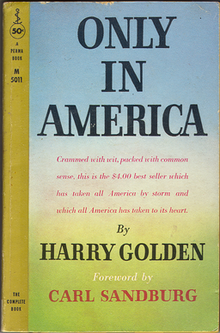 The essays in the book, like much of Golden's writings, fell into three categories. He wrote on general issues for Jewish Americans of the time, with a unique viewpoint as a Jew in one of the least Jewish areas of the country. He was also a staunch supporter of racial equality and wrote eloquently against the segregated South. But the most popular essays were when he reminisced about his boyhood in New York before World War I.


