Showing posts with label science fiction. Show all posts

Sunday, June 28, 2026

The Quatermass Xperiment (The Creeping Unknown)


The Quatermass Xperiment

(1955)
Directed by
Val Guest
Written by Richard Landau, Val Guest fr4om a TV miniseries by Nigel Kneale
Starring Brian Donlevy, Richard Wordsworth, Margia Dean, Richard Wordsworth
IMDB Entry

We now go backwards to the first of the Quatermass films, a milestone in UK science fiction of the 1950s.

Brian Donlevy is the original Quatermass, head of a group putting the first human-crewed market into outer space. It crashes in the English countryside and Quatermass is quick on the scene.  But two of the three men in the crew are dead, their spacesuits empty. The third, Victor Carroon (Richard Wordsworth). stumbles out, saying only two words before collapsing:  "Help me." Carroon is taken to a hospital, but is catatonic and has some odd physical changes happening to him. Carroon's wife Judith (Margia Dean) doesn't think the doctors are doing enough for him, so manages to sneak him out, when he escapes, killing others and going on a rampage.

The characterization of Quatermass changes over the three films. In this one, he is prickly and short tempered, excusing himself because he's a scientist. In Quatermass 2, he's softened a bit. And in Quatermass and the Pit, the new actor, Andrew Kier is much more avuncular and not particularly short with others.

Val Guest, who directed this and its sequel, also directed the great UK SF film The Day the Earth Caught Fire.

Chuck Rothman is author of The Cadaver Princess, from Amazing Story Selects.

Sunday, June 21, 2026

Quatermass 2


Quatermass 2

(1957)
Directed by
Val Guest
Written by Nigel Kneale, Val Guest
Starring Brian Donlevy, John Longden, Synden James, Bryan Forbes, Tom Chatto, William Franklyn
IMDB Entry

Since I highlighted Quatermass and the Pic last week, I decided to check out the other films in the series.  Quatermass and the Pit was the third in the series, so my next step backwards was to see and talk about Quatermass 2.

Bernard Quatermass (Brian Donlevy) is head of an attempted project to set up a base on the moon. One night, his assistants discover signs of thousands of meteorites falling from the sky in the area of Winnerden Flats. Curious, he brings one of his staff, Marsh (Bryan Forbes) to investigate. They find a secret military base that looks suspiciously like the base Quatermass was designing for his moonbase.  As they observer, an object falls and lands on Marsh's feet.  When he examines it, it explodes, putting a v-shaped scar on his face.  Guards arrive and order Quatermass off the property, and takes Marsh, ostensibly to the infirmary.

Quatermass is curious about the installation and he finds Vincent Broadhead (Tom Chatto), a member of Parliament who is also curious about it. He is told it is a government facility making a type of artificual food.  They manage an inspection tour, which is clearing being carefully managed to keep them away from discovering what's behind it. Quatermass finds things that aren't covered in the tour, and Broadhead gets inside one of the domes, only to die, covered by a corrosive black slime. Quatermass thinks this is the beginning of an alien invasion. When a colleague of his tries to warn authorities, he discovers that the commissioner of police has the V-shaped mark and that the aliens have taken over the government.  Quatermass has to act to prevent the alien takeover.

The film is an effective SF monster movie thriller, with a credible alien threat and a fair solution (though it differed from that in the TV series). 

This film features the Bernard Quatermass actor from the first of the series, Brian Donlevy. Nigel Kneale, the writer of the TV series, did not like Donlevy as an actor, mostly because he had a drinking problem. It was one reason why he didn't come back for Quatermass and the Pit. Also of interest in the cast is Byron Forbes, who switched over from acting to writing and directing, with such films as King Rat, The Wrong Box, The Stepford Wives, and Chaplin (writing only).

Another effective piece of SF horror from the time.


Sunday, June 14, 2026

Quatermass and the Pit

Quatermass and the Pit

 (1967)
Directed by
Roy Ward Baker
Written by Nigel Kneale
Starring James Donald, Andrew Keir, Barbara Shelley, Julian Glover
IMDB Entry

Science fiction came to TV early on. One of the first shows in the US was Captain Video and His Video Rangers It will holds the record for the most episodes of a TV show* and set the template for US-based SF as being something mostly for kids. The UK went in a different direction, with several miniseries about the adventures of space scientist Bernard Quatermass**, written by Nigel Kneale, which leaned heavily on horror of a grown-up nature. Quatermass and the Pit was the adaptation of the third of these serials and is a science fiction horror story.

When building a new station on the London Underground, workers discover an ancient ape. Dr, Mathew Roney (James Donald) sees something odd about the ape.  More strangely, a metallic object is discovered.  Professor Bernard Quatermass (Andrew Kier) is discussing plans for his rocket program, objecting to the military, led by Colonel Breen (Julian Glover), attempting to turn it into a military mission News comes to them about the metallic object and, thinking it's an unexploded bomb from the blitz, they go to deal with it.

They soon discover it it impossibly hard. Quatermass thinks it was sent long ago by Martians and when they finally make a hole, they find a creature that looks like a giant grasshopper, that has horns that, in dim light, make them look like the devil.

Breen, of course, pooh poohs the idea and insists it was some kind of German terror weapon.  He's wrong, and the ship has some sort of psychic power that wrecks havoc in London.

The setup is slow and filled with tension.  We know that thd alien craft is some sort of threat, and the movie keeps up the tension by slowly  revealing the situation. I do think the ending is a bit quick after the slow buildup.

This is the third  Quatermass film, developed from a TV series from 1957.  Most of the cast were mainstays of British TV, but I note Julian Glover, who was the last of the Scaroth in one of the best Tom Baker serials of Doctor Who, "City of Death." The film was a Hammer production and the slow build made it quite different from other films from  that studio.

Chuck Rothman's novel, The Cadaver Princess, the story of body snatchers and evil plots in pre-Victorian London, is available from most online book sellers and to borrow from your local library using the Hoopla app.

_________________________________________________________________________
*It ran five days a week for almost six years.

** Note the spelling: there is only one "r."

Sunday, June 7, 2026

When Worlds Collide


When Worlds Collide

(1951)
Directed by
Rudolph Maté
Written by Sydney Boehm from a novel by Edwin Balmer and Philip Wylie
Starring Richard Derr, Barbara Rush, Peter Hansen, John Hoyt, Larry Keaton
IMDB Entry

For decades, Hollywood ignored science fiction. It can probably be traced back to the movie Just Imagine, an attempt at a comedy musical SF films starring the legendary El Brendel. It was expensive and was a major flop, reducing science fiction to Saturday morning Flash Gordon serials for kids. But after the bomb dropped, interest in the genre was renewed and more adult films were attempted. Producer George Pal decided to try it, an hedge his bets by helping to create a new genre: the disaster film. The result was When Worlds Collide.

David Randall (Richard Derr) is a pilot asked to deliver some important photos to astronomer Cole Hendron (Larry Keating). Randall learns that the news is extremely bad:  a rogue star, Bellus, and its accompanying planet, Zyra, are going to crash into Earth.

Hendron goes to the UN to warn them, but he's not believed. He wants to create "arks" to save as many people as he could. He's not believed, but manages to raise money to start the project for one of these. Part of that is getting financing from wheelchair-bound millionaire Sidney Stanton (John Hoyt). They begin work on the ship.  Randall falls in love with Hendron's daughter Joyce (Barbara Rush), which leads to issues. Since not everyone can fit in the ship, a lottery system is set up.

Zyra reaches Earth first, causing tsunamis, volcanoes, and floods.  And there is plenty of interpersonal conflict and issues among the people. It forms the template for a disaster film, even though the genre did not really become a thing for years later.

The special effects were probably top notch for the time, though they pale in comparison to modern effects.  And the movie tries to get the science right. 

Still, the film is a bit slow moving, with a lot of talk about what's going to happen, so it movie is pretty flat in long stretches.  It wasn't as influential as was hoped.*

Chuck Rothman's novel, The Cadaver Princess, the story of body snatchers and evil plots in pre-Victorian London, is available from most online book sellers and to borrow from your local library using the Hoopla app.

____________________________________________________________________
*The second book in the series, After Worlds Collide.

Sunday, December 3, 2023

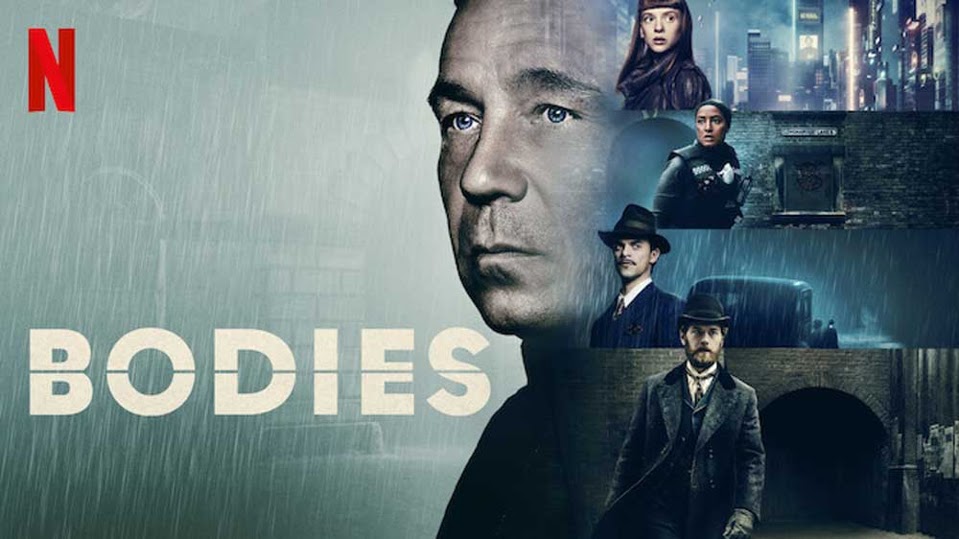
Bodies (TV)


(2023)
Created by Paul Tomalin, based on a graphic novel by Si Spencer
Starring Amaka Okafor, Kyle Soller, Shira Haas, Jacob Fortune-Lloyd, Tom Mothersdale, Stephen Graham. Gabriel Howell

IMDB Entry

Time travel is fascinating, and when I heard good things about Bodies, I decided to take a look.  It was a good decision.

It starts out in the present day. Detective Shahara Hassan (Amake Okafor) is called to investigate a naked corpse in Whitechapel in London. The corpse has been shot in the eye and has a strange tattoo on its wrist. She tracks down a man who found it and, to her utter shock, he commits suicide, uttering the words, "Know you are loved." Her investigation leads her to Elias (Gabriel Howell), a troubled teen.

Then we move to 1941. Charles Whiteman (Jacob Fortune-Lloyd) in out to investigate the death of the same naked corpse in the same location with the same characteristics. He is also following orders from a mysterious woman who contacts him by phone, ending each conversation with the line, "Know you are loved."

The scene shifts to 1890. A third detective, Alfred Hillinghead (Kyle Soller), investigates another copy of the same corpse. A photo was made of it, with a man lurking in an alley.  He goes to find the man and slowly uncovered a conspiracy that's involved with it all.

One more shift to 2053. This time, it's Iris Maplewood (Shira Haas) who's investigating. She is called by Elias Mannix (Stephen Graham), the nation's leader, who took over the country after an atomic bomb destroyed much of London, using the slogan (Know you are loved or KYAL). He sends Iris to get to the root of the matter.*

The miniseries is based on a comic book by Si Spencer with art by Dean Ormiston, and it seems to be a fine adaptation. They keep the story lines straight by using titles showing the year, and often a split screen to switch from one to another. The mystery is strong and revealed in small chunks, as is the relationship between the various stories. What's especially good is the resolution, which is more an example of the butterfly effect than it is a single event.

The acting is all fine. Especially of note is Amaka Okafor as Shahara, a detective and mother who learns that she must act to save her son and family. The characters are all tormented by the events, and the actors play their parts that make you feel their pain. I especially like the way the narratives are woven together, and the logic of time travel.**

You can watch it on Netflix.

_____________________________________________________________________

*It tough to write a spoiler-free synopsis of this without giving things away, especially since you have four different stories, all with some connection. 

**Though I will admit that the final scene, while a terrific sting, doesn't make any sense given what was established.


Sunday, November 12, 2023

Berkeley Square/I'll Never Forget You

Berkeley Square

Berkeley Square

(1933)
Directed by Frank Lloyd
Written by John Balderston (play, screenplay), Sonya Levien (screenplay)
Starring Leslie Howard, Heather Angel, Valerie Taylor, Irene Browne
IMDB Entry

Time travel is a common trope these days, but, outside of Will Rogers's A Connecticut Yankee and several silent iterations of A Christmas Carol, it rarely made it to movie screens. I was surprised to see that one of the earliest sound features with time travel as a major element was Berkeley Square, and its remake I'll Never Forget You.

Peter Standish (Leslie Howard) lives in a house in Berkeley Square in London and is fascinated by its history, finding letters and diaries from its inhabitants from 1784. He begins to believe that he'll be transported to the time and finds it happening.  He takes on the identity of his ancestor from America* and falls in love with Kate Pettigrew (Valerie Taylor), even though arrangements were made for Standish to marry her sister Helen (Heather Angel).  Kate has been betrothed to a gross, rich merchant, a way for her family, who are in financial straits, to get on their feet again.

Peter starts causing trouble by using words that haven't been coined, and by mentioning things that haven't happened yet. People wonder why he can know these things. At the same time, he misses all the 20th century conveniences.**  Kate learns his story and urges him to return to his own time. She says they'll be back again one day in heaven.

Peter returns to his own time. His 18th century counterpart has been in his place, with people thinking he is mad.

The movie is quite slow moving and takes some time to get to the story (though it does open with a frame tale of Peter traveling to London). 

I'll Never Forget You

I'll Never Forget You

(Alternate title: The House on the Square)

(1951)
Directed by Roy Ward Baker
Written by Ranold MacDougall, based on the play Berkeley Square by John L. Balderson
Starring Tyrone Power, Ann Blyth, Beatrice Campbell, Michael Rennie, Irene Browne
IMDB Entry

The remake keeps the same basic plot but does add some differences.  Peter (Tyrone Power) is now an atomic scientist*** who tells his friend Roger (Michael Rennie) of his theory of time travel, and, after a literal stroke of lightning, Peter goes into the past. He falls in love with Helen (Ann Blyth) and she begins to discover where he came from. Peter invents some more modern technology -- electric lights, for instance -- and Helen is impressed. But history says he marries Kate (Beatrice Campbell). In addition to that complication, Peter is deemed mad and sent to Bethlem Royal Hospital (i.e., Bedlam) before he finally returns home. It is then that he meets Roger's sister Martha -- who looks exactly like Helen.

The remake tries to explain the time travel element, but it really doesn't add anything to the film. In this one, though Peter really isn't very smart and goes much too far in giving himself away.  But the ending is a bit better, with its hint that Martha and Peter may be together. And, like The Wizard of Oz, the opening and ending sequences (in the present) are in black and white, while the scenes from the past are in color.

____________________________________________________________________

*Also named Peter Standish

**Plumbing, especially

***Though that has nothing to do with the main plot.

Sunday, January 29, 2023

Sapphire and Steel (TV)

Sapphire and Steel
 (1979-82)
Created and written by
Peter J. Hammond
Starring David McCallum, Joanna Lumley
IMDB Entry

Sometimes you get the wrong impression of a TV series that you heard of but never saw. When I first heard of the UK series Sapphire and Steel, I got the impression it was some sort of private detective show where the stars solved mundane crimes. Having seen it, I couldn't have been more wrong.

Sapphire (Joanna Lumley) and Steel (David McCallum) are two mysterious beings that appear at places where mysterious things are happening, usually involving ghosts. Their origins were never explained, other than their job is to fix anomalies in times. Sapphire has some ability to control time, and Steel can kill the creatures by lowering his body temperature to near absolute zero.  They can also communicate telepathically. It's implied that there are other people carrying out other missions.

The show has a Doctor Who feel to it -- low budget, cheap special effects -- and was conceived to rival the Doctor in its adventures, but didn't quite work as well, possibly due to a lack of humor of the characters. Steel is cold and dismissive of the people they meet. Sapphire is more considerate and more willing to listen to see if it includes any clues to what's happening.

There were six serials of the show, ranging from 4-8 episodes each. The pacing was very slow, but it seemed to work as a way to ratchet up the tension. Another problem was the availability of the main actors, who had thriving careers that led to availability issues. Further, issues with the production company management also worked against it. The final series was basically just burned off.

The show was revived as a series of audio dramas at Big Finish with Susanna Harker and David Warner. 

The show never seemed to have a regular run in the US, probably because of the lack of episodes. But it is an interesting attempt at a science fiction/fantasy series.

Sunday, August 29, 2021

She Devil

She Devil

(1957)
Directed by
Kurt Neumann
Written by Carroll Young and Kurt Newman (screenplay) based on “The Adaptive Ultimate” by John Jessel (Stanley G. Weinbaum)
Starring Mari Blanchard, Jack Kelly, Albert Dekker, John Archer, Fay Baker, Blossom Rock.
IMDB Entry

50s science fiction has the reputation of being monsters attacking. That’s generally true, but from time to time a movie was made with a different focus.  She-Devil doesn’t fit that model as all.

Dr. Dan Scott (Jack Kelly) is working to develop a project that could curse any disease. The only thing he needs is a human subject, but his mentor, Dr. Richard Bach (Albert Dekker) blocks the idea as too dangerous. But Kyra Zelas (Mari Blanchard), a young woman dying of tuberculosis, seems a perfect subject and Scott manages to browbeat Bach into trying.

The cure is miraculous. Within a day or so, the TB is gone, and Kyra is able to get out of bed.  Scott and Bach have her stay at their house so they can observe.And they discover that Kyra can do anything in order to adapt:  change her hair color, manipulate people, and seduce them* as necessary.  Dr. Bach wants to put an end to this, but Dan has already been seduced by her and is very reluctant to act. It becomes a moot point as Kyra quickly adapts to thwart their plans. Soon she is nearly invulnerable, so she leaves the house to find more wealthy prey.

The movie is adapted from the story “The Adaptive Ultimate” by Stanley G. Weinbaum.** I’ve talked about Weinbaum before, but, in brief, he wrote one of the most influential  stories in the entire science fiction genre, “A Martian Odyssey.” The movie stays pretty close to the book. It’s also different from most 50s SF in that there is no actual monster. Kyra is manipulative and cruel, but still human in appearance. The grand climax has next to no action, but the point of the movie is the concept and the puzzle of how to stop her.

Jack Kelly became a TV star a few years later as he portrayed Bart Maverick when James Garner had a contract dispute. Here he is a typical 50s leading man – smart and resolute. Albert Dekker was a minor SF icon as the title character of Dr. Cyclops, though you’d be hard pressed to recognize him, since he hasn’t shaved his head and doesn’t wear Coke bottle glasses. He is the scientist who keeps urging Dan to do the right thing. Dekker had a long career in both movies and TV.

Mari Blanchard was busy as an actress, almost always in small roles. He work here shows a lot of range, moving from a woman scared of dying to being a heartless manipulator. She had made quite a few B movies in the 50s, but retired in 1963*** after being diagnosed with cancer. She died in 1970 at age 47.

Of course, those reading the cast list should immediately recognize Blossom Rock. She looks quite different than Grandmama in The Addams Family, but once she speaks, she’s instantly recognizable.

The movie was overlooked. It was rare to see it in discussions of 50s SF.**** I suppose it was because it didn’t fit in the mold for the genre – no action scenes, no giant monsters. It certainly wasn’t successful enough to cause a buzz for a sequel. I found it quite good, if talky.

-----------------------------------------------------------------------------------------------
*Chastely, of course.  These are the 50s.

**The story was published under his Jessel pseudonym.

***Except for a few small guest starring roles.

****I remember one reviewer (possibly Baird Searles of F&SF) who had no idea it had anything to do with Weinbaum until he saw it and recognized the plot (probably because he didn’t know who Jessel really was).

Sunday, August 8, 2021

Star Hunters (comic book)

Star Hunters

1977-78
Written by
David Michelinie
Art by Don Newton, Don Newton, Bob Layton

Comic books are an iffy medium and there were many times where a comic died early due to lack of interest. One interesting failure was DC’s Star Hunters.

It was an attempt to cash in on the popularity of Star Wars.  Marvel had gotten the rights to the Star Wars characters, so DC created their own. The Star Hunters were a group of space adventurers* who were sent off on a mission by the Corporation to find the origins of human life. Their leader was Donovan Flint,** who tried to complete the mission.  He has no choice:  they’ve all be infected with a virus that will kill them if they ever set foot on Earth again.

The seven issues saw the crew finding out new things about the universe, each other, and the Corporation.

I picked up the first issue because of my love of science fiction and the idea of a space opera series that presented something a bit different and I had liked Michelinie’s continuation of Swamp Thing, which managed to pick up the story and take it in new directions. But this story never actually caught fire.

What I do remember best from it was the cover of the fourth issue.  In issue 3, some danger overtook Fint. And the cover of issue 4 says, “What happens when a hero dies?”

Well, the first rule of advertising is to never lead with a question and my thought at once was “He comes back to life again.’

Still, I think the comic was an interesting attempt at comic book space opera, even though it was ultimately unsuccessful. The title folded after seven issues. The characters have made very sporadic appearances, but lay in the forgotten corner of comic book history. Maybe one day someone will try to bring them back.

_________________________________________________________

*Akin to the crew of the Liberator in Blake’s 7

*Clearly with a nod toward Errol Flynn

Sunday, April 25, 2021

Six Hours to Live

Six hours to live

(1932)
Directed by
William Dieterle
Written by Morton Barteaux and Gorgon Morris(original story), Bradley King (screenplay)
Starring Warner Baxter, Miriam Jordan, John Boles, George F. Marion, Halliwell Hobbes, Irene Ware, Beryl Mercer
IMDB Entry
Full Movie on Youtube

Hollywood was slow to embrace science fiction. Outside of Frankenstein and SF horror, it didn’t really crop up until the 1950, and didn’t become respectable until 20 years later. I was delighted to find a pre-code example when I heard about Six Hours to Live.*

Captain Paul Onslow (Warner Baxter) is representing his county at a treaty conference, where he is the only opposition. His position leads to death threats and when he is returning back to the place he is staying with Baroness Valerie von Sturm (Miriam Jordon), someone takes a shot at him. It misses, but it leads Valerie to fall in love with him, much to the consternation of Karl Kranz (John Boles), her long time friend who loves her. Meanwhile Professor Otto Bauer (George F. Marion) visits the home of Valerie’s father, Baron von Sturm (Halliwell Hobbes) with an exciting new device that can bring the dead back to life – but only for six hours. And when Onslow is strangled, they want to bring him back to catch his murderer.

The idea is a great one, and could have been made into a taut thriller like D.O.A. Unfortunately, they went in a more philosophical direction. I suppose there isn’t much suspense possible with Onslow knowing his murderer from the start, but the story does drag a bit. Still there some good moments, most notably when Onslow gives his money to a prostitute (Irene Ware) in order to give her a new start.**

Warner Baxter was a big star at the time, having just won the first Oscar for Best Actor, and ended up with a long career, most notably as the lead in 42nd Street the same year. Most of the rest of the cast had far shorter careers.

Director William Dieterle was also quite successful, usually with biographies and period dramas. He also did the Max Reinhardt version of A Midsummer Night’s Dream in 1935.

It’s hard to determine the success of the film. Despite the presence of Baxter and some good reviews (The New York Times spoke highly of it), it seemed to have just faded away.

It’s an interesting example of an early SF trope and certainly deserves rediscovery.

________________________________________________________
*A terrific title.

**This being pre-Code, they are quite upfront about her occupation. In fact, Ware is billed as “The Prostitute” in the credits. the Times, however, listed the character as “The Woman” in their review.

Sunday, April 18, 2021

A Trip to Mars (Himmelskibet)

A Trip to Mars

(1918)
Directed by
Holger-Madsen
Written by Ole Olsen from a novel by Sophus Michaelis
Starring Gunnar Tolnæs, Zanny Petersen, Nichola Neiiendam, Alf Blutücher, Svend Kornbeck, Lily Jacobson, Philip Bech, Frederik Jacobsen
IMDB Entry
View entire film on Youtube

People tend to forget how international the silent film industry was. Hollywood was king, but many other countries had film industries and it was relatively easy to translate films so they could be seen in different languages. A Trip to Mars was an example from the Danish film industry, and is a landmark film in many respects.

Avanti Plantearos (Gunnar Tolnæs) decides to make his mission to travel to Mars. Aided by his father (Nicolai Neiiendam) and sister Corona (Zanny Petersen), he spends two years developing the space ship Excelsior, his work scoffed at by Professor Dubius,* who has tried and failed. Nevertheless, Avanti gathers a crew, including his friend Dr. Kraft (Alfe Blütecher) and the American David Dane (Svend Kornbeck). They journey takes months, and after surviving a mutiny, they land on Mars, an advanced civilization of vegetarians who have eliminated all conflict. Trouble ensues, and Avanti is aided by Marya (Lilly Jacobson), daugther of the Mars’s leader (Philip Bech).

The movie it notable in being the first feature science fiction film. Though there were short subjects earlier (e.g., Méliès, A Trip to the Moon), feature films were rare, and science fiction was not considered a good subject. Many of the elements soon became clichés, but weren’t tired in 1918.**

The movie consists of a a series of episodes.*** The mutiny story is quite good for the time, as is the lightning storm and Avanti’s trial.

The film is also a spirited plea for pacifism. Since it was shot while World War I was raging, that’s understandable (Denmark was neutral in the war). There was also a religious theme that seems a bit heavy-handed.

Director Holger-Madsen was an actor and director and continued to direct in Denmark into the 1930s. Of course, once sound came in, markets constricted and Denmark was at an especial disadvantage because the Danish-speaking market was small. Subtitling a movie was far more expensive than reshooting the intertitles, and there was always the problem of not losing them against the background. Danish film suffered and they struggled. The next science fiction film out of Denmark was Reptilicus In 1961.

Overall, though the film is a fascinating look at early cinema, and the effects are pretty good for the time.

Note: The movie is one of many that are available from the Danish Silent Film Website. It’s worth a look if you are interested in silents, and the prints are beautiful

____________________________________________________________
*The pun might be unintentional (the Danish word for “dubious” is “tvivlsom”) but appropriate. Given the other punny names, though (“Avanti” is Italian for “Forward,” for example) they might have actually meant it, or possibly the name was added by a playful translator.

**I don’t know how popular the film was in the US, but it’s unlikely to have influenced Hollywood films. The Excelsior resembles the spaceships in the Flash Gordon serials, but I doubt it was an influence.

***It’s listed as being “in Six Parts,” but I don’t know if it was shown that way or as one film.

Sunday, October 25, 2020

The Devil-Doll

Devil Doll

(1936)
Directed by
Tod Browning
Written by Garret Fort & Guy Endor (screenplay), Erich von Stroheim (screenplay), Tod Browning (story), based on a novel by A. Merrit
Starring Lionel Barrymore, Maureen O’Sullivan, Henry B. Walthall, Rafela Ottiano,Frank Lawton
IMDB Entry

Lionel Barrymore was part of the most distinguished acting family of the 1930s, so it’s a bit surprising to see he would be appearing in a horror film. But given that it was being directed by horror genius Tod Browning, maybe it’s not so surprising. The result, The Devil-Doll, is a nice excursion into the horror genre.

Paul Lavond (Barrymore) is a bank executive who has been sent to Devil’s Island after being wrongly convicted of robbing his bank and killing a guard. He is aided by Marcel (Henry B. Walthall), a brilliant scientist. The two make it to Marcel’s secret lab, where his wife Malita (Rafelela Ottiano) has kept things up. Marcel has developed a method to shrink people and animals, who stay inert until they are willed to move. Marcel dies, and Lavond, joined by Malita, plots revenge.

He returns to Paris and, disguised as the toymaker Madame Madelip, uses the dolls to get his revenge.

The movie is pretty standard horror revenge. The effects – a combination of double exposure and giant props – are quite good for the time as we watch Lavond put his scheme to catch the real criminals into action.

What helps set it apart is a subplot between Lavond’s daughter Lorraine (Maureen O’Sullivan) and the her taxi driver boyfriend Toto (Frank Laughton). She hates her father for ruining the family name. Much of the impetus for Lavond’s revenge is to show her that her father was not a criminal.

Barrymore is a fine actor and actually is fairly believable as Madam Madelip. This was one of the last films where he was able to walk,* so he’s able to get around. It also gives him a chance to be more than just a madman out for revenge: his reason isn’t so much to clear his own name as much as it is to show his daughter the truth.

Tod Browning was the master of horror in the early thirties, with films like Dracula and Freaks, along with several of Lon Chaney, Sr.’s silent films. This was one of his last films. He had already had trouble getting assignments after the controversy over Freaks and it seems that he was blacklisted.

The movie seems to have flopped, but it did get some critical notice, especially for its special effects.

__________________________________________________________
*Barrymore acted out of a wheelchair for the last year of his life, the result of arthritis or a broken hip (sources disagree as to which was the main cause, but Barrymore said it was the hip).

Sunday, September 27, 2020

Otto Binder (author)

Otto Binder

(1911—1974)
Wikipedia Entry

Many of the great comic book creators of the 40s were anonymous. Companies didn’t list the writers like they may have the artists, so people like Bill Finger and Gardner Fox were not given the proper credit.*  One of the biggest and most successful at the time was Otto Binder.

Binder first started out as a science fiction writer, co-authoring stories with his brother Earl using the pen name “Eando Binder”,** starting with “The First Martian” in Amazing Stories in 1932. The collaboration produced a bunch of pulp novels and stories, and one that made a big splash:  “I, Robot.”*** It was one of the first SF stories to portray a robot as something other than a monster.**** As such, it was adapted to comics in 1955 and again in 1965. It was also the basis for an episode of the original Outer Limits with Leonard Nimoy, who also appeared the 1990s version of the show when they did the story again. It led to a series of stories about the robot, Adam Link.

By 1940, Earl stopped writing, becoming Otto’s agent and Otto started writing comics for Harry “A” Chesler’s comic book shop.  He was hired away by Fawcett  assigned to Fawcett’s major title, Captain Marvel. Binder wrote well over half of the Big Red Cheese’s adventures and created most of the characters that made it successful. Binder also worked for other companies, moving to DC when Fawcett stopped publishing comics. He introduced such mainstays as the Legion of Superheroes, Brainiac, Kandor, Supergirl, the Phantom Zone, Lucy Lane, Titano the Super Ape, Bizarro. and Jimmy Olsen’s signal watch. He continued to write Superman stories until 1969. He continued to write science fiction in his spare time, and returned to it after leaving comics.

Binder had a way of understanding the underlying silliness of comics and created character that where both whimsical and serious, often at the same time. His Mr. Mind – a superintelligent worm -- was one of Captain Marvel’s major foes and he managed to make Mr.Tawky Tawney – a tiger with the bearing of a man – into a charming sidekick.

Alas, in 1967, tragedy struck. Binder’s daughter died and it seemed to affect him. His stories became more pedestrian and he became interested in UFOlogy, writing many articles on the subject.

Binder died in 1974, but the characters he created are still  remembered well today.

___________________________________________________________
*Of course, this was often a deliberate decision on the part of the artist (like Bob Kane), but also, while fans might recognize an artist’s style, the writing was not easy to pick out.

**Eando Binder: E–and-O Binder

****Not to be confused with the Isaac Asimov collection of the same name. Asimov has said that he read it and it influenced him to start writing robot stories.  The publisher of his first collection of robot stories used the title, despite Asimov’s objections.

****Lester del Rey’s “Helen O’Loy” beat it to publication by a month (by cover date).

Sunday, March 3, 2019

Mildred Clingerman (author)

MIldred Clingerman(1918-1997)
ISFDB Biography
(A version of this originally appeared in Tangentonline.com)

Science fiction started out as a male abode; the names of early SF writers shows this clearly. While there were women writing in the genre from early on, the numbers were swamped by male names. Over time, this changed.

Mildred Clingerman started publishing in 1952 with “Minister Without Portfolio,” in Fantasy and Science Fiction and appeared there three times that year alone. She quickly became a regular contributor to F&SF and was often chosen to appear in their years Best of … anthology. She was clearly one of the top women writing SF in the era.

Quite a few of her works were anthologized. Not counting single-author anthologies, it looks like 14 of her 19 stories were collected in books.  That’s an amazing percentage.

So how do the stories hold up? Actually fairly well. Some of the social conventions are dated -- the women generally don't work outside the home -- and the stories stick to the assumptions of their time. But the characters are richly drawn, even in the lightest of tales, and the stories run the gamut from science fiction to fantasy to horror. It's a different, quieter voice of science fiction, subtly played and strong on character instead of plot. In many ways they’re a precursor to modern SF.

Particularly memorable stories were the subtle but horrifying "The Gay Deceiver," the ironic "Letters from Laura," and the combination of the two in "Stickney and the Critic."

It's easy to see why the stories were so well received at the time. And how she was an important voice in SF short fiction.

Monday, November 26, 2018

The Man in the White Suit

Man in the White Suit(1951)
Directed by
Alexander Mackendric
Written by Roger Macdougall, John Dighton, & Alexander Mackendrick
Starring Alec Guinness, Joan Greenwood, Cecil Parker, Michael Gough, Ernest Thesiger
IMDB Entry

After World War II, a small English film studio started making a name for itself with small, quirky comedies, with offbeat characters and whimsical concept.  Ealing Studios produced only a handful of films, but a whole bunch of gems, many of which starred Alec Guinness, their biggest star.* And one of the most interesting of them was the science fiction comedy, The Man in the White Suit.

Sidney Stratton (Guinness) is a brilliant research chemist who is obsessed with finding a miracle fiber that never wears out or gets dirty. After years of failure (and explosions), he succeeds:  his creates a fabric that’s even better than he hoped and makes a white suit about it.**  He thinks he’s on the way to strike it rich.

But, though lauded at first, people begin to see the ramifications of the suit. If fabric doesn’t wear out, no one will buy new suits.  If it doesn’t need cleaning, laundries would be a thing of the past. Both plant management and trade unions realized it could be the end of their business, so both try to keep the fabric from being made.  Stratton, of course, is a scientific idealist, who refuses to see the drawbacks of his invention.

Spiffy

Guinness, of course, is great.  That’s a given.  People tend to forget just how much a gift for comedy he had, given that his best known roles were serious ones, but in the early 50s, he was England’s greatest comic actor, using his versatility to take on roles that were all different from each other.

Joan Greenwood is not well known today. She primarily appeared in English actress, often with Ealing, known for her low voice and great dignity. Primarily a stage actress, she had a long career.

When I first saw it, I was delighted to see Ernest Thesiger, who’s best known as Dr. Pretorius in Bride of Frankenstein.

The movie was a big success, being one of the most popular films of the year in the UK and got an Oscar nomination for the screenplay.

The Ealing Studios continued on until 1958.  And The Man in the White Suit is one of their many highlights.

___________________________________________________________
*Guinness didn’t really care much for his role in Star Wars and probably would be preferred to be remembered for his stage work and his films from Ealing.

**Since the fabric repels dirt, it can only be white, though Stratton says you could dye it early in the process and it would stick.  It also glows in the dark.

Sunday, July 10, 2016

Through Time and Space with Ferdinand Fegoot (book)

By Grendel Briarton

FeghootAh, Ferdinand Feghoot.  Traveler through space and time*and always ready to show up in any situation and crack the world’s worst puns.  He even gave his name to the literary form: the feghoot.

It began in The Magazine of Fantasy and Science Fiction.  Grendel Briarton’s** first effort immediately set the stage when, when Feghoot was captured by a shaggy alien with a hand on its head and holding a hypodermic needle.  But Feghoot wasn’t fazed:  he recognized the creature for what it was:  a furry with a syringe on top.

And it continued for years and over 120 variations, all capable of eliciting appreciative groans from any audience.  There were only two rules:  You couldn’t use made up names, and you had to keep it as short as possible.

The first time I encountered one was in an issue of Venture Science Fiction, *** who’s Feghoot told of a Paris landlord who jumped in the river and refused to come out because he didn’t have enough rents to come in out of the Seine.

The concept took off.  George Scithers, editor of Isaac Asimov’s Science Fiction Magazine, helped keep it going with other authors. Asimov himself wrote several, including the brilliant “Death of a Foy.”****

Currently, Steve Pastis uses feghoots in his comic strip, Pearls Before Swine.”

But, if Briarton hadn’t actually invented the genre, he certainly popularized it. The originals are still brilliant puns, if some of the references are a bit dated.

And remember:  a gritty pearl is Michael, L.Ld.

___________________________________
* Preceded Doctor Who by several years.

**An anagrammatic pseudonym for author Reginald Bretnor.

***A short-lived sister publication of F&SF.  It published a full-length novel in every issue, but only lasted a short time in each of its two separate runs.  For many years afterwards, though, the masthead of F&SF had a line “including Venture Science Fiction.”

****Scithers turned it down for Asimov’s, probably because it broke rule number 1.  But if you’re Isaac Asimov, you can break rules.

Saturday, June 27, 2015

Theodore Sturgeon (author)

(1918-1985)
Wikipedia Page
Science Fiction Encyclopedia
Internet SF Database

Theodore SturgeonI’ve been watching Sense8 on Netflix and have been following the commentary on it.  Some have compared it to Philip K. Dick, but the clearest precedent is one of the great writers of the genre:  Theodore Sturgeon.

Sturgeon was born as Edward Hamilton Waldo but changed his name at age 11 when his mother remarried.,  He started publishing in 1937 – mainstream stuff, it seems – but switched to science fiction,  where his first genre story, “Ether Breather,” appeared in Astounding in 1939.

Sturgeon was a prolific short story writer, and he quickly became noted as one of the top names in the genre.  His first truly original story – and most influential -- was “It,” in 1941.  “It” established the concept of a vegetation-based monster like Swamp Thing, The Heap, and Man-Thing.  It’s also a masterpiece of horror, with a scare in it that has rarely been duplicated.  Sturgeon’s monster is scary because it’s not evil, which means its actions cannot be predicted.

“Shottle Bop” from the next year is one of the first in the mysterious shop subgenre of fiction and “Microcosmic God” – about a man who creates a whole civilization of people – is still considered one of the greatest sf short stories of all time.  Some of my other favorites include

  • “Two Percent Inspiration,” a slight story, but one Sturgeon loved for pulling off three plot twists at the end.
  • “Killdozer!” about a sentient killer machine; it’s been dramatized a couple of time.
  • “Baby is Three,”  the introduction of the concept used in Sense8.
  • “Mr. Costello, Hero,” a devastating attack on Joseph McCarthy and the modern culture of surveillance.*
  • “The World Well Lost” – Aliens have (for the time) a terrible secret.  Maybe the first sympathetic treatment of homosexuality in the genre.
  • “The Man Who Lost the Sea”
  • “When You Care, When You Love” – mostly the story of a loving relationship, with a twist at the end.
  • “If All Men Are Brothers, Would You Let One Marry Your Sister?”  Not only a great title, but probably the most dangerous of the Dangerous Visions.
  • “It Was Nothing, Really” – a lighter piece about force fields and toilet paper.
  • “Slow Sculpture” where a woman and a scientist heal each other by their presence.
  • “Not an Affair” about a seduction and a disease that has surprising consequences for the human race.

There are many more.

Sturgeon’s best known influence is from two TV scripts her wrote for the original Star Trek: “Shore Leave” and “Amok Time.”  In the latter, he created the concept of pon farr, wrote the line “Live Long and Prosper,” and suggested the Vulcan salute.**  And, of course, he’s known most widely for Sturgeon’s Law:  “90% of everything is crap.”***  He’s also known in science fiction for his credo, “Ask the next question.”

He only had a handful of novels published.  Sturgeon both preferred the short story and also seemed to go through periods of writers block, which may have caused him to stay away from longer work.  One of his best novels overall wasn’t even under his own name:  The Player on the Other Side was an Ellery Queen novel that Sturgeon wrote with advice from Queen.

It was a cliché of the time that Sturgeon wrote about love.  It’s basically true, but his stories were not just simple romances.  They explored the possibilities of relationships of all types.

Sturgeon was anthologized all over the place during his lifetime; anyone who read SF anthologies would come across his name.  He also had several collections published.****  And, like most short story writers of his era, he’s slowly fading away.  His complete short works are available for completists, and anything republishing stories from his time frame will include something of his.  But reprint anthologies are more for the long-time fan than anyone new.

But he deserves to be listed as one of the true greats of the field.

_____________________________________________
*It was made into a radio play and I was surprised to learn the name of the characters was pronounced COS-tuh-lo.

**Though Nimoy determined what exactly it would be.

***This was in reply to someone saying that 90% of science fiction was crap.  Note that there are various other words used instead of “crap.”

****One was probably the cleverest title ever given to an anthology:  Caviar.  Think about it.

Sunday, March 1, 2015

The Monolith Monsters

image(1957)
Directed by
John Sherwood
Written by Norman Jolly and Robert M. Fresco (screenplay); Jack Arnold and Fresco (story)
Starring Grant Williams, Lola Albright, Les Tremayne, Trevor Bardette, Phil Harvey, Linda Scheley
IMDB Entry

I always liked 50s monster movies, and even today the best hold up pretty well.  Oh, the science is often silly, but once granted the premise, it sticks it with logical solutions and results.  The monster are very similar though:  usually some sort of giant creature that runs amok.  Certainly the most imaginative threat in these shows up in The Monolith Monsters.*

It starts with a meteorite crashing into the desert near a small California town.  Geologist Ben Gilbert (Phil Harvey) finds one of hundreds of black rocks and takes it back for study.  When water falls onto one of the rocks, it starts to bubble.

The next day, Dave Miller (Grant Williams) returns from a business trip to find Ben, his body turned into rock.  Meanwhile, the schoolteacher Cathy Barrett (Lola Albright) takes her class on a field trip, where her kids find more of the rocks, and Ginny Simpson (Linda Scheley) take it home. Cathy recognizes the rock in the lab as the same one that Ginny took with her, and they rush to her house, only to find it destroyed and Ginny slowly turning to stone.

The black rock turns out to be a crystal that grows when exposed to water.  After a rainstorm, the monoliths begin to move:  they grow to immense height, then topple over, breaking into thousands of  pieces that grow when exposed to water, and repeating the cycle.  And they cannot be stopped.

The movie isn't perfect.  The biggest flaw is that to increase suspense the characters are slow on the uptake:  trying to find what causes the monoliths to move, they take forever to realize its water. 

The Monoliths attack!But the monoliths are the stars of the film.  They are a different type of threat:  mindless, moving only the way gravity takes them, and totally dangerous.  The shots of them growing and crashing, destroying anything in their path are impressive.

The story was credited to 50s movie great Jack Arnold, who I've discussed before.  You can see similarities to other of his films, most notably the desert locale and the attempt to make the pseudoscience believable.

The film didn't make much of a splash when it came out, released as part of a double feature and disappearing.  It's fallen into public domain and can be found in the Internet Archive.

Despite the fact that a sequel would be natural, the monolith monsters never showed up again.**  It's still one of the top examples of the subgenre.

_________________________________________
*I had always loved the premise, but didn’t get a chance to see it until recently.

**Other than a cameo appearance in 2001: A Space Odyssey

Sunday, January 18, 2015

The Day the Earth Caught Fire

image(1961)
Directed by
Val Guest
Written by Wolf Mankowitz, Val Guest
Starring Janet Monro, Leo McKern, Edward Judd, Arthur Christiansen
IMDB Entry

The British always did downbeat science fiction well, and The Day the Earth Caught Fire is a minor classic in the genre.

It starts out with an abandoned London, where reporter Peter Stenning (Edward Judd) staggers sweaty in the heat.  He goes to his office, so hot the typewriter platen* is melting.  He then starts to dictate the story.

It’s three months earlier.  The newspaper is humming and Bill McGuire (Leo McKern**) is covering for Peter’s absence due to his personal problems.  But things are going wrong.  There are sunspot and seismic activity that seem to be connected with a nuclear test a few days before. And that’s just the beginning:  a solar eclipse happens ten days early and a massive heat wave envelops Britain. And more and more weather anomalies occur.  Eventually the news gets out:  The explosions have changed the tilt of the Earth – for a start.

The movie is reminiscent of films of the 30s:  rapid and witty dialog (especially from McKern).  Another nice touch is that the newspaper scenes were shot at an actual newspaper, and the editor of the real Express newspaper (Arthur Christiansen) plays the editor in the film.

The results of the changes are well thought out, and the movie does not have a conventional happy ending, leaving the result ambiguous.

Director/Writer Val Guest got his start in science fiction by writing and directing the movie version of  the seminal British SF TV show The Quatermass Experiment.

__________________________________________
*For those of you who have never seen a typewriter, the platen was the cylinder, usually made of rubber, where the keys strike the paper.

**Yes, Rumpole.  It’s odd seeing him so young.  He is one actor who is always a pleasure to watch, and I remember him as the villain in the Beatles’s Help and as Number 2 in The Prisoner.

Sunday, October 12, 2014

Rosel George Brown (author)

(1926-1967)

Rosel George BrownRight now, there is some debate in the science fiction field about the role of women in current science fiction. It’s indisputable that SF has had more male writers than females over the years, but even from the very beginning, women did try their hand at the genre.*  Many are overlooked today, and one that needs to be rediscovered is Rosel George Brown.

Brown was born in New Orleans and lived there most of her life, after getting an MA in Greek from the University of Minnesota. Biographical information is scarce; I believe her birth name was Rosel George, since her husband’s last name was Brown.

Her first sale was “From an Unseen Censor,” which appeared in Galaxy in September 1958.  Most of her short stories appeared there and in The Magazine of Fantasy and Science Fiction. She was praised both by critics and readers of the time.

I imagefirst encountered her with her anthology A Handful of Time, which included most of her best short stories.  It was a book I kept rereading for years, but I seem to have lost my copy in the interim. 

Brown switched over to novels with Sybil Sue Blue, about a female detective of the future.  Sybil was strong and competent, a single mother who has to juggle both her work life and dealing with her teen daughter. 

She collaborated on the novel Earthblood with Keith Laumer.

In this time frame, of course, a lot of the sexist assumptions of the 50s and earlier fit among the more feminist concepts. You can’t blame Brown for that, though. Feminism started gaining mainstream attention in the mid-60s, but Brown’s last story short story came out in 1964, with Earthblood out two years later.    She was diagnosed with lymphoma and died in 1967 at age 41.

That left her to be just a minor footnote in the history of SF.  However, if she hadn’t died so young, she may have been recognized as one of the major names of the genre.

_________________________________________
*John W. Campbell published a story by Amelia Reynolds Long in the third issue of Astounding SF in 1937, and Long had been publishing regularly since 1928.