Sunday, March 7, 2021

Two Seconds

Two Seconds

(1932)
Directed by
Mervyn LeRoy
Written by Elliot Lester (play) Harvey F. Flaw (adaptation)
Starring Edward G. Robinson, Vivienne Osborne, Preston Foster, J. Carrol Naish, Guy Kibbee.
IMDB Entry

Edward G. Robinson made his reputation playing a gangster and often was typecast in the role.* But he was a multifaceted actor** who could play more than just that. In Two Seconds, he’s a man who loses control of his life and suffers the consequences.

The movie starts with an intriguing premise: a man who is going to witness the electrocution of John Allen (Edward G. Robinson) asks how long it takes for a condemned man to die. “Two seconds,” someone replies, then someone adds, “That’ll be the longest two seconds of his life.”

We flash back to John working on a skyscraper with his friend Bud (Preston Foster). After work, Bud takes John on a blind date, but he bails as soon as he sees her and goes to a dance hall, where he meets – and become smitten by – Shirley Day (Vivienne Osborne). They agree to date, despite Bud’s warnings, and Shirley gets John drunk and marries him. A few weeks later, John and Bud get into an argument about her – John still thinks she’s bad news – and John loses his temper and attacks Bud, who  falls to his death

The death brings on a deep depression, so John is unable to work. Shirley goes back to her dime-a-dance life and John slides further into alcoholism and tries to make a big score gambling.

Given the opening scene,  it’s clear where it all ends up.

Robinson accurately portrays a descent into mental deterioration, while Osborne – who had been a success on Broadway – is excellent as Shirley, cold and hard as glass. She is in many ways the precursor to the film noir femme fatale of the 40s. Preston Foster is also good as Bud, as he played the role on Broadway.

Notable in the cast is Guy Kibbee as John’s bookie. Kibbee is best known as a befuddled comic character in Busby Berkeley movies. Oddly, his nice persona works well in this context: the bookie is charming and understanding to his customers.

The movie is a fascinating early version of a film noir – possibly the first -- and is unrelenting as we watch John’s life spin away from him.

______________________________________________________
*When asked what the “G.” stood for, he would say “gangster.”

**For his time. Everyone under the studio system was typecast in one was or another.

Sunday, February 28, 2021

Hail the Conquering Hero

Hail the Conquering Hero
(1944)
Written and Directed by
Preston Sturges
Starring Eddie Bracken, Ella Raines, Raymond Walberg, William Demarest (of course), Franklin Pangborn, Georgia Caine, Freddie Steele, Al Bridge, Jimmy Conlon, Bill Edwards
IMDB Entry

Sturges’s next film after The Miracle of Morgan’s Creek was his last great one. Hail  the Conquering Hero satirized hero worship, politics, sentimentality.

Woodrow Wilson Pershing Truesmith (Eddie Bracken) is sadly drinking in a bar when a group of marines come in, led by Sergeant Heffelfinger (William Demarest).The marines are broke, but Woodrow stand them to drinks, and he sadly tells them his story. His father was a hero in World War I, but Woodrow wasn’t allowed into the marines due to his hay fever, so he spent the war in a shipbuilding plant. Unable to tell his mother about his failure, he had concocted a series of letters which told her he was overseas and fighting the Japanese.

One of the marines take it upon himself to call his mother and tell her Woodrow is coming home a hero and Sergeant Heffelfinger, who served with Woodrow’s father in the Great War, pushes him to go through with the charade.This creates tension with his old girlfriend Libby (Ella Raines), who he broke it off with and who is now engaged to Forrest Noble (Bill Edwards).The town takes to him so much that they push him into running against Mayor Noble (Raymond Walburn). Woodrow, who never really wanted to go along with this at all, is pushed deeper and deeper into the issues from his impersonation.

The movie has some great scenes, notably when Woodrow tries to tell the crowd that he shouldn’t be mayor, and they react by praising his modesty.

Woody is a change from Bracken ‘s performance as Norval in the previous film. He’s not a buffoon but rather a man who is depressed that he couldn’t live up to his image, an honest man caught in a web of lies and who can’t get out. Ella Raines makes a good love interest and Bill Edwards is different from the usual portrayal of the the Guy Who’s Going to Lose the Girl:  he’s a genuinely nice guy and probably would made a good husband to Libby if she didn’t love Woodrow.

William Demarest did his usual thing in a Sturges movie, but other members of the stock company also are memorable, with Franklin Pangborn as a harried organizer of the welcome and Raymond Walburn as the mayor. There’s also Freddy Steele* as Bugsy as one of the marines who had a mother fixation.The movie moves along to a strong – and quite reasonable – conclusion.

A fine film in all respects.

Alas, at this point, Sturges made a career mistake. Frustrated by Paramount’s interference and their tendency to hold back his films,** he joined up with Howard Hughes to form his own production company.***  It took three years before they produced anything. 

In the meantime, Paramount released The Great Moment, which had been completed before Conquering Hero. Sturges seems to have ignored the message of Sullivan’s Travels: the film was a serious look at the development on anesthesia. Paramount foolishly promoted it as another wacky Sturges comedy, and it flopped badly.

Three years later, the partnership with Hughes finally bore fruit with The Sin of Harold Diddlebock. The concept was clever: Harold Lloyd played the character from his film The Freshman twenty years later and stuck in a boring job until he finally broke loose. It’s funny in spots, but not up to the standards that people were used to from Sturges. It only ran a short time. Hughes later recut it and rereleased that version as Mad Wednesday.

Unable to work with Hughes, Sturges dissolved the partnership and joined Fox  for Unfaithfully Yours about a classical conductor who plotted revenge to the tune of various composers. The film was another flop and coupled with the disaster of Diddlebock put Sturges’s career in jeopardy. His final Hollywood effort, The Beautiful Blonde from Bashful Bend and a total disaster and he went to work in France, directing only one movie after that, Les carnets de Major Thompson (The French They Are a Funny Race). It flopped, too.He died in 1959.

Sturges flops have been rediscovered and their critical consensus has improved over the years, and his successes are still well regarded – for good reason. They hold up surprisingly well. He is one of the top names of film comedy of his era and deserves recognition beyond film buffs.

____________________________________________________________
* A former middleweight boxing champion who turned to acting

**Miracle was held back for two years, and an early film, The Great Moment, was also slow to the theaters.

***Leading him to be one of the few to be credited as writer, director, and producer.

Sunday, February 21, 2021

Miracle of Morgan’s Creek

Miracle of Morgan's Creek

(1943)
Written and Directed by
Preston Sturges
Starring Eddie Bracken, Betty Hutton, Diana Lynn, William Demarest, Brian Donlevy, Akim Tamaroff
IMDB Entry

Sturges’s next film is my favorite, a glorious combination of bawdiness and slapstick. The Miracle of Morgan’s Creek is one of the greatest of Hollywood comedies.

The film starts out with a scene in the Governor’s office, where McGinty (Brian Donlevy) and the Boss (Akim Tamaroff)* receive a phone call about a crisis in the town of Morgan’s Creek. Then we go back nine months, where Trudy Kockenlocker (Betty Hutton) decides to go out partying with a group of soldiers who are shipping out. She wakes up the next day with a crazy story she tells to her sister, Emmy (Diana Lynn): that she met a soldier named “Ratzkywatzky or Zitzkywitzky” and, seriously drunk, they decided to get married -- under assumed names, of course. They even decided to use a cigar band for the ring!  Funny stuff until Trudy discovers a cigar band on the ring finger of her left hand.

Soon she discovers she’s pregnant.

Of course, there is no evidence of the marriage and a single mother in 1942 could only have disgrace in her future. Luckily, there is an option: Norval Jones (Eddie Bracken), who has been in love with her for years at a distance, is the perfect fall guy. Norval is clumsy and awkward, and do anything for Trudy. It is complicated by Trudy’s father, Constable Kockenlocker (William Demarest), who complicates the matter when trying to help.

This was pretty bawdy stuff for the time. I note  that Trudy had to be married before getting pregnant, undoubtedly because the censors would wouldn’t allow anything else. There was also the name “Kockenlocker,” which is spoken an inordinate amount of times (in one scene with him, Norval ends every sentence with “Constable Kockenlocker”). It certainly hints at something fairly obscene. Sturges always tried to stretch the bounds of what the Hayes Office allowed, and this was a particularly edgy example.

Eddie Bracken was not a major star when cast in the role of Norval. He plays the stuttering and slightly stupid nice guy to perfection and makes the movie work. Betty Hutton was something of a sex symbol but shows herself an adept comedienne as the sweet but slightly dumb Trudy. And contrasting her is Diana Lynn’s more sardonic sister.

But the real delight is William Demarest. He was always a treat in Sturges, but this was his biggest role so far, and his bluster and crustiness (with a heart of gold beneath) is wonderful from start to finish.

A favorite scene of mine is where Constable Kockenlocker is trying to get Norval to break out of  his jail without being obvious about it. So you have him saying something like, "If you take the keys from my belt, you can unlock yourself when I'm looking," only to have Norval reply, "Oh, I'd never do that, Constable Kockenlocker." Demarest's frustration is worth the price of the movie.

The movie was a massive success, Paramount’s top-grossing film of the year.

___________________________________________________________
*Yes, from Sturges’s The Great McGinty. This is one of the few times where characters reprised their roles in a movie that wasn’t actually a sequel.

Sunday, February 14, 2021

The Palm Beach Story

The Palm Beach Story


(1942)
Written and Directed by
Preston Sturges
Starring Claudette Colbert, Joel McCrea, Mary Astor, Rudy Vallee, Sig Arno, William Demarest, Robert Dudley
IMDB Entry

After Sullivan’s Travels, Sturges dropped the obvious social commentary and went back to straight comedy. The Palm Beach Story is a return to pure screwball comedy, with some themes that snuck by the Hayes office.

Tom (Joel McCrea) and Gerry Jeffers (Claudette Colbert) are a couple whose marriage is falling apart due to financial stress. Gerry decides that the way to relieve it is to get a divorced, so after getting some money from the Wienie King, she takes a train down to Palm Beach. But on the trip down, she meets millionaire John. D. Hackensacker (Rudy Vallee) and sets her sights of marrying him after she’s free. She then expects to use the money to help out Tom, who needs it to finance a new invention. Tom, learning about her plan to divorce, flies down to Palm Beach to stop her, and ends up involved with Hackensaker’s sister the Princess Centimilla, an oft-married femme fatale. Also involved in the trail trip is the Ale and Quail club, who are going down to Palm Beach to shoot (and to drink ale).

The plot is complicated, with confusion over who’s  pretending to be who, with a bizarre twist at the end that cuts through all the problems.

It’s mostly Colbert’s movie and she shows her usual comic gift.* McCrea is fine, but is overshadowed by the other character actors around him. Mary Astor has film immortality from The Maltese Falcon, and in this case that mercurial personality is perfect for the part. Rudy Vallee was considered a washed-up crooner; the part gave him a new  lease on his career. And, of course, the Sturges stock company was there, headed by his favorite, William Demarest as one member of the Ale and Quail Club.

The Ale and Quail Club
The censors found a lot to object to in the early drafts of the script, most notably the notion of divorce,** the many marriage of Centimilla (they cut down a few), and the idea of a married woman romancing Hackensacker. But Sturges made some cuts to get the movie films, and always had a way of getting past the censors when he wanted to.

The return to comedy was a success and The Palm Beach Story is a classic of screwball  comedy.

___________________________________________________
*There are echoes of her role in It Happened One Night.

**It was rare for there to be any sign of divorce in movies, and in comedies the divorcing couple always ended up back together at the end. The first portrayal of a divorced woman who didn’t go back to her ex, and who managed to make a successful life afterward was probably in Miracle of 34th Street, where Doris Walker has successfully moved on.

Sunday, February 7, 2021

Sullivan’s Travels

Sullivan's Travels
(1941)
Written and Directed by
Preston Sturges
Starring Joel McCrea, Veronica Lake
IMDB Entry

By 1941, Preston Sturges was now a big enough name director to be featured in film trailers, but seemed to be considered less important because he filmed comedies. His next film, Sullivan’s Travels, was clearly an answer to that criticism, and to comment on Hollywood’s penchant for undervaluing comedy.

The movie is about John L.Sullivan (Joel McCrea), a Hollywood director who yearns to tackle serious subjects. When his next project, a serious look at poverty in American called O Brother, Where Art Thou* is turned down, Sullivan, who has never actually been poor, decides to go of on his own as a hobo in order to see real life.  On the way, he joins up with a woman (Veronica Lake) who is sympathetic to his “plight,” but who becomes furious when she realizes he is very well off.

Sullivan starts out again. His identification is stolen and he ends up in a prison farm, looking for a way to straighten anything out.

McCrea handles the comedy well, especially since the character as egotistical and somewhat naïve.

Veronica Lake and Joel McCrea

Veronica Lake was a 40s phenomenon, a major star mostly due to her hairstyle, a long lock that fell down over her right eye. Sullivan’s Travels was one of her several successes of the time. But her career started collapsing after only a few years. She cut off the long hair at the request of the Defense Department, since women workers copying the style were getting it caught in machinery. She was less distinctive without it, and she had already developed a reputation of being difficult to work with. A drinking problem added to her fall. Her later years had few successes and she ended up leaving Hollywood, even spending some time working as a waitress.

The movie didn’t do as well as Sturges’s earlier ones. It got some good critical buzz, but the seriousness of the theme worked against it.** It also was

_______________________________________________________
*That’s where the George Clooney movie gets its title.

**Ironic given the fact that the film was a complaint against too much seriousness. But much of the film shows people in poverty and the big scene takes place in a theater filled with prisoners. Of special note was that one scene portrayed a Black church and portrayed Black parishioners respectfully. It’s a sad commentary on Hollywood values of the time that this was enough to get a commendation from the NAACP

Sunday, January 31, 2021

The Lady Eve

The Lady Eve

(1941)
Written and Directed by
Preston Sturges
Starring Henry Fonda, Barbara Stanwyck, Charles Coburn, William Demerest, Eugene Pallette
IMDB Entry

We continue our overview of Preston Sturges with his next hit, They Lady Eve. His success with The Great McGinty and Christmas in July allowed him to use some top-of the line actors in a movie that’s a comic retelling of the Garden and Even.

Jean Harrington (Barbara Stanwyck) is a con woman  who works in tandem with her father Colonel Harrington (Charles Coburn). On a ship, they set their sights on Charles Pike (Henry Fonda), an rich heir who is traveling home after an expedition to the Amazon to study snaked. Jean makes a play for him, and hooks him easily, but the con falls apart  when the falls in love with him. Even worse for her, Charles’s valet, Muggsy (William Demarest) does some snooping of his own and discovers the truth. Charles dumps her.

Jean, angry and jealous, gets back at Charles by posing as the Lady Eve Sidwich and quickly raps the naïve Charles around her finger. And the complexities grow.

Both leads are, of course, first class. Henry Fonda is not often classed as a comedian, but he could handle it with the best of them, and by playing it all straight, it makes it al funnier. The same can be said of Stanwyck, who clearly is having fun with the role. She makes a great comic temptress, exuding too much sexuality for Charles to stand. The entire movie plays with the Adam and Eve there, except now Eve tempts the man who studies snakes.

I can’t go without mentioning William Demerest. The plot depends on Charles not realizing Jean and Eve are the same woman and Sturges had the audacity to let the audience know that it’s just a convention.  Muggsy spends much time trying to convince Charles of that, but Charles refuses to listen.

Sturges love for bawdiness is in full  string here, especially in a scene where Eve tells Charles all the men she’s  been with.  He gets around the censors by just showing Charles’s reaction.

The movie was another hit for Sturges and began to show his forte for bawdy situation and great slapstick.

Sunday, January 24, 2021

Christmas in July

Christmas in July

(1940)
Written and Directed by
Preston Sturges
Starring Dick Powell, Ellen Drew, Raymond Walburn, Ernest Truax,
William Demarest
IMDB Entry

After the The Great McGinty was shot, writer-director Preston Sturges wasted no time  in shooting his second film. Less and a month after it wrapped, shooting began on his follow up, Christmas in July.

Jimmy Macdonald (Dick Powell) is an office worker who dreams of glory, entering every contest he can find so that he could use the winnings to marry his girlfriend, Betty Casey (Ellen Drew). His current dream is to win the Maxford House Coffee, with the slogan, If you can’t sleep at night, it’s not the coffee -- it’s the bunk.”

A group of coworkers prank him by sending a fake telegram telling him he’s the winner. and he goes off the Dr. Maxford (Raymond Walburn), owner of the coffee company, in order to collect the money. No winner had been announced, but Maxford assumed they forgot to notify him and, seeing the telegram, he writes the check and Jimmy goes off to spend it. But eventually, the truth comes out and Jimmy is in deep trouble..

As is usual for Sturges, it’s populated with idiosyncratic characters and frenetic situations. Powell by this time had the role of a charming romantic lead down pat.* and Ellen Drew is also quite good. The Sturges stock company showed up, most notably William Demarest as the head of the slogan judges.

And the twist at the end is one of the funniest in film.

The movie was another hit for Sturges, and two successes in only two months put in into the forefront of top directors.

___________________________________________________________
*Though a few years later he remade his image as a hard-boiled detective with a sense of humor.

Sunday, January 17, 2021

The Great McGinty

The Great McGinty

(1940)
Written and Directed by
Preston Sturges
Starring Brian Donlevy, Akim Tamiroff,  Muriel Angelus, William Demerest
IMDB Entry

Last week, I wrote up a blog post on Easy Living, a movie with a script by Preston Sturges. But I realize that Sturges fits firmly in the category of Great but Forgotten. These days, you have to be a big film buff to know the name, but in his heyday he was one of the great comic minds of film,a man able to use both witty dialog and lowbrow slapstick as needed for a gag. But since he didn’t show his face, he gets overlooked. So I’ll be doing an overview of some of his films in the next few weeks, starting with the one that got him into the director’s chair:  The Great McGinty.

The film starts in a small bar in South America where Dan McGinty (Brian Donlevy) is the bartender and starts to tell his story to an American visitor.  McGinty was a tramp who took up an offer of $2 per vote to vote under a false name, and does it so well, that the political boss (Akim Tamiroff) starts rising in the machine, eventually being elected mayor as a reformer. He marries Catherine (Muriel Anglus) to prove his credentials as a family man and rises to become governor – before he falls.

The movie is a satire on old-fashioned machine politics of the era, but still holds up well  today.

Sturges had written the script and sent it to Paramount, who wanted to go forward. But Sturges had one condition:  he would sell the script to Paramount for $10, but only if he were allowed to direct the film. This was unheard of in Hollywood,* but Paramount agreed and Sturges ended up being the first to have a “Written and Directed by” credit.

Even better:  the movie was a hit. And Sturges won a best screenplay Oscar, making it the least expensive screenplay ever to win the award.

As for the cast, most were chosen because they were under contract and came cheap.   Brian Donlevy had been a dependable actor, though never really a star before this. His best-know role after this (in the UK,at least) was as the title character in The Quatermass Xperiment.

Akim Tamiroff’s accent meant he specialized in portraying foreigners. Probably his best-known role these days was Joe Grandi in Orson Welles’s Touch of Evil.  Muriel Angelus had a spotty career. This was her only lead role (and final film) but she is quite good as the woman who convinces McGinty to change his ways.

The film also introduced the actors who became part of Sturges “stock company,” who he used time and again in his movies.  Most prominent was William Demarest, who appeared in eight of Sturges’s films, plus two others he wrote.

A great beginning to a fine directorial career.

___________________________________________________________
*Except for Charlie Chaplin, who was sui generis.

Sunday, January 10, 2021

Easy Living

Easy Living

(1937)
Directed by
Mitchell Leisen
Written by Preston Sturges from a story by Vera Caspary
Starring Jean Arthur,  Edward Arnold, Ray Milland, Mary Nash,Luis Alberni, Franklin Pangborn, William Demarest, Robert Greig
IMDB Entry

Preston Sturges is one of the most overlooked great names in film comedy. You have to be a film buff to know of him, yet his films are still riotously funny today (not an easy trick). And his career was very unusual for the time: he started out as an uncredited dialog writer and moved on to do screenplays. Easy Living showed him in full flower before he moved on to being a writer/director.

J. B. Ball (Edward Arnold), a rich banker, is incensed that his wife Jenny (Mary Nash) has wasted money on an expensive fur coat and tosses it from the roof of their penthouse, where it lands on Mary Smith (Jean Arthur). She tries to return it to Ball, complaining that it broke the feather on her new hat. Ball takes her – dressed in the mink – to the shop of Van Buren (Franklin Pangborn), who draws the conclusion that Mary is Ball’s mistress. Rumors spread and Mr. Louis Louis (Franklin Pangborn) – who is trying to get on Ball’s good side – offers her a suite. Mary still has no money, and, when she tries to find a way to steal a meal at the Automat, runs into Ball’s son, John (Ray Milland). Thinking he’s penniless, too, she lets him stay with her.

No one was Sturges’s equal in combining smart, snappy dialog with out-and-out farce and is clearly shows here. The idea about a comedy about a man’s supposed mistress might have gotten in trouble with the Hayes office, but the concept is hinted at subtly enough as to be easily missed.

I’m used to seeing Edward Arnold play a banker, but this one is different, where he actually is humane. Jean Arthur is one of my favorite 30s actresses, and this is a slightly different type of role. She usually plays a smart women, but Mary takes awhile to figure out what is going on about her.

Director Mitchell Leisen also came to directing in an unusual way: he was a set designer and moved on to directing in the mid-30s.

Jean Arthur, Ray Milland, and, to a lesser degree, Edward Arnold, were established Hollywood actors for many years. The movie also included Franklin Pangborn, Robert Greig, and William Demarest, who became part of Sturges’s “stock company” in later years.

It’s a successful comedy of its time that is still funny today.

Sunday, January 3, 2021

The Sinking of the Lusitania

The Sinking of the Lusitania

(1918)
Directed, Written, and Drawn by
Windsor Mckay
Wikpiedia Entry
Full Movie on Youtube

Name a shipwreck.

Chances are, you thought of the Titanic. And that’s not surprising, given how it has been talked about and turned into blockbuster movies. But for many years, the Titanic had faded into obscurity, not to be revitalized until Walter Lang had a best seller with his book A Night to Remember in 1955. Up until  then, however, the shipwreck people remembered was the Lusitania.

This main reason was its historical importance. The ship was sunk by a German U-Boat, at a time they claimed the right to sink any ship, passenger or warship, and became a catalyst for the US entering World War I.*

Windsor McKay was one of the great cartoonist of all time, creator of Little Nemo in Slumberland and Dreams of a Rarebit Fiend, both of which are still influential over a century after they were created.  He also was arguably the inventor of the animated film.**

The movie begins with a look and McKay  and his studio looking at photos of the ship and talks briefly of the 25k drawings needed to make the film and the technical issue of creating the look of the sea. It then tells the story of the ship, how it sailed and was hit by German torpedoes. It’s a propaganda film, or course, filled with remarks about the heartless hun torpedoing a passenger ship.***

The images are arresting and the ship was probably a pinnacle of animation in its time, filled with attention to detail. It ran for twelve minutes, making it the longest animated film up to that point. It’s still a powerful statement.

__________________________________________________________
*It raised outrage at the time. The sinking caused them to back off, but when they tried to reinstate it, the US declared war.

**It’s always iffy to call someone the inventor of an art form, but McKay was clearly one of the first, and the first to make a name for himself doing it. His Gertie the Dinosaur is still listed as one of the greatest cartoons of all time.

***The point of unrestricted submarine warfare was to prevent the allies from sneaking munitions into the UK on passenger ships. Afterwards, the UK insisted there was nothing of that nature aboard, until 1982, when the finally admitted there was ammunition on the ship.

Sunday, December 27, 2020

Beyond Tomorrow

Beyond Tomorrow

(1940)
Directed by
A. Edward Sutherland
Written by Adele Comandini (screenplay & story), Mildred Cramm (story)
Starring Harry Carey, C. Aubrey Smith, Charles Winninger, Maria Ouspenskaya, Richard Carlson, Jean Parker, Helen Vinson
IMDB Entry

In the 1940s, there was a small boomlet in a subgenre of dead people coming back to life, often in order to help others.The general explanation of their popularity is that, with people losing loved ones to the war, it was comforting to see an afterlife where the dead could still interact.* But one of this genre predates America’s entry into the war, but still has the theme:  Beyond Tomorrow.

Wealthy engineers George Melton (Harry Carey), Alan Chadwick (C. Aubrey Smith) and Michael O’Brien (Charles Winninger) are spending Christmas together in George’s mansion, joined by Madam Tanya (Maria Ouspenskaya). With nothing to do, the decide on a game:  each one throws a wallet with ten dollars and their business card on the street and see what happens. The result is that two people show up at the house:  James Houston (Richard Carlson) and Jean Lawrence (Jean Parker). James and Jean are attracted to each other and fall in love.

The three men go to fly to another city, despite Madam Tanya’s warnings that the trip is unsafe. Tanya is correct, and the three die, just before Jean and James come over to announce their engagement.  It throws a damper on it, but the two follow through on it, even getting some money in one of the men’s will.

Meanwhile, the three ghosts show up at the mansion to help out the young lovers. You see, James has become attracted to a golddigging actress (Helen Vinson) and it’s breaking up the marriage.

The movie really has two parts. The first half is a charming romantic comedy, but the second half falls into melodrama with ghosts trying to fix thing. The three ghosts have echoes of “A Christmas Carol,” though they don’t interact with the romantic leads.

The older actors are all long-time Hollywood veterans and show why as they never were wanting for work.  Richard Carlson had a long career in TV and movies, but his TV works was in guest star roles. Jean Parker also continued to work in movies until the mid-60s. Director Eddie Sullivan had directed W. C. Fields along with the comedy-horror The Invisible Woman.

______________________________________________________

*Given 2020, I wonder if it might be revived.

Sunday, December 13, 2020

Cruisin’ (Music)

Cruisin' 1956


(1970-1978)

Created by Ron Jacobs
Tribute Page

Nowadays, when you have your pick of oldies channels on SiriusXM, and when oldies stations have been a part of terrestrial radio for decades, it’s hard to understand what the situation was back in the 1960s. Oldies were considered disposable; top 40 radio rarely played anything more than a year old.* But in 1970, record producer Ron Jacobs figured the way to market them:  the Cruising series.

Jacobs grew up in Hawaii and started working in radio at the age of 15. By 1962, he was working as a DJ and program director, eventually working his way up to KHJ in Los Angeles and was noted for pushing his stations to number one in the market. After that, he moved on to produce American Top 40 with Casey Kasem and began the dream project of Crusin’ in 1970.

The concept was as brilliant as it was simple. Jacobs chose the top singles from a particular year and  put them on a disk with the voice of well-know DJs of the era, as well as advertisements, so it was just like listening to a radio show. The first entry Cruising 1956 was typical. Robin Seymour, who was working in 1956, was the DJ:

SIDE ONE:
Robin Seymour Theme -- The Four Lads
Roll Over Beethoven -- Chuck Berry
Recommended Record Stores
Eddie My Love -- The Teen Queens
Faygo Root Beer commercial
Why Do Fools Fall In Love -- Frankie Lymon & the Teenagers
Robin Seymour's Original Rock 'n' Roll Review
Tonite Tonite -- The Mello Kings
Dog Pound (remote) announcement
Fever -- Little Willie John
1956 Ford Commercial -- The Four Lads
The Great Pretender -- The Platters
WKMH station ID
SIDE TWO:
WKMH sports headlines -- Van Patrick
Tutti Frutti -- Little Richard (
Sunday Show Promo
Stranded in the Jungle -- The Cadets
Merchants Green Stamp commercial
Speedo -- The Cadillacs
WKMH jingle
Gee -- The Crows
Budweiser® commercial -- The Crew Cuts
In the Still of the Night -- The Five Satins
Detroit Times commercial
Honky Tonk -- Bill Doggett

As you can see, it was clearly a radio show of the time. Some songs that are classics, but also a few that have faded from memory, even at the time the records were release.

Jacobs continued with the series over the next few years, each record advancing a year and with a different DJ.

Cruisin' 1960

One of the charms of the series were their covers. Done in comic book style, they showed scenes from the lives of Peg and Eddie. The two would age and change (Hairstyles especially) as time went on.

The series continued to several years. The first series (1956-1962) was successful enough that Cruisin 1955 and Cruisin’ 63 were produced a year and a half later. and in 1973 four other volumes were produced, taking things to 1967. Later volumes were added in the late 80s and early 90s.

______________________________________________________
*I was amazed when a friend of mine recognized “Come Go With Me” from the Del-Vikings from an oldies collection I had, since I had never heard of it before.

Sunday, November 29, 2020

Top of the Lake

Top of the Lake

(2013)
Created and Written by
Jane Campion, Gerard Lee
Directed by  Jane Campion, Garth Davis
Starring Elisabeth Moss, David Wenham, Peter Mullan, Jacqueline Joe, Tom Wright, Holly Hunter.
IMDB Entry

Jane Campion came to notice with her direction of The Piano, a dark drama of forbidden love that won Oscars for herself, Holly Hunter, and Anna Paquin. In 2013, she turned to TV with the intense drama Top of the Lake.

Tui Mitchum (Jacqueline Joe), a 12-year old girl, is found standing in an icy lake. When she is rescued, they discover that she is pregnant. Robin Griffin (Elisabeth Moss), a detective who specializes in cases involving children, and who grew up in the area, joins to solve the case. Tui won’t name the father, but does put the words “No one” on the wall when asked to identify him. Then she disappears.

Robin goes to track down the girl, along with Al Parker (David Wenham), a local detective known for his work with young offenders. Tui’s father Matt (Peter Mullan) seems a very likely suspect, but Matt is extremely recalcitrant, making him look even more suspicious. Meanwhile, she finds Johnno Mitchum (Tom Wright), her sweetheart in her teens, and a bad boy who is still attractive. There is also a commune of women camped out at the lake, led by the spiritual leader GJ (Holly Hunter).

The show is more about Robin dealing with her past and her demons than a simple police procedural. All the characters have secrets, and the final revelation about Tui is horrifying. She ended up winning a Golden Globe for the part.

Moss is terrific in the role of a woman trying to get to the bottom of a horrific situation while dealing with her own problems. The rest of the cast is strong an understated.

Holly Hunter does a good turn as a character that really doesn’t have much to do with the story. I suspect she did it as a favor to Campion.*

The series was successful enough to earn Moss her first Golden Globe Award. Not for the fainthearted, but it is a first-class bit of drama.

__________________________________________________________
*Anna Paquin was planning to play Robin, but her pregnancy forced her to withdraw.

Sunday, November 22, 2020

Green Wing (TV)

Green Wing
(2004-2007)
Created by
Victoria Pyle
Starring Tamsin Grieg, Sarah Alexander, Mark Heap, Pippa Haywood, Stephen Mangan, Julian Rhind-Tutt, Oliver Chris, Michelle Gomez, Olivia Coleman
IMDB Entry

There are certain things you expect from a show these days. TV comedies are half an hour. Medical comedies are about wacky patients. Green Wing ignored these and became one of the funniest comedies of the last twenty years.

The cast was a big one, but the one who is closest to a lead is Caroline Todd (Tamsin Greig), who lacks confidence and is going to a posting at the mythical East Hampton Hospital* where she has to deal with situations that only lead to embarrassment. She ends up sharing and apartment with Angela Hunter (Sarah Alexander), who is effortlessly perfect in everything she does. Caroline also works with Guy Secretan (Stephen Mangan), a jerk who tries to bed any woman he sees, and “Mac” McCartney (Julian Rhind-Tutt), the handsome surgeon with plenty of real charm. There’s also consulting radiologist** Alan Statham (Mark Heap), who is overbearing, pedantic, and flustered, especially when his student Boyce (Oliver Chris) baits him. Statham is having a secret affair (he thinks) with the HR director Joanna Clore (Pippa Haywood), who hates her job. Harriet Schulenberg (Olivia Coleman) is the put upon mother of four, who is overworked and is stuck in a bad marriage. Martin Dear (Karl Theobald) is a shy and uncertain UK equivalent of a medical resident, who never has graduated to a full doctor because he keeps failing the tests.

And then there’s Sue White (Michelle Gomez), staff liaison officer. Ostensibly, her job is to help staff with problems, but her character is completely surreal. She doesn’t care about her patients, and goes out of her way to embarrass them. But it’s not deliberate cruelty. Sue does things that make no sense in any context, like wearing a mouse mask in her office or barking like a seal.

The show’s structure was very different. In addition to being an hour, it works like a series of blackout gags with multiple plotlines intertwined, some lasting multiple episodes. Stylistically, the scenes are separated by short bumpers of the characters doing something, with the action speeded up or slowed down (and often both in the same sequence) as sight gags come into play. Another characteristic is that it is extremely rare for them to be caring for patients. They are only seen occasionally and the doctors never even discuss medical issues.

The result is uproariously funny.

Of course, many of the names are quite well known now, most notably Olivia Colman, who seems to be in everything British these days. Tamsin Greig has been busy, mostly in TV like The Guilty and Episodes. Of course, Michelle Gomez became a figure in fandom after she was cast as Missy in Doctor Who.

The show ran two seasons, with a Christmas special. There was talk of more, but it never came to pass.

______________________________________________________
*In the UK. I grew up near East Hampton NY; my aunt lived there.

**The title becomes the basis of a very funny X-rated joke

Sunday, November 15, 2020

The Book Group (TV)

The Book Group(2002-2003)
Written and Directed by
Annie Griffin
Starring, Anne Dudek, Bonnie Engstrom, Michelle Gomez, Rory McCann, James Lance, Saskia Mulder, Derek Riddell
IMDB Entry

Awhile back, Hulu was not just another streaming service. It streamed most of its shows for free, hoping to make money by ads.Gradually, they added more and more paid entries, until it’s now using the same model as Netflix and the rest. But back then, you were able to discover shows you never would have noticed. It’s where I discovered Misfits, the best show about super powers on TV. But there were other, more grounded series and another great one was The Book Group.

Clare Pettengill (Anne Dudek) is an American who has moved to Glasgow, Scotland. Bored and not knowing anyone, she starts up a book group to discuss literature. The group consists of Kenny McLeod (Rory McCann), and easygoing guy who’s in a wheelchair after an accident. There are also Fist de Grook (Saskia Mulder) and Dirker (Bonnie Enstrom), trophy wives of local pro football* players, and housewife Janice McCann (Michelle Gomez. Rounding out the group are student Lachlan (James Lance) and Rab (Derek Riddel), who has some secrets of his own.

The story isn’t about the books – they rarely manage to get around to talking about them – but the personalities and quirks of the characters. Clair is acerbic, while Kenny is always upbeat. Janice is unhappy in her marriage, while the other all have issues that mix drama and comedy.

Annie Griffin not only wrote all the episode (not unusual in British TV), but directed them, too. It allows her to slowly reveal character as the show progresses, while also showing how the group changes them.

The show was successful  in the UK, winning a couple of BAFTA Awards** before Griffin moved on.

A couple of faces should be familiar.  Dudek – who is excellent – was cast in House as Amber. I’m certain that her performance in The Book Club was a factor in her getting the part; there are many similarities. She also had a recurring role in Mad Men.

Michelle Gomez went on to become famous as the totally bonkers Sue White in Green Wing. Of course, you’re more likely to have heard of her as Missy in Doctor Who.

After two seasons, the show Annie Griffith went on to other things. There was an announcement of a movie, but nothing seems to have come of it, and the cast has moved on. Still, the result is fun and entertaining.

_____________________________________________________
*Soccer, if you’re American.

**UK equivalent of an Emmy

Sunday, November 1, 2020

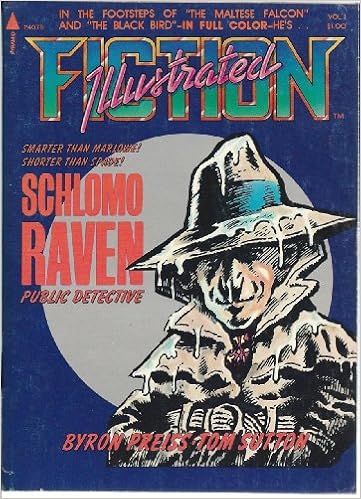
Schlomo Raven, Public Detective

(1976)
Written by
Byron Preiss
Illustrated by Tom Sutton

Byron Preiss was a book packager. He would put together books and series and sell them to publishers, saving them the effort of finding writers and coming up with themes. Preiss was a little different in that he was also an accomplished author, and one of his strangest projects was Schlomo Raven, Public Detective in the first issue of an intended series Fiction Illustrated.

The book was in graphic form, showing the adventures of Raven, who was based in Hollywood. It  consisted of two stories.In the first, “The Farx Job,”  where the Farx Brothers are kidnapped, possibly by monsters. The second story, “Rosebug,” has a more serious tone, as it shows an Orson Welles character working to save his film, American.

The names throughout are parodies of the real people. “The Farx Job” tries for a slapstick feel, while “Rosebug” is played a bit more straight.

Raven is short and with a prominent nose, part parody of the hard-boiled detective trope, and part pure slapstick. Tom Sutton’s art is reminiscent of 50s Mad Magazine. He shows a strong talent for caricature.

Fiction Illustrated format was strange. The book itself was an odd size (5 x 6 1/2”) and the pages were on newsprint, like a comic book. I wonder if the size hurt the distribution.

The magazine only ran four issues. Number two, Starfawn, had art by Stephen Fabien, but the story didn’t really go anywhere; I think they were hoping for a series.  Two more issues were produced before the series ended.

Schlomo Raven was an interesting experiment, but I think it might have had a better chance of catching on if there had been more issues of Fiction Illustrated featuring him.

Sunday, October 25, 2020

The Devil-Doll

Devil Doll

(1936)
Directed by
Tod Browning
Written by Garret Fort & Guy Endor (screenplay), Erich von Stroheim (screenplay), Tod Browning (story), based on a novel by A. Merrit
Starring Lionel Barrymore, Maureen O’Sullivan, Henry B. Walthall, Rafela Ottiano,Frank Lawton
IMDB Entry

Lionel Barrymore was part of the most distinguished acting family of the 1930s, so it’s a bit surprising to see he would be appearing in a horror film. But given that it was being directed by horror genius Tod Browning, maybe it’s not so surprising. The result, The Devil-Doll, is a nice excursion into the horror genre.

Paul Lavond (Barrymore) is a bank executive who has been sent to Devil’s Island after being wrongly convicted of robbing his bank and killing a guard. He is aided by Marcel (Henry B. Walthall), a brilliant scientist. The two make it to Marcel’s secret lab, where his wife Malita (Rafelela Ottiano) has kept things up. Marcel has developed a method to shrink people and animals, who stay inert until they are willed to move. Marcel dies, and Lavond, joined by Malita, plots revenge.

He returns to Paris and, disguised as the toymaker Madame Madelip, uses the dolls to get his revenge.

The movie is pretty standard horror revenge. The effects – a combination of double exposure and giant props – are quite good for the time as we watch Lavond put his scheme to catch the real criminals into action.

What helps set it apart is a subplot between Lavond’s daughter Lorraine (Maureen O’Sullivan) and the her taxi driver boyfriend Toto (Frank Laughton). She hates her father for ruining the family name. Much of the impetus for Lavond’s revenge is to show her that her father was not a criminal.

Barrymore is a fine actor and actually is fairly believable as Madam Madelip. This was one of the last films where he was able to walk,* so he’s able to get around. It also gives him a chance to be more than just a madman out for revenge: his reason isn’t so much to clear his own name as much as it is to show his daughter the truth.

Tod Browning was the master of horror in the early thirties, with films like Dracula and Freaks, along with several of Lon Chaney, Sr.’s silent films. This was one of his last films. He had already had trouble getting assignments after the controversy over Freaks and it seems that he was blacklisted.

The movie seems to have flopped, but it did get some critical notice, especially for its special effects.

__________________________________________________________
*Barrymore acted out of a wheelchair for the last year of his life, the result of arthritis or a broken hip (sources disagree as to which was the main cause, but Barrymore said it was the hip).

Sunday, October 18, 2020

Of Human Bondage

Of Human Bondage

(1934)
Directed by
John Cromwell
Written by Lester Cohen from a novel by M. Somerset Maugham
Starring  Leslie Howard, Bette Davis, Frances Dee, Kay Johnson, Alan Hale, Reginald Denny
IMDB Entry

Bette Davis was one of the great actresses under the studio system. And part of that was that she knew quality and worked to get roles where she could show her talents. She worked very hard to get a role in Of Human Bondage and the result was worth it.

Philip Carey (Leslie Howard) was a sensitive artist who, when he showed no talent decided to become a doctor. His studies were interrupted when one night he went to a bar and fell deeply for the lower class waitress Mildred (Bette Davis), who has only contempt for him. Slowly he wins her over a bit, taking her to dinner and the theater and becomes more and more enamored of her. But she doesn’t care and the moment she has a chance to marry Emil Miller (Alan Hale*). Philip is devastated and goes back to his studies, only to find Mildred showing up on his doorstep, pregnant and abandoned by Miller. Philip does everything to help her, even ditching his current girlfriend Norah, a romance writer. When the baby is born, Mildred gives her up to nurses and doesn’t want to see him, and hooks up with Philip’s best friend, Harry (Reginald Denny). But Philip just can’t quit Mildred.

Davis’s role was a revelation. Mildred is selfish, manipulative, and only in it for herself.  It was very unusual to see a character like her on the screen.  It certainly deserved Oscar consideration, but – in an early case of outrage over being snubbed – She was not nominated for an Oscar.  People were so angry that the Academy allowed her as a write-in, but she didn’t win.**

Howard does a good job with the role of Peter. The script has him as a weakling whose so infatuated with Mildred that he ignores everyone else, and all the obvious evidence that she is only using him. Still, Howard managed to make him as sympathetic as possible as a man unable to control his passion.

The movie was a big step in Davis’s career. Instead of being just another Warner Brothers starlet, it showed that she was more and could handle dramatic roles with aplomb. Her work – and gamble – paid off handsomely.

_____________________________________________________________

*The Skipper’s father.

** One thing marring it is her accent. She supposedly hired a cockney housekeeper to listen to the accent, but the veers from cockney, to upper class British, to hints of Brooklyn.

Sunday, October 4, 2020

Kim’s Convenience (TV)

Kim's Convenience
(2016 – )
Developed by
Ins Choi and Kevin White, from the novel Kim’s Convenience by Choi
Starring, Paul Sun-Hyung Lee, Jean Yoon, Andrea Bang, Simu  Liu, Andrew Phung, Nicole Power
IMDB Entry
Available on Netflix

Canadians are, of course, familiar with US TV shows, since they are often broadcast directly to them (and American TV is popular all over the world). But Americans are less familiar with Canadian shows. Netflix and other streaming services, hungry for content, are now brining them to America, so people can enjoy the delights of shows like Kim’s Convenience.

The title refers to a convenience store run by the Korean-Canadian family in Toronto. Sang-il “Appa” Kim (Paul Sun-Hyung Lee) is the head of the family and runs the store the way he sees fit. He’s very traditional in his outlook and not afraid to speak his mind. His wife Yong-mi “Umma” (Jean Yoon) is kindly and something of a peacemaker, but is not above jumping in to help (or inadvertently hinder) the rest of the family, especially their daughter Janet (Andrea Bang) who is in her 20s and struggling to make a life of her own. Their son, Jung (Simu Liu) is estranged from the family after getting caught doing minor crimes as a teenager, but had turned his life around, still speaking with Janet. He works at a car rental company, with his feckless best friend Arnold “Kimchee” Han (Andrew Phung) and his boss Shannon (Nicole Power), who had an awkward crush on him.

The show depends are the characterizations for the humor, especially the portrayal of Appa, who runs the store the way he sees fit, and who is not willing to indulge a difficult customer (from his own definition of difficult). He tries to lay down the law to Appa and Janet, but he ultimately becomes a grumpy old softy.

The actors are all fine, able to show their quirks and flaws but rarely being too ridiculous or obviously milking the laughs. 

Kim’s Convenience has run for four seasons so far and is an utter delight from start to finish.

Sunday, September 27, 2020

Otto Binder (author)

Otto Binder

(1911—1974)
Wikipedia Entry

Many of the great comic book creators of the 40s were anonymous. Companies didn’t list the writers like they may have the artists, so people like Bill Finger and Gardner Fox were not given the proper credit.*  One of the biggest and most successful at the time was Otto Binder.

Binder first started out as a science fiction writer, co-authoring stories with his brother Earl using the pen name “Eando Binder”,** starting with “The First Martian” in Amazing Stories in 1932. The collaboration produced a bunch of pulp novels and stories, and one that made a big splash:  “I, Robot.”*** It was one of the first SF stories to portray a robot as something other than a monster.**** As such, it was adapted to comics in 1955 and again in 1965. It was also the basis for an episode of the original Outer Limits with Leonard Nimoy, who also appeared the 1990s version of the show when they did the story again. It led to a series of stories about the robot, Adam Link.

By 1940, Earl stopped writing, becoming Otto’s agent and Otto started writing comics for Harry “A” Chesler’s comic book shop.  He was hired away by Fawcett  assigned to Fawcett’s major title, Captain Marvel. Binder wrote well over half of the Big Red Cheese’s adventures and created most of the characters that made it successful. Binder also worked for other companies, moving to DC when Fawcett stopped publishing comics. He introduced such mainstays as the Legion of Superheroes, Brainiac, Kandor, Supergirl, the Phantom Zone, Lucy Lane, Titano the Super Ape, Bizarro. and Jimmy Olsen’s signal watch. He continued to write Superman stories until 1969. He continued to write science fiction in his spare time, and returned to it after leaving comics.

Binder had a way of understanding the underlying silliness of comics and created character that where both whimsical and serious, often at the same time. His Mr. Mind – a superintelligent worm -- was one of Captain Marvel’s major foes and he managed to make Mr.Tawky Tawney – a tiger with the bearing of a man – into a charming sidekick.

Alas, in 1967, tragedy struck. Binder’s daughter died and it seemed to affect him. His stories became more pedestrian and he became interested in UFOlogy, writing many articles on the subject.

Binder died in 1974, but the characters he created are still  remembered well today.

___________________________________________________________
*Of course, this was often a deliberate decision on the part of the artist (like Bob Kane), but also, while fans might recognize an artist’s style, the writing was not easy to pick out.

**Eando Binder: E–and-O Binder

****Not to be confused with the Isaac Asimov collection of the same name. Asimov has said that he read it and it influenced him to start writing robot stories.  The publisher of his first collection of robot stories used the title, despite Asimov’s objections.

****Lester del Rey’s “Helen O’Loy” beat it to publication by a month (by cover date).

Sunday, August 30, 2020

All Creatures Great and Small (TV)

All Creatures Great and Small

(1978-1990)
Based on the novels of
James Herriot
Starring Christopher Timothy, Robert Hardy, Peter Davison, Carol Drinkwater/Lynda Bellingham
IMDB Entry

James Herriot* was a veterinarian in Yorkshire, UK for many years. After her retired, he started writing and, after numerous failures, he moved on from fiction to write about his experiences. The first book, If Only They Could Talk, was a a minor success, and when it was packaged with a second It Shouldn’t Happen to a Vet, under the new title All Creatures Great and Small, it was a best seller and was turned into a TV series by the BBC.

James Herriot was a young veterinarian who went to Yorkshire to practice with Siegfried Farnum (Robert Hardy) a quirky but smart vet. Farnum’s somewhat irresponsible brother, Tristan (Peter Davison) was also part of the practice.  James romances Helen Alderson (Carol Drinkwater/Lynda Bellingham**) and eventually marries her.

The show relied heavily on Herriot’s stories, usually dramatizing a couple of them. The strength  of the show was in the characters, not just the main one, but the many people who needed help for their animals. Heriot was not just dealing with dogs and cats, but with farm animals like cows*** and sheep and pigs, often in situations where the health of the animal was vital for the farmer to earn a living. There were also comic sidelights such as Mrs. Pumphrey and her spoiled Pekinese Tricki-Woo.

Christopher Timothy was just fine as Herriot – smart but sometimes a bit awkward, especially compared to the blustery Siegfried, where Robert Hardy was wonderful.

The show continued on and off until 1990, until Heriot’s stores were exhausted.. Hardy continued to work for years, most notably in various shows as Winston Churchill. And of course, Peter Davison became a legend by taking on the role of Doctor Who after Tom Baker retired.****

_______________________________________________________
*A pen name for James Alfred Wright. Veterinarians were discouraged from writing books about their cases, so Wright chose a pen name. He also gave new names to the people in worked with, so the character names are all pseudonymous.

**The role was recast after the third series.

***One of the most memorable things was the fact that Heriot or the Farnams would have to put their arms into the rear of a cow, something that was done without any trickery.

****I remember a clever piece of fan fiction where the Daleks landed in Yorkshire and spotted the Doctor. And then realize they could exterminate Winston Churchill.

Sunday, August 2, 2020

The Scarlet Pimpernel

The Scarlet Pimpernel

(1934)
Directed by
Harold Young
Written by Baroness Orczy
Starring Leslie Howard, Merle Oberon, Raymond Massey, Nigel Bruce,
IMDB Entry

I’ve written before about how much I enjoyed the writing of Baroness Orczy, but that has been a strictly literary admiration until now. It was inevitable that her best-know literary creation would be made into a film. Several silent films were made, but the first sound version was made in 1934 as The Scarlet Pimpernel.

The story was well known.* The Scarlet Pimpernel was the first character to use a secret identity, and he was a major influence on Bob Kane and Bill Finger when they created Batman. He helped victims of the French Revolution to safety in England along with the a group of twenty other English aristocrats who work with him.

He’s revealed to the audience to be Sir Percy Blakeley (Leslie Howard), a silly fop whose biggest interest is lame jokes and making sure other people tie their cravats properly. He is despised by his wife  Lady Marguerite Blakeley (Merle Oberon), who fantasizes about the Scarlet Pimpernel.** Meanwhile, the sinister French ambassador Chauvelin (Raymond Massey), plots to discover who the Pimpernel really is, and blackmails Marguerite to be his spy. Blakeley reveals he has a love/hate relationships with his wife after he hears she betrayed someone to the guillotine.

The movie is extremely faithful to the book. This isn’t surprising, since the Baroness wrote the script. The opening scene of the novel – one of the cleverest bits of derring do in literature – is portrayed almost intact, as is the scene where Chavelin first tries to trap the Pimpernel in a drawing room. The ending seems to have changed a bit – in the book, Lady Blakeley plays a bigger role – but is still first-class adventure.

The Blakeleys
Leslie Howard was an excellent choice for Blakeley,*** switching easily from heroic to foppish as needed.  Merle Oberon portrays Marguerite perfectly, bringing out her vulnerability and also her intelligence and ultimate bravery. The story is as much a love story as an adventure, and the relationship between Blakeley and his wife is well played.  Raymond Massey is fine as the sinister and manipulative Chavelin.

Nigel Bruce – best known as Doctor Watson  to Basil Rathbone’s Sherlock Holmes – was something of a surprise. He looked a little different when he was younger; it was only his voice that gave him away.

The movie was a success and gives a surprisingly good example of how a great book could become a great movie.

___________________________________________________________
* Warner Brothers even parodied it in a Daffy Duck cartoon. But the parody set it long before the French revolution.
**Early Bruce Wayne was clearly modeled on Blakeley, and the Superman-Lois Lane-Clark Kent love triangle also has its source with the Pimpernel.
***Charles Laughton was considered for the role, but the fans seriously objected for the rotund and ugly Laughton playing the romantic swashbuckler.

Sunday, July 26, 2020

The Man from 1997

(1956)
Directed by
Roy Del Ruth
Written by James Gunn (screeenplay), Alfred Bester (story)
Starring Jacques Sernas, Charlie Ruggles, Gloria Talbott, James Garner
IMDB Entry

Full Show on Youtube

The 50s were dubbed “The Golden Age of Television” for many reasons. Now, there was plenty of bad TV back them, but only the good shows are remembered, and the worst have been lost. But the one major difference from today was the number of anthology shows. They were quite common, often with one or two every evening. And among them are some surprising finds like “The Man from 1997,” which aired on the short-lived series, Conflict.

Johnny Vlakoz (Jacques Sernas) is a Polish immigrant who’s working to learn English. He buys several books at a bookstore to study, but just after he leaves, a strange little main in a white suit (and with self-lighting cigarettes) named B.O. Boyne (Charlie Ruggles) appears, wanting to retrieve one of the volumes. Johnny takes it back to his apartment and discovers one particular book is titled Almanac of 1997,* including racing results. Johnny is romancing Maurine Donnelly (Gloria Talbot), whose ne’er-do-well brother Red (James Garner) is an inveterate horseplayer. Johnny asks Red to place a bet on a major longshot. When it comes through, gamblers decide to figure out his secret.

The writing, which would have fit right in as one of the more lighthearted episodes of The Twilight Zone has a great science fiction pedigree. The story was by future SFWA Grandmaster Alfred Bester, best known for his classic The Stars My Destination.

Jacques Sernas was originally from Lithuania, and started out in Italian films before trying his hand on American TV. Charlie Ruggles was a character actor who worked steadily from the silent days until the 1960s, usually playing a somewhat befuddled character.**

This was a major turning point of James Garner’s career. He was supposed to play Red as a lowlife, but Garner gave him a surprising amount of charm. A producer saw him in the role and thought him the perfect actor for a new show he was developing:  Maverick.

Director Roy Del Ruth was reaching the end of a long career, where he was best known for directing for Warner Brothers in the 30s, with some musicals and gangster films under his belt.

Like most 50s shows, Conflict and “The Man from 1997” faded away. It appears to have been recorded on film, but only twenty episodes were made,*** not enough to be shown in syndication, and in ten years, obscure black and white shows were hard to find. But it is an entertaining hour.

______________________________________________________________
*Always a mistake to put near-future dates on things in science fiction story.

**His most notable role was as the voice of Aesop in the Aesop and Son cartoons, but he was in plenty of TV and movies. One of his credits was in the film Ruggles of Red Gap, but, alas, not at Ruggles (not that he would have been right for the role).

***It ran on alternate weeks with Cheyenne.

Sunday, July 12, 2020

Albert Brooks -- Comedy Minus One (comedy)

(1973)

Comedy Minus One
Albert Brooks is now a comedy legend, but like all comedians, he started out in standup.  And one of the earliest recorded examples of his work was the impressive Comedy Minus One.

Brooks had been called the comedian’s comedian, mostly because it’s a nice joke. His father, Harry Einstein, had a nice career in the 30s and 40s under the name Parkyakarkus. His son Albert went into the family business, though changed his last name to Brooks for reasons that should be obvious.*

He started doing guest spots on various variety shows and eventually got a recording contract. Comedy MInus One was his first effort.

It was definitely a strange mix. In the middle is a straight standup act about him as an opening act for Richie Havens, the crowd chanting “Richie, Richie, Richie” throughout his routine. There’s also an interruption where he asks “What do you think of the Record?” and the introduction where he brings in a notary public to prove that the album was in front of a live audience.

But it was the second side is where it takes off. “Comedy Minus One” is a standup act – only you’re the comedian. A script was written inside the album cover, and the listener could read it and have Brooks – and later Georgie Jessel (a legend of vaudeville comedy) – play the straight man.

The cover even showed what was going on. There was the legend, “Introducing the comedy team of Albert Brooks and . . . (over).”  When flipped over, there was an aluminum foil “mirror” with the word “You” above it.

Like many of Brooks’s comic idea, the idea was offbeat and played straight.

I remember when it came out. I was program director of the college radio station, and put out a warning that no one was to try to take the part. It was difficult to make it work over the air because you needed to get the timing right. But, of course, I broke my own rule. Since I had rehearsed it a bit, there were no awkward pauses and I think it came off pretty well.

Brooks did a second comedy album before branching out into short films and full-length comedies.** He always had a slightly different view of life, which made him so much fun.

_________________________________________________________
*Brooks said that his father claimed to have never heard of Albert Einstein, but that he was probably pulling Brooks’s leg.

**His brother, Bob Einstein, carved out a niche for himself as Super Dave Osborne.

Sunday, June 14, 2020

The Mouse that Roared

(1959)
Directed by
Jack Arnold
Written by Roger MacDougall and Stanley Mann, from a novel by Leonard Wibberley
Starring Peter Sellars, Jean Seberg, William Hartnell, David Kossoff, Leo McKern
IMDB Entry
The Mouse that RoaredI’ve talked about Jack Arnold, the king of 50s science fiction, several times in this blog.  But Arnold did more than just SF horror. The Mouse that Roared was satirical humor, but with a science fiction bent.

The tiny duchy of Grand Fenwick, ruled by its Queen Gloriana (Peter Sellers), is suddenly facing financial ruin when an American winery comes up with a cheap imitation of the major export, Pinot Grand Fenwick wine. Despite pleas for help, the US does nothing, so the prime minister, Count Montjoy (Sellers) decides there’s only one thing to do:  declare war on the United States. They have not the slightest expectation of winning, but since the US was generous to its enemies after WWII, they expect to be treated generously. Led by game warden Tully Bascomb (Sellers), who commands 20 soldiers armed with bows and arrows,* they land in New York City, during an air raid that leaves the streets empty. They happen to find Dr. Alfred Kokintz (David Kossoff), who has invented the quadrium bomb – which makes the atomic bomb look like a sparkler. 

Bascomb seizes the bomb, along with Kokintz and his daughter Helen (Jean Seberg), and take them all back to Grand Fenwick. They have won the war.  And their troubles begin.

As the cast list shows, this was a showcased for Sellers, who played the major roles.  He switches nicely between the regal Gloriana, the upper class Montjoy, and the more common Bascomb.  This seems to be his first major role in the US and he was unknown to US audiences at the time. Leo McKern** is nice as the leader of Montjoy’s loyal opposition party.

The movie is quite faithful to the book.*** It’s also very funny.  One of my favorite gags is during a chase scene.  The bomb is the size and shape of a football and has a hair trigger.  The scene starts out and suddenly there’s a picture of the mushroom cloud. Then a narrator comes in and says, “Ladies and gentlemen, this is not the end of the film. However, something like this might easily happen, and we thought we should put you in the proper mood. And now, back to our story.”

The movie was a big hit and Sellers became a star. Jean Seberg never reached stardom,**** possibly because of blacklisting and eventually committed suicide. The FBI had gone after her for her politics and the situation may have contributed.

But the film itself is funny and entertaining.  Wibberley, a prolific author, wrote four other “Mouse” novels with one, The Mouse on the Moon, also being turned into a film.
_____________________________________________________
*Including soon-to-be-Doctor-Who William Hartnell as their gruff sergeant, a role he eventually was typecast in at the time.
**Rumpole, #2, and the Clang from the Beatles’ Help
***The only big difference is that In the book, Gloriana was a young and attractive woman who eventually marries Bascomb. Obviously, Sellers wouldn’t work in the role. Instead, they added Kokintz’s daughter as a love interest.
****She started out with a big production of Joan of Arc with Otto Preminger, but got terrible reviews, mostly because she was considered too inexperienced to handle the role.  She later found success in France