Sunday, October 18, 2020

Of Human Bondage

Of Human Bondage

(1934)
Directed by
John Cromwell
Written by Lester Cohen from a novel by M. Somerset Maugham
Starring  Leslie Howard, Bette Davis, Frances Dee, Kay Johnson, Alan Hale, Reginald Denny
IMDB Entry

Bette Davis was one of the great actresses under the studio system. And part of that was that she knew quality and worked to get roles where she could show her talents. She worked very hard to get a role in Of Human Bondage and the result was worth it.

Philip Carey (Leslie Howard) was a sensitive artist who, when he showed no talent decided to become a doctor. His studies were interrupted when one night he went to a bar and fell deeply for the lower class waitress Mildred (Bette Davis), who has only contempt for him. Slowly he wins her over a bit, taking her to dinner and the theater and becomes more and more enamored of her. But she doesn’t care and the moment she has a chance to marry Emil Miller (Alan Hale*). Philip is devastated and goes back to his studies, only to find Mildred showing up on his doorstep, pregnant and abandoned by Miller. Philip does everything to help her, even ditching his current girlfriend Norah, a romance writer. When the baby is born, Mildred gives her up to nurses and doesn’t want to see him, and hooks up with Philip’s best friend, Harry (Reginald Denny). But Philip just can’t quit Mildred.

Davis’s role was a revelation. Mildred is selfish, manipulative, and only in it for herself.  It was very unusual to see a character like her on the screen.  It certainly deserved Oscar consideration, but – in an early case of outrage over being snubbed – She was not nominated for an Oscar.  People were so angry that the Academy allowed her as a write-in, but she didn’t win.**

Howard does a good job with the role of Peter. The script has him as a weakling whose so infatuated with Mildred that he ignores everyone else, and all the obvious evidence that she is only using him. Still, Howard managed to make him as sympathetic as possible as a man unable to control his passion.

The movie was a big step in Davis’s career. Instead of being just another Warner Brothers starlet, it showed that she was more and could handle dramatic roles with aplomb. Her work – and gamble – paid off handsomely.

_____________________________________________________________

*The Skipper’s father.

** One thing marring it is her accent. She supposedly hired a cockney housekeeper to listen to the accent, but the veers from cockney, to upper class British, to hints of Brooklyn.

Sunday, October 4, 2020

Kim’s Convenience (TV)

Kim's Convenience
(2016 – )
Developed by
Ins Choi and Kevin White, from the novel Kim’s Convenience by Choi
Starring, Paul Sun-Hyung Lee, Jean Yoon, Andrea Bang, Simu  Liu, Andrew Phung, Nicole Power
IMDB Entry
Available on Netflix

Canadians are, of course, familiar with US TV shows, since they are often broadcast directly to them (and American TV is popular all over the world). But Americans are less familiar with Canadian shows. Netflix and other streaming services, hungry for content, are now brining them to America, so people can enjoy the delights of shows like Kim’s Convenience.

The title refers to a convenience store run by the Korean-Canadian family in Toronto. Sang-il “Appa” Kim (Paul Sun-Hyung Lee) is the head of the family and runs the store the way he sees fit. He’s very traditional in his outlook and not afraid to speak his mind. His wife Yong-mi “Umma” (Jean Yoon) is kindly and something of a peacemaker, but is not above jumping in to help (or inadvertently hinder) the rest of the family, especially their daughter Janet (Andrea Bang) who is in her 20s and struggling to make a life of her own. Their son, Jung (Simu Liu) is estranged from the family after getting caught doing minor crimes as a teenager, but had turned his life around, still speaking with Janet. He works at a car rental company, with his feckless best friend Arnold “Kimchee” Han (Andrew Phung) and his boss Shannon (Nicole Power), who had an awkward crush on him.

The show depends are the characterizations for the humor, especially the portrayal of Appa, who runs the store the way he sees fit, and who is not willing to indulge a difficult customer (from his own definition of difficult). He tries to lay down the law to Appa and Janet, but he ultimately becomes a grumpy old softy.

The actors are all fine, able to show their quirks and flaws but rarely being too ridiculous or obviously milking the laughs. 

Kim’s Convenience has run for four seasons so far and is an utter delight from start to finish.

Sunday, September 27, 2020

Otto Binder (author)

Otto Binder

(1911—1974)
Wikipedia Entry

Many of the great comic book creators of the 40s were anonymous. Companies didn’t list the writers like they may have the artists, so people like Bill Finger and Gardner Fox were not given the proper credit.*  One of the biggest and most successful at the time was Otto Binder.

Binder first started out as a science fiction writer, co-authoring stories with his brother Earl using the pen name “Eando Binder”,** starting with “The First Martian” in Amazing Stories in 1932. The collaboration produced a bunch of pulp novels and stories, and one that made a big splash:  “I, Robot.”*** It was one of the first SF stories to portray a robot as something other than a monster.**** As such, it was adapted to comics in 1955 and again in 1965. It was also the basis for an episode of the original Outer Limits with Leonard Nimoy, who also appeared the 1990s version of the show when they did the story again. It led to a series of stories about the robot, Adam Link.

By 1940, Earl stopped writing, becoming Otto’s agent and Otto started writing comics for Harry “A” Chesler’s comic book shop.  He was hired away by Fawcett  assigned to Fawcett’s major title, Captain Marvel. Binder wrote well over half of the Big Red Cheese’s adventures and created most of the characters that made it successful. Binder also worked for other companies, moving to DC when Fawcett stopped publishing comics. He introduced such mainstays as the Legion of Superheroes, Brainiac, Kandor, Supergirl, the Phantom Zone, Lucy Lane, Titano the Super Ape, Bizarro. and Jimmy Olsen’s signal watch. He continued to write Superman stories until 1969. He continued to write science fiction in his spare time, and returned to it after leaving comics.

Binder had a way of understanding the underlying silliness of comics and created character that where both whimsical and serious, often at the same time. His Mr. Mind – a superintelligent worm -- was one of Captain Marvel’s major foes and he managed to make Mr.Tawky Tawney – a tiger with the bearing of a man – into a charming sidekick.

Alas, in 1967, tragedy struck. Binder’s daughter died and it seemed to affect him. His stories became more pedestrian and he became interested in UFOlogy, writing many articles on the subject.

Binder died in 1974, but the characters he created are still  remembered well today.

___________________________________________________________
*Of course, this was often a deliberate decision on the part of the artist (like Bob Kane), but also, while fans might recognize an artist’s style, the writing was not easy to pick out.

**Eando Binder: E–and-O Binder

****Not to be confused with the Isaac Asimov collection of the same name. Asimov has said that he read it and it influenced him to start writing robot stories.  The publisher of his first collection of robot stories used the title, despite Asimov’s objections.

****Lester del Rey’s “Helen O’Loy” beat it to publication by a month (by cover date).

Sunday, August 30, 2020

All Creatures Great and Small (TV)

All Creatures Great and Small

(1978-1990)
Based on the novels of
James Herriot
Starring Christopher Timothy, Robert Hardy, Peter Davison, Carol Drinkwater/Lynda Bellingham
IMDB Entry

James Herriot* was a veterinarian in Yorkshire, UK for many years. After her retired, he started writing and, after numerous failures, he moved on from fiction to write about his experiences. The first book, If Only They Could Talk, was a a minor success, and when it was packaged with a second It Shouldn’t Happen to a Vet, under the new title All Creatures Great and Small, it was a best seller and was turned into a TV series by the BBC.

James Herriot was a young veterinarian who went to Yorkshire to practice with Siegfried Farnum (Robert Hardy) a quirky but smart vet. Farnum’s somewhat irresponsible brother, Tristan (Peter Davison) was also part of the practice.  James romances Helen Alderson (Carol Drinkwater/Lynda Bellingham**) and eventually marries her.

The show relied heavily on Herriot’s stories, usually dramatizing a couple of them. The strength  of the show was in the characters, not just the main one, but the many people who needed help for their animals. Heriot was not just dealing with dogs and cats, but with farm animals like cows*** and sheep and pigs, often in situations where the health of the animal was vital for the farmer to earn a living. There were also comic sidelights such as Mrs. Pumphrey and her spoiled Pekinese Tricki-Woo.

Christopher Timothy was just fine as Herriot – smart but sometimes a bit awkward, especially compared to the blustery Siegfried, where Robert Hardy was wonderful.

The show continued on and off until 1990, until Heriot’s stores were exhausted.. Hardy continued to work for years, most notably in various shows as Winston Churchill. And of course, Peter Davison became a legend by taking on the role of Doctor Who after Tom Baker retired.****

_______________________________________________________
*A pen name for James Alfred Wright. Veterinarians were discouraged from writing books about their cases, so Wright chose a pen name. He also gave new names to the people in worked with, so the character names are all pseudonymous.

**The role was recast after the third series.

***One of the most memorable things was the fact that Heriot or the Farnams would have to put their arms into the rear of a cow, something that was done without any trickery.

****I remember a clever piece of fan fiction where the Daleks landed in Yorkshire and spotted the Doctor. And then realize they could exterminate Winston Churchill.

Sunday, August 2, 2020

The Scarlet Pimpernel

The Scarlet Pimpernel

(1934)
Directed by
Harold Young
Written by Baroness Orczy
Starring Leslie Howard, Merle Oberon, Raymond Massey, Nigel Bruce,
IMDB Entry

I’ve written before about how much I enjoyed the writing of Baroness Orczy, but that has been a strictly literary admiration until now. It was inevitable that her best-know literary creation would be made into a film. Several silent films were made, but the first sound version was made in 1934 as The Scarlet Pimpernel.

The story was well known.* The Scarlet Pimpernel was the first character to use a secret identity, and he was a major influence on Bob Kane and Bill Finger when they created Batman. He helped victims of the French Revolution to safety in England along with the a group of twenty other English aristocrats who work with him.

He’s revealed to the audience to be Sir Percy Blakeley (Leslie Howard), a silly fop whose biggest interest is lame jokes and making sure other people tie their cravats properly. He is despised by his wife  Lady Marguerite Blakeley (Merle Oberon), who fantasizes about the Scarlet Pimpernel.** Meanwhile, the sinister French ambassador Chauvelin (Raymond Massey), plots to discover who the Pimpernel really is, and blackmails Marguerite to be his spy. Blakeley reveals he has a love/hate relationships with his wife after he hears she betrayed someone to the guillotine.

The movie is extremely faithful to the book. This isn’t surprising, since the Baroness wrote the script. The opening scene of the novel – one of the cleverest bits of derring do in literature – is portrayed almost intact, as is the scene where Chavelin first tries to trap the Pimpernel in a drawing room. The ending seems to have changed a bit – in the book, Lady Blakeley plays a bigger role – but is still first-class adventure.

The Blakeleys
Leslie Howard was an excellent choice for Blakeley,*** switching easily from heroic to foppish as needed.  Merle Oberon portrays Marguerite perfectly, bringing out her vulnerability and also her intelligence and ultimate bravery. The story is as much a love story as an adventure, and the relationship between Blakeley and his wife is well played.  Raymond Massey is fine as the sinister and manipulative Chavelin.

Nigel Bruce – best known as Doctor Watson  to Basil Rathbone’s Sherlock Holmes – was something of a surprise. He looked a little different when he was younger; it was only his voice that gave him away.

The movie was a success and gives a surprisingly good example of how a great book could become a great movie.

___________________________________________________________
* Warner Brothers even parodied it in a Daffy Duck cartoon. But the parody set it long before the French revolution.
**Early Bruce Wayne was clearly modeled on Blakeley, and the Superman-Lois Lane-Clark Kent love triangle also has its source with the Pimpernel.
***Charles Laughton was considered for the role, but the fans seriously objected for the rotund and ugly Laughton playing the romantic swashbuckler.

Sunday, July 26, 2020

The Man from 1997

(1956)
Directed by
Roy Del Ruth
Written by James Gunn (screeenplay), Alfred Bester (story)
Starring Jacques Sernas, Charlie Ruggles, Gloria Talbott, James Garner
IMDB Entry

Full Show on Youtube

The 50s were dubbed “The Golden Age of Television” for many reasons. Now, there was plenty of bad TV back them, but only the good shows are remembered, and the worst have been lost. But the one major difference from today was the number of anthology shows. They were quite common, often with one or two every evening. And among them are some surprising finds like “The Man from 1997,” which aired on the short-lived series, Conflict.

Johnny Vlakoz (Jacques Sernas) is a Polish immigrant who’s working to learn English. He buys several books at a bookstore to study, but just after he leaves, a strange little main in a white suit (and with self-lighting cigarettes) named B.O. Boyne (Charlie Ruggles) appears, wanting to retrieve one of the volumes. Johnny takes it back to his apartment and discovers one particular book is titled Almanac of 1997,* including racing results. Johnny is romancing Maurine Donnelly (Gloria Talbot), whose ne’er-do-well brother Red (James Garner) is an inveterate horseplayer. Johnny asks Red to place a bet on a major longshot. When it comes through, gamblers decide to figure out his secret.

The writing, which would have fit right in as one of the more lighthearted episodes of The Twilight Zone has a great science fiction pedigree. The story was by future SFWA Grandmaster Alfred Bester, best known for his classic The Stars My Destination.

Jacques Sernas was originally from Lithuania, and started out in Italian films before trying his hand on American TV. Charlie Ruggles was a character actor who worked steadily from the silent days until the 1960s, usually playing a somewhat befuddled character.**

This was a major turning point of James Garner’s career. He was supposed to play Red as a lowlife, but Garner gave him a surprising amount of charm. A producer saw him in the role and thought him the perfect actor for a new show he was developing:  Maverick.

Director Roy Del Ruth was reaching the end of a long career, where he was best known for directing for Warner Brothers in the 30s, with some musicals and gangster films under his belt.

Like most 50s shows, Conflict and “The Man from 1997” faded away. It appears to have been recorded on film, but only twenty episodes were made,*** not enough to be shown in syndication, and in ten years, obscure black and white shows were hard to find. But it is an entertaining hour.

______________________________________________________________
*Always a mistake to put near-future dates on things in science fiction story.

**His most notable role was as the voice of Aesop in the Aesop and Son cartoons, but he was in plenty of TV and movies. One of his credits was in the film Ruggles of Red Gap, but, alas, not at Ruggles (not that he would have been right for the role).

***It ran on alternate weeks with Cheyenne.

Sunday, July 12, 2020

Albert Brooks -- Comedy Minus One (comedy)

(1973)

Comedy Minus One
Albert Brooks is now a comedy legend, but like all comedians, he started out in standup.  And one of the earliest recorded examples of his work was the impressive Comedy Minus One.

Brooks had been called the comedian’s comedian, mostly because it’s a nice joke. His father, Harry Einstein, had a nice career in the 30s and 40s under the name Parkyakarkus. His son Albert went into the family business, though changed his last name to Brooks for reasons that should be obvious.*

He started doing guest spots on various variety shows and eventually got a recording contract. Comedy MInus One was his first effort.

It was definitely a strange mix. In the middle is a straight standup act about him as an opening act for Richie Havens, the crowd chanting “Richie, Richie, Richie” throughout his routine. There’s also an interruption where he asks “What do you think of the Record?” and the introduction where he brings in a notary public to prove that the album was in front of a live audience.

But it was the second side is where it takes off. “Comedy Minus One” is a standup act – only you’re the comedian. A script was written inside the album cover, and the listener could read it and have Brooks – and later Georgie Jessel (a legend of vaudeville comedy) – play the straight man.

The cover even showed what was going on. There was the legend, “Introducing the comedy team of Albert Brooks and . . . (over).”  When flipped over, there was an aluminum foil “mirror” with the word “You” above it.

Like many of Brooks’s comic idea, the idea was offbeat and played straight.

I remember when it came out. I was program director of the college radio station, and put out a warning that no one was to try to take the part. It was difficult to make it work over the air because you needed to get the timing right. But, of course, I broke my own rule. Since I had rehearsed it a bit, there were no awkward pauses and I think it came off pretty well.

Brooks did a second comedy album before branching out into short films and full-length comedies.** He always had a slightly different view of life, which made him so much fun.

_________________________________________________________
*Brooks said that his father claimed to have never heard of Albert Einstein, but that he was probably pulling Brooks’s leg.

**His brother, Bob Einstein, carved out a niche for himself as Super Dave Osborne.

Sunday, June 14, 2020

The Mouse that Roared

(1959)
Directed by
Jack Arnold
Written by Roger MacDougall and Stanley Mann, from a novel by Leonard Wibberley
Starring Peter Sellars, Jean Seberg, William Hartnell, David Kossoff, Leo McKern
IMDB Entry
The Mouse that RoaredI’ve talked about Jack Arnold, the king of 50s science fiction, several times in this blog.  But Arnold did more than just SF horror. The Mouse that Roared was satirical humor, but with a science fiction bent.

The tiny duchy of Grand Fenwick, ruled by its Queen Gloriana (Peter Sellers), is suddenly facing financial ruin when an American winery comes up with a cheap imitation of the major export, Pinot Grand Fenwick wine. Despite pleas for help, the US does nothing, so the prime minister, Count Montjoy (Sellers) decides there’s only one thing to do:  declare war on the United States. They have not the slightest expectation of winning, but since the US was generous to its enemies after WWII, they expect to be treated generously. Led by game warden Tully Bascomb (Sellers), who commands 20 soldiers armed with bows and arrows,* they land in New York City, during an air raid that leaves the streets empty. They happen to find Dr. Alfred Kokintz (David Kossoff), who has invented the quadrium bomb – which makes the atomic bomb look like a sparkler. 

Bascomb seizes the bomb, along with Kokintz and his daughter Helen (Jean Seberg), and take them all back to Grand Fenwick. They have won the war.  And their troubles begin.

As the cast list shows, this was a showcased for Sellers, who played the major roles.  He switches nicely between the regal Gloriana, the upper class Montjoy, and the more common Bascomb.  This seems to be his first major role in the US and he was unknown to US audiences at the time. Leo McKern** is nice as the leader of Montjoy’s loyal opposition party.

The movie is quite faithful to the book.*** It’s also very funny.  One of my favorite gags is during a chase scene.  The bomb is the size and shape of a football and has a hair trigger.  The scene starts out and suddenly there’s a picture of the mushroom cloud. Then a narrator comes in and says, “Ladies and gentlemen, this is not the end of the film. However, something like this might easily happen, and we thought we should put you in the proper mood. And now, back to our story.”

The movie was a big hit and Sellers became a star. Jean Seberg never reached stardom,**** possibly because of blacklisting and eventually committed suicide. The FBI had gone after her for her politics and the situation may have contributed.

But the film itself is funny and entertaining.  Wibberley, a prolific author, wrote four other “Mouse” novels with one, The Mouse on the Moon, also being turned into a film.
_____________________________________________________
*Including soon-to-be-Doctor-Who William Hartnell as their gruff sergeant, a role he eventually was typecast in at the time.
**Rumpole, #2, and the Clang from the Beatles’ Help
***The only big difference is that In the book, Gloriana was a young and attractive woman who eventually marries Bascomb. Obviously, Sellers wouldn’t work in the role. Instead, they added Kokintz’s daughter as a love interest.
****She started out with a big production of Joan of Arc with Otto Preminger, but got terrible reviews, mostly because she was considered too inexperienced to handle the role.  She later found success in France

Sunday, June 7, 2020

White Zombie

White Zombie
(1932)
Directed by Victor Halpern
Written by Garnett Weston
Starring Bela Lugosi, Madge Bellamy, Robert Frazier, John Harron
IMDB Entry
I’m not a big fan of the modern zombie. They just don’t seem to be a scary threat. But the classic zombie of Haitian legend is a different matter. And one of the first of that that genre was White Zombie.

The movie begins as Neil Parker (John Harron) and Madeline Short (Madge Bellamy) stumble upon a strange ceremony as someone is buried in the middle of the road. Their carriage is later stopped by Legendre (Bela Lugosi), who takes a somewhat creepy look at Madeline then sends them on their way. They go to the house of their acquaintance, Charles Beaumont* (Robert Frazier).

Beaumont immediately falls for Madeline and goes to Legendre, who gives him a potion to give to her. He resists, but – as Legendre understands – his obsession gets the best of him and he poisons her so that she will be turned into a zombie to be his. It goes without saying that things do not work out well.

The age of the film certainly works against it, since the acting style is too stagy for modern viewers. But there is much of interest.  There is a nice atmosphere of death and decay, and Madge Bellamy’s blank-faced stare as Beaumont tries to talk to her is chilling. And a lot of elements of it were taken by later horror films.

The most memorable scene is when Beaumont goes to meet Legendre in his sugar refinery. The zombies are the workers, dropping canes of sugar into a series of blades to be cut. Their blank faces – showing no emotion even when one of them falls to his death in the machinery – make it all look like a version of hell.

Lugosi is adequate as Legendre.**

The film was a big success financially, though panned by the critics. Even fans of it today may be put off by the wooden acting. But there are enough creepy moments to make its short runtime worth it.
____________________________________________________________
*Coincidentally, also the name of an author who was one of the major contributors to The Twilight Zone
**I don’t care much for his acting:  it always seems to stolid and wooden and lacking any sense of humor. He supposedly thought this was his best performance.

Sunday, May 3, 2020

Vicious (TV)

Vicious(2013-2016)
Created by
Mark Ravenhill, Gary Janetti
Written by Gary Janetti
Starring Ian McKellen, Derek Jacobi, Frances de la Tour, Iwan Rheon, Marcia Warren, Philip Voss
IMDB Entry
Overacting is an art. It’s hard to know the exact way to walk the tightrope so you’re producing just the right amount of hamminess that’s funny without being obnoxious. And one of the best examples of this was Vicious.

Freddy Thornhill (Ian McKellen) and Stuart Bixby (Derek Jacobi) are gay flatmates, living together for 48 years.* Freddy is an actor who made a living at it, but who never had a notable role.** Stuart is a former bartender and their relationship has settled in to their constantly sniping and insulting each other, though it’s clear that there’s some underlying affection. The friend Violet (Frances de la Tour) drops in, but things change when Ash Weston (Iwan Rheon) takes the flat upstairs. Ash is young and handsome and straight (and a little oblivious). At first, Freddy and Stuart are attracted to him, but they back off quickly and become friends. Rounding out the cast are Penelope (Marcia Warren), whose memory is not what it used to be, and Mason (Philip Voss), a friend who sees some of the egotism of the other two.

Cast of ViciousThe writing of the show is merely OK, but watching McKellen and Jacobi and the rest deliver them with just the right amount of theatrical bombast. Much like Oscar Jaffee in Twentieth Century, the two of them bicker and manage to wring every bit of humor from every line.

Frances de la Tour may not be as well known as the two main leads, but she is a very successful stage actress and won several Olivier Awards and a Tony. Her film and TV appearances are usually smaller roles.*** I remember her for her turn with Robert Hoskins in Flickers.

I first saw Iwan Rheon in Misfits, where he was part of the original cast. He later gained prominence as Ramsay Bolton in Game of Thrones.

The series ran two seasons for a total of 14 episodes, with an additional series finale. Given the prominence of the actors, who were busy doing other things, too, it’s not surprising it didn’t continue longer, but the show was always filled with funny lines.

___________________________________________________________
* McKellen and Jacobi actually had crushes on each other when the started out acting in the 1960s, but never told the other. Homosexuality was still criminal at the time, and talking about it could send you to prison.
**One of which was a monster on Doctor Who.
***She was Madame Maxime in Harry Potter and the Goblet of Fire.

Sunday, April 26, 2020

Honeycombs (music)

Honeycombs
The Honeycombs
1964-66
Members:
Denis D’Ell (vocals, harmonica), Martin Murray (rhythm guitar), Allan Ward (lead guitar), John Lantree (bass), Anne “Honey” Lantree (drums, vocals)
Wikipedia Page

“One-hit wonder”* is something of a pejorative term, often designating musicians who were talented but only managed to hit it big once. The Honeycombs only had one hit, but it’s a terrific song.

The group came out of London, founded by Martin Murray, who worked in a hair salon with Anne “Honey” Lantree. They brought in Honey’s brother John, and others and started playing in local pubs in February of 1964, just a Beatlemania was hitting the states. While performing, they attracted the attention of Ken Howard and Alan Blaikley, who were just starting out their careers, who gave them “Have I the Right?”

As the “Sheratons,” they were signed by producer Joe Meek, who produced a bunch of UK hits in the era. The record company changed their name to “The Honeycombs,”* and the song was released.
The song went to #1 in the UK and #5 in the US.

The band was notable for being one of the few with a female drummer. Honey Lantree became something of a star, with articles being written about her, concentrating on the novelty of a woman in a rock band – and one who was a drummer. She rightly considered herself a pioneer, but the interest was, sadly, due to the novelty.***

Alas, they had trouble doing a followup. Their next few singles were minor successes in the UK and didn’t break in the US.

They did, however become popular in Japan.  Most of the group broke up in 1966. Honey (who started doing vocals) and John Lantree recruited new members, but only released one single. Despite some popularity in Japan, the group faded away.

The result was one great song.
__________________________________________________
*For a series of looks at one-hit wonder acts, look for videos by ToddintheShadows on Youtube, which are always fascinating.
**A pun on Honey’s job has a hairdresser: Honey combs.
***Some sneered that Honey was not actually playing drums. From videos, though it does look like she’s handling things, and drumming is really hard to fake for a lip sync. Still, she was derided as a gimmick.

Sunday, April 5, 2020

Cavalcade

Cavalcade(1933)
Directed by
Frank Lloyd
Written by Reginald Berkley, from the play by Noel Coward
Starring Diana Wynyard, Clive Brook, Una O’Connor, Herbert Mundin, Frank Lawgon, Ursula Jeans, Joe Warburton
IMDB Entry

The Academy Awards have had a spotty record of getting things right over the years, especially in the early years when studios instructed their workers to vote for specific films.* It’s interesting to see how well they hold up today. Cavalcade – Best Picture of 1933 – doesn’t do badly.

Starting on the last day of 1899, it shows the lives of two families – the wealthy Marryots, and their servants, the Bridges – over the next thirty years. Jane Marryot (Diana Wynyard) Is always concerned about the well being of her husband Robert (Clive Brook), especially as war and tragedy affects them. Meanwhile Alfred Bridges (Herbert Mundin) and his wife Ellen (Una O’Connor) go out on their own running a pub and raising their daughter Fanny (Ursula Jeans), who becomes an entertainer. She eventually catches the eye of Joe Marryot (Frank Lawton).
The Marryots and the Bridges
Herbert Mundin, Diana Wynyard, Clive Brook, and Una O'Connor
The movie is a combination of romance and tragedy, all set against the backdrop of early 20th century England. It’s also interesting in how it portrays people’s reactions as they get over loss surprisingly easily.  Admittedly, time passes, but most of the characters just move on.**  The one exception is Jane, who still remains emotionally affected by the problems in her life.  The movie also has a very strong antiwar message.

It was especially nice to see Una O’Connor. She was a very successful character actress in the early days of Hollywood, best known at Minnie, the comic relief maid in Bride of Frankenstein. She had a distinctive look and appeared in over 80 films and TV shows, often as a maid. This is one time I caught her in a dramatic role, and she’s extremely good.

The rest of the cast are mostly unknown to modern viewers, but they all are just fine (though the acting is a bit stagy).

Noel Coward wrote several original songs for the play, including his standard “Twentieth Century Blues.”

Definitely strong dramatic entertainment.
_______________________________________________________
*The Academy was originally set up as a yellow union – company run so that a regular union couldn’t get a foothold and make trouble. The awards were an afterthought.
**There also a scene that plays to a big reveal that is pretty obvious from the start. I imagine audiences of the time didn’t see it coming, but modern viewer might even laugh a bit at the way it’s handled.

Sunday, March 29, 2020

A Shaun the Sheep Movie: Farmageddon

(2019)
Directed by
Will Becher, Richard Phelan
Written by John Brown, story by Mark Burton and Nick Park
IMDB Entry
Given the current situation, I’m always looking for light, funny fare to fill the days. I’ve also written several times about various films from Aardman Animations. So I was delighted to find an Aardman film that I had overlooked:  A Shaun the Sheep Movie: Farmageddon.

This is the third time Shaun has appeared in films, starting out with the Wallace and Gromit classic, A Close Shave.* There also was the Shaun the Sheep Movie plus a series of TV cartoons. Shaun is a smart sheep,** who leads both the flock and also – in the background – everything on the farm. All of his appearances have no dialog. Characters speak in very expressive sounds, but no words. All is told by action, much like a silent film.

In the movie, a UFO lands near the village of Mossingham with a little rabbit-like alien in it. Shaun discovers him and helps him out, learning the alien has levitation powers with his long ears. After the alien, dubbed Lu-La, inadvertently creates crop circles, the Farmer decides to cash in by creating a theme park, Farmageddon, to raise money for a new harvester. Meanwhile, Shaun discovers Lu-La is only a child and wants to go back to his parents, while the Ministry of Alien Detection (M.A.D.) is hunting her down.

The movie is a delight a slapstick and visual humor, especially the final sequence where events at Farmageddon become far more alien than even the Farmer imagines.

Part of the fun are references to SF movies and TV shows.  Doctor Who is there in many ways (of course, including a Dalek), and the alert viewer can see references to Close Encounters, the X-Files, Hitchhiker's Guide, 2001, Star Trek, and many others. But these are just icing on the cake: the film itself is wonderfully funny and the expressions of the sheep, the dog Bitzer, and the fantastically oblivious farmer would make it a great film even without those.

For animation fans, it’s a pleasant way to find something to laugh about.
________________________________________________________
**His name is a delightful pun. After the unnamed sheep has all his wool cut off, Wallace decides to call him Shaun.
**The most dangerous of all animals.

Sunday, March 8, 2020

I Am Not Okay with This (TV)

I Am Not OK with This(2020 – ??)
Created by Jonathan Entwistle, Christie Hall
Starring Sophia Lillis, Wyatt Oleff, Sofia Bryant, Kathleen Rose Perkins, Richard Ellis, Aidan Wojtak-Hissong
IMDB Entry

In my old age, I find myself watching more teen dramas and comedies.* Maybe it’s because my teenage years were not particularly dramatic. When someone recommended I Am Not OK with This, I decided to give it a shot.

The main character is Sydney Novak (Sophia Lillis), teen who is dealing with a complicated life. Her father has committed suicide without leaving a note, and her mother (Kathleen Rose Perkins) is trying to support Sydney and her brother Liam (Aidan Wojtak-Hissong), making her absent most of the day. Sydney’s only close friend is Dina (Sofia Bryant), who does make her life bearable, but Dina is moving away from her in order to date Brad Lewis (Richard Ellis), not noticing what a major jerk he is.

In among all this drama, there’s another twist:  Sydney is developing a superpower.

When she loses her temper due to frustration – a common occurrence – she shows telekinesis, destroying things around her.  Her nerdy neighbor Stanley Barber discovers her secret and works with her to try to control things. But – as the very first shot of the show indicates – things don’t go well.

Sophia Lillis is terrific as Sydney, who’s confused and conflicted and unsure about everything around her. She had a very subdued and cynical personality that’s perfect to portray her troubles. Wyatt Oleff’s Stanley tries hard to be helpful, but really doesn’t understand, while Sofia Bryant** portrays Dina as the one sunny thing in Sydney’s life. And Richard Ellis is terrific as the sleazy Brad, who is able to switch from charming to psychotic at the drop of a hat.

The show only ran seven episodes on Netflix and ended on a major cliffhanger. Hopefully, it will continue so we we can see more of Sydney and what is really going on with her.  But any show that uses a song from Captain Beefheart on the soundtrack is something worth paying attention to.
______________________________________________________
*For instance, Sex Education
**I wonder if there’s confusion on the set with two main leads with the same name. There was also a recurring role for Sophia Tatum.

Sunday, February 23, 2020

Holy Matrimony

(1943)
Directed by
John M. Stahl
Written by Nunnally Johnson from a novel by Arnold Bennett
Starring Monty Woolley, Gracie Fields, Laird Cregar, Una O’Connor, Eric Blore
IMDB Entry

Fame is fickle.  Many major stars of the 30s and 40s are virtually unknown today/ This is especially true if they were stars outside the US and only had moderate success over here. Others had US success, but the memory of them is faded away because their films are fading away. Holy Matrimony is a perfect example.

Priam Farll (Monty Woolley) is considered England’s greatest artist, but he has no use for the fame and fortune, so he moves to a small house on the other side of the world to be left alone, accompanied only by his butler Henry Leek (Eric Blore). Farll is summoned to the UK to be knighted, but when they get there, Leek dies of pneumonia, and Farll decides to pose as Leek to avoid the bother.

He quickly realizes this is a mistake, but is unable to convince anyone of his real identity. He’s about to be arrested for disrupting his own funeral, when Alice Chalice (Gracie Fields) spots him. She had been corresponding with Leek with an eye to matrimony, and confirms his identity as Leek, who she has only seen in a photograph of Leek and Farll that didn’t specify who was who. Farll is attracted to Alice’s personality and marries her.

All is well until Leek’s real wife show up. And Farll decides he needs to support Alice better and returns to painting. His art is purchased by the unscrupulous art dealer Clive Oxford (Laird Cregar), who sells them as undiscovered works of Farll. Then things get complicated.

Monty Woolley was a close friend of Cole Porter* and a Broadway director.  He became a major Broadway star playing Sheridan Whiteside in the classic “The Man Who Came to Dinner” and reprised his role for the film version. Here, he plays a similar character, a curmudgeonly man who refuses to compromise.

Gracie Fields, though, was a major star in the UK, primarily as a singer of music hall tunes.  She became a movie star in 1931 with a series of hit films, all of which didn’t make much impression on this side of the pond. Holy Matrimony was her first US film, and was impressive enough for her to make several more. Her Alice is delightfully warm and understanding.

The film is populated by several of the great character actors of the time. Eric Blore made a career of playing butlers and was almost certainly the first people they thought of when the film came up. Una O’Connor, who plays Leek’s wife, was Hollywood’s favorite old biddy, and is most notable as the maid in Bride of Frankenstein. Franklin Pangborn (best known as the bank examiner in The Bank Dick) has a small role as Farll’s cousin and future science fiction icon Whit Bissell plays Leek’s son.

Then there’s Laird Cregar. This movie doesn’t quite let him display the urbane wit he showed in Heaven Can Wait, but he’s an interesting presence.

The movie was successful and the studio gave Fields a contract. Alas, she was unable to duplicate her success and eventually returned to England, where she was a beloved figure. Woolley never duplicated the success of Whiteside, though he continued to act.
___________________________________________________________
*He appeared as himself in the Porter biopic Night and Day

Sunday, February 16, 2020

It Happens Every Thursday

It Happens Every Thursday(1953)
Directed by
Joseph Pevney
Written by Dane Lussier from a novel by Jane S. McIlvaine
Starring Loretta Young, John Forsythe, Frank McHugh, Edgar Buchanan, Jimmy Conlin, Jane Darwell, Willard Waterman, Gladys George, Regis Toomey
IMDB Entry

Even the most obscure film can have some wonderful delights. It Happens Every Thursday is a small, unassuming movie that makes them most of what it had, and which has things that might surprise you.

Jane and Bob MacAvoy (Loretta Young and John Forsythe) are a couple with a young son and a baby on the way. Bob is a newspaper reporter who has dreams of publishing a small-town newspaper. When Jane spots a newspaper up for sale in California, she sees it as a dream come true, and convinced Bob to uproot themselves to buy it.

When they get to California, they realize that the advertisement . . . exaggerated. The circulation figure was inflated by real estate agent Fred Hawley (Frank McHugh), and the photo hides the actual appearance of the rundown building. The paper is operating, with Jake (Edgar Buchanan) and Matthew (Jimmy Conlin) getting it out each week on a press that breaks down regularly.
Jane and Bob decide to stick it out, with various promotions to increase circulation and make money.

The movie is low key* but surprisingly modern in many respects. One fascinating scene is when Jane goes to businessman Myron Trout to sell ad space, where he starts hitting on her. Jane deflects him in a way that is probably familiar even today.

The way Jane’s pregnancy is handled is also different. She is shown clearly pregnant in the opening scenes, but it is not referred to until several minutes of film time later. And while there is a scene where she gives birth,** it is early one and not a centerpiece of the film.

What’s also interesting is that Jane is clearly shown as the one taking charge. She comes up with the ideas, the money, sells the ads, comes up with promotion, and much else. She is the go-getter in the family, which is unusual for the time. And she is by no means perfect, making mistakes but managing to help Bob recover from them.

There is also a subplot about what is clearly supposed to be a bordello, also surprising given the time frame.

The cast is just fine. Loretta Young is charming and lively throughout, while Forsythe is quietly practical. Of course, it’s great to see Edgar Buchanan, playing the same sort of character as he played in Petticoat Junction.  Frank McHugh, a film veteran at the point is fun to see, even if the role doesn’t give him much to do.

The film was Loretta Young’s last. She moved on to television, including hosting her own anthology show. And several of the actors also moved on to television.  John Forsythe starred in Bachelor Father and did both his own show and, eventually Dynasty.  He also was the voice of Charlie in Charlie’s Angels. Jane Darwell, who plays one of the townspeople also switched to TV, but did have one final memorable movie role: the lady feeding the birds in Mary Poppins.

Director Joseph Pevney also moved to TV and directed several of the best Star Trek episodes, including “The Trouble with Tribbles,” “City on the Edge of Forever,” “Amok Time,” “The Devil in the Dark,” and “Wolf in the Fold.”

While the movie is clearly not a classic, there’s plenty to enjoy.

And, as a personal note, the movie title reminds me of my hometown weekly, which also was published on Thursday.
___________________________________________________
*It was based on an autobiographical novel, which might explain some of the elements.
*Discretely.  There were the 50s.

Sunday, February 9, 2020

The Turtles Present the Battle of the Bands (music)

The Turtles Present the Battle of the Bands.
(1968)Howard Kayland (lead vocals), Mark Volman (vocals), Al Nichol (guitars, organ, Jim Pons (bass, vocals, Johnny Barbarta (drums)
Wikipedia Entry

I’m a big fan of concept albums. There’s something very exciting about seeing a group trying to write an entire album of songs with a thematic link. But most concept albums are serious (if not bombastic). One of the few that manages to be funny is The Turtles Present the Battle of the Bands.

The Turtles were a California-based group that started out performing surf rock. They signed a contract with the small label White Whale records and began to record. Sensing that surf rock was losing popularity, their first album leaned toward protest rock, with three Bob Dylan songs, plus “Eve of Destruction.” Most of the album was made up of covers.

Then the Lovin’ Spoonful came along.  The group was intrigued and wanted to get away from the protests and into lighter, feel-good fare. And, on their third album they hit the jackpot: “Happy Together” was a number one hit.* They then had a number 3 hit with “She’s Rather Be With Me.”

They had hit the big time, but, of course, there were storm clouds. White Whale had no other successful acts. So the pressured the group to put out another hit.

Meanwhile, Howard Kaylan, the group’s front man, was becoming more ambitious. He wanted to write more of the songs** and to get the rest of the band involved in the songwriting. The result was The Turtles Present the Battle of the Bands.

The concept was a clever one. The album was ostensibly about various different groups all performing in a battle of the bands.*** So you had the fake groups The Atomic Enchilada, Quad City Ramblers, The Fabulous Dawgs, The Cross Fires.**** The inner gatefold showed these groups – all the Turtles – in different costumes. They ran a gamut of musical styles, from surf music, to R&B, to Bluegrass, to psychedelic rock.
Inner gatefold
Column 1: The U.S. Teens featuring Raoul, The Atomic Enchilada, Howie, Mark, Johnny, Jim & Al
Column 2: Quad City Ramblers, The L.A. Bust '66, The Fabulous Dawgs,
Column 3: The Cross Fires, King Kamanwanalea and the Royal Macadamia Nuts, Nature's Chidren,
Column 4: The Bigg Brothers, Fats Mallard and the Bluegrass Firebal, All


In response to White Whale’s pressure to produce a hit, the group wrote a song with the dumbest lyrics they could, a satirical looks at the pop love songs of the day. Of course, as luck would have it, the song, “Elenore,”  was a major hit, making everyone happy.

The record also included “You Showed Me,” a song by the early Byrds that had not been previously recorded. It also made the charts.

One of the slyest jokes was the song “I’m King Kamanawanlea (We’re the Royal Macadamia Nuts),” the title of which came from a risque schoolyard joke of the era.

Despite the two hits, the album only did middling sales. Perhaps the mix of styles was an issue: people who didn’t get the joke were not interested in songs that weren’t in the genre they preferred.

The group did one more album, Turtle Soup, produced by Ray Davies, but that got good press but failed to crack the charts. At that point, the group broke up, though White Whale put out an album of B-sides and whatever could be found in the studio.

Volman and Kaylan (along with drummer Jim Pons*****) joined the Mothers of Invention.****** White Whale, refused to let them use the Turtles name, or even their own, so they were billed as “The Phlorescent Leech and Eddie.” They were featured and given a large part in Zappa’s 200 Motels. As “Flo and Eddie,” they did several moderately successful humorous albums. Eventually, they got the rights to their own names back, but by then Flo and Eddie was too well-established to change.
___________________________________________________________
*Knocking the Beatles out of the #1 spot.
**Their two hits were written by outside songwriters, as were most of their songs on the albums.  Of note was that they recorded at least one song written by Warren Zevon.
***This was a common concept in the 60s, where several local groups would perform one evening, with a prize given to those who the audience liked best (judged by applause at the end). It’s a common plot element of any TV show or movie featuring a rock band, from Josie and the Pussycats to School of Rock.
****An early name of the group.
*****Who later quit music to work for PR with the New York Jets, and designed the logo the team used in the 1980s.
*****One nice irony: on the Mothers’ first album, the liner notes disdainfully quoted a record executive who wanted to make the Mothers as big as the Turtles.

Sunday, January 26, 2020

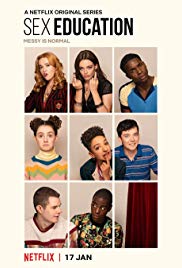
Sex Education (TV)

Sex Education
2019-
Created by
Laurie Nunn
Starrring Asa Butterfield, Gillian Anderson, Emma Mackey, Ncuti Gatwa, Connor Swindells, Alistair Petrie, Tanya Reynolds, Patricia Allison
IMDB Entry

Netflix has such a vast array of show that some excellent ones get lost in the shuffle. One that I’ve heard very little buzz about is Sex Education, even though it’s absolutely delightful.

Otis Milburn (Asa Butterfield) is a teenager in the UK equivalent of a high school. His mother, Jean (Gillian Anderson), is a sex therapist, and Otis has overheard a lot of her sessions through an air vent by his bed.  A classmate, Maeve Wiley (Emma Mackey) sees him answering questions from other classmates and offers a business arrangement:  She will book appointments and Otis will counsel the other students. It, of course, leads to complications.

The show manages to mix uproarious comedy with powerful drama. It’s extremely frank and very realistic in the way it shows teens dealing with sex and emotions.*

The strength is in the characters. Otis is well-versed in the theories of sex, but has no actual experience, complicating matters. And his mother is portrayed as very open and sex positive – but with no respect for Otis’s boundaries, bringing up subjects that no teen boy wants to talk about with his mother. Some of the funniest scenes are her trying to be so completely understanding of things that Otis does not want brought up.

Maeve is smart, but categorized as a bad girl because she doesn’t go along with the rules of the school. Eric Effiong (Ncuti Gatwa) is gay and open about it, leading to bullying and other issues. Lily Inglehart (Tanya Reynolds) writes fan fiction porn, and is the one most willing to cut through other people’s bullshit.

You can’t really single out any one person in the cast. All are excellent, but it’s especially gratifying to see Gillian Anderson do deadpan comedy.

The second season just dropped and seems to move in a more dramatic direction,** but it’s still showing the difficulties of sexual and romantic relationships.
___________________________________________________________
*The frankness may be offputting to some, but it can be extremely funny.
**Though I laughed hardest at a scene in the first episode of the second season when Jean is trying to advise Otis.

Sunday, January 19, 2020

The Man Who Could Work Miracles

The Man Who Could Work Miracles
(1936)
Directed by
Lothar Mendes, Alexander Korda (uncredited)
Written by H.G. Wells
Starring Roland Young, Ralph Richardson, Ernest Thesiger,
IMDB Entry
I’ve been poking around the Internet Archive, looking for movies to write about and came upon The Man Who Could Work Miracles. I’d seen parts of it over the years, but this was my chance to see the entire thing.

It starts out with a group of Celestial Beings who wonder if the human race would be better off if they could perform their own miracles. The pick George McWhirter Fotheringay (Roland Young), a clerk in a department store, as their first experiment. George discovers he can merely request something and have it come true. It starts out small, with candles and rabbits. George thinks it might be the basis for a magic act. But, as he learns more, he begins to think bigger.  The Vicar, Mr. Madig (Ernest Thesiger), thinks he should use it to help humanity, while Colonel Winstanley (Ralph Richardson) feels it will be a disaster.

It is based on a story by H.G. Wells, who is the only writer credited. The movie is filled with discussions of miracles and their pros and cons, reflecting Wells’s politics.

Young portrays George as a slightly thick character, with a blinkers on about the possibilities of his gift.He can’t seem to work out the implications of possibilities of his gift without others pointing them out to him.* Thesiger** plays the role of the Vicar with earnest idealism, while Richardson hams things up at bit as Winstanley.

One scene that I remember well from when I first saw it was when George gets mad at a cop and tells him to “Go to Blazes!” The policeman finds himself in a very hot place, and starts to take notes.***

The movie’s special effects were top notch for their time, and somewhat innovative. There’s a lot of things appearing out of nowhere, of course, a trick that dates back to George Melies, but other scenes were state of the art for the time. There’s one where George tidies up the store that is particularly impressive.

The movie got mixed reviews when it opened, and I can see that – it gets bogged down in philosophy while the humor is generally mild. But overall it’s a fairly entertaining concept.
____________________________________________________________
*Young is best known for portraying Cosmo Topper, the same sort of befuddled character.
**Best known as Dr. Pretorius from Bride of Frankenstein.
***The original story has “Go to Hades,” but the censors wouldn’t allow that.

Sunday, January 12, 2020

The Pay Off

The Pay Off
(1942)
Directed by
Arthur Dreifuss
Written by Edward Dein (screenplay), Arthru Hoerl (story)
Starring Lee Tracy, Tom Brown, Tina Thayer, Evelyn Brent
IMDB Entry
Full Movie at the Internet Archive
Many people don’t understand what a B movie was in the days of the studio system. Since the studios owned the theaters, they were in constant need of product and a B movie was one with a lesser-known cast, cut to run in a shorter time to make for a double feature, often in small, neighborhood theaters whose audiences were all within walking distance.That didn’t mean they were necessarily bad, and there are always some nice little films in that classification.  The Pay Off fits into this category.

It starts out with the murder of a special prosecutor and one of the suspects has an airtight alibi: he was playing poker at the home of wisecracking reporter Brad McKay (Lee Tracy). McKay goes on the case and discovers Tina Thayer (Phyllis Walker) may have an important clue. Aided by Guy Norris (Tom Brown) and distracted by femme fatale Alma Dorn (Evelyn Brent), McKay slowly ferrets out the mystery.

The role fits Lee Tracy like a glove. He made a career of playing wisecracking reporters, both on screen and on Broadway.* He definitely takes center stage and it’s surprising that his career didn’t make more of a splash, other than perhaps because the stereotype grew old after WWII.

Like most movies of this type, the plot moves along briskly with a few twists here and there.

Director Arthur Dreifuss made a few dozen B movies, but never moved on to anything more. Most of the cast didn’t break through, but the result is a nice little bit of entertainment.
______________________________________________________
*He played HIldy Johnson in the original production of The Front Page.

Sunday, December 8, 2019

How Murray Saved Christmas (TV)

(2014)
Directed by
Peter Avanzino
Written by Mike Reiss
Starring: Dennis Haysbert, Jerry Stiller, Sean Hayes, Jason Alexander, Kevin Michael Richardson
IMDB Entry
How Murray Saved ChristmasThe Christmas season is inundated with specials. Which are good from the point of view of the network that commissioned them.  You can trot them out every year and get an audience big enough to make them worthwhile. It’s unusual for a special to have only one or two broadcasts, and especially strange when the show is as good as How Murray Saved Christmas.*

The story – set entirely in verse and narrated by Dennis Haysbert – is set in the town of Stinky Cigars, where all the symbols of holidays live. Characters like the Easter Bunny, Cupid, George Washington and Abraham Lincoln go about their lives, with the name of the town keeping outsiders away.  And, of course, Santa Claus (voice of Kevin Michael Richardson). Murry Weiner (Jerry Stiller) is the cranky old man who runs the town diner, but when Santa suffers a concussion due an invention of Edison Elf (Sean Hayes), Murray become the only one who can deliver the presents.
 
It’s a witty version of the story, aimed at adults. Mike Reiss was a writer for The Simpsons and wanted to have the same sort of irreverent attitude. He certainly succeeded and the verses are terrific.

The show was run on NBC in 2014 and got poor ratings, with a lot of people complaining that it wasn’t for kids.** They ran it again the next year, but cut it from an hour to a half hour. Now it is possible to fit a long story into a half hour slot,*** but you can’t do it by indiscriminately slashing it in half. In any case, I haven’t seen it on the air since, though it can be found online.

But the show managed to mix a great deal of humor with the Christmas spirit, and even has some clever songs.****  If you’re looking for a grownup Christmas cartoon, this is well worth watching.
_____________________________________________________________
*Saving Christmas is probably the top plot of any Christmas special, if you don’t count remakes of A Christmas Carol or It’s a Wonderful Life.
**Too many people don’t understand that animated films are not necessarily children’s fare – to their loss, alas.
***There’s an excellent radio version of The Maltese Falcon using the main cast from the Bogart movie that is a marvel of condensation.
****Especially the song of the exploited elves.

Sunday, December 1, 2019

Nothing Sacred

Nothing Sacred

(1937)
Directed by
William Wellman
Written by Ben Hecht from a story by James Street
Starring Carole Lombard, Fredric March, Walter Connolly, Charles Winninger
IMDB Entry

The screwball comedy was a glorious subgenre of the 1930s, a series of romantic comedies based up an off-beat situation that get their laughs by wild plotting and characters. One of the more overlooked films in the genre is Nothing Sacred.

Wally Cook (Fredric March) is a reporter for The Morning Star in New York, on the outs with his editor, Oliver Stone (Walter Connolly) after his big scoop turned out to be a hoax he fell for. In order to repair the paper’s reputation, he spots an article about Hazel Stone (Carole Lombard), who is dying of radium poisoning and goes up to her home in Warsaw, Vermont, to cash in on the sob story. But just as he arrives, Hazel learns from her doctor Enoch Downer (Charles Winninger) that the tests were wrong, and she’s perfectly healthy. As she leaves, Wally spots her an offers her a trip to New York.  Hazel, who always wanted to visit the city, goes along. She is wined and dined and celebrated for her bravery as Wally begins to fall in love with her.

The movie – written by former newspaperman Ben Hecht, who I’ve discussed before – is designed to be a cynical look at the newspaper game. Hazel becomes caught up in all the honors, until she is riding a tiger she can’t easily get off.

Lombard is, as always, wonderful, and March puts in another fine performance. He’s not usually noted for his comedy chops, but manages to pull it off.

Modern audiences can spot Margaret Hamilton from The Wizard of Oz as one of the residents of Warsaw.

The movie did poorly at the box office. I think a main flaw is that it takes too long for the hoax to be revealed to the world. There was a lot of comedy to be milked out of the situation of trying to deal with the issue, but it’s pretty much missed and ends with a results that’s a bit too glib.*  Still, it’s worth seeing for Lombard’s performance
___________________________________________
*To modern eyes, there are also a few things that don’t sit well.

Sunday, November 24, 2019

Behave Yourself

Behave Yourself(1951)
Directed by
George Beck
Written by George Beck from a story by Beck and Frank Tarloff
Starring Farley Granger, Shelley Winters, William Demarest, Francis L. Sullivan, Margalo Gillmore, Lon Chaney Jr., Hans Conreid, Elisha Cook, Jr., Sheldon Leonard, Alan Jenkins, Marvin Kaplan
IMDB Entry

Character actors are the bread-and-butter of old time Hollywood, coming on for small roles and making them memorable. When I spotted the cast list for Behave Yourself, I knew I had to see it for the actors alone.

In the film, Bill Denny (Farley Granger) is desperate for an anniversary gift for his wife Kate (Shelley Winters) to prove to his mother in law (Margolo Gillmore) that he hasn’t forgotten.* A stray dog follows him home. Due to a mixup (this movie’s stock in trade), Kate thinks the dog is the gift. The problem is that the dog Archie is specially trained to deliver some sort of contraband to a couple of buyers, Shortwave Bert (Sheldon Leonard) and Max the Umbrella (Marvin Kaplan). Other criminals also want the package, including Gillie the Blade (Hans Conreid), and Pinky (Lon Cheney Jr.) and Albert Jonas (Elisha Cook Jr). Denny tries to return the dog, but after Jonas is murdered, the police, led by office O’Ryan (William Demarest) get involved.

The cast here is filled with great character actors. If the mere mention of their name doesn’t ring a bell, here’s a rundown.
  • Farley Granger starred in two Hitchcock classics, Rope and Strangers on a Train. it’s odd to see him doing comedy.
  • Shelly Winters won two Oscars after this and is best known today for her role in The Poseidon Adventure. In this early part of her career, she was cast as a blonde bombshell,** but she got away from it in order for people to recognize she was more than just a sex symbol.
  • William Demarest was memorable in The Miracle of Morgan’s Creek and other Preston Sturges films, but he’s better known as Uncle Charlie in My Three Sons.
  • Margolo Gillmore had a solid Hollywood career but was a major Broadway star in the 20s and 30s.
  • Sheldon Leonard is best known for his small role in It’s a Wonderful Life (“Look at me.  I’m making angels.”) but was even more successful as a TV producer, with shows like I Spy, Andy Griffith, Dick van Dyke, and Gomer Pyle.
  • Lon Cheney, Jr.  The Wolf Man,et. al.
  • Elisha J. Cook, Jr. Wilmer in The Maltese Falcon, et al.
  • Hans Conreid.  Voice of Snidley Whiplash and many others. In this, he puts on an English accent!
  • Marvin Kaplan. Longtime TV character actor and voice of Choo Choo in Top Cat.
You can also spot King Donovan (50s horror movie icon) and Herb Vigran (a busy TV character actor).

The movie is fun, if sitcom-like. Plenty is made of the fact that Bill always shows up when someone is murdered.

This was director George Beck’s only film, though he did continue on as writer for TV and movies. The movie seems to have been successful at the box office, thought not a smash, and seems to be overlooked in lists of films of the year. It’s in the public domain now, and is available at archive.org.
_______________________________________________________
*Of course, he has.
**Indeed, there are many indications in the film that Bill is frustrated by Archie because the dog prevent him from getting time alone with his wife.

Sunday, November 17, 2019

Ariel (music)

(1977)
Written and performed by
Dean Friedman
Wikipedia Page

Being a one-hit wonder is no disgrace. It takes a lot of talent to get a recording contract and both talent and luck to have a hit. Dean Friedman only had one song that made it on the US charts,* but it was a delight.

“Ariel” is a song about meeting a girl and becoming lovers, but it’s filled with charm and clever lyrics.

Part of its charm was that it was set in Paramus, NJ, where Friedman grew up, and there are many references to it and to the NYC area. Indeed, there are several lines in the song that only someone from the area would understand.** Plus there is some clever wordplay, like in the line “I said ‘Hi,’ she said, ‘Yeah, I guess I am.’" Or “I was messing around with the vertical hold.”***

The song got a lot of FM airplay, and reached 26 on the charts. One issue was that the record company was new and hadn’t pressed enough copies to meet the demand.****

Freidman was not able to duplicate that success, but continued to record and perform and also wrote some music for TV.

____________________________________________________
*Though he continued to record and is still performing today.

**For instance, there’s a line about the “Friends of BAI,” a reference to WBAI, a listener supported station in the area.

***A control on TVs of the era, unneeded now. But in the context of the song, it also meant he was holding her.

****See what I said about luck.

Sunday, November 3, 2019

I’ve Heard the Mermaids Singing

(1987)Written and Directed by Patricia Rozema
Starring Sheila McCarthy, Paule Baillargeon, Ann-Marie MacDonald
IMDB Entry
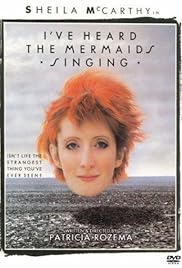
Image result for i've heard the mermaids singingOne of the nice things in the days of video stores was the ability to find oddball movies that you never heard of. You could glance at the boxes on the walls and find things that were obscure, or old, or too independent for the big studios. That’s where I stumbled upon I’ve Heard the Mermaids Singing.

Poly Vandersma (Sheila McCarthy) is a klutzy young woman who ekes out a living doing temporary secretarial work, her job choices hindered by the fact she’s a lousy typist.  But she is hired for a permanent position by Gabrielle (Paule Baillargeon), the owner of a private art gallery.  When Gabrielle ex-lover Mary (Ann-Marie MacDonald), things start to get complicated.

This is not a plot-driven movie. Most of its joys are from McCarthy’s performance, which is utterly charming. As the movie progresses, she learns to be just a bit more competent.

The film was Canadian, and has often been listed among the greatest Canadian films of all time.

McCarthy went on to have a long career in TV and film. Most recently, she appeared in The Umbrella Academy as Agnes, the owner of a diner.