 (1974)
Directed by Stephen Spielberg
Written by | Steven Spielberg | | (story) and |
| Hal Barwood | | (story and screenplay) & |
| Matthew Robbins | (story and screenplay)
Starring Goldie Hawn, Ben Johnson, Michael Sachs, William Atherton.
IMDB Entry Steven Spielberg became a superstar director with Jaws. Fans of his career, of course, remember he got started directing a sequence of the original Night Gallery TV movie, and the TV movie Duel. Oddly enough, however, his first film seems to get short shrift. The Sugarland Express was not a blockbuster, and was far less action-oriented that the films where Spielberg made his reputation, but it ranks among the best first films by any director.** Yet somehow it gets overlooked when considering his films. The story begins with Lou Jean Poplin (Goldie Hawn), who visits her husband Clovis (William Atherton) in a halfway house. Clovis is about to be released from prison in a few weeks. So Lou Jean breaks him out. They overpower rookie cop Maxwell Slide, steal his patrol car and, with Slide as their hostage, head toward Sugar Land.** The escape as inexplicable and as it is inept, but the trio drive, followed by Captain Harlan Tanner (Ben Johnson) and police from every town they pass through on the way. We learn the reason for all this early on. Lou Jean's baby had been in a foster home and they were preparing to adopt him. Lou Jean will do anything to stop this. The result is a long low-speed chase. Indeed, the lasting image of the film is watching the police car carrying them driving across the Texas landscape, following by an ever-growing parade of cop cars waiting for a chance to stop Lou Jean. She becomes something of a folk hero -- a woman fighting for her child -- and a celebrity. 
This is one of Goldie Hawn's best roles (she thinks so). She manages to wring a lot out of the role, being both charming and also more serious in purpose than in many of her films. Ben Johnson is also quite good as a man who is trying to find a peaceful solution to a situation that is spiraling out of control. The film did respectably at the box office*** but was quickly forgotten. Why? Most likely because of Jaws. The film put Spielberg on the map and identified him as a maker of blockbuster films. He followed that up with Close Encounters and -- after the flop of 1941 -- the Indiana Jones films. People expected big films with plenty of action from him, and the small, more character-driven story of Sugarland Express just didn't appeal. By the time Speilberg started making more serious films, it had already been forgotten. Nowadays, when people think of Spielberg, they think of his blockbuster, and of the more serious films**** that have helped him earn Hollywood respect. The Sugarland Express, though, is among his best work and showcases some fine performances that shouldn't be missed. ______________________________________________ *Some others: Preston Sturges's The Great McGinty, Mel Brooks's The Producers, Peter Bogdonovich's Targets, Kevin Smith's Clerks, and, of course, Citizen Kane. It's interesting that in all the films, the director was also credited with the writing. **A real town in Texas. The movie calls it Sugarland, but the town is two words. ***Bolstered by the fact that it had two recent Oscar winners in Hawn and Johnson. ****Though he has tried a couple of "smaller" films (for Spielberg) lately in Catch Me If You Can and The Terminal.
(1976-78)
Produced by Nebraska Public Television
Starring Cynthia Herman, Jill Tanner, George Backman and Paul Hecht.
Wikipedia Entry Back in the mid-70s on our local public TV station, Sunday night was Monty Python night. The show was broadcast every week at 10:30. That mean, of course, that you couldn't watch the typical one-hour show broadcast in that slot. So, without cable, you were pretty much committed to watching PBS. That's how I discovered Anyone for Tennyson. The show was based on an idea that only PBS would come up with: live poetry readings. Each show had a theme, and a group of actors would give a dramatic reading of various poems that fit the theme, often in locations with a connection to it (e.g., Mystic Seaport for poems of the Sea; Gettysburg for Civil War poems, Stratfor-on-Avon for Shakespeare's verse). I was hooked. The actor/readers did more than just recite the words; they brought the poetry to life, not only expressing the words, but acting out the emotions of the poems. Various guest stars would appear to join in, people like Vincent Price, Ruby Dee, Will Geer, Darren McGavin, and LeVar Burton. They had as much fun with their poems as the regular cast. The show ran for three seasons and 50 shows. Some are available on DVD, but I'd love to see the entire run. It was a delight for anyone who loves poetry and language.
 (1983)
Directed by Alan Johnson
Written by Ronnie Graham and Thomas Meehan, based upon the 1942 screenplay by Edwin Justus Meyer, with story by Ernst Lubitsch and Melchior Lengyel,
Starring Mel Brooks, Anne Bancroft, Tim Matheson, Charles Durning, Christopher Lloyd, Jose Ferrer, Ronnie Graham, Jack Riley
IMDB Entry
The original To Be or Not to Be is something of a minor film classic now, but when it came out in 1942, it didn't do too well. It was Carole Lombarde's last film before her death in a plane crash and its star, Jack Benny, did not catch on in the films and, as a comedian, he joked about how bad his films were. In addition, director Ernst Lubitsch's idea for having a comedy of manners about Hitler in the middle of a war was considered in bad taste, and in worse taste once people discovered what Hitler was like. But, over the years, the film's reputation grew. It is a certainly a fine movie, with the touch of a director who believed that, if Hitler had bad manners, it meant he was capable of all sorts of monstrosities. So when there was news that Alan Johnson, best known as an Emmy-winning choreographer, was directing a remake in 1982, it probably was considered by many to be the worst possible idea. Why remake a minor classic? And it's one thing to treat Hitler in a comedy of manners during the war, when we didn't know exactly what was going on in Germany, and quite another to do a light comedy like this now that we did know. Enter Mel Brooks. Brooks, of course, is known as a funnyman*. But Brooks had a serious side, even if it didn't show up in his films. Back in the early 80s, he set up Brooksfilms to do not only comedies, but some serious efforts such as The Elephant Man, Frances, and the remake of The Fly. So Brooks, who clearly had no problems poking fun at Hitler,** agreed to finance and star in the film. Even better, his wife, Anne Bancroft -- known for serious roles -- agreed to costar. The film's opening sequence sets the scene nicely, with Frederick and Anna Bronski (Brooks and Bancroft) doing a duet on stage of "Sweet Georgia Brown." Bronski is a legend in his own mind, a two-bit actor and producer who thinks he's the world's greatest actor. Anna, meanwhile, is busy having an affair with a handsome pilot Andre Sobinski (Tim Matheson) at the same time Bronski is onstage as Hitler, doing a satire on the dictator. It all changes the next day, as Hitler invade Poland. Bronski works to smuggle out a Polish scientist as well as some local Jews and gays.*** The movie is funny as Bronski uses his Hitler impression to fool the Nazis**** and make the plan work. But there's also a serious subtext; this is more than just jokes. Lives are at stake and the horror of what the Nazis want to do is a constant thought in the back of our heads. Brooks is at his best as Bronsky. Johnson manages to keep him from mugging and overacting more than necessary, making it one of his best comic performances. Bancroft is obviously having fun in his role, and the cast is filled with highly skilled comic actors who bring the whole thing off.***** Alas, director Alan Johnson's career did not continue to direct. He work with Brooks and still continued choreography, winning another two Emmies, but despite this promising beginning, he only directed one more film, Solarbabies. Worse, when people do remember this film, they think that Brooks directed. I think in many ways To Be or Not to Be is Brooks's best role, and shows that maybe he might have been a much funnier screen personality if he let other people direct him. _____________________________________________ *I find that Brooks never was as good or important to comedy as his contemporary Woody Allen, and he ultimately fell behind the Zucker-Abrahams-Zucker combine, which took Brook's method and turbocharged it. The only fully satisfying comedy of his was Young Frankenstein (though Blazing Saddles and Silent Movie come close). **Especially in springtime. ***This is one of Hollywood's first portrayals of homosexuals being part of those sent to the camps. ****It seems clear that Brooks's philosophy on Nazism is simple: they were fools and if we treat them like fools, people will laugh them away. It may be a better way to discredit them than to constantly say how bad they are; in fiction and elsewhere, one great way to create sympathy is to have people badmouth someone. ***** Of special note is Ronnie Graham, who helped write the screenplay, and also appears in the cast as the theater manager. Graham had a long list of writing and guest starring roles (especially in the TV version of M*A*S*H), but is best known to those of a certain age as Mr. Dirt in a commercial for Mobil gasoline.
 (1973)
Directed by Howard Zieff
Written by W.D. Richter
Starring James Caan, Peter Boyle, Sally Kellerman, Louse Lasser, Alan Garfield, Richard B. Shull
IMDB Entry
I've mentioned elsewhere that I'm a fan of director Howard Zieff. Nearly forgotten today, and with a movie career that was much too short, Zieff came on the scene with a love for quirky characters and situations. He first made his mark doing commercials -- both TV and print -- and started a trend to use unusual-looking people instead of the perfect hair and teeth models advertising has used previously.* Slither was his first film. It's the story of ex-con David Kanipsia, who is having trouble adjusting to life on the outside. He meets with his ex-cellmate Harry Moss (Richard B. Shull), who is shot while David watches. Dying, he tells David of $300,000 that he had embezzled with his partner Barry Fenaka* (Peter Boyle) that's David's for the taking. David then runs into Kitty Kopetzke (Sally Kellerman), who offers him a lift, with a short stop to rob a diner. They find Fenaka and his wife Mary (Louise Lasser), and then head off in Fenaka's RV to find Vincent J. Palmer (Alan Garfield), who has the money for safekeeping. But soon they are followed by three sinister black RVs, whose intentions are unclear. The plot is convoluted, but ultimately unimportant. What makes the film work are series of oddball setpieces -- in a bingo hall, at a vegetable stand, a sales pitch for RVs -- all of which are funny in a low-key way. The cast is made up of some charming actors. Caan, fresh from his breakthrough role in The Godfather, gives a fine performance as an absurdist version of Hitchcock's "running man" heroes. Kellerman puts in her best performance next to M*A*S*H, and, of course Boyle, Lasser, Garfield, and Shull are always delightful to see on the screen. There's also a fine cast of supporting actors. Like in his commercials, Zieff loved to film an interesting face, and he fills the movie with them. The film did well enough to give Zieff a solid start to his career. *** He followed it with the delightful Hearts of the West as well as movies like House Calls, The Main Event, Private Benjaman, and My Girl. Sadly, he had to retire from filmmaking after doing My Girl 2 in 1994 after developing Parkinson's Disease. He died in January of 2009. ________________________________________________ *His best-known commercial of the time was the brilliant "Spicy meatball" Alka Seltzer commercial as well as their "No Matter What Shape You're Stomach's In," which spawned a hit single. **The IMDB has "Barry Fenaka," but the original New York Times revies lists it as "Henry Fenaka." You make the call. ***There was even a short-lived TV show.
(1948)
Directed by Alfred Werker, Anthony Mann (uncredited)
Written by Crane Wilber (story), Crane Wilbur and John C. Higgins (screenplay), and Harry Essex (additional dialog)
Starring Richard Basehart, Scott Brady, Roy Roberts, Whit Bissell, James Cardwell, Jack Webb
IMDB Entry The question every science fiction writer gets from time to time is "Where do you get your ideas?" It's sometimes nice to see something that makes it clear where a creator got his ideas, and that is one of the great things about He Walked by Night. 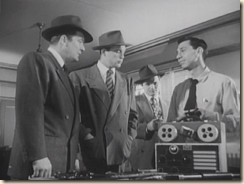 The film was part of the group of postwar semidocumentary police procedurals* -- a short-lived trend in films that tried to portray a realistic view of police work. It's the story of a sociopath (Richard Basehart) who kills a Los Angeles cop and the attempt to track him down. The killer is clever and careful, leaving no evidence. Sgt. Marty Brennan (Scott Brady) was a friend of the murdered policeman, and vows to find his killer. The investigation is run by Captain Breen (Roy Roberts) with help with forensics expert Lee (Jack Webb). After many dead ends, plus some scenes showing the basic police work, the police slowly find small clues that lead to them finding the killer.
The acting is underplayed, letting the story carry the movie. Indeed, the characters (other than Brennan mentioning he knew the murdered cop) are give no backstory; it's all unimportant to the main work of finding the killer. Basehart, though, great as the killer -- cool, collected, and ready for anything. Whit Bissell is also good as Paul Reeves, the one person who has met the suspect. The direction keeps the plot moving. Alfred Werker was credited, but some -- and maybe most -- of the film was directed by Antho0ny Mann, who had earlier directed T-Men, another film in the semidocumentary genre. But what is especially interesting is the beginning of the film. It sets the scene in Los Angeles by showing sights of the city, and indicates that the story is true -- and the names have been changed to protect the innocent. If that phrase doesn't ring a bell, you're probably too young to remember Dragnet. Dragnet was in the same vein, taking actual cases from the Los Angeles police department, changing the names, and showing the ins and out of police work. And, of course, the producer and star of Dragnet was Jack Webb -- who had a role in this film. It's clear that this is what Webb used as his template. Supposedly, someone on the set suggested he do a radio show (and later a TV show) based on LAPD cases. Dragnet began in the same way as the movie, saying the story is true, the names have been changed, and then talking about life in Los Angeles.** In addition, the word "Dragnet" appears several times in the film, describing the LA police rounding up the usual suspects after the cop is killed. I suspect Webb (whose performance is more Gil Grissom than Joe Friday) used the film as a template. The cast, of course, is filled with names who were busy actors once TV came along. Not only Webb, but Basehart (Voyage to the Bottom of the Sea) starred in TV series, while Roy Roberts, Scott Brady, and Whit Bissell were very busy TV guest stars. The film has lapsed into the public domain, so it's easy to find. It's worth a look, not just because it's a pretty good thriller, but because of it's long-term influence on the genre. It's in the public domain, so you can find it at Archive.org. _______________________________________________ *The film is often classed as film noir, but, other than lighting, it has no real noir elements. Noir tends to focus on a man trapped into murder (usually due to a two-timing woman). We identify with the person who is either framed or tricked into it. He Walks by Night does not identify with the killer, and there are no female characters. Anthony Mann's earlier T-Men -- also a semidocumentary -- is a better model. **A basic Dragnet opening would go something like this: "This is the city. Los Angeles, California. I work here. I carry a badge." Of, though, Friday would go on about some of the great things about LA, segueing into that introduction.
(1971)
All Music Guide  Papa John Creach was an very unlikely rock star and his path to success was unusual, to say the least.
Creach was born in 1917, making him a bit old when rock came into being. And he really wasn't a blues musician, though he did play blues, too. He played on an instrument -- violin -- that one hardly associates with either genre* and, indeed, one gets the impression he played in bars and ballrooms in the 40s and 50s. He probably would have stayed that way if drummer Joey Covington hadn't stumbled upon him working. Covington was a friend (and soon to be drummer) of the Jefferson Airplane, and he soon introduced them to the band. Creach started playing with Hot Tuna** and soon with the Airplane themselves. He was an immediate crowd favorite. Back in 1971, the Airplane, like many big name groups of the time, had their own record label (Grunt)*** and decided to feature Creach on an album. The record featured a lot of San Francisco's top musicians, members of the Airplane, Quicksilver Messenger Service, Santana, and the ubiquitous Tower of Power horn section.**** Clearly, people just enjoyed playing with Creach, and it's clear he enjoyed the music more than anyone. The songs are a mix of the old ("St. Louis Blues" and lovely versions of "Over the Rainbow" and "Danny Boy"), songs composed by his friends (Joey Covington wrote "The Janitor Drove a Cadillac"), and some of Papa John's own compositions. It's charming, filled with blues, jazz, standards, rock, and all sorts of musical styles. The album was the peak of his solo career, but he kept working with all the various incarnations of the Jefferson Airplane/Starship**** and Hot Tuna. Papa John died in 1994, after a long life of spreading joy through music. _______________________________________________ *Though violins in rock don't get the respect they deserve, especially with musicians like Richard Greene (Seatrain), Don "Sugarcane" Harris (The Mothers, after making a name for himself as a guitarist and singer in the 50s) and David LaFlamme (It's a Beautiful Day) **A side project by Airplane guitarist and bassist Jorma Kaukonen and Jack Cassady. ***It started with Frank Sinatra with Reprise, but others who had labels at the time were the Beatles (Apple, of course), The Rolling Stones (Rolling Stones), The Moody Blues (Threshold), Rare Earth (Rare Earth), Frank Zappa (two labels -- Bizarre Records and Straight Records; later he ran Barking Pumpkin Records), Led Zeppelin (Swan Song) and the Grateful Dead (Grateful Dead). Producers like Lou Adler (Ode and Ode 70) and Neil Bogart (Casablanca) also had boutique labels, though they were more involved in developing talent for them. Except for the Grateful Dead, all were distributed by established record companies. ****Whenever you wanted horns on your record, you hired Tower of Power. *****Though he had left by the time they recorded "We Built This City."
 (1930- )
John Barth Information Center
The Sot-Weed Factor may be my favorite book of all time. And John Barth is one of my favorite authors. Barth is usually classed as an academic writer, and his work is clearly filled with intellectual ideas and words like "postmodernism" are bandied about. But he also has a very wicked (and bawdy) sense of humor. His books are a lot of fun to read, with plenty to reward even the casual reader. Barth grew up in the Eastern Shore of Maryland, a factor that is part of all of his works. His first novel, The Floating OperaI (1957), is about Todd Andrews, a lawyer who is contemplating suicide. The story goes off on weird and wonderful directions, with weird characters, bizarre lawsuits, and many other wonders. It is an amazing beginning, though still shows he hadn't found his way. Next came The End of the Road (1958),* the story of Jacob Horner, who is paralyzed by indecision after having an affair with his best friend's wife and is working through the incident with his psychiatrist. Horner is a shell of a man, yet it makes sense that the woman has the affair with him.  But Barth really hit is stride with The Sot-Weed Factor (1960)**. It is a long, sprawling, bawdy, hilarious historical novel set in colonial Maryland, about Ebenezer Cooke, a third rate poet (and virgin) in London (that is, he'd be one if he ever wrote any poetry) who gets himself named poet laureate of Maryland and who travels to his plantations there to take charge. Followed by his former tutor Henry Burlingame III (a man who is never what he seems), and guided by his unconsummated love of prostitute Joan Toast. Cooke's tale is filled with adventures and digressions, including the search for a secret diary of Captain John Smith, which provides the McGuffin for the plot. Maryland is filled with memorable characters.
One amazing thing about the book is that there really was an Ebenezer Cooke who did indeed write a poem called "The Sot-Weed Factor."*** One of the major plot points is the search for the secret of the sacred eggplant, something so bizarre that it seemed to confirm to me how wild Barth's imagination could be -- until I discovered it was based on an actual text. Giles Goat-Boy (1966) came next, the story of a hero -- carefully following the Joseph Campbell template long before Star Wars. It's something of a fantasy, set at a university that is an allegory for the world. But again, it's funny and bawdy. By now, Barth was at his peak. Both books were both critical and popular successes, and he followed them up with an excellent short story collection, Lost in the Funhouse(1968). Barth was beginning to write more metafiction where the story commented on the story and storytelling, but never stopped being entertaining. The title story is one of the great mainstream short stories of the 20th century, about a boy who gets lost in a carnival funhouse and tries to escape by imagining a story called "Lost in the Funhouse" where he escaped.**** "Frame Tale" is perhaps the longest story every written -- or the shortest. Chimera (1972), his next book, are three linked novellas, again concentrating on what a story is and what makes a hero. It portrays the Greek heroes Perseus and Bellerophon looking back on their deeds and revisiting them. It won Barth a National Book Award. Barth was riding high, but his next novel, LETTERS (1979)a tour de force of storytelling and structure. Subtitled, "An Old Time Epistolary Novel by Seven Fanciful Drolls & Dreamers Each of which Imagines himself actual," the book consists of letters written by characters from Barth's earlier novels, as well as though written by a new character, Germaine Pitt, and Barth himself to the characters. If you take the first letter of each of the letters, it spells out, "An Old Time Epistolary Novel, etc." If you put the dates of the letters on a calendar and turn the months sideways, it spells out "LETTERS." The letters are presented by character; thus you will occasionally read a reply before you read the letter that engendered it. I can't imagine how Barth managed to keep this all straight, but he did a terrific job of it. Like the characters in Chimera, Barth revisits his triumphs and comments on storytelling and the novel in the late 20th century. Like all of Barth, it is filled with great characters and wild storytelling. But, for some reason, it was a critical flop. More than that, it seemed to turn Barth from the front rank of literary novelists. He was never taken as seriously from that point on, and I can't imagine why (though I suppose that if you haven't read his earlier books, it may be difficult to follow). Barth continued with the more traditional Sabbatical: A Romance (1982) and The Tidewater Tales (1987), both of which covered similar ground. He went into full-fledged fantasy with The Last Voyage of Somebody the Sailor (1991), a retelling of the Sinbad tale.***** I haven't read his later stuff except for Coming Soon!!! A Narrative, a novel about how the novel was becoming outdated in the 21st century. The critical disappointment with LETTERS turned Barth from a popular writer to a niche writer. It also retroactively affected his earlier novels. All have remained in print in one form or another, but few people go back to them to read for pleasure. This is a mistake. At the very least, read The Sot-Weed Factor and prepare to be amazed at a true writing genius. ____________________________________________ *The only one of his novels to be made into a movie (and probably the only one that could be made into a movie) starring Stacy Keach and James Earl Jones. **The cover of the first edition (shown here) was created by the great Edward Gorey. **Which roughly translates into "The Tobacco Wholesaler" in modern English. ***It's also filled with good advice for the beginning writer. ****Barth always was on the edge of fantasy; Giles Goat-Boy, Chimera, and LETTERS all had fantastic elements scattered throughout. Barth also had the lovely quote, "Science fiction writers are not like you or me. They have more fun," the fun being science fiction conventions.
 (1969)
Directed by Costa-Gavras
Written by Jorge Semprún from a novel by
| Vasilis Vasilikos | |
Starring Jean-Louis Trintignant, Yves Montand, Irene Papas, Jacques Perrin.
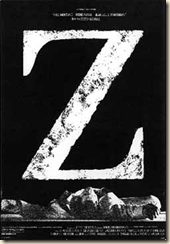
IMDB Entry | | Costa-Gavras* was one of the most political of all directors. He managed to combine a very strong point of view -- liberal but with a strong mistrust of communism -- into some very successful political films. Z was one of his biggest and better-known films. The subject matter was highly political when it came out. Costa-Gavras was born in Greece, and in 1969, the country was ruled by a repressive right-wing military dictatorship. Indeed, the film is based upon actual events of the time -- with a disguise so thin that no one in Greece would fail to see through it. In the film, we see an unnamed country where a Deputy of their legislature (Yves Montand) wants to give a speed on nuclear disarmament. But the right-wing forces don't want it and suddenly obstacles appear. He is forced to go to another venue when the original one mysteriously becomes unavailable. And as he walks across the street after his speech, a small truck somehow manages to get through the police cordon and the Deputy is hit. He dies soon afterward. The authorities say it was a hit-and-run driver, but the hospital** reports that the injuries aren't consistent. An uproar occurs, and the government is forced to investigate. An Examining Magistrate (Jean-Louis Trintignant) is named. He, at first, starts examining the evidence objectively, and slowly reveals evidence of a political cover-up. The movie plays as a taut thriller as the Examining Magistrate digs at the evidence.*** Trintignant is terrific as a man who is only interested in the truth -- no matter where it leads. Jacques Perrin is also memorable as the photojournalist who pushes the investigation. But the story does not have an entirely happy ending; dictatorships don't take lightly having their members being arrested. The final credits give a list of things that were currently banned in Greece: the Peace Movement, the Beatles, Aeschylus, Mark Twain, and many others, including the letter "Z," which referred to the assassination, meaning, "He is alive." The film was a major hit of the time, winning a bunch of awards including an Oscar for Best Foreign Film (and a nomination for Best Picture). Costa-Gavras went on to other political films like The Confession and Missing. Nowadays, the movie is still shown in film classes, and in trivia contests (tied for shortest title ever with M and the shortest title to be nominated for an Oscar). But since it's not in English, audiences are not familiar with it. Perhaps they think it's too political to be entertaining, but they couldn't be more wrong. ________________________________________________ *He didn't generally use his first name professionally. Or, rather, Costa-Gavras was his nickname with a hyphen in it. **In a telling scene, right after the Deputy his hit, an ambulance appears out of nowhere and tries to take him to a hospital across town, but they are forced to take him to one that is nearer -- and better. ***Though by today's standards, the dictatorship is pretty unsophisticated in its plotting.
(1960-1964)
Starring Mark Wilson, Nani Darnell, Bev Bergeron
IMDB Page
Mark Wilson's Webpage  I've always loved magic. If a magician is performing, I want to watch. I know enough about the art to occasionally figure out a trick, but even that doesn't make it less enjoyable. It's the showmanship and the surprise that really grabs me.
And it started with The Magic World of Allakazam." The show was broadcast on Saturday morning when I was a kid. It was conceived by and starred Mark Wilson, who, though in his 30s at the time, had been performing magic professionally for 15 years. There was some belief that magic wouldn't work on TV, especially on videotape, since everyone would think things were edited. Wilson had a simple solution: make as few cuts as possible to make it appear as though you were watching it live. He also insisted on a live audience to further show that things were not fixed in the production. With these precepts in mind, he created The Magic World of Allakazam. Wilson's illusions were not groundbreaking. They were versions of traditional magic tricks*, done in a simple and straightforward style. Wilson would dress up the magic with scenarios revolving around Allakazam. His wife Nani Darnell was his assistant, and Bev Bergeron played Rebo the clown**, who added some straight slapstick to the mix. The show was and an instant hit and a staple of Saturday morning TV for several years, first on CBS and later on ABC before going into syndication. It showed that magic could work as televised entertainment. Wilson went on to create several other, less well known shows, most notably, a series of Magic Circus specials. He continus to be a popularizer of magic and has written several books on the subject. It looks like he's branched out to DVDs, including videos of Allakazam. I think that most television TV magicians own Wilson a debt. _________________________________________________ *Insert Arrested Development reference. **A character name later used on Babylon 5. Creator J. Michael Straczynski would have been about the right age to be watching The Magic World of AllakazamI when it was on.
 (Vynález zkázy*)(1958)
Directed by Karel Zeman
Written by Frantisek Hrubín and Karel Zeman; dialog by Milan Vácha; based on the writing of Jules Verne
Starring Lubor Tokos, Arnost Navrátil, Miroslav Holub, Frantisek Slégr, Václav Kyzlink,
IMDB Entry For me, movies are about plot and character. But, occasionally, there is a movie that stands out in terms of style and visual imagination. Days of Heaven, with its beautiful cinematography, stands out, as does Medium Cool, with its cinema verite mixture of story and actual events. And though I don't care much for the film, it's clear that the visuals in The Matrix were groundbreaking. But few films have ever topped The Fabulous World of Jules Verne. The film was created by Czech director Karel Zeman. Zeman had a fascinating idea: make a movie from the works of Jules Verne, but in the style of the illustrations of the time. The result is an amazing combination of live action and animation, with sets that are often drawings, filled with details and crosshatching. It's all done in a crisp black and white cinematography that makes it seem like line drawings come to life. The story is high adventure about a mad scientist who lives in a volcano and who is developing a super bomb. It's just the type of film that would stick in the mind of young boy, and, though I haven't seen it for 50 years until I started writing up this blog entry, some of the images in the film are as memorable to me as though I had seen them yesterday. The film's style, of course, is what would not be labeled steampunk. Steampunk owes a lot to Verne and H.G. Welles, and, of course, the illustrations of the time. While I have no way of knowing, I do note that the authors who first developed the steampunk movement were all about my age. I wonder if this movie somehow influenced them. Zeman was already a major talent in Czech cinema, and, after the success of The Fabulous World of Jules Verne, he made several other Verne adaptations. Alas, they seem to have been a casualty of the Cold War and didn't make it to the US in wide release**. He does seem to be worthy of rediscovery. A visual imagination like his should not be forgotten. ______________________________________________ *Literal translation: A Deadly Weapon
**Perhaps Fabulous World didn't do well enough to warrant it.
 (1981)
Directed by Jean-Jacques Beineix
Written by Jean-Jacques Beineix and Jean Van Hamme
Based on the novel by Delacorta
Starring Frédéric Andréi, Wilhelmenia Wiggins Fernandez, Richard Bohringer
IMDB Entry
Official Website
Diva has it all -- comedy, romance, thrills, great chase scenes, wonderful characters and much more. If it had been filmed in Hollywood, it would have been remembered for the classic it is. But it was filmed in France, in French, and is known to a far-too-small number of people. It was the feature debut of director/writer Jean-Jacques Beineix. Beineix had come up through the ranks: he was an assistant director for ten years* before getting his chance to direct -- and hitting a home run. The story is simple and direct. Jules (Frédéric Andréi) is a Parisian messenger, who travels the city on his scooter delivering packages. He's also an opera fan, especially of the American opera singer Cynthia Hawkins (Wilhelmenia Wiggins Fernandez). Well, more than a fan -- he falls in love with his voice and does the one thing the singer has forbidden: recorded her in concert. But he is spotted by two Hong Kong tape pirates, who think they can make a mint with a live recording. He also draws the attention of a prostitution ring -- with members in high places -- when the tape is mistaken and switched for one that will blow their crimes wide open. And the chase begins. The movie contains some of the best chase scenes in film, especially when Jules rides his scooter through the escalators of the Paris Metro. Andréi is charming as Jules, but also memorable is Fernandez in a difficult part.** The movie got good reviews when it opened, but, of course, did so-so business in the US (subtitled films usually do). It was a big hit in France and Europe, though. Beineix has been working in the French film industry since then, but without any big splashes that crossed the ocean. Andréi has had some roles in French films and has moved into directing, while Fernandez returned to opera, where she's had a solid career on stage. The film was revived in 2007 to find new audiences, but I fear those were probably too small for people to see just how wonderful this film was. _______________________________________________ *Including time working on The Day the Clown Cried, Jerry Lewis's epic unreleased disaster. **Including casting. The story required a world-class opera singer who was fluent in both English and French.
by Frederick Lewis Allen (1931)  "Beyond the limited scope of his political experience, he was 'almost unbelievably ill-informed'.... His mind was vague and fuzzy. Its quality was revealed in the clogged style of his public addresses, in his choice of turgid and maladroit language . . . . It was revealed even more clearly in his helplessness when confronted by questions of policy to which mere good nature could not find an answer."
If I told you the above paragraph was written about a president, you'd probably know which one. But the words were written in 1931, and spoke about Warren G. Harding. This is one of the many delights of Frederick Lewis Allen's classic social history, Only Yesterday. The book was something new when it came out: a social history of a very recent time period (1919-1929, published in 1931). Histories previously had tended toward writing about big events of many years before. This one covered events that were well-known to much of its readers, and managed to become a best seller. Allen was not a trained historian, but rather an editor for Harper's Magazine who wrote as an amateur.* The writing is clear and easy to read, with a gentle mocking tone that is very entertaining. Allen didn't just write about big events; he touched on ephemeral items and fads. The chapters of the books are not strictly chronological, but rather thematic, and several chapters begin by going back to 1919 to trace a particular thread. The politics are there, of course -- Allen's talk of the Teapot Dome scandal is very entertaining -- but he also talks about things like the Great Red Scare (long before McCarthy), the Florida Land Rush, the Scopes Trial, the flapper phenomenon, and the Hall-Mills trial.** He also nicely documents the rise of radio and mass media, and the Great Bull Market and Stock Market Crash. His section on the Crash is just great writing. It puts you into the shoes of an investor on Black Thursday -- the first day of the crash -- demonstrating how uncertainty led to fear. How it was impossible for an investor to know what the price of a stock was. And how you'd realize that the prices you saw were an hour and a half late -- and things had continued to drop! How you'd hear people in a brokerage trying to sell stock at prices far below what the ticker was saying. Allen makes the panic real, and turns the book from a history lesson into a novel. The book was a major success and still remains in print. Allen followed it up with Since Yesterday, another successful history covering the 1930s. These are among the most entertaining history books written, and one of the best ways to get the flavor of the roaring twenties. ________________________________________________ *There was enough interest in the field those days for several other authors to make a name for themselves writing history despite being from outside academia. **Probably surpassed only by the O.J. Simpson case in sensationalism. The Pig Woman testifying from a hospital bed in the middle of the courtroom is an unforgettable image.
(1993)
Created by Pen Desham
Starring Jeff Kaake, Jack McGee, Marjorie Monaghan, Danny Quinn, Gottfried John, Linda Hunt, Cary-Hiroyuki Tagawa, Clint Howard
IMDB Entry Sometimes a TV show has everything going against it. Comparisons to another show. A network with little commitment to it, and which insists on showing the episodes out of order. Attempts to be different that aren't accepted by the conservative viewing audience. And a show like that always fails. So Space Rangers failed. But it deserved much better. CBS has never been a hotbed of science fiction. Oh, there was The Twilight Zone and The New Twilight Zone, but they were more fantasy than science fiction. In general, though, they stayed away from the genre, especially something that's out-and-out space opera. But evidently something was in the air in January of 1993. Star Trek: Deep Space Nine was coming on the air, and Babylon Five was in development.* So producer Pen Desham created Space Rangers and got CBS to air it.  The show's premise was also similar: it follows the adventures of a space police force stationed on the space station Fort Hope. The crew was led by Captain John Boone (Keff Kaake). Jojo (Marjorie Monaghan) was his pilot, Zylyn (Cary-Hiroyuki Tagawa) was the token alien, and Mimmer (Clint Howard) was the resident geek. They were led by Commander Chennault** (Linda Hunt) and were sent out on various missions to protect the station and rescue others.
Desham tried to do things a little differently. There were no ray guns. Instead, the Space Rangers fired real guns with bullets. This raised scorn from a lot of sci-fi fans -- the bullets might pierce the hull -- but it really wasn't impossible if they were designed not to.*** He also had the pilot's chair set up so JoJo lay prone on it. The Rangers were portrayed in a blue-collar world, where they expected hazard pay for risking their lives. Now the show was no Babylon 5. And it also hurt it that it premiered the same week as Deep Space 9. Trekkers heaped scorn on it, mostly because it wasn't Star Trek. I remember one heated debate that complained that in the first episode, JoJo banged her fist against a piece of malfunctioning equipment to get it to work. Trekkers derided the show, saying this was impossible and a sign that the writers didn't know science fiction. Until I pointed out that in the Deep Space 9 premiere, Sisko banged his fist against a piece of malfunctioning equipment to get it to work. The show as pure space opera, and handled in a bravura manner. Whereas DS9 took a season or so to hit its stride, Space Rangers hit it from day run, a mix of action and adventure that was a lot of fun to watch. Alas, CBS ran the shows in a really messed up order. Episode three was first, then two, then one, then four, then it was canceled. This wasn't an arc heavy show like Babylon 5, so it wasn't a disaster, but it did confuse some people.*** The cast list is interesting. The name that pops out is Linda Hunt, who had won an Oscar in The Year of Living Dangerously. She always was a superb actress, and seemed to be enjoying herself as the station commander. I liked Cary-Hiroyuki Tagawa's Zylyn. He looked alien enough and was a violent warrior (and cannibal) with strange blinked out eyes. Majorie Monaghan was also a standout as the tough-as-nails pilot. There's also Clint Howard, Ron's younger brother. Clint usually plays bit roles; this was one of his few regular roles in a TV show. After the show, the actors moved on, none becoming major names. Interestingly, both Tagawa and Monaghan appeared in Babylon 5. Producer Desham was back in TV a few years later with the revival of The Outer Limits that was pretty good and the second revival of The Twilight Zone, which wasn't. Space Rangers wasn't great SF, but had a lot going for it, a fun, likeable puppy of a TV series that had too many strikes to overcome. ______________________________________________ *There was a lot of speculation that Deep Space 9 was created primarily to block Babylon 5 from the air. The show had some strong superficial similarities -- set in a space station -- and J. Michael Straczynsky had pitched the idea to Paramount. It seems likely to me that DS9 had taken some of B5's elements when they were creating the series. **A reference to Claire Chennault, commander of the Flying Tigers squadron in World War II. *** I also was amused at the fact that this implied people thought the only way to do good science fiction was to make sure it had ray guns. ***Actually, I liked one element of this: instead of starting with an episode that fills in all the backstory, they jumped right into the action and worried about the background later. I think SF shows should do this more often (it also worked nicely for Firefly).
(1966-67)
Created by: Jerry Belson and Garry Marshall
Starring Will Hutchins, Sandy Baron, Pamela Rogers, Michael Constantine, Miko Miyama, Ann Morgan Guilbert, Kathryn Minner
IMDB Entry  Some TV shows seem to really vanish. They don't have a long enough run to go into syndication, and they never got any particular notice. Even in the Internet age, you can find only sketchy information. And in the case of Hey, Landlord, that's a shame.
The show was the first one produced by Garry Marshall. He and another ex-Dick Van Dyck Show writer, Jerry Belson, branched off to develop it for NBC. The premise was certainly a good one. Ohioan Woody Banner (Will Hutchens) inherits a New York brownstone and goes to live there. He shares his own apartment with aspiring comedian Chuck Hookstratten (Sandy Baron), and has to deal with the foibles of the tenants. These include photographer Jack Ellenhorn (Michael Constantine), aspiring model Timothy Morgan (Pamela Rogers) and her roommate Kyoko Mitsui (Miko Miyama), plus Mrs. Henderson (Ann Morgan Guilbert), and Mrs. Tecker (Katryn Minner). Woody was the fish out of water, unused to the quicker pace of the Big Apple, while Chuck tried to guide him away from the worst of the pitfalls. Jack was always morose about life and of course, Tim (real name Teresa) was there as a potential love interest. The show succeeded on the charm of Will Hutchens. Hutchens was attempting something of a comeback: he had been the star of the ABC TV series Sugarfoot for several years and was switching to comedy.* But my favorite was Sandy Baron. First of all, it was great to see someone on TV named "Chuck." And Baron was a very funny guy -- a standup Borscht Belt comedian moving into sitcoms. Michael Constantine was also terrific as the morose Jack Ellenhorn. If you remember him from Room 222, his role in this show was very similar, though far less watered down. And, of course, Ann Morgan Guilbert was already a TV legend from The Dick Van Dyck Show, and continued on a long TV career. The show was also a beginning for comedy writer James L. Brooks. Despite good writing, a great cast, and a theoretically good time slot (between Walt Disney's Wonderful World of Color and Bonanza), Hey Landlord couldn't compete against The FBI and Ed Sullivan. It ran against the second half of both shows and thus depended on its viewers to come from the Disney audience, which probably was too young to be interested. I'd guess that Disney viewers would catch the second half of Sullivan instead of sticking with Hey Landlord. In any case, it only ran one season. Hutchens tried again a couple of years later with Blondie, which also flopped, then did various guest shots before dropping out of acting. Baron was never given a chance to display his talents on TV, so returned to standup and also appeared as one of the comedians in Broadway Danny Rose and is the one narrating the movie. And the producers and writers for the show went on to create many more TV successes. But despite some great talent, Hey Landlord has been forgotten. ________________________________________________ **Not that Sugarfoot was a serious western.
(2008)
Directed by Randall Miller
Screenplay by Jody Savin, Ross Schwartz & Miller; story by Savin, Schwartz, Miller, and Lannette Pabon
Starring Chris Pine, Alan Rickman, Bill Pullman, Rachel Taylor, Freddy Rodriguez, Dennis Farina, Eliza Dushku, Bradley Whitford, Miguel Sandoval, and Mary Pat Gleason*
IMDB Entry You can't go very far wrong with a nice underdog story, and whereas the plot is most common with sports movies, sometimes, there's a different twist on it. One result was Bottle Shock.  It's based (loosely) on a true story, the famous "Judgment of Paris" in 1976. Well, famous in wine circles -- it was the first time an American wine beat French wine in a tasting. The story focuses on Steven Spurrier** (Alan Rickman) a British sommelier and owner of a Paris wine shop, who needs some publicity to get people into his store. He concocts the idea of a blind testing of Napa Valley wines versus the best France has to offer and flies out to California to find candidates.
Meanwhile, Jim Barrett (Bill Pullman) is working diligently to make great wine and wishing his son Bo (Chris Pine) took a more serious interest in the business. Bo is more interesting in good times and pot, but starts to take more interest when Sam (Rachel Taylor) shows up at the vineyard as an intern. Spurrier shows up looking for wine. Barrett isn't interested, put off by Spurrier's superior attitude. He's also a man at the end of his rope, for though he's been working at it, he is still working on making the wine to meet his standards. This isn't a film with surprises; you know from the start how the contest will end up. What makes it work are the characters and also the trials and tribulations everyone goes through to get the judgment. The cast seemed to enjoy their roles. No one does a superior sneer better than Rickman, and Pullman has a nice earnestness that makes you want him to succeed. Chris Pine shows the same devil-may-care attitude that got him cast as James T. Kirk in the Star Trek remake. Some of the other bigger names -- Dushku, Whitford, and Farina -- are really nothing more than just cameos, lending their names to help out the projects. They handle their scenes well, but the main story is in the hands of lesser-known actors. The film did fairly modest business, probably on the art film circuit. But it's an entertaining (if not inspiring) little movie with nice characters and a lot of heart. _________________________________________________ *Just a bit part, but Middleman fans will recognize her as Ida.
**No, not that Steven Spurrier, sports fans.
|


 (1984)


