Thursday, July 31, 2008

The Boys From County Clare

The Boys from County Clare(2003)
Directed by
John Irvin
Written by Nicholas Adams
Starring Colm Meaney, Bernard Hill, Charlotte Bradley, Andrea Corr, Shaun Evans.
IMDB Page

When the awards are given out to Best Actor who Starred in a Star Trek Series, Patrick Stewart is the clear winner.  But the second choice is more interesting.  You could make a nice case for Scott Bakula, primarily from his performances in Quantum Leap.*  But my favorite is a dark horse:  Colm Meaney.

Meaney made a name for himself in a bunch of delightful British/Irish comedies such as The Commitments, The Snapper, The Van, and The Englishman Who Went Up a Hill but Came Down a Mountain. He specializes is bemused Irishmen and is always a delight whenever he's on the screen.

The Boys from County Clare** has Meaney as Jimmy MacMahon, a successful Irish businessman living in Liverpool in the early 60s.  He loves Irish music* and organizes a band to compete in the annual Céilidh competition in County Clare.

John Joe (Bernard Hill), the winner the previous two years, will have none of it and pulls out all stops to both keep Jimmy from competing. Jimmy, however, gives as good as he gets, and does the same to John Joe.

We learn the two have a deep-seated grudge between them that goes back to when they were boys.  Brothers, as a matter of fact.

There are also a subplot about one of the member's of Jimmy's band, Teddy (Shaun Evans) who falls in love with Anne (Andrea Corr), who plays with John Joe.

The movie is a delightful mix of comedy and drama, with a nice twist at the end. The two men fight, make up, fight, and generally act as royal pains in each other's butt. 

Meaney is excellent, of course. Jimmy is gruff and driven, and though he has a softer side, he refuses to let it come out.  Hill's performance as Jimmy Joe is also delightful.

This was another fine film by director John Irvin, who did Turtle Diary and Widow's Peak. As usual, he concentrates on quirky characters and small but rich situations.

And the music is just plain delightful.

*Enterprise was actually just a Quantum Leap episode, where Sam leapt into the body of a starship captain. The problem was that he needed to fix what went wrong in order to leap out, and the show was impossible to fix.

**Called The Boys and Girl from County Clare in the US, a pointless bit of marketing that ignored the main focus of the movie and makes it sound vaguely pornographic. 

***And thinks that new group of Liverpool musicians, the Beatles, will never amount to much

Wednesday, July 30, 2008

Widow's Peak

(1994)
Directed by
John Irwin
Written by High Leonard
Starring Mia Farrow, Joan Plowright, Natasha Richardson, Jim Broadbent
IMDB Page

I wrote previously about how when making up a list of films to discuss here, I discovered the name of John Irwin, a British director whose name meant little to me until I realized I wanted to talk about several of his films.  Widow's Peak is the second.

It a charming little revenge comedy, set in the 1920s in the small Irish town of Kilshannon. The title refers to a hill overlooking the town, where widowed women go to live after their husbands have died. But these aren't a bunch of timid mourners.  Led by Mrs. Doyle-Counihan (Joan Plowright), they are the type of women who speak their mind and always get their way.

Natasha Richardson, Jim Broadbent, Mia Farrow But there is one non-widow living at Widow's Peak -- Miss Katherine O'Hare (Mia Farrow), a spinster who seems to have some secrets hidden away.  And when the Mrs. Edwina Broome (Natasha Richardson) -- who has been living in America comes to town, Miss O'Hare takes an instant dislike to her. Edwina and Miss O'Hare start to scheme against each other.  Soon the entire community is in a uproar.

It's a comedy of manners, and a very funny one, with a surprising and delightful twist at the end. 

Joan Plowright is spectacular as Mrs. Doyle-Counihan, who runs the little community as her own person benevolent fiefdom.  Mia Farrow -- in her first role after the messy breakup with Woody Allen -- is surprisingly devious, and Natasha Richardson matches her.

Sunday, July 27, 2008

Robin and Marian

(1975)
Directed by
Richard Lester
Screenplay by James Goldman
Starring Sean Connery, Audrey Hepburn, Robert Shaw, Richard Harris, Nicole Williamson, Denholm Elliott, Ian Holm
IMDB Page

Sean Connery as Robin Hood.  Sounds like the casting for a first-class action adventure film.  But Robin and Marian is a much different movie, a unique look among films at the part of the legend of Robin Hood (or any hero) that is rarely shown.

The story is about Robin's later years. After spending years fighting in the Crusades with Richard the Lionhearted,* Robin (Connery) returns home to find King John (Ian Holm) running the country, and the evil Sheriff of Nottingham (Robert Shaw) still out there wanting to make his life miserable.  He seeks out Maid Marian (Audrey Hepburn), only to find that she has entered a convent. When the Sheriff tries to arrest Marian, Robin rescues her -- against her will -- and brings her back to the aging members of his Merry Men.

Despite everything, Robin and Marian resume their romance, leading to a final showdown with the sheriff and an amazingly beautiful ending.

The theme of the film is to ask the question "What happens when a hero gets old?" and it develops this in a charming and touching manner.

Robin and Marian

Connery's Robin is one of his top performances.  It's interesting to think that he was playing an old man over 30 years ago.  His Robin is always a hero, even when it might be inconvenient to be one. 

Audrey Hepburn is radiant as Marian.  She had been happily retired from films for a decade, turning down many offers until this one came along. Her Marian is radiant in a role that lets her use her strengths of an actress, and the star power of her and Connery together is a joy to watch.

This was a departure for Richard Lester, who was better known for his comedies like A Hard Day's Night, Help!, and The Ritz. Though there are funny moments, the tone is bittersweet and highly romantic in all the best ways.

It's not a swashbuckler, but rather a character study. If you want to see a different view of Robin Hood, this is a film to watch.

*Richard is portrayed as something of a jerk here, which actually is more like how he was in real life. Though a hero in the UK, he wrecked the country's economy with his crusading and generally wasn't much better than his brother John, who's always portrayed as a tyrant.  But he had a cool nickname, so that counted for a lot.

Wednesday, July 23, 2008

Regal Crown Sours (candy)

The biggest problem about writing about forgotten brands of food is that there is often no way of getting them back.*  Many of the things I'm writing about can be found in some way -- DVDs, CDs, old videotapes, etc.  But once food and candy goes, there's no way to get it back.

Which brings us to Regal Crown Sours.

I first saw them in the late 60s.  Large tubes (maybe about 5 inches and about 3/4 in in diameter) with hard candy.  They were made of up individual candies, each wrapped in wax paper, in sort of a flying saucer shape.  And they were sour.

Oh, not as puckeringly sour as things like Sour Patch Kids today. But compared to the usual hard candy fare -- Life Savers, lemon drops -- pretty sour.

The candy was imported from the UK, though I believe they originated in Denmark.  They came in several flavors:  Sour Cherry, Sour Orange, Sour Grapes (yes), and, my favorite, Sour Lemon.  As least twice the size of a Life Saver, they were a great bargain.  I tend to like things tart, and these were just wonderful.

Over time, though, they vanished.  I haven't seen them in a candy story in about 30 years and the last time I tried them was nearly 20  years ago, where I found them in the United Kingdom pavilion at the Epcot Center.  In among the faux-British shops was a candy store, and which sold -- yes -- Regal Crown Sour Lemon.

They were just as good as ever.

After the Internet came along, I learned about various old time candy sites and went to see if any of them had it.  Alas, the only place I've been able to see the Regal Crown sours are on lists of discontinued candy no longer available.

At least there is a possibility, with the interest in sour candy, that someone might bring it back. Of course, they'd have to deal with old folks like me saying "It's not the way I remember it," but I think it'd be worth it for another taste.

*Sometimes even the recipe is lost forever. Leiderkrantz cheese was discontinued by their last owner, Borden Foods, a couple of decades ago, and it would be impossible to get it back. The cheese's flavor depended on a specific culture of bacteria that was in the original factory (when they moved to a new one, they had to scrape the walls so that it could establish itself) that gave it its flavor. No one analyzed what the bacteria was, and it is impossible to duplicate, so even if someone wanted to bring it back, they're out of luck.

Saturday, July 19, 2008

The Scaffold (music)

(1960s)
The Scaffold -- Mcgough, Gorman, and McGear Mike McGear, Roger McGough, John Gorman
All Music Guide

You have to give Mike McGear a lot of credit. When he went into the music business, he had an automatic "in."  His name alone would have opened doors and probably have gotten him a contract. So he changed his stage name to "McGear" and tried to make it on his ability alone.

His real last name was "McCartney."

But McGear didn't want to trade on his brother Paul's reputation. Instead, he joined up with poet Roger McGough and post office cler John Gorman to form the Scaffold. And, to tell you the truth, the Scaffold was not likely to appeal to Beatlemanics. Their music was a combination of catchy tunes, humor, and clever lyrics.

The Scaffold is connected in many ways to the Bonzo Dog Band; they started out in the same venues, and later did albums with former members of the group.  They are not in the Bonzos class as musicians (actually, McGear, McGough, and Gorman didn't play instruments at all), but they have a similar goofy sense of humor.  McGear and McGough had a knack for catchy music that stays in your head, while McGough was an inspired lyricist.

And when I say McGough was a poet, I mean that literally.  He is considered one of the UK's top poets, especially as a performance poet.  His work has appeared in The Norton Anthology of Modern and Contemporary Poetry, and he's been granted a knighthood. In fact, his poem "Goodbat Nightman" was the only poem in that anthology that was also a popular song (by Scaffold, of course).  But his most famous work -- if uncredited -- was the dialog for Yellow Submarine, much of which was his doing.

Scaffold had a decent amount of success.  It helped that they used some top sessions musicians like Jack Bruce, Jimi Hendrix, Graham Nash, Ringo Starr, and a very young Elton John, so the music behind the voices was top notch.

Their single "Thank U Very Much" made the UK charts and they reached number one with "Lily the Pink," an old rugby drinking song cleaned up. 

Three albums were released -- Lily the Pink, Fresh Liver and Sold Out, while a live album of their stage show was released a few years ago.  In addition, there are a couple of compilations for the group, which probably capture them better -- they were more a singles and stage act than one that worked with albums.

However, the group couldn't continue forever.  They never made in impact on the US, and all had other interests.  McGough and McGear joined the British comedy rock group GRIMMS, then had solo careers, McGough as a poet, McGear with a couple of solo albums (one produced by his brother).

They left behind a couple of albums, and some fond memories.

Sunday, July 13, 2008

Nightmare Cafe (TV)

(1992)
Created by
Wes Craven and Thomas Baum
Starring Jack Coleman, Lindsey Frost, and Robert Englund
IMDB Page

"Touch that remote -- and you die!"

As I've mentioned previously, anthology series on US TV are pretty much gone with the dinosaurs. The only way to try to get around it is to use recurring characters and make them involved in the story, like Quantum Leap. So when Wes Craven -- even back in 1992, a well-regarded director of horror -- wanted to try something, he had to create a different hook.  The result was Nightmare Cafe.

Nightmare cafeThe show was set up nicely in the first episode.  Frank Nolan (Jack Coleman) and Fay Petrovic (Lindsay Frost) coincidentally survive drowning the very same night and go into a small, abandoned restaurant that's near the water. No one is there, and strange things happen:  voices are heard, doors open into places miles away (or even hundreds of thousands of miles away) and a television shows scenes from their lives earlier in the day. And then there's the mysterious Blackie (Robert Englund), whose dry sense of humor shows a devilish tendency of stirring the pot and making a bad situation worse.

It turns out that Frank and Fay died that night. But the Cafe (which is a character all by itself) gave them a second chance.  They will work there and help give other second chances.

And so they run the cafe, which travels randomly from place to place (not unlike the TARDIS), putting them where they can do the most good.  It grants wishes (usually when you don't expect it), shows what's happening to the others on its special TV, punishes those who deserve it, and rewards those who do.

Jack Coleman is your standard hero type as Frank, and Lindsey Frost gives some nice life to Fay. But it's Englund's Blackie who quietly steals every scene he's in, giving you both laughs and chills.

Only six episodes were aired. The show probably sounded too much like an anthology (it was promoted as such, even though everyone working with it took pains to say it was not), and the tone varied -- a deliberate mixture of film noir, horror, and slapstick comedy or whatever fit best into the story to be told. 

In fact, it was clear that everyone knew the effort would be doomed. In the final episode, the very funny "Aliens Ate My Lunch," (a send-up of The X-Files a year before The X-Files went on the air, with a combination of aliens, cows, and midgets), they showed a "Where are they now" for all the characters in the episode -- and for Frank, Fay, and Blackie. Perhaps it was the anthology tag, or maybe the horror, but the show never found an audience.

Craven, of course, went on to add to his resume with the Scream franchise, and Englund (who had already achieved horror film immortality as Freddy Krueger) has worked regularly over the years. Coleman worked in TV and is now a regular on Heroes, and Frost has been successful as a guest star.

Maybe there was no chance that Nightmare Cafe would ever succeed, but it is indeed a first-class show that deserved more than six episodes.

Saturday, July 12, 2008

Noises Off

(1992)
Directed by
Peter Bogdonovich
Written by Marty Kaplan, from the play by Michael Frayn
Starring Michael Caine, Carol Burnett, Denholm Elliott,  Julie Hagerty, Marilu Henner, Belinda Blair, Mark Linn-Baker,     Christopher Reeve, John Ritter, Nicollette Sheridan

Noises Off  I first became familiar with Michael Frayn from his novel, The Tin Men. It's sort of science fiction (about robots) and was one of the funniest things I've read.  I read a couple of other novels of his, then lost track until I heard he changed to a playwright with Noises Off, and eventually won all sorts of awards for Copenhagen.

I also was a fan of Peter Bogdonovich. He started out with a real bang (literally) with Targets,* but lost his way after the flop of At Long Last Love.

So, when I heard Frayn's play was going to be directed by Bogdonovich with an all-star cast, I knew I had to see it.

Noises Off is a behind the scenes look at the production of a stage farce Nothing On. Director Lloyd Fellows** (Michael Caine) tries to keep order but the characters off-stage lives and stage characterizations lead to slapstick situations and some very funny lines.

The movie and play was designed in three acts at different stages of the production on the road to Broadway.  The first act -- the final dress rehearsal -- is a comic disaster, with people dropping lines, missing cues, and everything that can go wrong going wrong.  The second act shows a later performance -- but from backstage and you see what's going on behind the scenes in the same scene you saw in the first one. The third is opening night on Broadway, and brings the entire disaster to a triumphant and funny conclusion.

Bogdonovich does not try to open up the movie. There's really no point, since the original material is so good that you might as well stick with it. All the acting is first-rate, though Caine is memorable as the director and John Ritter*** is surprisingly good as an actor who stammers badly offstage, but has no problem reading his lines.

The movie got mediocre reviews. Part of the problem is that the play is so good that transferring it to film loses some of the frenetic humor on stage. Anyone who saw the stage production probably was disappointed by the movie, but if you hadn't the material is good enough for an enjoyable film.  Still, it flopped at the box office and sent Bogdonovich back scrambling for work.

Still, despite the carping, it's a very funny film farce, with too many funny scenes and lines to list.  Well worth digging up.

*Not counting Voyage to the Planet of Prehistoric Women, but no one really counts that one.

**I'm using the names in the movie; there are variation in the play.

***Of all people.  I'm not a big John Ritter fan.

Sunday, July 6, 2008

Steambath (TV)

image (1973)
Directed by
Burt Brinckerhoff
Written by Bruce Jay Friedman
Starring Bill Bixby, Jose Perez, Valerie Perrine, Art Metrano, Kenneth Mars, Herb Edelman

Bruce Jay Friedman is pretty much forgotten as a writer these days, but back in the 60s, he was a big success, writing very funny short stories, plays, and novels, usually dealing with Jewish New Yorkers, like Woody Allen, though more wry.

Steambath was his second play.  It ran for several months off Broadway, with a cast that included Anthony Perkins and Hector Elizondo, but obviously wasn't a major hit. So that's probably why when it was first adapted it was done for PBS.

The play was set in a steambath (obviously). Tandy (Bill Bixby in the TV version) finds himself there but doesn't know how he got there. It's populated by a variety of people, all waiting -- though for what, no one can say -- and getting few straight answers from the attendant (Jose Perez). But eventually, Tandy stumbles on the truth:  he is dead, and the steambath is a waiting room for heaven. And the attendant is God.

Very metaphysical, but also very funny.  Tandy wants to go back to his life and we learn about the various people in the steambath.

The show as a success for PBS; the local station ran it often in their fund drives at the time.  Not only because it's an interesting play, but because of the nudity. It was a steambath, of course, and the people inside only wore towels, which didn't always stay in place, especially to towel covering the top of Valerie Perrine as Meredith.

The real find of the play was Jose Perez. His God was put-upon and short tempered and unwilling to produce miracles just to prove who he was.  He had few credits beforehand, but starred soon after in Calluci's Department in a supporting role and as the lead in On the Rocks. They even tried to make the play into a series, with no success.

Valerie Perrine -- a fine actress who was typecast because she was both sexy and willing to do nudity -- never really had the success she deserved.  Bill Bixby, on the other hand, has been one of TV's most successful leading men.

Freidman worked on some screenplays, most notably Stir Crazy and Splash, and his short story "A Change of Plan," became the basis for The Heartbreak Kid.

Maybe one day, when PBS needs pledge money, they'll bring this back to enjoy.

Saturday, July 5, 2008

Gallipoli

(1981)
Directed by
Peter Weir
Screenplay by Weir (story) and David Williamson (Screenplay)
Starring Mark Lee and Mel Gibson
IMDB Entry

I've always been a history buff, especially war history. And the war I found the most interesting (after the Civil War) was World War I. It was one of the bloodiest of all wars, and filled with military incompetence (another subject I find fascinating). Yet World War I has gotten something of a short shrift by filmmakers. Once World War II broke out, the first war was forgotten except for a handful of films usually focused on the air war.

So a movie about Gallipoli was something I knew I had to see. If you're not familiar with the battle, it was an attempt by the allies to open another front by invading Turkey, a disaster of epic proportions. The plan -- in part developed by Winston Churchill* -- allied troops landed on a handful of beaches and were immediately pinned down by Turkish forces (led by Mustafa Kemel, later known as Kemel Ataturk, the founder of modern Turkey). After several month and horrific losses (mostly by Australian and New Zealand units), the allies retreated.

The campaign was an important point both in Turkish history and in Australian and New Zealand history and Australian director Peter Weir decided to make a movie about it.

Weir had made a couple of critically successful films in Australia before this.  He recruited an obscure US actor, Mel Gibson**, and started the film.

Mel Gibson and Mark Lee Most of the film is not about Gallipoli. Frank Dunne (Gibson) and Archy Hamilton (Mark Lee) are Australians who met and become friends before deciding to join the army to fight the war. We follow their careers from Australia, to Egypt for training, and finally to Gallipoli itself.

The movie's most memorable moment was the final sequence in the battle, one of the most dramatic and frustrating war scenes put on film.  But it's primarily a film about friendship.

The film was a critical success and made some money at the box office. And when I first saw it, it was really nice to spot a potential star in the film. Of course, that seemed to be Mark Lee, who never really had any major hits.

Weir was able to move to the US on the strength of the film and was soon  was making a mark in Hollywood with The Year of Living Dangerously, Witness, Dead Poets Society, The Truman Show, and Master and Commander: the Far Side of the World.  Gibson also seems to have has some success as an actor and director.

But this is where they both started (in terms of being known to a US audience) and it's a great place to start.

* Who, for all his good points, evidently never saw a topological map of the Balkans and assumed they contained no mountains.

** Gibson had already made the original Mad Max, but it had only a very limited release in the US when Gallipoli was released.

Monday, June 30, 2008

Elton John -- 11/17/70 (music)

 Elton John, piano, vocals
Dee Murry, bass
Nigel Olson, drums
Wikipedia Page

11/17/70Elton John hit America with the single "Your Song," which immediately characterized him as a sensitive singer/songwriter who just happened to use a piano instead of a guitar.  His later work showed him as a very successful pop songwriter.

But Elton John, at least in the beginning, thought of himself as a rocker in the Jerry Lee Lewis mode. He complained how "Your Song" gave the wrong impression, that he would much rather rock out than play the role of the singer/songwriter.

11/17/70* proves him right.

It was somewhat groundbreaking from the start.  Elton was asked to perform a live radio concert in A&R studios in New York on November 11, 1970.  A small group of people were in the audience, and the set went onto the airwaves. Afterwards, Elton and his producer, Gus Dudgeon**, listened to the tape of the concert and were impressed by its quality. Because of this, and because bootlegs of the concert were showing up, they released it as an album.

It's a high energy, rocking show. The concert*** stared out with "Bad Side of the Moon" from original album.  The original song (from his Elton John album) was a moderate tempo rock song with a string accompaniment.  Here, not only is it stripped down to piano, bass, and drums, but it at a faster, wilder tempo.  "Amoreena" (from Tumbleweed Connection) turns from almost a ballad to rock, while "Take Me to the Pilot," a pretty uptempo rocker to begin with, becomes a frenzied anthem.

The rest of the concert continues at this wild pace.  "Sixty Years On" slows things up a bit, but Elton goes back to rocking with a cover of "Honky Tonk Woman" and the obscure original "Can I Put You On."

The high point of the album is its finale, an 18+ minute version of "Burn Down the Mission," performed at a breakneck pace and interpolating verses from "My Baby Left Me" and "Get Back."

It is an exhilarating experience.

The album sold OK, but was his worst selling album of the early 70s.  It reached 11 on the Billboard charts, but that was nothing for an artist who had seven number one albums. Elton also went in a different direction, moving away from the Jerry Lee Lewis piano pounding to more pop songs. Those who liked songs like "Levon," "Tiny Dancer," or "Daniel," would have found 11/17/70 a bit too different and even his foray into rock and roll -- "Crocodile Rock" -- doesn't come close to the energy he showed on that one night.

The CD is still in print, often for good prices, but iTunes has only portions of the concert (because he included songs by the Beatles and the Stones).  Hopefully, it will be available there, too.

But if you want to see a different Elton John than you're used to, seek out this gem.

*In the UK, of course, the album name is 17/11/70.

** Also the producer of several Bonzo Dog Band albums. I had to mention that.

***The original album changed the order of the songs and left off "Amoreena."

Saturday, June 28, 2008

The Bedford Incident

Bedford Incident (1965)
Directed by
James B. Harris
Written by James Poe, from a novel by Mark Rascovich
Starring Richard Widmark, Sidney Poitier, James MacArthur, Martin Balsam, Wally Cox, Eric Portman
IMDB Entry

You would have thought that the tensions of the Cold War would have lent themselves to some interesting films back when it was going on. Yet there were surprisingly few films that dealt with it directly.  Most used a fantastic element (science fiction films about giant ants) or made it into a background for general derring-do (James Bond), or used it for black comedy (Dr. Strangelove, The Mouse that Roared). Serious dramas were rare, probably because the subject was too close to the bone.

The Bedford Incident was one of the few examples. And its strength is that it was a chilling and realistic portrayal of just how things could go wrong.

The USS Bedford is a destroyer patrolling off Greenland. From the start, there are tensions among the crew.  Its commander, Captain Eric Finlander (Richard Widmark) is a little too tightly wound, putting immense pressure on his crew to do things right, especially on Ensign Ralston (James MacArthur), who never seems to get things right.  Reporter Ben Munceford (Sidney Poitier) observes what's going on as he tries to write an article about life on a naval destroyer and is bothered by Finlander's attitude, but Finlander isn't interested in what a civilian things and believes his criticism of Ralston will make him a better officer.

Into the mix comes a Soviet sub. The Bedford tracks it, in a game of cat and mouse, ratcheting up the tension to unbearable levels.  Seaman Merlin Queffle (Wally Cox) breaks under the strain, but Finlander won't give it up, refusing to let the sub alone, even when it begins to leave the area.

It's a recipe for disaster.  I won't go into how it happened, but it's a tragedy in the classical sense:  where the characters' flaws lead to an inevitable conclusion.

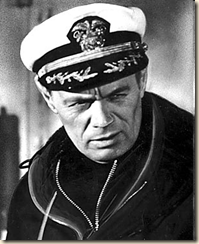
Richard Widmark as Eric Finlander Richard Widmark is superb as Finlander.  He made a career of tightly wound men, and this is one of his best. Finlander has some depth to him:  he's not just a martinet, and he's not just a commie hunter and Widmark brings it all out.

Sidney Poitier had recently won his Oscar and also puts on a fine performance as the voice of reason that Finlander refuses to listen to, and MacArthur's Ralston is a wonderful portrayal of a man who is trying to do his best -- and exactly the wrong type of person to be under Finlander's command.  It's also interesting seeing Wally Cox not only acting (instead of being on game shows), but in a dramatic role.

The movie did OK, but was no hit. It got grouped in with Dr. Strangelove and Fail-Safe as "The nuclear disaster trilogy," but since it was the last of the three to hit the screens, it made the least impact. Director Harris made a few more films, but nothing that made any impact.  MacArthur went on to play Danny Williams ("Book 'em, Dano") on Hawaii 5-0 and, of course, Poitier is still well-regarded today.

The movie was a warning and a tragedy, and I'm sorry that it seems to have sunk out of sight.

Friday, June 27, 2008

Digi-Comp

(1963)
Friends of Digi-Comp Yahoo Group.
A nice overview.

I was interested in computers at a very early age. They were so science fictional (I loved science fiction) and the idea of one of those big electronic devices (with vacuum tubes and blinking lights, or course) was pretty exciting to a kid.

So, one year, my parents gave me one as a gift:  Digi-Comp

Digi-Comp

Digi-Comp was a mechanical computer.  No power source.  It was made out of plastic, some metal, and rubber bands.  You programmed it by putting a series of one-inch long plastic tubes* on pegs.  The location of the tubes determined the programming, and you could do arithmetic operations by moving a lever back and forth.  The numbers were in binary, of course, and there were three digits, so you could only get up to seven before overloading the computer.

Here's a nice little Youtube clip.  If you look closely, you can see the white numbers on the left side increase each time the computer is cycled.


Digi-Comp was clearly not designed for any serious computing, but it did display the principles nicely.  I took it into school to show how computers worked.

I did grow tired of it, mostly because moving the tubes around was always difficult and slow, and debugging involved making sure they were all in the right place.

But it was a great toy while it lasted.

*Just like the Internet!

Tuesday, June 17, 2008

Heartland

(1979)
Directed by
Richard Pearce
Screenplay by Beth Ferris, with additional scenes by Bill Kittredge.  Based on the letters of Elinore Pruitt Stewart
Starring Rip Torn, Conchata Ferrell, Megan Folsom
IMDB Entry.

image We all know what the American West was like -- outlaws and cowboys and Indians all shooting it out among themselves, with an occasional sheepman for color.  The marshal wore a star and everyone lived in towns with wooden sidewalks and hitching posts, whose only businesses were the livery stable, the general store, and about three saloons, all of which had those swinging half doors and a poker game going on at all times.

Heartland is nothing like that. It's one of the more realistic portrayals of the American West, concentrating on the human drama instead of shoot-'em-ups. 

That's because it's based on a real story.  Elinore Pruitt Stewart wrote letters back East about her life, and someone managed to collect them an turn them into a movie.

The plot is simple.  Eleanor Randall (Conchata Ferrell), with her daughter Jerrine (Megan Folsom), travels to Wyoming to work as housekeeper for the reclusive and taciturn farmer, Clyde Stewart (Rip Torn). Despite his pennypinching ways, they slowly develop a relationship until Clyde asks him to marry her.  But life is difficult and lonely on the plains and it puts a strain on their lives.

This is a real human story, the type of tale that tells more about how people actually had to live than any other Hollywood film.  The cinematography (by Fred Murphy) gives the audience a real idea about just how desolate life on the plains could be, and how much a struggle it was just to survive.

I've spoken about my admiration of Conchata Ferrell  before, but this is truly her best role.  Eleanor is brave, determined, and very human, fighting to make a better life for her daughter and herself.  It's a shame she hasn't been given a chance to repeat something this memorable.

Rip Torn is also terrific as Clyde, a man of very few words and who seems emotionally distant, but who shows flashes of the true personality beneath his hard exterior.

The film was an art house hit (at a time there were still art houses), but not a big money maker.  Torn's career took off afterwards (this was at a relatively low point in his career curve, before he started getting major roles again.  Director Richard Pearce worked in TV and got good reviews for his film The Long Walk Home, but has never had something like this to work with.

If you're fond of films with great characters and an unblinking look at how the West was won, this is a good place to start.

Tuesday, June 10, 2008

Renaissance (music)

RenaissanceKeith Relf, Vocals, Guitar; Jim McCarty, Drums; Jane Relf, Vocals; John Hawkin, piano; Louis Cennamo, bass
All Music Guide Page

The Yardbirds is one of the seminal groups of British rock, second only to John Mayall's Bluesbreakers as the place where great musicians first came to prominence. Their original lead guitarist was Eric Clapton, of course, and when he left, Jeff Beck was chosen as his replacement.  Later, Jimmy Page joined the group, but disagreed with Beck, who went off to form the Jeff Beck Group with Rod Stewart doing vocals.  There were further disagreements and eventually Page took over the group and formed the New Yardbirds (with a trio of unknowns named Robert Plant, John Bonham, and John Paul Jones) to fill out some concert dates.*

But the least known connection -- and the one that seems so unlikely -- was Renaissance.

You see, the leader (and vocalist) of the group during much of its time was Keith Relf, not the guitar heroes that gave it its fame.  When he and Page started arguing about the direction the group was going, Relf (along with original drummer Jim McCarty) went off to form Renaissance.

It was a radical departure from the heavy blues (and India-influence music) that made the Yardbirds famous. Relf was going for a more acoustic sound.  He and McCarty provided a rock basis, and the real find -- keyboardist John Hawkin -- provided a baroque classical  and jazz-tinged mood. Relf's sister Jane provided some beautiful vocals and the result was an album entitled simple "Renaissance."

The album starts with a bang with a long piano intro to the first song "Kings and Queens" and never disappoints. The other songs ("Innocense," "Island," "Wanderer," and "Bullet") are all exciting primarily because of Hawkin's amazing piano and Jane Relf's voice.  It is a powerful melding of classical and rock music, and a first-class debut.

Alas, it did poorly, not even charting. A second album was recorded but left  unreleased, at which point the Relfs and McCarty left the group.  But the group continued on. They added Annie Halsam on vocals and emerged with the album "Prelude," (which had none of the original members**) at which point the name Renaissance because a cult favorite.  But the group was blander and smoother, without the edge of Hawkin's piano to give it bite.

In many ways, this is a parallel to the situation with Blood, Sweat, and Tears, whose original lineup was not the one that became a success (though BS&T were more successful, and actually had memers of the original group when they found their success). Keith Relf tried several bands before dying by accidentally electrocuting himself while playing guitar.  The other members of the group formed Illusion, which had limited success and split up, Hawkin joining the Strawbs. The art rock movement not only was dead, but was the subject of derision by punk rockers, so there was no point any more.

I'm a fan of the art/rock genre -- the melding of classical and rock -- and the first Renaissance is one of the high points of the genre.

*I can imagine people showing up and complaining that it was only Page and a bunch of nobodies and demanding their money back.

**Jim McCarty has a credit on the album, but was not the regular drummer.

Sunday, June 8, 2008

Fresno (TV)

fresno (1986)
Directed by
  Jeff Bleckner
Written by Mark Ganzel, Barry Kemp, Michael Petryni
Starring Carol Burnett, Dabney Coleman, Gregory Harrison, Teri Garr, Charles Grodin, Luis Avalos, Pat Corley, Valerie Mahaffey, Anthony Heald, Teresa Ganzel, Bill Paxton, Jerry Van Dyke

TV miniseries are almost always dramas. If you want to do a comedy, you create it as a series, mostly because it's unlikely that people will want to stay for several nights (some have suggested that comedy usually outstays its welcome when it goes on for too long, and a look at movie running times seems to confirm that).  But one exception was Fresno.

This was in the 80's, when prime time soaps like Dallas, Dynasty, and Falcon Crest ruled the air.  So Barry Kemp and Mark Ganzel decided that the time was right for a spoof of the prime-time soaps.  Kemp decided on Fresno because at the time the city was listed at the top of several "worst place to live" lists. 

Fresno was the epic of the Kensington family, wealthy raisin growers and the threat to their empire by the evil raisin tycoon Tyler Crane (Dabney Coleman). Charlotte Kensington (Carol Burnett) drinks too much, mourning the death of her husband in a dehydrator accident. Cane Kensington (Charles Grodin) tries to save the farm by making a deal with to be a toxic waste dump, while his wife Talon (Terri Garr) goes from one affair after another, and sets her sights on the farmhand Torch (Gregory Harrison), who always appears without his shirt.

The plot is impossibly convoluted, playing off the nighttime soap opera cliches of the time. And while there are few one liners, the little tale about the naming of the city is funny:

Two Spanish conquistadors present a load of grapes to the commandante.  He takes one taste and spits them out.

"You call these grapes?" he asks.  "They taste like fresno!"

Everyone had a great time on the show. Dabney Coleman is always great as a villain and the others get the most out of their roles, underplaying very nicely.

The show didn't overwhelm in the ratings.  It was probably too subtle, and the six hour length was a bit daunting, especially since the humor was more like Mary Hartman, Mary Hartman than Carol Burnett's soap opera spoofs. In addition, it was suggested that it might have been a little too well written -- the plotting was never as slapdash as in the real things.

Like most miniseries, this vanished after it was first run.  It got some Emmy nominations, but not in any category anyone but the people nominated (and their families) cared much about.  Mark Ganzel went on to produce Coach and the infamous Dads*.

Fresno has been on DVD, but seems to have gone off the market.  It would be great to see it again.

*Dads would probably be up there among the worst comedies on TV, except for the fact it I'm not sure if it ever appeared on TV.  However, the tape is still being used by market research firms, who will ask you to view a videotape of it purportedly to determine if it goes on the air. In actuality, they want you to watch the ads in the middle and then, when they do survey you, they ask two questions about the show and a dozen about the ads.  I don't know why they don't just send you the ads to see instead of trying to fool you (not that anyone would be fooled by this gambit).  The last time a market research firm asked me about sending me a video to give my opinions about the show, I asked them, "Are you going to send me Dad's again?" 

Saturday, June 7, 2008

Turtle Diary

Turtle Diary (1985)
Directed by
John Irvin
Screenplay by Harold Pinter, from a novel by Russell Hoban
Starring Ben Kingsley, Glenda Jackson, Michael Gambon
IMDB Page

I keep a list of films and shows I want to write about here on the blog, and sometimes I can see patterns.  I know I've been featuring Alfred Hitchcock, and also Harlan Ellison, as well as Stephen Frears. But sometimes I find other connections that I hadn't realized -- good films that have a director in common, but which I never realized the connection. This happened awhile ago when I realized that two fine films -- Little Voice and Brassed Off -- had the same director.

But John Irvin is the first time I listed three films before realizing the same director was involved in each.

I'll start with Turtle Diary. As you can see by the screenplay credits, it had an impressive genesis.  I remember Russell Hoban's Riddley Walker as an interesting science fiction novel, one of the few (A Clockwork Orange is another) that created an entire new language for the future and told the story in that language. And Pinter, of course, is one of the 20th century's greatest playwrights.

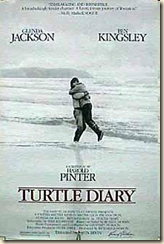
Turtle Diary is the story of William Snow (Ben Kingsley) and Nearea Duncan (Glenda Jackson), two lonely people who meet at the turtle tank at the London Zoo and embark on a quixotic task to release the turtles into the wild.  They are aided by the turtles' keeper George Fairburn (Michael Gambon) and work to free the turtles -- and also free themselves. 

It's a quiet movie without a lot of plot, but Jackson and Kingsley are marvelous as two shy people who learn to trust one another and open up to the world. It's charming from start to finish, with nice flashes of humor. 

Irvin went on to direct some other films in the same vein (which I'll talk about some day), but this one really stands out.

Thursday, June 5, 2008

Hero

Hero (1992)
Directed by
Stephen Frears
Written by Laura Ziskin & Alvin Sargent and David Webb Peoples
Starring Dustin Hoffman, Geena Davis, Andy Garcia, Chevy Chase, Joan Cusak

Some directors seem fated to go unrecognized. One example is John Irvin.  And another is British director Stephen Frears.

Frears list of films include Gumshoe, My Beautiful Laundrette, Prick Up Your Ears, Sammy and Rosie Get Laid, Dangerous Liaisons (the John Malkovich/Glenn Close version), and The Grifters. After he moved to Hollywood for The Grifters (a modest success), he got his first big-time cast in Hero, a fascinating look at heroism.

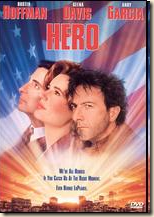
Bernie Laplante (Dustin Hoffman) is a petty thief and lowlife who happens to be in the right place at the wrong time as an airliner crashes. Reluctantly, he pulls people from the wreckage, saving lives, then goes off to avoid the glare of the spotlight.

The mysterious savior becomes a media obsession -- "The Angel of Flight 104" -- and Gayle Gayley (Geena Davis) goes off to find the hero of the hour.  The evidence points to John Bubber (Andy Garcia), who shows up with the evidence -- one of Laplant's shoes -- to claim a reward.  Bubber is charming and sympathetic, but he's also a fraud.  Laplante is sleezy and dirty, but really the hero. 

The plot uses this turnaround to say some fascinating things about heroism.  The movie is funny, but also has a lot to say.

Hoffman, of course, is great as Laplante, a riff on his Ratso Rizzo role. Garcia is just as strong, and Davis is good as she starts to fall for Bubber only to begin to suspect he might not be what he seemed.

The movie did very poorly at the US box office, especially for a film with such star power.  It broke even overseas, but Frears seemed to go back to the UK, where he continued with such gems as The Snapper and The Van (semi-sequels to the film The Commitments), High Fidelity, Mrs. Henderson Presents and The Queen.

The film wasn't a drag on his career, but it deserves to be remembered as more than just one name in a distinguished list.

Friday, May 30, 2008

The Ritz

The Ritz (1975) 
Directed by
Richard Lester
Written by Terrence McNally
Starring Jack Weston, Rita Moreno, Jerry Stiller, Kaye Ballard, Treat Williams, F. Murray Abraham, Paul B. Price, Jerry Stiller
IMDB Page

Pure film farce is rare.  Oh, you have comedies, but the rapid-fire humor and outrageous situations and complex plotting is very hard to pull off. And add to that some subject matter that is dicey today and you have a movie that vanishes from consideration.

But when you have one of the funniest characters in film, it deserves to be known.

Terrence McNally, who adapted the screenplay from his original play, set The Ritz in a gay bathhouse.  This gives it a whole new dimension to the heterosexual bed hoppping that characterizes good farce.  And throwing a straight man into that scene leaves things ripe for comic possibilities.  And when you get one of the top comedy director of the time to film it, the result is hilarious.

Gaetano Proclo (Jack Weston) is a salesman from Cleveland who becomes the target for murder by his mob-connected brother-in-law, Carmine Vespucci (Jerry Stiller).  Proclo ends up hiding out in the Ritz, a gay New York Bathhouse, thinking at first that it's like a health spa.  He is quickly disabused of that notion and becomes the romantic target of Claude Perkins (Paul B. Price), a "chubby chaser," who tries to seduce Proclo with promises of candy and other treats (starting with food).  Michael Brick (Treat Williams) is a detective with a buff body and a ridiculous high voice who is looking for Proclo, and also becomes the object of the affections of others in the Ritz. Chris (F. Murray Abraham) is one of the bathhouse regulars who tries to help Proclo in adjusting.

And then there's Googie Gomez (Rita Moreno), an aggressively untalented singer at the baths, who thinks Proclo is a Broadway producer and her route to stardom.  Proclo thinks she is a man in drag, and tries to avoid her, as well as his brother-in-law (who's coming for him with a gun), Claude Perkins and everyone else in the bathhouse.

Moreno invented the character of Googie, performing as that alter ego at parties, where McNally happened to see her.  Speaking with an weirdly exaggerated Puerto Rican accent, she is convinced that she is the greatest talent ever to appear on stage, despite all the evidence to the contrary. She's the type of character that causes you to lean just a little bit closer to the screen just to make sure you don't miss anything she says.

The result is a mad mix of jokes and very funny situations.

The acting is all first-rate. Farce requires good timing, and most of the cast had been in the Broadway version, allowing them to work perfectly as a team to make the jokes work.

And Richard Lester was the perfect director for such a film. Lester had vaulted to the top of comedy filmmaking with A Hard Day's Night (and The Mouse on the Moon), and directed a series of very good films:  Help!, Petulia, The Three Musketeers, The Four Musketeers, and Robin and Marion.  He was famous for his rapid cutting style, something that is almost routine these days, but which was a big revelation in the 60s.  He actually shot this one in a more standard (for the time) style, but his penchant for humor gave it just the right touch.

The movie did well enough, and even got a few Golden Globe nominations, but it faded away.  The subject matter made it unsuitable for TV and, the AIDS epidemic made the behavior portrayed in it much too dangerous to be funny.

But I do miss Googie Gomez. If there was any character who deserved to have more films, it was her.

Monday, May 26, 2008

Buffalo Bill (TV)

Buffalo Bill (1983-84)
Produced by
Tom Patchett and Jay Tarses
Starring Dabney Coleman, Joanna Cassady, John Fiedler, Max Wright, Geena Davis, Meshach Taylor, Charles Robinson
IMDB Entry
The first rule of casting your TV show is to have a likeable main character. But what happens when you don't want a likeable character? When your star's most famous role is being one of the blackest of comic villains? Well, you end up great but forgotten.
The show was designed as a vehicle for Dabney Coleman. At the time, Coleman was best known at the double dealing mayor in Mary Hartman, Mary Hartman, the villain in Tootsie,  and as the nasty boss Franklin M. Hart in the movie Nine to Five, a male chauvinist pig of towering proportions.* The producers, Tom Patchett and Jay Tarses were former writers for the MTM productions like The Bob Newhart Show and decided the best way to work around it was to use good writing and a nicely sympathetic cast.
Bill Bittinger (Coleman) was the host of a mid-day talk show in Buffalo, NY. He was egotistical, vain, sexist, conniving, two-faced, and sneaky, though managed (most of the time) to keep his true nature off the air.
Geena Davis, Joanna Cassady, and Max Wright He did drive the others on the show crazy, though.  They included Jo Jo White (Joanna Cassady), his director; Karl Shub (Max Wright), the station manager; Woody (John Fielder), the stage manager (who was independently wealthy, but still loved his job); Wendy Killian (Geena Davis), his research assistant; Tony (Mesach Taylor), the assistant director, and Newdell (Charlie Robinson), the make-up man who didn't take any of Bill's guff.
As you can see by the cast list, there were talented people, and the show was well regarded by critics.  And it didn't help that there were some controversial themes.  One show -- a two-parter called "Jo Jo's Problem" was a very funny and touching episode about Jo Jo mulling an abortion**.  It also didn't help that NBC didn't have any idea what to do with the show, so let it out to die.
I can't single out anyone in this excellent cast.  I've been a big fan of John Fielder (best known as the neurotic Mr. Peterson in The Bob Newhart Show*** ) and his Woody is wonderful -- a sweet guy who knows that Bill really has a heart of gold (Bill doesn't, of course).
Geena Davis was also memorable. She had only appeared in a small part in Tootsie at the time, and this was just a wonderful role for her. Her Wendy was a delight to watch.  Max Wright later had TV success in Alf, as did Meshach Taylor in Designing Women, and Charlie Robinson in Night Court.
But talent isn't enough in the TV game.  Ratings matter and despite acclaim and awards (11 Emmy nominations and one Golden Globe win), the show was canceled after two seasons.
Coleman tried a few more times to headline a comedy (The Slap Maxwell Story, Drexel's Class, and Madman of the People), but, even though they were well regarded, too, audiences didn't show up.  Ultimately, his character's abrasive personalities didn't play well in prime time. 
Still, Coleman has remained busy, as have all the other main members of the cast. They show may have been forgotten, but its influence lives on.****

*It was hard to take him seriously when he showed up in On Golden Pond as Jane Fonda's fiance and later husband; you got the impression he had something nefarious on his mind.
**One of the last network shows that portrayed a main character deciding to end the pregnancy; even now, that topic is off limits.
***And on Broadway as the only white member of the original cast of Raisin in the Sun.
****Four footnotes -- a record.  But I wanted to say that Pardon My Enthusiasm is now a successful show with an unlikeable character -- the type of thing Buffalo Bill  was trying to do.

Saturday, May 24, 2008

Morning Chex Press

(1960s)
By Ron Goulart

If you're like me, you read the back of cereal boxes.  When I was a kid, they were colorful things, filled with offers for toys (send in your boxtops) and other things.  Definitely kid's territory.

Which could be a problem if you had a cereal for adults. This was long before nutrition was a selling point, so the question was what to put on the box?

Ralston-Purina, makers of Chex Cereal (and Purina Dog Chow) decided to do something different.  They hired an ad copywriter (Ron Goulart) to write a newspaper parody on the back of their boxes.  Thus, the Morning Chex Press was born.

Every few months, a new box would come out. They were filled with jokes, oddball stories, a weather report, and the "No Pictures Comic Strip."  The results were a delight.  I think one reason I still love Corn Chex and Rice Chex is thinking about the old Chex Press.  I'll admit I don't remember too many details (even the Internet gives no specifics), but I do remember looking forward to reading the box each time we bought a new one.

Goulart was just starting his career as a writer. He later developed into one of the funniest writers in science fiction before branching out to write mysteries, including a fairly recent series featuring Groucho Marx as a detective. He's also well known for his various books on popular culture.

It seems unlikely that the Chex Press will be seen again. Cereal boxes are even more ephemeral than regular newspapers (which at least have microfilm). And Ralston-Purina spun off its human food division, which was then sold to General Mills in 1997, as Ralston decided to concentrate on manufacturing store brand cereals instead of their own (which leads to an interesting point:  if you buy store brand Chex-equivalent, you're buying from the original manufacturer; if you buy Chex, you are not).

In any case, the Chex Press seems gone for good. I'm somewhat saddened that I can't go back and see what I liked so much.

Thursday, May 22, 2008

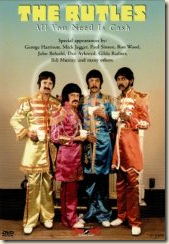
All You Need is Cash

(1979)
Directed by Gary Weiss and Eric Idle
Written by Eric Idle
Starring Eric Idle, Neil Innes, John Halsey, Rickie Fartaar, Michael Palin, George Harrison, Bianca Jagger, Mick Jagger, Dan Ackroyd, Gilda Radner, Bill Murray
IMDB Entry
The Rutles Web Page

As I mentioned before, Eric Idle had bad luck in his post-Monty-Python endeavors. That didn't mean they were all terrible, though, and All You Need is Cash is a movie that needs to be mentioned.

The term "mockumentary" was coined by Rob Reiner to refer to This is Spinal Tap. Certainly that put the finishing touches on all the elements of the genre (having the movie basically ad-libbed by the actors), but is it the first? Probably not. There were scripted mocumentaries before Spinal Tap (though not many). Woody Allen's Zelig certainly fits the definition, and you could make the argument that A Hard Day's Night could be considered the first (it did, after all, show a day in the life of the Beatles).

The Rutles But All You Need is Cash deserves consideration as a pioneer.
It was Eric Idle's baby. After Monty Python ended, Idle created a show for the BBC called Rutland Weekend Television, similar in concept to Second City TV in Canada -- the broadcast day of a small TV station that was an excuse for various skits and hijinks. One recurring bit was that of the Rutles -- Rutland's prefab four.  Idle got his friend Neil Innes of the Bonzo Dog Band* (scroll down) to help write music. 

Idle brought the tape of one of the songs to an appearance on Saturday Night Life and Lorne Michaels liked it enough to do an entire special on the concept.

The concept is just what you'd think.  Dirk McQuickly (Idle as Paul McCarney,  pretending to play bass guitar left handed), Ron Nasty (Innes, as John Lennon), Stig O'Hara (Ricky Fataar -- once a member of the Beach Boys and here standing in for George as the Quiet Rutle**) on lead guitar) and Barry Wom (Barrington Womble, played by John Halsey, on drums) met in the clubs of Liverpool, polished their act in Hamburg Germany, and returned to become the center of Rutlemania.

Much of the fun comes from the shock of recognition. Innes's songs can lull you into believing they are Beatles songs.  Consider, for instance, "Ouch":


Or especially, "Piggy in the Middle"

This is more than reference comedy; the parodies are so exact that you can't help but being enchanted by them. And the changes in the Beatles over the years were neatly matched in the film.

Idle plays multiple roles, too (the only one of the prefab four to actually have a background in acting).

The TV was broadcast on NBC on March 22, 1978. Ratings were dismal. There was a theatrical release, and the film probably made back its cost -- since it was made dirt cheaply.

A record album came out at the time.  And, many years later, in response to the Beatles's Anthology album, they added some new songs can released Archeology (without Innes).

The film is a high point of musical satire and an early example of the mockumetary genre. And the songs are just as wonderful now as they ever were; the shock of recognition is still there.

*Idle and Innes had worked together on Do Not Adjust Your Set, and Innes wrote several songs for Monty Python).

**He never says a word.

Monday, May 19, 2008

Nuns on the Run

(1990)
Written and Directed by
Jonathan Lynn
Starring Eric Idle, Robby Coltrane, Camille Coduri, Janet Suzman.

Poor Eric Idle. He never really established himself once he left Monty Python, despite being the one person who wrote sketches without any partner. He was limited to guest star roles in so-so comedies (and horrible ones, like Nearly Departed) and voice work.  He also worked on turning Monty Python and the Holy Grail into Spamalot (where he gets songwriting credit*)

Alas, his best post-Python work was in a very funny movie that no one has seen, called Nuns on the Run.

For title alone, it clearly is a movie worth watching.

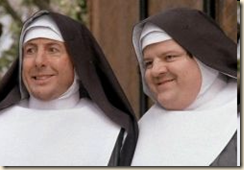
The situation is very similar in situation to Whoopi Goldberg's Sister Act, which came a couple of years later (but whose basic script was written before). Charlie and Brian getting into the habit (sorry)

Brian Hope (Robbie Coltrane) and Charlie McManus (Eric Idle) are two low-level gangsters who want to leave the mob. Their boss doesn't like this and tries to have them killed -- after they collect some money for him.  But they escape with their lives and the money and end up having to hide out in a convent.

Charlie knows nothing about Catholicism, and has to lean from Brian. The two have to deal with being men in a woman's institution (including the showers), plus dealing with Brian's girlfriend Faith (Camille Coduri).

It's really Robbie Coltrane's movie. His has most of the best lines (the role was originally offered to Michael Palin) and is a very funny presence. Idle is good as Charlie, though, as he tries to figure it all out while not blowing their cover.

The movie did adequately at the box office, but was no hit. Director Lynn went on to direct My Cousin Vinnie and The Whole Nine Yards, far more conspicuous success.  Coltrane, though well-liked in the UK, never was able to establish himself in the US.  He was certainly not leading man material, but seems to be a fine character actor. His career wasn't helped by the outcry over the great but forgotten The Pope Must Die!, which might have made a difference.

It's a nice little comedy that, like many, got lost in the shuffle. As a footnote, this was the last major production of Hand Made Films, George Harrison's film production company that produced a nice string of British comedies in the 80s.

*Incorrectly in the case of the song "Brave Sir Robin," which was written by his friend Neil Innes of the Bonzo Dog Band)>

Saturday, May 17, 2008

Captain Nice (TV)

(1967)
Produced by
Jay Sandrich
Created by Buck Henry
Starring William Daniels, Alice Ghostley, Ann Prentiss
IMDB Entry

I grew up loving superheroes.  I was also a big fan of satimageire and spoofs (probably, like most people my age, from reading Mad Magazine). So the combination was like catnip to a cat.  And when NBC announced they were doing a superhero spoof at a midseason replacement, I was there.

The show was created by Buck Henry.  Henry had just created Get Smart and wanted to do a superhero spoof much like the other show was a spy spoof. The result was Captain Nice.

Carter Nash (William Daniels) was a police chemist* who developed developed a serum that gave him superpowers. He took on the identity of Captain Nice and started fighting crime.  His mother (Alice Ghostley) was the only one who knew is identity and sewed him a costume.  Sgt. Candy Kane was his girlfriend, who kept getting in trouble and had to be rescued.

The show was just irreverent enough to make it work both as spoof and superhero. Carter was never as dumb as Maxwell Smart, but often had problems trying to live up to the superhero lifestyle. Here's a look at the first few minutes of the first episode.

William Daniels, whose been working regularly on TV and movies ever since, brought quite a bit of sincerity that grounded the concept. And Alice Ghostley was a busy character actor in the 60s, best known as Aunt Esmerelda in Bewitched.  Ann Prentiss (Paula's younger sister) also brought fun to her role.

There was even a novelization by the great William Johnston.

Alas, the show didn't catch on.  It wasn't quite as good as Get Smart, but what hurt it the most was the fact that CBS decided to premier a very similar show, Mr. Terrific, the same night. If there were only one, it's possible Captain Nice would have survived.  As it is, the two shows become a more obscure version of the Addams Family/Munsters debate.

William Daniels, of course, is still working today, and went on to some fame in St. Elsewhere and Boy Meets World (I saw him on Broadway playing John Adams -- the lead -- in 1776). Ghostley kept busy as a character comedienne, and Ann kept working.

They used to say satire was what closes on Saturday, and this definitely fit the bill. It's too bad, since the show had some great potential.

*An honorable profession for superheroes -- see Barry Allen.

Friday, May 16, 2008

The Starcrossed (book)

(1976)
by Ben Bova

The Starcrossed In 1973, some TV producers decided to create a science fiction series and actually went about it the right way. They hired Harlan Ellison to write the treatment.  Ellison has written scripts for some of the best SF on TV (The Outer Limits, Star Trek, The New Twilight Zone, Babylon 5) and certainly he could come up with something exciting.

And he came up with The Starlost.

The trouble was, the producers didn't trust the material and knew nothing about SF, so once production began, everything fell apart.  Ellison's concept (which even he admitted was cliched, even though the producers thought it was brilliant and original) was watered down, and the show's cheap production values were blatantly apparent.  Ellison washed his hands of the project (changing his credit to "Cordwainer Bird") and has trashed it in print even since.  The show lasted for 16 episodes -- all syndicated -- before dying a lingering death.

And he is right.  The show was dull and plodding, introducing the well-worn concept of a generation ship as though it was the newest concept under the stars.

But this isn't about The Starlost.  It's about a book that is the one thing that made the series worthwhile (if not worth watching):  The Starcrossed by Ben Bova.

Bova was in on the disaster from the start, hired as technical consultant.  He's primarily known as a hard SF writer, but strayed into comic territory as he wrote something very unusual in science fiction:  A roman a clef.

The Starcrossed is the story of the production of The Starlost. In the book, Bill Oxnard (who is clearly Bova himself) is the technical advisor of a 21st century TV show based on Romeo and Juliet (hence, The Starcrossed), developing a new form of 3D TV. Becoming involved, he is treated to the antics and wild behavior of the main character, Ron Gabriel.

Gabriel is blatantly based on Harlan Ellison. If you're not familiar with him, he is a legend in the science fiction world. And that's not hyperbole: there are jokes that go around SF conventions that substitute Harlan's name for the original punchline. He is a larger than life character who revels in attention, and can be nasty and funny at the same time.  If you know about Harlan, you'll love this book.

Bova was friends with Ellison, so he's not treated unkindly, but he is a cyclone going through the madness of the TV production. I don't know how much of the book was true, but the outlines are there, and Gabriel is always fun to read about. It certainly captures the flavor of a bad TV production team who drives their head writer crazy with their cluelessness.

This was quite a departure for Bova, best known for his hard science books. But the result is a funny satire of the insanity of TV.

Monday, May 12, 2008

Jeff Wayne's Musical Version of the War of the Worlds

 (1978)
Music and Lyrics by
Jeff Wayne
Performers include:  Richard Burton, David Essex, Justin Haywood, Phil Lynott, Julie Covington, Chris Thompson
Web Page

The rock opera seems to be long past dead. The idea of an album with a theme and plot is quaint in a time when people buy songs individually, but it was an important subgenre in the 60s and 70s.

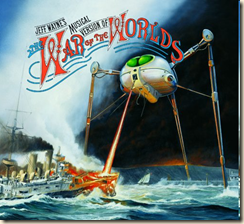
And one of the best (if not the one with the clunkiest title) was Jeff Wayne's Musical Version of the War of the Worlds.  Wayne started out writing music for West End musicals in London and moved on to be a record producer for many years. But Wayne was still composing, and, in 1978, got a group of big names together to record his take on War of the Worlds.

War of the WorldsThe album follows Welles's novel more closely than any other adaptation of it.  Wayne knows enough to let the story speak for itself and to concentrate on the music, which is an appealing combination of rock and classical, with a dramatic bent.

Richard Burton as the narrator gives the disk a lot of its strength. Burton often overacted, but in this case his performance is nicely subdued.  He doesn't sing, but he draws the images -- probably directly from the novel -- with a keen sense of drama. Maybe since he was only  a voice, he found it easier to hit the right notes to hold the story together.

Justin Haywood of the Moody Blues sings a couple of the songs. One, "Forever Autumn," was a minor hit, but -- though an excellent song on its own -- it's a bit out of place in the story, a love song in the middle of the carnage of the invasion.

The rest of the singers are all fine, taking various characters from the novel and telling their story.

The album was a major success in the UK, but barely charted in the US, where it was poorly promoted.  CBS records had no idea what to do with it, and never seemed able to capitalize on any potential.

Wayne went back to producing, not coming out with another album of music for almost 15 years.  That record, Spartacus, was in the same vein, but nowhere near as good. There have also been attempts to turn it into a stage show -- so far, unsuccessful.

You can listen to it online at the War of the Worlds Website (click on "Click here for music player").  It holds up very well and is rock opera at its best.