
https://greatbutforgotten.blogspot.com/2023/01/sapphire-and-steel-tv.html
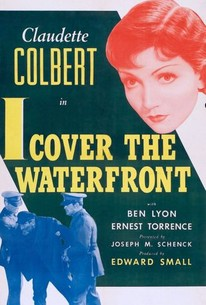
Ben Lyon is pretty much forgotten today, but he was a busy leading man in the 1930s, appearing in over 30 films during that decade. He usually played a bland but likeable hero, and I Cover the Waterfront seems to be a typical example of his work.
Joe Miller (Ben Lyon) is a reporter working the waterfront beat. He finds it dull, as he explains to his friend McCoy (Hobart Cavanaugh). He gets a report that a woman is swimming naked and goes to check it out. He finds Julie Kirk (Claudette Colbert), who is the daughter of Eli Kirk (Ernest Torrence), who Joe suspects of being up to shady deals -- like smuggling Chinese into the country.*
Joe decides to romance Julie to find out what her father is doing. But Eli keeps his unsavory side secret from her, and Joe begins to fall in love with her for real.
You can see why Lyon is not remembered. He's not bad, but there is nothing about him that stands out, and the fact that he was never in a classic movie didn't help modern audiences to see his work. On the other hand, Claudette Colbert became a major Hollywood star and brought a strong presence to her role.
The character of Eli Kirk is an interesting one. He shows compassion for the Chinese he is smuggling into the country but throws the same man overboard to drown when he needs to get rid of the evidence. It's a mixture of thoughtfulness and cruelty which makes it easy to understand why Julic believes he had done nothing wrong. He does show cocompassioned for his daughter and for Joe in the end.
James Cruze was a successful director from the silent days, including movies with Roscoe "Fatty" Arbuckle and Wallace Reid.**
________________________________________________________________________
*History lesson -- this was during the time of the Chinese Exclusion Acts, which limited and even banned Chinese from entering the US.
**Reid is best known for his death due to morphine addiction, which brought the issue to the general public.
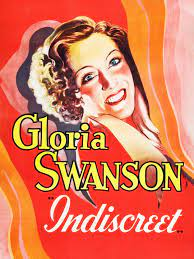
One thing about pre-code movies is their attitudes. Yes, they were willing to include sexual innuendo, but there were still attitudes that seem very old fashioned today. Indiscreet is based on a situation that was far less common these days than it was in 1931.
It starts where Gerry Trent (Gloria Swanson) is breaking up with her boyfriend Jim (Monroe Owsley) since he'd been seeing other women.* Some time later, she meets Tony Blake (Ben Lyon) author of the book Obey that Impulse. Tony practices what he preaches and asks her to marry him as soon as they meet. She falls in love but her aunt Kate (Maude Eburn) insists she tell him about Jim. Eventually she does, but Tony insists she not go into details or ever mention the man's name.
Jim returns from Europe, but now engaged to Gerry's sister Joan. Gerry warns Jim to stay away, but he refuses. He invites her to a house party, and, since Tony is away on business, she accepts. But Tony arrives early and goes to the party.
Of course, misunderstandings are rife. Gerry decides to pretend to still love Jim, and have Joan see them together. Tony sees it, too, and goes to take a boat to France.
The movie is an odd mixture of comedy and drama. The ending is amusing as Gerry tries to board the boat without a ticket.
What is interesting are the attitudes. The fact that Gerry was engaged to Jim is considered a big enough scandal for it to be a major plot point. But it's not quite a double standard -- Tony hints that he may have been with other women, too.
The ending is very dated. Gerry and Tony both get on the boat and he offers to pay her ticket. But there are no free cabins. He says she can be in his. Scandal! It's all fixed when they ask the captain to marry them so they can share quarters.**
Gloria Swanson handles both the silliness and seriousness well. In certain scenes, you can see her silent-film-style acting, but overall, she handles the switch to talkies just fine. Her career had ups and downs after this but she was superb as Norma Desmond in Sunset Boulevard.
Director Leo McCarey is known for his comedies, including helming Duck Soup, The Awful Truth, and Going My Way. Writers Desylva, Brown, and Henderson were a strong songwriting team, with hits like "The Best Things in Life are Free," "California Here I Come," and "Button Up Your Overcoat."
____________________________________________________________________
*One nice gag is just after she sends him off, she calls him back. No, it's not a change of mind -- she just wants him to take his golf clubs with him.
**Of course, captains can't perform marriages, but this was a standard trope in old movies.
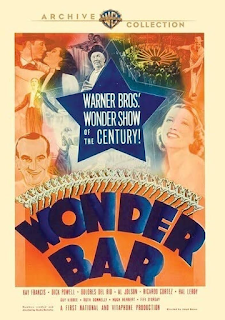
Pre-code movies had exceptional freedom that vanished for over 30 years, but sometimes freedom can be problematic in the extreme. Despite its cast, and choreography by the great Busby Berkeley, Wonder Bar is not often shown -- and for good reason.
The movie is set in the Wonder Bar in Paris, run by Al Wonder (Al Jolson) and revolves around pairs of lovers. Al has a crush on Inez (Dolores del Reo), a featured dancer, who has an unrequited crush on her partner Harry (Richardo Cortez). Harry is in love with the married Liane Renard (Kay Francis). Captain Hugo Von Ferring is also at the bar, having one last fling before committing suicide after he lost all his money. There is also a comic subplot of Corby Pratt (Hugh Herbert) from Schenectady, who is visiting Paris with his wife Pansy (Louise Fazenda) and their friends Henry Simpson (Guy Kibbee) and Ella (Ruth Donnelly).*
The movie nicely intertwines the stories, with Wonder acting as master of ceremonies, and Tommy (Dick Powell) the featured singer of Busby Berkeley classic choreography of Harry Warren and Al Dubin's "Don't Say Goodnight."
But there's another Busby Berkeley song that you rarely hear or see. When I watched it, my reaction was similar to the audience in The Producers when they first saw "Springtime for Hitler." It's appalling.
The song is "Going to Heaven on a Mule." Now, it's not surprising that Jolson is doing a blackface number -- he was famous for it. In this one, he sings about heaven. And heaven is portrayed with just about every offensive racial stereotype imaginable.**
I'm surprised it flew even back in 1934. And it would be difficult to cut it out, since it's the big finish number of the movie. I'm guessing it's just too much of an embarrassment, so the movie was rarely replayed on TV.
The movie makes light of suicide, too -- something not uncommon of the era. It also lets someone get away with murder and portrays a version of the Apache dance,*** only with a whip(!),
There are other things that do show that pre-code had its advantages. One well-reported scene is when a man asks to cut in with a dancing couple, but chooses the man instead of the woman, with Jolson quipping, "Boys will be boys." Mrs. Simpson and Mrs. Pratt let themselves be seduced by gigolos and their husbands hook up with chorus girls,**** There are also sly bawdy references sprinkled throughout.
This isn't a movie I could recommend, but if you want to see just how awful things could be, it's a prime example.
___________________________________________________________________________
*Which comes up with a hilarious bit of geographical nonsense if you know the Schenectady area. When first seeing the Wonder Bar, she says, "This place doesn't compare to the Bijou Theater in West Schenectady." Of course, this is there to show how provincial the two couples are, but there is no West Schenectady. The area to the immediate west of the city center is the GE plant. Oddly, the South Schenectady Fire Department is west of the city.
**There's even a hint of antisemitism as a bonus.
***There was an inexplicable fad for these in the 20s and 30s (and beyond -- it even shows up on The Muppet Show, on the insistence of guest star Rita Moreno), where a man would toss around and slap his dance partner.
***If that's what they're really supposed to be.

Joe E. Brown was one of the biggest names of film comedy in the 1930s.* But his type of comedy went out of style and his films forgotten. Nowadays, the casual movie fan only knows him as Osgood Fielding in Some Like It Hot, speaking the classic line, "Nobody's perfect." I decided to check out what his films were like and picked Painted Faces, knowing nothing about it.
It is a real gem.
Buddy Barton (Barton Hepburn) and Babe Barnes (Dorothy Gulliver) are vaudeville partners, but Babe is harassed by Roderick (Lester Cole).** Buddy threatens to take care of him and -- you guessed it -- during a performance there is a shot and Roderick is dead, with Buddy holding a gun. He is quickly charged with murder, even though he insists he's innocent.***
After the trial, the jury retires to come to a verdict. Eleven of the jurors say guilty, but one -- Hermann (Joe E. Brown) -- keeps voting "not guilty." He refuses to change, saying only he thinks that Buddy is innocent and doesn't want him to go to the chair. Nothing can dissuade him. As the days drag on and Christmas approaches, Hermann finally explains. He was a circus clown, a father figure to Nancy (Helen Foster) and knew Roderick. There was a good reason why he knew Buddy wasn't the killer.
Brown is surprisingly good. Speaking with a comic accent,*** he seems somewhat simple, but he knows what's going on. His comedy in the movie is mostly physical and outside of the story -- he gives a demonstration of his circus act to the courtroom and it's shown in flashbacks.***** But he also manages some great pathos and drama throughout.
Lester Cole is a great cad. He had a short career, usually as a singer. But here he's despicable yet charming. Helen Foster is great as the naive young woman. Barton Hepburn and Dorothy Gulliver vanish from the movie once the scene shifts to the jury room.
Director Albert S. Rogell worked regularly, but didn't produce anything of note, other than the first movie version of L'il Abner, which flopped.
One interesting thing is that the songs are woven naturally into the plot. In a time when movies were "all singing, all dancing," there are no production numbers, but the handful of songs are all performed on stage or in contexts where people would naturally be singing. Another amusing theme is their visit to a Chinese restaurant, where Herman has no idea of what "chow mein" is.
The story seems to be hugely inspired by Vincent Starrett's story, "The Eleventh Juror," which came out two years before. Modern viewers would see parallels to Twelve Angry Men. Overall, the film is surprisingly good and touching, especially the ending.
__________________________________________________________________
*He was often caricatured in cartoons, a sure sign he was a household name of the time.
**Roderick is undeniably a sexual predator, showing that "me too" existed long before it became a movement.
***They vanish from the movie until the final scene.
****They call him "Dutch," but it doesn't sound like Dutch to me.
*****He was a circus acrobat before going into movies.

The Motion Picture Production Code put a damper on what could be portrayed in movies for almost 35 years. Adult subjects were taboo. Even worse, the hint of anything resembling an adult subject (primarily sex) was not allowed. This was a shame, since it was possible to handle the subject in ways that were subtle. A prime example of this is Ernst Lubitsch's Trouble in Paradise.
It starts in Venice, where the master thief Gaston Monescu (Herbert Marshall) is the target of pickpocket Lily (Miriam Hopkins). Both quickly realize the other's game in a scene where they steal the other one's things, culminating in Gaston stealing Lily's panties. The two fall in love. They move to Paris to swindle Madame Mariette Colet (Kay Francis), owner of a major perfume manufacturer. Gaston steals her diamond-encrusted purse but, realizing the reward for it is more than what he would get from selling it, he returns it to her, and sets himself up as her secretary and runs her business interests, arousing suspicion from the head of her board of directors, Adolph Giron (C. Aubrey Smith). He convinces her to keep a large sum of money in her safe, which he learns the combination to. Lily suspects that they are getting far too romantically involved. Things get complicated when the Major (Charles Ruggles) and Francois Filiba (Edward Everett Horton), who were both swindled by Gaston in Venice, slowly begin to catch on to his identity.
Lubitsch clearly shows a sexual relationship between Gaston and Mariette, with her spending one night in his room. But it's done so deftly that it would barely be PG rated today. This was the origin of the "Lubitsch touch," where such things are handled with delicacy, but where the smart viewer will understand what's happening.
Herbert Marshall had a long career as an actor and leading man despite losing a leg in World War I. Miriam Hopkins is delightful, especially in her scenes with Marshall. Kay Francis was a big star of the era, but seems to have been forgotten.*
Once the Hays office took over censoring, the movie was deemed unacceptable, and was not shown for over 50 years.
______________________________________________________________________
*She had a minor speech impediment, pronouncing "r" as "w" and thus referred to as "Kay Fwancis." You can hear it in her pronunciation of "very," but it never reaches Elmer Fudd levels.
Directed by Jack Conway
Written by J.C. Nugent, Elliot Nugent, from a novel by Tod Robbins
Starring Lon Chaney, Harry Earles, Eliot Nugent, Lila Lee, Ivan Linow
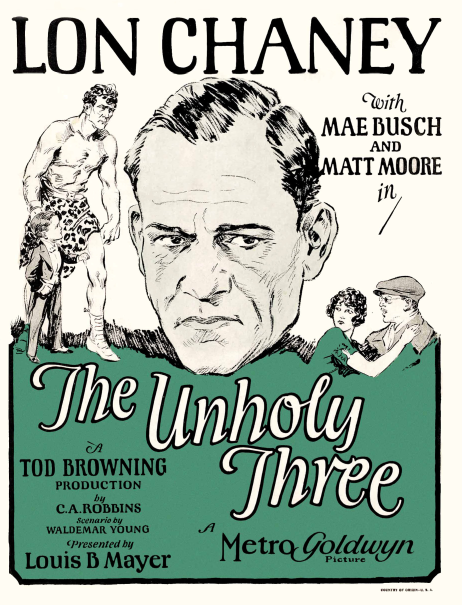
In the early days of sound films, occasionally someone would remake an existing sound film as a talkie. The Unholy Three is an interesting example of this, since it was made with some of the original cast and also was the only sound film Lon Chaney made before his early death.
In the original version, Echo (Lon Chaney) is a ventriloquist in a sideshow act. When the show is shut down, he comes up with a scheme with the strongman Hercules (Victor McLaghlen), the midget Tweedledee (Harry Earles), and the pickpocket Rosie (Mae Busch) to steal. Echo dresses in drag as Mrs. O'Malley, the owner of a pet shop. Mrs. O'Malley sells parrots with impressive talking abilities, but they don't talk while taken home. Mrs. O'Malley comes with her infant grandson -- Tweedledee in disguise -- who cases the place as he uses his ventriloquism to make the parrot talk. Later, the two are joined by Hercules to steal whatever they can find.* Rosie runs the shop, along with Hector (Matt Moore), who knows nothing about the enterprise but who was hired to be a patsy if things went wrong. Despite herself, Rosie falls in love with Hector.
Of course, things go wrong. Echo calls off a job, but Tweedledee and Hercules go anyway, killing the homeowner. The cops start looking into the shop. They frame Hector, but Rosie tries to stop them.
The sound version follows the plot exactly, but to lesser effect. Chaney and Earles reprise their roles, with Lila Lee as Rosie, Ivan Linow as Hercules, and Elliott Nugent, who also had writing credit, as Hector, The difference is the change of director. Tod Browning had a flair for the macabre and certainly liked to portray sideshows and midgets. Jack Conway was workmanlike studio director with little flair.
One interesting difference was the part of Echo's pet gorilla.** In the sound version, it was portrayed by a man in a gorilla suit, but Browning used a chimpanzee and undersized props. On the other hand, the sound version has Mrs. O'Grady accidentally speaking in Echo's voice, giving away her ruse, something that you couldn't do in a silent film. Also, the characterization of Echo at the end is softened a bit in the sound film, but it does make more sense.
Browning, who started out as an assistant to D.W. Griffith, went on to direct the Bela Lugosi Dracula, but his film after that, Freaks, was both a scandal and a flop and his career petered out. The most successful actor in the cast was Victor McLaghlen, who appeared in many John Ford films and who won an Oscar for The Informer.
__________________________________________________________________
*Echo calls the plan "simple," but it is anything but.
**I told you things were complex.
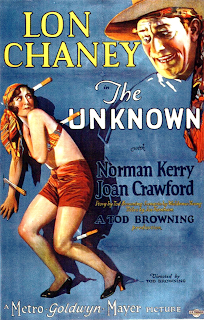
Posterity isn't fair. Lon Chaney was considered one of the greatest actors of the silent era, but he's now been reduced to one image -- the reveal of his face as the Phantom of the Opera. His son, Lon Chaney, Jr.* is even more of a film icon for his portrayal of the Wolf Man, and his appearance in dozens of horror films of the 1940s. He is not comparable to his father in acting ability, but the odds are that he's more familiar. But Lon Chaney, though he loved to play grotesque characters, shows off some amazing acting chops, and none better than in The Unknown.
Alonzo the Armless (Chaney) is a knife thrower in the circus, tossing the blades with his feet to his assistant Nanon (Joan Crawford). But Alonzo isn't actually armless: he binds his arms so that he seems so and to hide his identity, since he's a criminal with a strange double thumb on one hand. The circus strongman Malabar (Norman Kerry) is in love with Nanon, but she doesn't reciprocate and confides in Alonzo that she cannot stand a man's hands touching her. Later, Nanon's father, the circus owner (Nick De Ruiz), discovers Alonzo's secret. Alonzo strangles him, witnessed by Nanon, who doesn't see his face, but sees the double thumb. So Alonzo decides to take drastic measures to solve the problem.
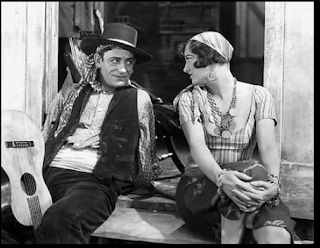
Most people think of Joan Crawford in the Mommy Dearest image, but forget she got started as an ingenue. She makes an appealing love interest and later said that she learned more from Cheney about acting than from anywhere else. Of note is John George as Alonzo's friend and confidant: he had a long career as a bit player, often uncredited****
Chaney received raves for the part, as did director Tod Browning, who later directed the Bela Lugosi Dracula and the classic horror film, Freaks. But, unfortunately, Cheney died in 1930 from a combination of lung cancer and an infection caused when some artificial snow lodged in his throat. He only made one sound film, and his career has taken a back seat to his son's. Nowadays, if you hear his name, you usually think of Junior, but the original is still a fine example of acting.
__________________________________________________________________________
*Born Creighton Chaney
**He's far less sinister than he appears in the movie poster.
***Given the constraints of silent film.
****Interestingly, he was an extra in The Man of a Thousand Faces, Chaney's film biography.
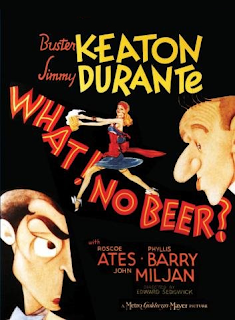
Buster Keaton's last film for MGM (and his last American starring feature) was another teaming with Jimmy Durante, What No Beer?
Elmer J. Butts (Keaton) is a taxidermist who falls for Hortense (Phyllis Barry). His best friend, Jimmy Potts (Durante), is an avid "wet" -- favoring the end to Prohibition. After repeal, Jimmy gets the idea to make beer and cash in. Elmer puts up the money (hidden in various animals in his shop) to buy a brewery and start brewing. They manage to make a batch, and are raided, but it turns out the beer they were selling has no alcohol content. Released by the authorities, they go into making "near beer" -- without alcohol -- when they discover one of their workers was a brewmaster in St. Louis with that as his specialty. Elmer wants to money to woo Hortense, and the gangster Spike Moran (Edward Brophy) gives them cash -- and secretly has them brew real beer, so Elmer and Jimmy will be the fall guys if they're raided.
Like Keaton's other films with Durante, this is a pleasant and forgettable comedy. But Keaton was on the downswing. Frustrated by his deteriorating personal life and divorce, his lack of input in his movies, and his orders not to do any dangerous physical gags, he turned to drink. Indeed, he appears to be drunk in several scenes. Stunt men handled the physical comedy (except for pratfalls) and Keaton would not show up for shooting some days.
Durante plays Durante. He was not someone who could play any character but himself, but he's good enough to fit in. In this film, he's billed with Keaton above the title, though Keaton's name is on the left.
The movie did well enough to create talk of another teaming. But Keaton's alcoholism reduced MGM's faith in him, and when he did something to piss off Louis B. Mayer (accounts vary), he was fired. It was the low point of his life. He kicked the alcohol and was eventually hired by Educational Pictures* for a series of short comedies. He also made a living as a gag writer, eventually working his way into supporting roles. He shows up in Sunset Boulevard as one of the Hollywood "waxworks," a comment that he was washed up.
But Keaton was a shell of himself. His age made it harder to do physical comedy. He had some success in television.** Eventually, a biopic was made of his life starring Donald O'Connor. It bore no resemblance to his actual life, but the money allowed him to buy a house where he lived the rest of his life.
____________________________________________________________________
*A misleading name. Founded to make actual educational films, it switched to two-reel comedies with sound, often starring established comedians who had been dropped by a major studio. As a footnote, I have a film guide in French that says that Roscoe "Fatty" Arbuckle did "films éducatifs." Given his reputation after the scandals, the idea that he did lower-case "educational films" is highly absurd.
**Including a Twilight Zone episode "Once Upon a Time," with Keaton as a time traveler. It was one of the few times that he was allowed free reign to do the kind of gags he did back in the silent days (much of the show is shot silent and in black and white); writer Richard Matheson made it an homage to Keaton's greatness and director Norman Z. Mcleod had helmed movies with the Marx Brothers and W.C. Fields, so he understood comedy. It is one of the most entertaining episodes of the show.

Speak Easily was the second teaming of Buster Keaton and Jimmy Durante. Keaton was still top billed in the credits, but Durante was now billed prominently after the title.* Once again, this is primarily focused on Keaton, though the two have more time together than in The Passionate Plumber.
Professor Timothy Post (Keaton) has lived all his life at Potts College. When told he had inherited $750,000,** he leaves the college to see the world. He runs into a traveling theater troupe, managed by James (Durante). Potts becomes enamored of Pansy Peets and joins the troupe, convincing them to head to New York and put their show on Broadway, with Potts backing. Unbeknownst to Potts, the "inheritance" was a joke played on him to get him out of his bookish life, And just before the curtain comes up, the bills come due.
Keaton liked to play the innocent. Most of his verbal comedy comes from his not understanding what's happening. As for the physical comedy . . .
Keaton contributed to many of the gags, but they don't land well. MGM refused to let him do anything dangerous. Keaton told them that people wouldn't laugh at a stunt man, but, as usual, they ignored him. Thus the gags fall flat without Keaton's comedic abilities, especially in the final sequence, which should have made the movie much better. They're funnier in concept than in execution and without Keaton executing them, they don't work well.
Durante has a larger role than in their first teaming, with his well-known brash comedy style. Most of his best scenes has Keaton too innocent to understand the slang Durante is using. Interestingly, Durante has practically no scenes on his own, and no backstory or B plot. He's just there, playing Jimmy Durante.
Ruth Selwyn is a typical ingenue of the period and Thelma Todd -- best known on screen as a foil for Groucho Marx -- plays a vamp trying to seduce the oblivious Post.
___________________________________________________________________
*Some of the movie posters have them both billed above the title, but the credits did not.
**$16 million in today's dollars.

After the success of The Sidewalks of New York, MGM decided they knew better than Buster Keaton and treated him even more like a contract player. They came up with the idea of pairing him with Jimmy Durante. The first movie with this was The Passionate Plumber.
Elmer* Tuttle (Buster Keaton) is a plumber and inventor living in Paris, friends with cab driver Julius J. McCracken (Jimmy Durante). Patricia Alden (Irene Purcell) is a wealthy American who is having an affair with Tony Lagorce (Gilbert Roland), who is simultaneously wooing Nina Estrada (Polly Moran). Patricia wants to make Tony jealous, so she pretends to be in love with Elmer, who believes she means it. Her off-again, on-again romantic gestures toward Elmer leads him to believe the sentiment is reciprocated.
I had always thought the pairing of Keaton and Durante was a bad idea. Durante is a strong presence and bravura performer, while Keaton is laid back and quiet. But it was better than I expected. Keaton tended to be an innocent and Durante's brashness does mesh in that respect. But Durante is a supporting character -- he vanishes for large parts of the movie. I suspect this was partly a tryout to see if they could work together. Since his screen time is limited, and there are only a few scenes where he appears with Keaton, the combination is adequate, but not great.**
There are some decent comic sequences, all featuring Keaton. There's an attempted duel between him and Tony, and a scene in the casino where the naive Keaton never really catches on to how gambling works.
You can also see the pre-code credentials in the basic story and in the scene when Keaton emerges from the bathroom in just a towel after his clothes are soaked. Tony challenges him to a duel by slapping Elmer's face with a glove. Elmer removes the towel to slap Tony with it; Patricia screams.
Gilbert Roland had a very long career as a character actor, and is probably best known from the movie versions of The Cisco Kid.
______________________________________________________________________
*Keaton was fond of the name Elmer, using it almost twenty times in his movies,
**As an aside, at one point Durante refers to the French national anthem as "The Mayonnaise." This was an ancient joke at the time. When Alexander Woolcott wrote his review of the Marx Brothers' "I'll Say She Is" on Broadway in 1924 (a rave, but not a great review, since he talks more about himself than he does the Marxes), he says "it was in a music hall in Omaha in 1904 that a French scene was last played without someone referring to that inspiring anthem The Mayonnaise." Some hyperbole, but obviously a very old joke.

Al Boasberg was one of the greats of radio comedy, but you have to be a completist to know anything about him. He was a gag writer and made a living -- often a very lucrative one -- selling gags to vaudeville and radio comedians, and acting as what today we'd call a script doctor to punch up a movie.
Boasberg was born in Buffalo and grew up to work in his father's jewelry store. In in spare time, he wrote jokes and sent them to vaudeville comedians. In 1921, he sold his first jokes to vaudevillian Phil Baker for $5 each.* His career took off when George Burns came to town and offered him a job writing for him.
Word of his talent got around. He was instrumental in creating Jack Benny's comic persona and wrote for Bob Hope; Burns and Allen; Wheeler and Woolsey; and Leon Errol. He moved to Hollywood in 1926 to work with Buster Keaton and was credited as a writer on The General. He also wrote for Harold Lloyd, Olson and Johnson, and many others, usually uncredited. He was making $1000 a week to come in and add jokes to script and continued to write for Benny's radio show.
His most famous work was when he was hired to write a bit for the Marx Brothers in A Night at the Opera. Supposedly he had some falling out with the producers and did not deliver the script. When they went to find out where it was, they discovered it had been cut into strips with a single line that were nailed to the ceiling of his office. It was worth putting them together -- they were the basis for the classic stateroom scene.
He also contributed dialog to the classic horror film Freaks, certainly the odd movie out on his list of credits.
He also directed the occasional short subject.
Sadly, he died of a heart attack at age 45. Just the day before, he had introduced the character of Rochester to the Benny show.
A giant of comedy.
________________________________________________________________________
*That may not sound like a lot, but it's the equivalent of about $80 today. It was a common practice even up to the 70s for comedians and cartoonists to buy jokes.

Twitter and Facebook occasionally bring up the question, "What was the first movie you saw in a theater?" I would answer Sleeping Beauty, but recently I realized that was wrong. Checking the release dates, I realized I had seen tom thumb the year before.
Jonathan, a poor woodsman (Bernard Miles), is asked not to chop down a tree by the Forest Queen (June Thorburn) and is granted three wishes. That backfires, but later there's a knock on their door and Jonathan and his wife Anne (Jessie Matthews), who always wanted a son, find there's one adadditional wish granted. Tom (Russ Tamblyn) is tiny but still a full-grown man (with a child's look at the world). Meanwhile, Woody (Alan Young) is in love with the Forest Queen, but she doesn't think him a suitable match. When tom goes to the fair, two villains (Terry-Thomas and Peter Sellers) trick him into a scheme to rob the town's treasury. He naively obliges, and his parents are accused of the crime. Tom has to work to capture the villains and prove their innocence.
George Pal directed. He was a master of stop-motion animation, and the movie is filled with sequences highlighting this, most notably when tom's toys join in with musical numbers. The effects are quite good for the time and the illusion of tom's size is kept up throughout.
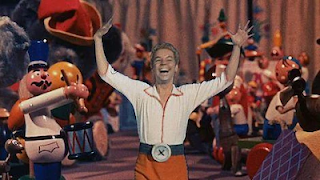
Russ Tamblyn is an acrobatic dancer and his performance as tom is very childlike and naive, which causes him all sorts of trouble in stereotyping, but he did appear in several film classics. Terry-Thomas and Peter Sellers ham it up royally as the villains.
Nowadays, Alan Young is known for Mr. Ed,** but he was a very well-regarded radio comedian who never became a big movie star. He also did a lot of voice work after Mr. Ed, including as Scrooge McDuck and as various roles in The Smurfs.
___________________________________________________________________
*The Grimms, by the way, did not actually write the fairy tales attributed to them. They collected them from existing tales. Any objections to their content have nothing to do with them. Second, Jacob Grimm is well known in language studies as the developer of Grimm's Law, which explained how words changed their sounds over time. For example, the "p" in the Proto-Indo European "pods" changes to the "f" in "foot."
**Mr. Ed never had a great timeslot. It originally aired in syndication, and then at 6:30 on Sundays, which was not considered prime time. It did go to a later spot for one season, but returned to the earlier slot, a time where TV watching is low.

I've decided to investigate more of the sound films of Buster Keaton. As is well documented, Keaton slowly lost control of his movies and was forced to do what the studio asked of him. Parlor, Bedroom and Bath is another example that isn't bad, but wastes Keaton's talent.
It starts out with a love complication. Jeffrey Heywood (Reginald Denny) is in love with Virginia Embrey (Sally Eilers), but she won't marry before her sister Angelica (Dorothy Cristy) so she won't be (gasp!) an old maid. Jeffery runs into Reggie Irving (Buster Keaton). Reggie is shy and know nothing about women but is convinced to pretend he's a rich playboy to attract Angelica. Jeff tries several schemes to make Reggie seem more attractive, one of which is to ask a newspaper reporter, Polly Hathaway (Charlotte Greenwood) to pretend to be a romantic party in a hotel to make Angelica jealous. Meanwhile Virginia is angry with Jeffrey and joins Reggie on the trip.
The extremely contrived plot still manages to be funny. Polly shows Reggie how to be romantic. It's ludicrous but turns out to be extremely effective.
Since this was from a stage play, the only Keatonesque portions of his role were the pratfall, except for one sequence where he and Virginia are driving to the hotel. It is Keaton at his best, especially with one gag where his car gets stalled on the railroad tracks as a train is coming. I laughed out loud twice -- unusual for me. It goes on to a very funny sequence when they arrive sopping wet at the hotel.
Most intriguing is Charlotte Greenwood. She had a lot of second banana roles in films over the years and was a gifted physical comic, using her long legs to great effect. She and Keaton make an excellent teaming and it's too bad it didn't happen again.
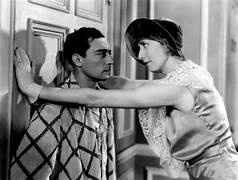
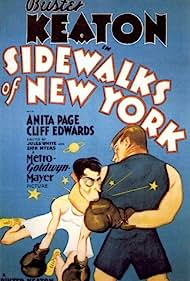
Sometimes a success leads to long-term failure, usually because the actor becomes typecast and can't move on. Sidewalks of New York is an example of this where its success was the beginning of the end of a brilliant career.
Harmon (Buster Keaton) is a slumlord who is hated by the residents of his buildings. When his assistant Poggie (Cliff Edwards) tries to collect rent, the boys of the neighborhood drive him away. Harmon goes to see and is attacked by one of the boys, Clipper (Norman Phillips, Jr). His sister Margie comes to his defense and Harmon is instantly smitten. He wants to have Clipper prosecuted, but, after seeing Margie again in the courtroom, drops all charges. A cop tells Harmon that the boys aren't really bad but need an outlet for their energy. To impress Margie, Harmon builds a gym and tries to get the boys interested, including getting into the ring with a local boxer, Mulvaney (Syd Saylor). Clipper falls in with a bad crowd, and the hoodlum Butch (Frank Rowan) uses him to take part in robberies.
Keaton was beginning to feel the pinch of the studio system. After a couple of flops, he had signed with MGM, against the advice of Charlie Chaplin and Harold Lloyd and practically everyone who knew him.* Keaton was no longer in control of production; he called the decision the worst of his life. Once sound came in, things got worse. MGM didn't let him do stunts -- the bread-and-butter of his career -- and dictated to him what movies he would do. Sidewalks of New York was his second sound film, Keaton hated the film and tried mightily to get out of the assignment. But MGM thought it was good and Keaton gave up, held his nose, and did it.
And it turned out the executives were right. Sidewalks of New York was Keaton's biggest success. It made it impossible for him to object to scripts, since he was (in the executives' eyes) so wrong that they didn't have to listen to him. He had to do what he was told.
So how good was the movie? It wasn't a disaster; the story moved nicely and there were some good gags. Keaton was fine handling the slapstick parts; the pratfalls are good, But it was nowhere up to the heights of his career.
The movie was directed by the team of Zion Myers and Jules White, who had previous success with comedy shorts. White, of course, later directed many of the Three Stooges shorts and the movie often seems to be more one of their films than Keaton's. One scene where Harmon is being sworn in as a witness in court was even reused by the Stooges.

_____________________________________________________________
*Except for his wife Natalie Talmadge, sister of Norma and Constance Talmadge, two of MGM's biggest stars. Norma was married to Keaton's business partner Joseph Schenck, brother of Nicholas Schenck, head of MGM. A bit of nepotism, isn't it?
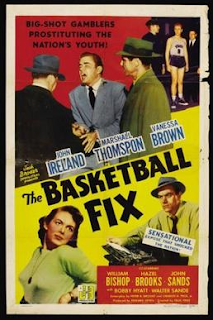
Law and Order was the first to dramatize events "ripped from the headlines." The Basketball Fix was deliberately based on the college basketball point shaving scandal of 1951, rushed into production to take advantage.
A little background for those who don't follow sports (or even those who do). For many sports, you bet on how many points a team will win by. Thus, an underdog team can still win if they don't lose by too much.
Within ten years of the concept being introduced, gamblers figured out a way to game the system. They would bribe basketball players to miss shots -- not enough to lose the game, but to keep the team from beating the point spread. Point shaving didn't require a team to lose a game, making it easier to convince players that no harm was being done. The scandal erupted when City College of New York (CCNY), which had won both the NCAA and the more prestigious (at the time) National Invitational Tournament (NIT) in 1951,* had several players who were found to be shaving points.
The Basketball Fix follows dominating high school basketball player Johnny Long (Marshall Thompson). Reporter Pete Ferreday (John Ireland) becomes interested in helping Johnny get into college on a scholarship. Johnny doesn't think it possible, since he has to support his little brother Mickey (Robert Hyatt), but manages to convince a local college coach Nat** Becker (Walter Sande) to give him a scholarship. Things go well: over the summer, he meets Vanessa Brown (Pat Judd) and they start dating. But he also meets Mike Taft (William Bishop), a gambler.
Taft is genial and friendly and very likeable. But when Johnny starts starring for the team, Taft begins to ask for more. At first Johnny resists, but his poverty is the hook to catch him.
John Ireland was a veteran of several classic westerns like My Darling Clementine and Red River and Marshall Thompson reached TV stardom in Daktari. Their roles are workmanlike, possibly due to the rush in putting out the film.*** The ending of the film is clearly rushed; you could have done an entirely new movie dealing with the aftermath.
Director Felix E. Feist directed a bunch of programmers and TV episodes from the 30s to the 60s. His adopted son Raymond E. Feist is a well-known writer of fantasy fiction.
_________________________________________________________________________
* The only team to do so, and the only team that will ever do so -- the NCAA switched to conflict with the NIT; expanded the field, leaving fewer teams available; and finally a rule was passed to ban teams from playing in both.
**Note that the coach of the CCNY team was Nat Holman. He was cleared of any wrongdoing; the players had kept him in the dark.
***The scandal broke in February and the film was released in September.

The cliche is that actors want to direct. Sometimes it works out well.* Sometimes it doesn't. And when the actor/director also produces the movie, it has a good chance of being a vanity project that is an utter disaster. Time Table is something that might have fallen into the category, but the result is an excellent film noir with surprising twists.
We see Dr. Paul Brucker (Wesley Addy) riding a train and being called to help a sick passenger. He discovers the man has a highly contagious disease, blocks off the car, and goes to the baggage car just behind to his medical kit. Once there, he takes a gun from the kit and tells the baggagemen to lie down, where he injects them with a sedative. While they are asleep, he blows up the safe and escapes with half a million dollars in an ambulance with the patient.
Charlie Norman (Mark Stevens) is called away from a planned Mexican vacation with his wife Ruth (Marianne Stewart) to investigate the robbery for the insurance company. He joins up with railroad cop Joe Armstrong (King Calder) to find the robbers. When all the clues turn out to be dead ends, Charlie and Joe both agree that this was incredibly well planned.
Warning: Major plot twist given away in next paragraph.
Then we discover who the mastermind -- Charlie himself. He has been having an affair with Bruckner's wife Linda (Felicia Farr) and they plan to run off together with the money. Of course, snags occur in his master plan and he has to improvise. It only makes things worse. And there are more twists to come until the end.
It's an interesting role for Stevens. He definitely looks like the standard Hollywood hero and, up until the twist, you figure he will slowly uncover the evidence to put the thieves behind bars. The twist is a surprise, but logical. Instead, King Calder fills that role, even though he and Charlie are close friends. Wesley Addy was a successful film heavy of the 40s and 50s.
One familiar face in the cast is Jack Klugman, in one scene as a man peripherally involved with the heist and who reluctantly gives the investigators details. A familiar name and voice is Alan "Fred Flintstone" Reed as the man who rents the criminals a helicopter.
____________________________________________________________________
*Charles Laughton, Ron Howard, Robert Redford, et al.

Sometimes it's fun to see the early roles of actors who became household words later on and it's even more fun when you can see why they got those roles. Please Murder Me gives a look at one of the big names of 50s television in a role that is very close to it.
Craig Carlson (Raymond Burr) is a lawyer who has fallen for Myra Leeds (Angela Lansbury), wife of his best friend Joe (Dick Foran). But when Myra kills Joe, Craig takes on her case and gets her acquitted. Then he discovers that he's been played: Myra loves Carl Holt (Lamont Johnson) and dumps Craig. Feeling guilty on getting her off, he works on a scheme to enlist the district attorney (John Dehner) to help send her to prison.
The actor I was talking about was, of course, Raymond Burr. The courtroom scene where Craig gets Myra off would not be that out of place in Perry Mason. It's likely that this role did have something to do with him getting the role, since he began with Mason the next year.
Of course, Angela Lansbury also became a TV icon. People tend to think of her as Jessica Fletcher and don't remember that when she was young, she made a great femme fatale. She is good here, seemingly sweet and loving, but hiding a darkness that's not obvious.
The plot does owe a lot to Double Indemnity, where the woman entices the man to murder. Several other elements also have similarities to the older film. It does end with a very good twist.
Also in the cast is John Dehner. He was a very busy radio actor, most notably in Frontier Gentleman and Have Gun Will Travel. He switched to TV and appeared in over a hundred TV shows, often westerns, as a guest star. One of the recurring role was in The Roaring Twenties.

In the late 40s-early 50s, film noir was big, and it looked like everyone wanted to get into the act, even those who you might not expect.* Quicksand is one of those, where Mickey Rooney put his nice guy persona into noir, and the results are surprisingly effective.
Dan Brady (Rooney) is an auto mechanic who spots a Vera Novak (Jeanne Cagney) pretty woman and asks her out despite already having a girlfriend, Helen (Barbara Bates). Trouble is, he has no money. A friend agrees to lend him the -- the next day, too late for the date. Dan decides to take the money from the till, since no one will check for a couple of days, and goes to the date, ending up at a penny arcade run by Nick Dramoshag (Peter Lorre).
But the auditor comes early, and Dan has to make up the money. He buys a watch on credit, then hocks it to get the money to make the money in the cash drawer come out right. It turns out that wasn't legal, and Dan has to keep trying more and more desperate schemes to keep from going to jail, all of which backfire.

Director Irving Pichel had an under-the-radar career, but also directed The Great Rupert.
One interesting name in the cast is Jimmy Dodds as one of Brady's co-workers. He's best known to people of a certain age as Jimmy, the leader of the original Mickey Mouse Club.
The movie does opt for a happy ending, which fits in well as a film but cuts back on the noirness. In any case, it's worth seeking out on Youtube.
________________________________________________________________
*Then again, who thought Fred MacMurry would become the lead in one of the classics of the genre.
**James Cagney's sister. She had a moderately successful career, including a couple of films with her brother.

The Golden Age of 50s television may have been overstated. While there were plenty of good shows, the reality is that the bad ones have not been preserved and remembered.* However, Wuthering Heights is an example of a lost TV show that deserves to be acclaimed.
The story is familiar. Heathcliffe (Richard Burton) is a foundling, adopted by Mr. Earnshaw (Barry Jones). He falls in love with Catherine (Patty Duke as a child, Rosemary Harris as an adult), but is driven off by her brother Joseph (Bernard Miles). Catherine marries Edgar Linton (Denholm Elliott). When Heathcliffe returns he vows to win Catherine back.
You can see why Burton was a star. His Heathcliffe is brooding and tortured and he really brings the character to life. Rosemary Harris was a major star on Broadway, though now is probably known as Aunt May in several Spider-man films.
This is something of an all-star cast, many in classic TV and movies. Bernard Miles had a long film and stage career, while Denholm Elliott is most remembered today as Indiana Jones's friend Marcus. Patty Duke also was very successful as a child and adult and John Colicos was Count Baltar in the original Battlestar Gallactica.
While the production was aired as a Dupont Show of the Month, It looks like it was shot on film, making it more dramatic.
The movie is available on Youtube.
_________________________________________________________________________
*This is common in all arts. Time and distance only preserve the best, making things seem better than they were.
(1942)

Last week, while researching my entry for The Brasher Doubloon, I happened on the fact that the book has previously been adapted as a Mike Shayne programmer starring Lloyd Nolan. Naturally, I had to check out Time to Kill.
Michael Shayne (Lloyd Nolan) is a detective hired to find the Brasher Doubloon, stolen from Mrs. Murdock (Ethel Griffies). He meets her secretary Myrtle Davis (Heather Angel), who seems to be hiding a secret.
The movie varies substantially from the later version. Myrtle's secret gets a short shift, where it is far more prominent in the remake. The big difference is Lloyd Nolan's portrayal of Shayne. Whereas George Montgomery didn't quite have the gravitas to be Marlowe, Nolan makes him more than just a wisecracker. Nolan played Shayne in five times before this and is the perfect actor for this sort of role. Alas, this was the last movie in the series.
The studio clearly didn't know what to do with Chandler. It was an odd hybrid of franchises. Chandler had had some success, but the studio must have decided he wasn't well enough know to make a movie featuring his name and instead attached it to an existing franchise, with just enough of his novel left to make the connection clear.
Director Herbert I. Leeds did several B-pictures for Fox and seemed to be known for his efficiency. This might have served him well in television,* but his death in 1953 cut short his career.
Nolan had a long career as a character actor and is best known for playing Diahann Carrol's crusty but kind boss in Julia.
______________________________________________________________
*He directed many episodes of Jackie Gleason's The Life of Riley.

In the late 40s, Hollywood discovered Raymond Chandler. Double Indemnity and Murder My Sweet* were hits and established the film noir genre. Other studios rushed to adapt his works. 20th Century Fox was lucky: they already owned the rights to Chandler's The High Window** and turned it into The Brasher Doubloon.
Detective Philip Marlowe (George Montgomery) is hired by Elizabeth Murdock (Florence Bates) to recover the coin that gives the movie its name. In her mansion, Marlowe runs into Merle Davis (Nancy Guild), Murdock's secretary, who seems to know a dangerous secret and Murdock's son Leslie (Conrad Janis), who is suspicious as all get-out. Marlowe gets caught up into a bunch of shady criminals, who may have stolen the doubloon -- or may not have. After several murders, Marlowe gets to the bottom of the case.
Chandler's storytelling carries the movie. George Montgomery is perhaps the least impressive version of the detective -- heavy on the wisecracking but light on the mood that makes film noir. Nancy Guild doesn't stand out particularly, though Florence Bates and Conrad Janis*** do make their characters stand out.
Marlow's meeting with Mrs. Murdock parallel similar scenes between Marlowe and General Sternwood in The Big Sleep. Another character, Rudolph Vanier (Fritz Kortner), clearly is based on Joel Cairo in The Maltese Falcon.
Viewers may recognize Roy Roberts as the police officer leading the investigation. Roberts was a busy character actor in TV, with noticeable roles in Petticoat Junction, Bewitched, The Lucy Show, McHale's Navy, and The Gale Storm Show.
________________________________________________________________________
*He cowrote the script on the first and the second was based on one of his novels.
**And had filmed it as Time to Kill, starring Lloyd Nolan as Michael Shayne.
***Best known today for his role in Mork and Mindy.

Directed by Robert Florey (as Florian Roberts)
Written by Anthony Coldeway, from a play by Dorothy Mackaye and Carlton Miles
Starring Faye Emerson, Julie Bishop, Frank Wilcox, Roland Drew, Jackie Gleason
IMDB entry
It's not all that unusual for a movie's title to be misleading. Lady Gangster sounds exciting, but it more a prison drama than a movie about her running rackets.
Dot Burton (Faye Emerson) joins a gang planning to rob a bank. They hand her a dog to make her seem even more harmless, but when she doesn't know the dog's name, everything unravels. She is caught but manages to hide the money and is convinced by a crusading reporter™ Kenneth Phillips (Frank Wilcox) to turn herself in, do the time, and come out a free woman. Dot, who has fallen in love with Phillips, agrees and is sent to prison.
The crooks want the money. Their leader, Carey (Roland Drew), dresses up as her sister to try to find where she hid the loot. The movie focuses on the politics of the woman inmates, including portraying a Black woman (unusual, though the just wants to play boogie woogie music on the radio) and hinting a a few same-sex couples.* Dot eventually has to break out of prison to keep Carey from getting the money and killing Kenneth.
The acting is serviceable. Emerson does give a nice portrayal of a hard-nosed woman, and Julie Bishop is fine as her friend in prison. Jackie Gleason** had part of one of the crooks who is enamored of Dot and tries to stand up for her against Carey. Viewers who look carefully might spot William Hopper*** as the D.A.'s aide John; he's not recognizable due to his dark hair, but his voice is familiar to any Perry Mason fan.
Director Robert Florey was in movies from the silent days into the TV era. His best-known film was the first film by the Marx Brothers -- The Cocoanuts. Legend has it he was unable to control his laughter and ruined takes until he took up residence in a soundproof box.
_______________________________________________________________________
*Given the time frame, the Hayes Office wouldn't allow anything more than the most subtle of hints. They had no problem with the crossdressing scene.
**Billed as Jackie C. Gleason
***Billed as DeWolfe Hopper. Everyone knows that gossip queen Hedda Hopper was his mother, but his father, DeWolfe Hopper, was a major vaudeville star, known for his rendition of "Casey at the Bat." He was instrumental in popularizing the poem.

Monogram pictures was the low-rent district of
Hollywood. They produced pictures that
aspired to be B-movies and were usually at the bottom of the barrel, most of
them forgotten and forgettable. As I was looking up film noir for this series,
I stumbled across Sensation Hunters. I had seen very few Monogram pictures, so
decided to look it up.
Julie Rogers (Doris Merrick) is a young woman who's going out with Ray Lawson (Eddie Quillan), a trumpet player. Her domineering father (Bryon Folger) doesn't like the match. One evening, Ray had to leave for an audition, and she sees Danny Burke (Robert Lowry). Burke is a cad, who loves 'em and leaves 'em, but Julie doesn't care.
Ray takes her to a gambling club, which is raided. He is sentenced to 30 days in jail. Julie can't pay the fine, but her father shows up and takes care of it. Once that's done, he kicks her out of their apartment and out of his life.
Julie gets a job singing at the Club Paradise, and rekindles her infatuation for Danny, even when Ray establishes himself as a successful bandleader. I
t all leads to the inevitable (but arbitrary) tragedy.
The movie is all over the map. Julie gets her job too easily. She suffers because Ray took her to the illegal gambling den, whereas you'd expect it to be Danny. Any tension is broken up by musical numbers that pad out the time. The ending seems like a half-assed attempt to make the whole mess a film noir.
Still, it's fun to watch, if not exactly good. Doris Merrick had a few films, but never made a splash, Robert Lowrey and Eddie Quillan both had long careers in TV and movies as minor players, Quillan working steadily into the 1980s, his biggest role in the TV show Julia. The most recognizable actor to modern audiences is John Hamilton-- Perry White in The Adventures of Superman -- who has a few lines as a judge. Minerva Urecal, who was very busy as a character actress, has a small part as Julie's mother.
Director Christie Cabanne was unfamiliar to me, but he directed over 160 films, starting in the silent days and cranking out up to seven full-length features a year.* I figure he worked fast and brought things in under budget. Most of his films are forgettable and his list has few titles that even the most avid film buff would recognize.
__________________________________________________________________
*He started work as an assistant to D.W. Griffith.

As I mentioned last week, "film noir" is an exceedingly imprecise term. It has become a catchall for any film in black and white where a crime has been committed at some point and has themes of moral and political corruption. Borderline starts out noir, but turns into something else.
Madeline Haley (Clare Trevor) volunteers to go undercover to smoke out the Mexican drug lord Pete Ritchie (Raymond Burr).* She flirts with one of Ritche's gang and gets close to him when a rival drug lord, Johnny Mackin (Fred MacMurray) breaks in and steals his narcotics. He grabs Madeline and takes her with him on a trip to smuggle the drugs and see who the American contact is.
Turns out that Mackin is also an undercover narcotics agent. Both keep their secrets from each other.**
At this point, the film changes into what was clearly influenced by It Happened One Night.*** The two have adventures and issues, as they keep running into Ritchie.
MacMurray usually preferred to play a nice guy image, but his best films had him as a bad guy. His introduction as a drug dealer is electrifying; he's good once he softens, but it is a letdown.
Trevor won an Oscar a couple of years before in Key Largo. She's also very good in the early going before the film goes all romantic.
Raymond Burr was a very busy actor before Perry Mason and Godzilla. He was one of the best heavies of his era, his size making him menacing. The great Charles Lane makes an appearance as a customs official uncredited (of course).
Borderline is a strange movie, mostly because of its jarringly shift in tone. But if you go with it, it's quite enjoyable
______________________________________________________________________________
*Especially interesting is an early scene where Madeline tries to volunteer for the job. She is eminently qualified, but her boss doesn't recognize her fitness for the job (despite her angling hard for it) until one of the male agents mentions her.
**One of the few times where it's not unreasonable that the two don't tell the secret that would solve their problems: both think the other is among drug dealers.
***A couple of the scenes parallel scenes from the earlier movie -- sharing a hotel room without sharing a bed, and hitchhiking. Luckily, they both vary their ending to be different.


