 (1975)
Directed by Richard Lester
Written by Terrence McNally
Starring Jack Weston, Rita Moreno, Jerry Stiller, Kaye Ballard, Treat Williams, F. Murray Abraham, Paul B. Price, Jerry Stiller
IMDB Page
Pure film farce is rare. Oh, you have comedies, but the rapid-fire humor and outrageous situations and complex plotting is very hard to pull off. And add to that some subject matter that is dicey today and you have a movie that vanishes from consideration.
But when you have one of the funniest characters in film, it deserves to be known.
Terrence McNally, who adapted the screenplay from his original play, set The Ritz in a gay bathhouse. This gives it a whole new dimension to the heterosexual bed hoppping that characterizes good farce. And throwing a straight man into that scene leaves things ripe for comic possibilities. And when you get one of the top comedy director of the time to film it, the result is hilarious.
Gaetano Proclo (Jack Weston) is a salesman from Cleveland who becomes the target for murder by his mob-connected brother-in-law, Carmine Vespucci (Jerry Stiller). Proclo ends up hiding out in the Ritz, a gay New York Bathhouse, thinking at first that it's like a health spa. He is quickly disabused of that notion and becomes the romantic target of Claude Perkins (Paul B. Price), a "chubby chaser," who tries to seduce Proclo with promises of candy and other treats (starting with food). Michael Brick (Treat Williams) is a detective with a buff body and a ridiculous high voice who is looking for Proclo, and also becomes the object of the affections of others in the Ritz. Chris (F. Murray Abraham) is one of the bathhouse regulars who tries to help Proclo in adjusting.
And then there's Googie Gomez (Rita Moreno), an aggressively untalented singer at the baths, who thinks Proclo is a Broadway producer and her route to stardom. Proclo thinks she is a man in drag, and tries to avoid her, as well as his brother-in-law (who's coming for him with a gun), Claude Perkins and everyone else in the bathhouse.
Moreno invented the character of Googie, performing as that alter ego at parties, where McNally happened to see her. Speaking with an weirdly exaggerated Puerto Rican accent, she is convinced that she is the greatest talent ever to appear on stage, despite all the evidence to the contrary. She's the type of character that causes you to lean just a little bit closer to the screen just to make sure you don't miss anything she says.
The result is a mad mix of jokes and very funny situations.
The acting is all first-rate. Farce requires good timing, and most of the cast had been in the Broadway version, allowing them to work perfectly as a team to make the jokes work.
And Richard Lester was the perfect director for such a film. Lester had vaulted to the top of comedy filmmaking with A Hard Day's Night (and The Mouse on the Moon), and directed a series of very good films: Help!, Petulia, The Three Musketeers, The Four Musketeers, and Robin and Marion. He was famous for his rapid cutting style, something that is almost routine these days, but which was a big revelation in the 60s. He actually shot this one in a more standard (for the time) style, but his penchant for humor gave it just the right touch.
The movie did well enough, and even got a few Golden Globe nominations, but it faded away. The subject matter made it unsuitable for TV and, the AIDS epidemic made the behavior portrayed in it much too dangerous to be funny.
But I do miss Googie Gomez. If there was any character who deserved to have more films, it was her.


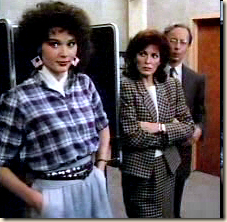 He did drive the others on the show crazy, though. They included Jo Jo White (Joanna Cassady), his director; Karl Shub (Max Wright), the station manager; Woody (John Fielder), the stage manager (who was independently wealthy, but still loved his job); Wendy Killian (Geena Davis), his research assistant; Tony (Mesach Taylor), the assistant director, and Newdell (Charlie Robinson), the make-up man who didn't take any of Bill's guff.
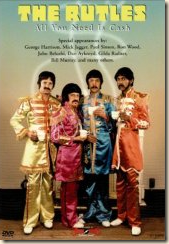 But All You Need is Cash deserves consideration as a pioneer.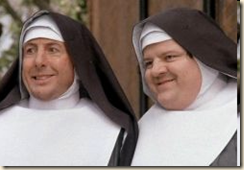


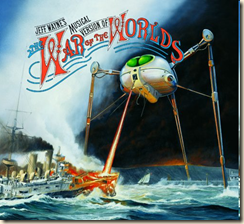 The album follows Welles's novel more closely than any other adaptation of it. Wayne knows enough to let the story speak for itself and to concentrate on the music, which is an appealing combination of rock and classical, with a dramatic bent.
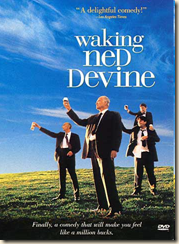 (1998)
 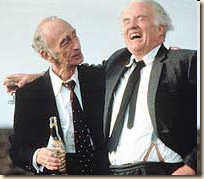 The movie is funny from start to end. Ian Bannen and David Kelly are great as the conniving Jackie and David, with Kelly especially good (he's probably best known to American audiences from his part of O'Reilly the carpenter in Fawlty Towers). Both turn on the charm in especially winning roles.


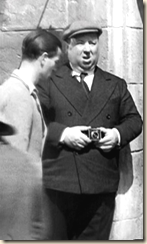 Hitchcock gives this theme his full attention. There are plenty of great scenes, sharp dialog, and bravura direction. The shot where Hitchcock reveals the murderer is justly famous, a long slow camera movement across a ballroom until it goes to close-up on the man's face.